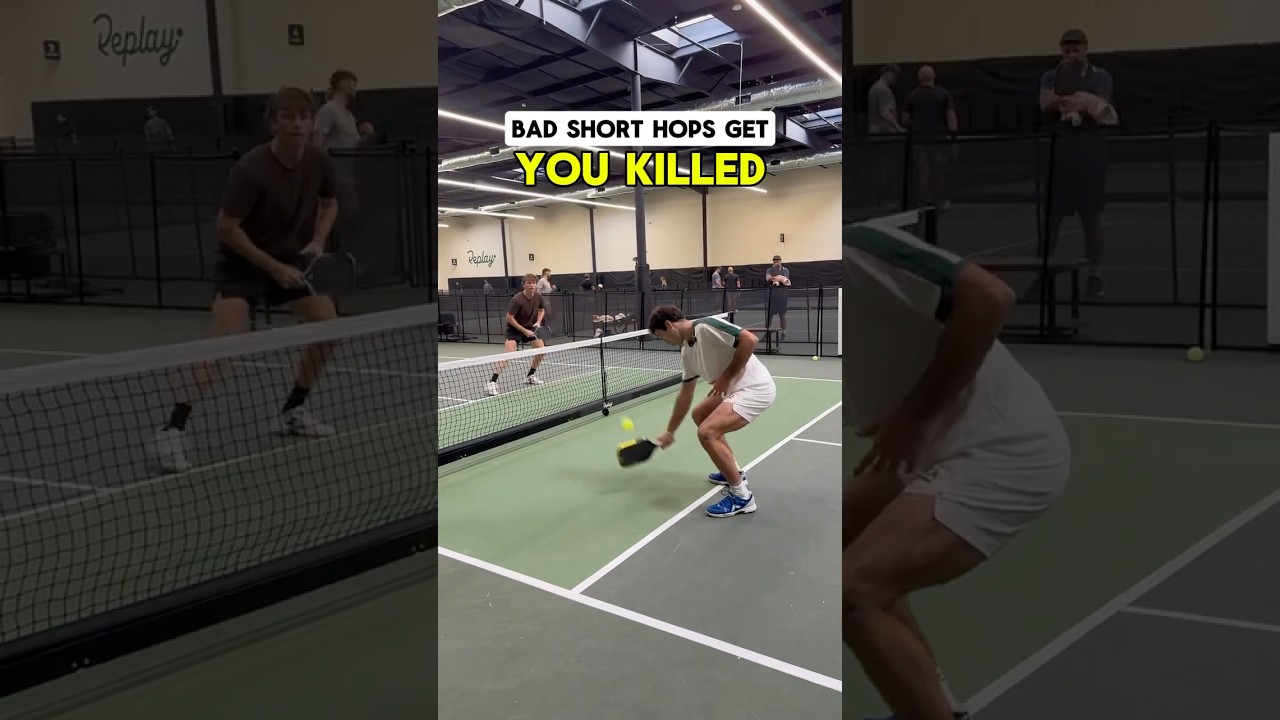
The short hop pickleball shot is one of the most misunderstood opportunities on the court. Learn the simple paddle angle fix that turns a risky wide ball into a consistent weapon.
The short hop pickleball shot is one of the most misunderstood moments in the game.
Most players panic when a wide ball drops fast and short, and they end up scooping it straight up into a perfect attackable ball for their opponent.
The problem is almost never timing. It is almost always paddle angle.
This breakdown comes from Richard Pickleball on YouTube, who cuts through a common bad habit and replaces it with a simple, repeatable setup that actually keeps the ball low even when you mishit it.
It's the same margin-first thinking behind the four key strategies winning points in 2026.
Love pickleball? Then you'll love our free newsletter. We send the latest news, tips, and highlights for free each week.
What Is a Short Hop in Pickleball?
A short hop is when you take the ball immediately after it bounces, before it has time to rise to a comfortable hitting height.
You are catching it low and early, almost like an infielder charging a grounder in baseball.
Done right, it is a massive advantage. Done wrong, it becomes an easy pop-up that hands your opponent a put-away.
The short hop matters most on wide balls, the ones that pull you toward the sideline.
Most players let these bounce and try to hit them after the ball has traveled past the ideal contact zone.
Taking it early lets you redirect it with far more purpose. That's the same court-awareness principle behind the five shots you must master before 2026.
Why Are You Popping It Up?
When your paddle face is vertical or slightly open at contact, any mishit tends to send the ball upward. This is the core reason players pop up short hops.
Think about it this way. If your paddle is straight up and you hit the bottom half of the ball even slightly, the ball launches upward.
You have no margin for error, and most players have less contact precision on wide balls because they are stretched out and off balance.
The fix is not to swing harder or be more careful.
The fix is to preset your wrist and angle your paddle before contact so that even an imperfect hit produces a good result.
This is the concept Richard Pickleball focuses on: building forgiveness into the shot through setup, not through skill alone.
You can learn more about how shot selection and setup choices affect every ball you hit.
How Does the Paddle Angle Fix Actually Work?
Here is the core technique. Before you make contact, preset your wrist so the paddle face angles toward the target corner, not straight ahead.
When you aim toward that far corner with your paddle angle already set, two things happen depending on where you actually contact the ball.
- If you hit it a little short, the ball lands in the middle of the opponent's box. That is still a good ball.
- If you hit it a little deeper than intended, the ball goes wider toward the sideline instead of flying long. That is also still a good ball.
You have essentially created a safety window on both sides of your intended contact point.
A ball that would have been a pop-up with a flat paddle face becomes a controlled, short dink with an angled one.
This is the same principle that applies when wrist position shapes your drop shot trajectory. Small adjustments before contact change the entire outcome.
 The Dink Media Team
How to Set Up the Short Hop on Wide Balls
The technique only works if you get into position early and commit to the paddle setup before the ball arrives.
Here is the full sequence:
- Read the ball early. As soon as you see the ball pulling wide, start moving toward it immediately. Do not wait to see where it lands.
- Get low. Drop your hips and get your paddle down to ball level before contact. Coming down to the ball from above is where pop-ups are born.
- Preset your wrist. Before contact, angle the paddle face toward the corner you are targeting. Do not try to adjust at the moment of impact.
- Use the width of the court. A wide ball gives you a wider angle to the far corner. Take advantage of that geometry instead of hitting back to the middle.
- Contact the ball out in front. Do not let it get beside or behind you. Short hops require early contact, so meeting the ball in front of your body is essential.
This is the same footwork discipline that separates steady kitchen players from reactive ones.
If you want to make it automatic, these footwork drills belong in your practice routine, and so does the 12-drill block built for 2026.
 The Dink Media Team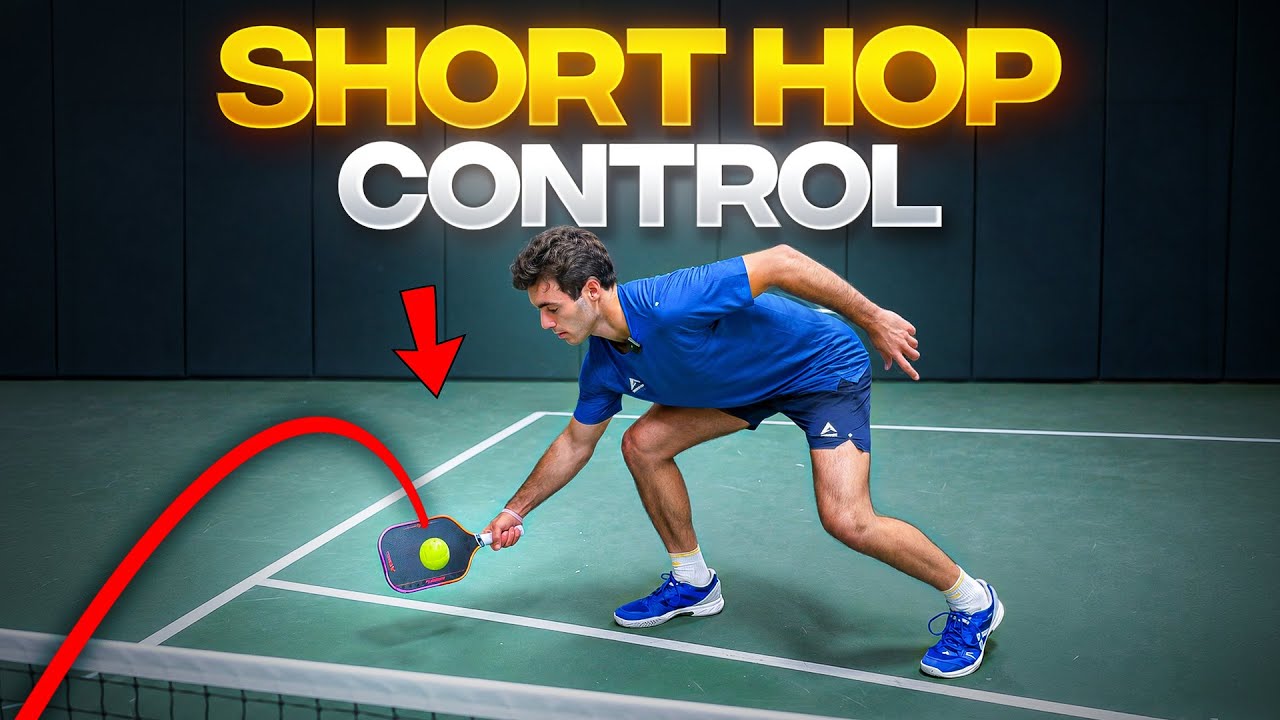
What Should Your Target Actually Be?
On a wide ball short hop, your target is the far corner of the opponent's kitchen. That's the diagonal cross-court landing zone.
Most players aim for the middle or play it safe down the line. Both choices give up the angle advantage you earned by getting to a wide ball quickly.
When you take the ball wide and early, your natural angle to that far corner is sharper than it would be from the center.
Using it keeps the ball short, forces movement, and makes the return difficult. Wide dink mistakes usually come down to surrendering exactly this angle.
The kitchen line is your friend here. You're not just landing the ball in bounds, you're landing it short enough that it dies in the non-volley zone.
Worth knowing the boundary cold, since the official USA Pickleball rulebook governs how that line plays, and seven new USAP rules land in 2026.
 The Dink Media Team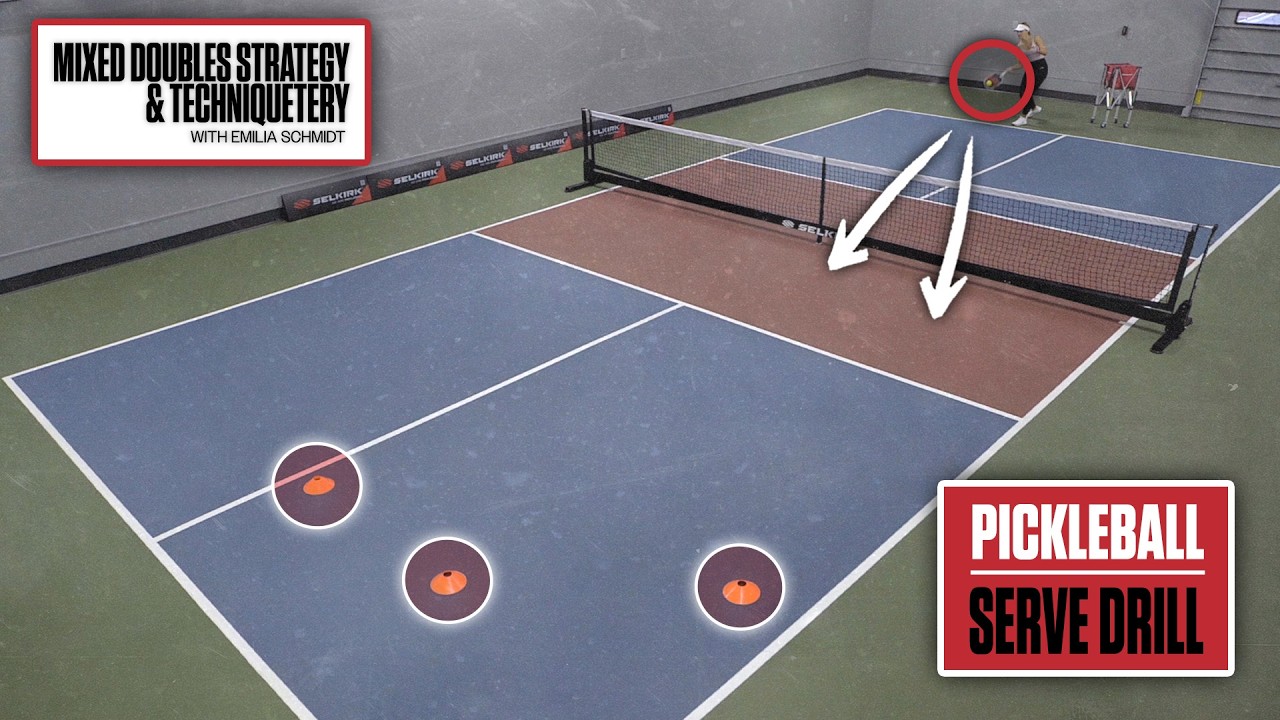
Why Does the Angled Paddle Keep the Ball Short?
This is the part that surprises most players.
When your paddle face is angled toward the sideline corner, a deeper contact point does not produce a deeper ball. It produces a wider ball.
The direction of the angled face redirects that extra energy sideways rather than forward.
So instead of the ball sailing long past the kitchen, it tracks toward the sideline and still lands in a useful spot.
Think of it as redirecting your mistakes rather than eliminating them. You will never have perfect contact every time.
But with the right paddle angle, your imperfect contacts still produce shots your opponent has to handle.
This ties directly into the reset philosophy of building margin into every touch.
 The Dink Media Team
Is the Short Hop Only for Advanced Players?
No. The short hop is actually more forgiving than waiting for a comfortable ball height, especially on wide balls.
Letting the ball bounce up to a comfortable level on a wide shot often means you are hitting it while off-balance and stretched, which is a worse position than taking it early and low.
The key skill required is not advanced hand speed or elite touch. It is getting low early and presetting the wrist before contact.
Both of those are learnable with focused repetition.
If you are working on building consistency at the kitchen line, these volley fixes will support the same contact habits you are developing with the short hop.
 The Dink Media Team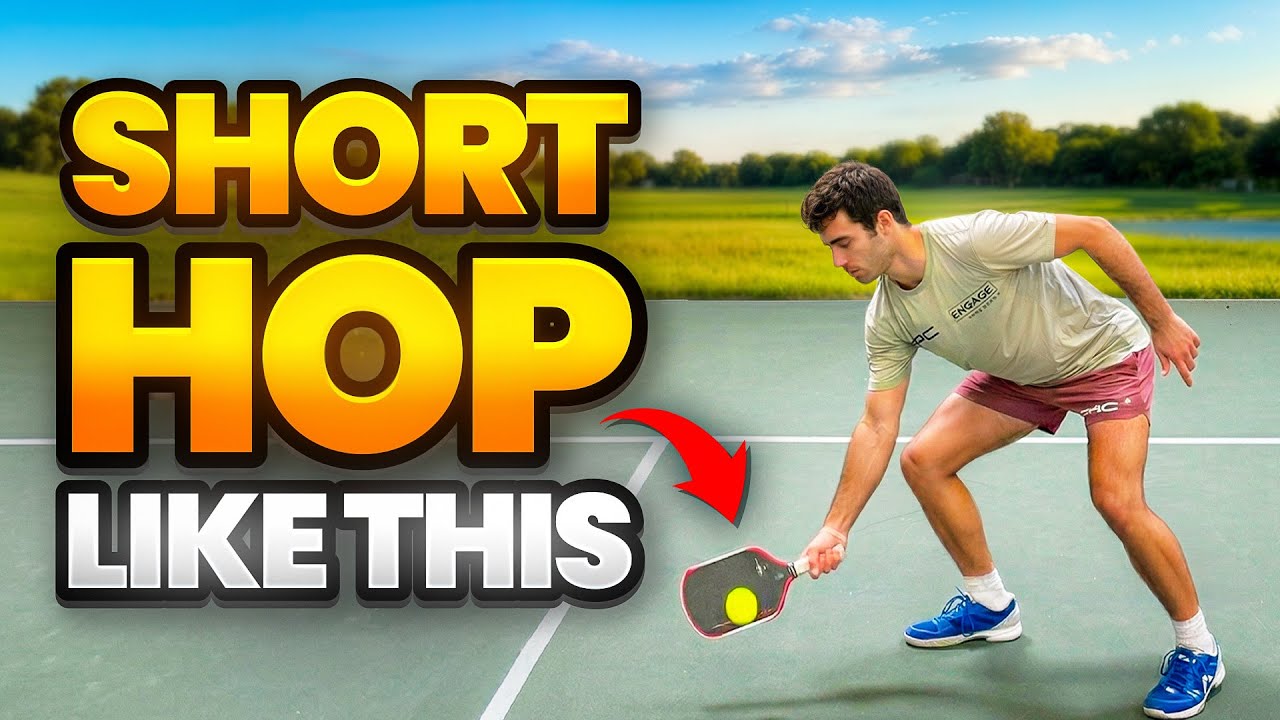
Common Mistakes to Avoid
Even players who understand the concept make avoidable errors when executing the short hop. Watch for these:
- Paddle face too flat. If you forget to preset the wrist angle, you are back to the original problem. Any mishit goes up.
- Getting to the ball late. If your feet are still moving when you make contact, your paddle control suffers. Move first, set up second, then hit.
- Aiming too deep into the kitchen. You want this ball to land short. Aiming at the back of the kitchen leaves no margin. Target the middle of the kitchen at most.
- Standing too tall. The short hop happens close to the ground. If your hips are up, your paddle is coming down at a bad angle. Get low before the ball gets there.
- Hitting toward the middle. You earned a wide angle. Use it. Going back to the middle turns a positional advantage into a neutral exchange.
These mistakes travel together. Players who stand tall also hit late and aim toward the middle because the shot feels rushed.
Fixing the footwork and getting low solves all three at once.
For a broader look at error patterns, check these bad habits most players don't realize they have and the four-step system for winning more games in 2026.
 Alex E. Weaver
How to Practice This in Drills
The best way to build this skill is to have a partner or coach feed wide balls deliberately at different speeds and depths.
Your only job is to get low, preset the wrist, and redirect to the far corner.
Start slow. Have your partner feed balls at half speed so you can focus on the setup position without rushing.
Once the preset wrist position feels natural, increase the feed pace.
You can also practice the wrist preset alone by holding the paddle in the angled position and checking it in a mirror or against a wall.
You want to feel what that angled face looks like so you can recreate it under pressure during a point.
Wall practice is genuinely useful for building contact habits like this one.
Another drill approach: play points with a rule that you must short hop every ball that lands past the kitchen line.
It forces you to read early and move fast. Constraint-based drills like this accelerate skill development faster than open free play.
 The Dink Media Team
The Bigger Principle Behind the Short Hop
What Richard Pickleball is really teaching isn't a single shot. It's a design idea: build your mistakes into the shot before you hit it.
When your technique only works on perfect contact, you're always one miss away from a pickleball pop up.
When it's designed so both early and late contact produce usable results, you become far more consistent under pressure.
That's the same mindset behind the reset philosophy of building margin into every touch, and the exact thinking behind this paddle positioning and hand speed fix.
Every ball you short hop correctly is a ball your opponent has to scramble for. That's the real payoff.
Frequently Asked Questions
What is a short hop in pickleball?
A short hop is when you take the ball immediately after it bounces, before it rises to a comfortable hitting height. It is an aggressive early-contact technique that is especially useful on wide balls where waiting for the ball to rise puts you in a worse position.
Why do I keep popping up my short hops?
The most common reason is a flat or slightly open paddle face at contact. When the paddle face is vertical and your contact point is even slightly off, the ball launches upward. Presetting your wrist to angle the paddle face toward your target corner before contact eliminates most pop-ups.
Where should I aim when short hopping a wide ball?
Aim for the far corner of the opponent's kitchen, the diagonal cross-court target. A wide ball gives you a sharper angle to that corner, and using it keeps the ball short while making your opponent move a long distance to reach it.
Is the short hop better than letting the ball rise to a comfortable height?
On wide balls, yes. Letting the ball rise on a wide shot usually means hitting while stretched and off-balance, which is harder to control than a low early contact. The short hop lets you meet the ball when you still have body control, as long as you move early and get low.
How do I practice the wrist preset for the short hop?
Start by holding the paddle in the angled position away from the court and feeling what the correct face angle looks like. Then have a partner feed wide balls slowly so you can rehearse the preset before contact without time pressure. Gradually increase feed speed as the preset becomes automatic.

Love Pickleball? Join 100k+ readers for free weekly tips, news & gear deals.
Subscribe to The Dink