
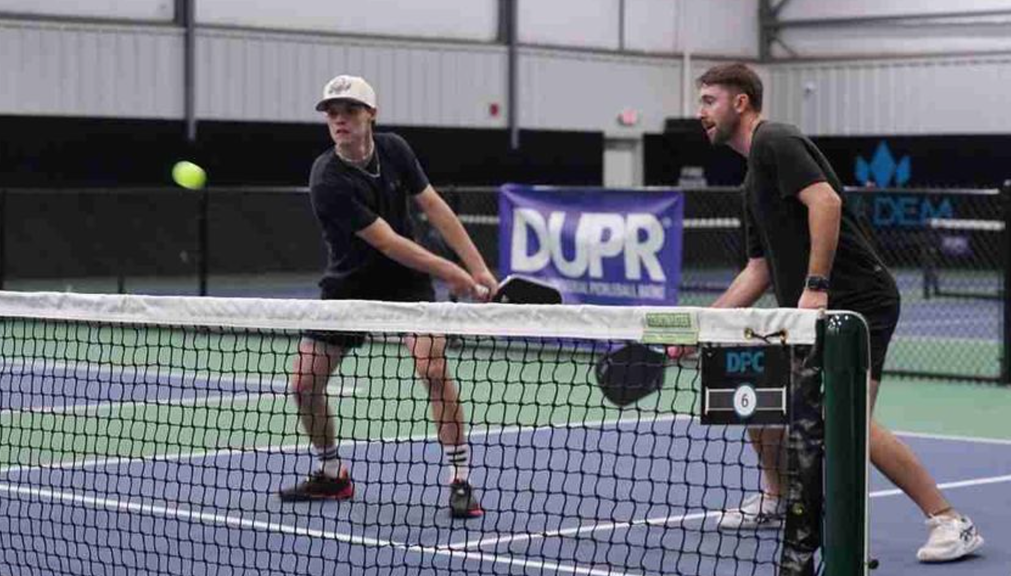
Playing the body not the lines is the fastest way to win more points without taking on more risk. This guide breaks down the three body targets that force errors, when to use them, and the rare moments the sideline is still worth it.
Playing the body not the lines is the fastest way to cut your unforced errors without giving up a single ounce of aggression.
Here's the thing about the sideline: it doesn't move. It doesn't flinch, it never gets jammed, and it has never once chicken winged a volley into the net.
Your opponent will do all three.
Most 3.5 and 4.0 players spend rec night trying to paint chalk. They aim two inches inside the line, miss by three, and call it going for it.
The best players do the opposite. They aim at a hip.
Playing the body not the lines turns a low-percentage winner into a high-percentage forced error, and the scoreboard doesn't care which one you got.
Neither does the player who just made five fewer mistakes than you.
Love pickleball? Then you'll love our free newsletter. We send the latest news, tips, and highlights for free each week.
Why Is Playing the Body Not the Lines Such a Cheat Code?
Because the body is a huge target with a bad defender standing in front of it.
Think of it this way. The sideline is a zero-inch target. Miss it by an inch and you lose the point outright.
A player's paddle-side hip is roughly a foot wide, sits four feet inside the boundary, and comes with a built in flaw: the human arm doesn't fold well in that direction.
You're not trading risk for reward. You're trading risk for a different kind of reward, one that shows up as a popped up volley instead of a ball sailing wide.
That's the whole argument. Line hunting produces unforced errors you hand over for free, while body hunting produces forced errors your opponent hands to you.
One of those is repeatable. The other is a coin flip with chalk on it, and the patterns that separate good players from great ones almost never involve chalk.
And no, this isn't a cheap shot strategy.
A ball that strikes a player is a fault on that player under the official USA Pickleball rules, which makes the torso a legitimate target.
Pros body bag each other constantly; the slow-motion footage is worth a watch.
In mixed or rec play, though, there's a real conversation about when body bags cross the line socially. Court sense matters. So does winning.
Where on the Body Should You Actually Aim?
Three spots, and only three: the paddle-side hip, the dominant shoulder, and the front foot.
Everything else is either too easy to handle or too close to the head, which nobody wants.
Learning to find those three zones under pressure is the real skill, and it's the same muscle you build when you work on attacking the right spots on your opponent in practice.
The Paddle-Side Hip Is the Money Zone
Aim at the hip on the same side as your opponent's paddle hand. That's it. That's the shot.
A right-handed player in a neutral ready position at the kitchen line has to make an ugly decision when a ball arrives at their right hip.
Block it backhand and collapse the elbow into the ribs? Or rotate and forehand a ball that's already past them?
Both answers are bad, and the hesitation between them is where you win the point.
Quick definition: a chicken wing is what happens when a player gets a ball jammed into their dominant hip and has to lift the elbow out sideways to make contact.
The paddle face opens, the ball pops up, the next shot gets put away.
Learning to avoid chicken wings in your own game teaches you exactly why it's so effective to cause one, and sitting neutral is the defensive side of the same coin.
Why Does Playing the Body Not the Lines Work So Well on Speed Ups?
Because a speed up is already a reaction test, and the body removes the easiest reaction.
When you flick a dink up at someone's outside shoulder, they get to extend their arm and counter with a clean, comfortable swing.
Flick it at the hip instead and they have nowhere to put their hands.
That's the difference between a counter attack coming back at your feet and a floater sitting up at eye level.
Timing still matters more than target.
If you're not sure when to pull the trigger, this speed up strategy breakdown covers the setup, and the set and snap technique handles the mechanics.
Pair good timing with a body target and your speed up conversion rate climbs fast.
What Does Playing the Body Not the Lines Look Like on a Drive?
Low and at the front foot. Not the chest.
Driving at someone's chest hands them a free blocking surface.
Driving at the shoelaces forces a half volley from a player who's still moving forward, and half volleys off a hard ball find the net more often than not.
The same logic runs through your third shot selection: a drive at the feet beats a drive at a gap that closes before the ball arrives.
If your drives keep floating, that's a contact point problem, and the fix lives in your third shot drop fundamentals.
 The Dink Media Team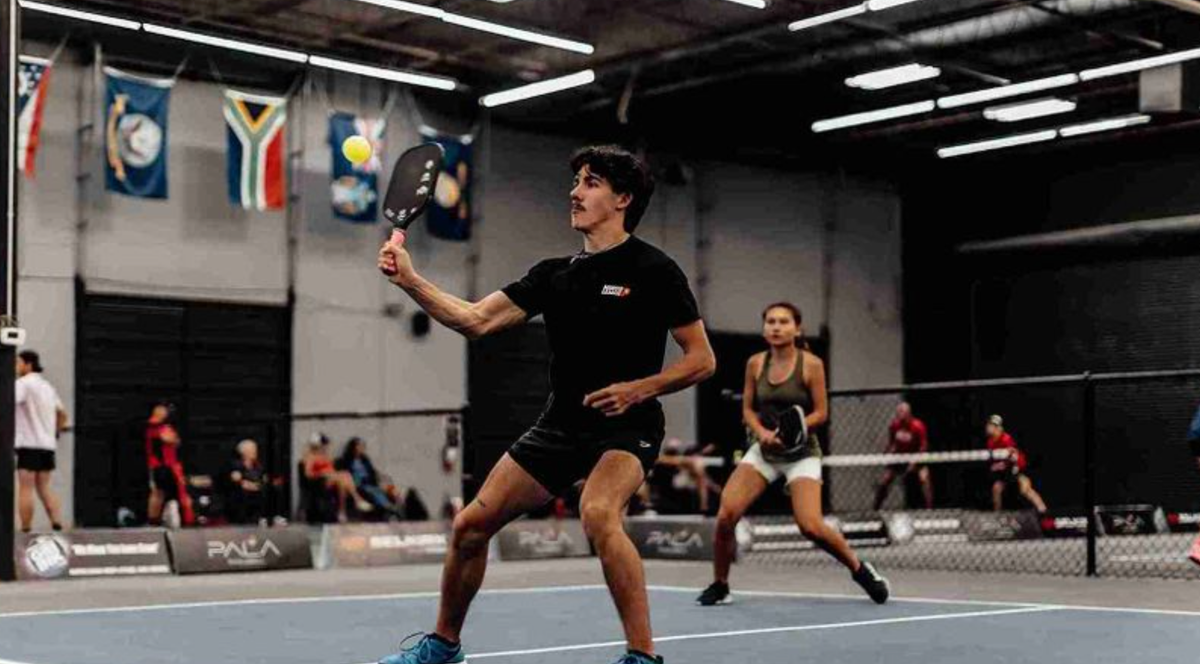
Playing the Body Not the Lines in Doubles: Pick a Human, Then Keep Picking
In doubles, body targeting works best when you choose one opponent and stay on them.
Here's why. Bouncing between two players lets both of them stay fresh and balanced.
Hammering one player's hip four shots in a row does something different: it drags them out of position, pulls their partner into covering ground they shouldn't have to cover, and opens the middle.
That's the 1-2 trap that creates through-the-middle winners, and it's the clearest example of how body targeting creates space instead of chasing it.
It also forces a quick answer to the question of who actually covers the middle.
Who do you pick? Usually the weaker hands, but not always.
Sometimes the right call is targeting your opponent's strength because strong players are used to winning free points and get impatient when they can't.
Read the matchup. Then commit for a few points before you judge whether it's working.
One more wrinkle: against bangers, body shots are defense as much as offense. A hard driver who gets jammed can't generate pace.
That's baked into the seven-step system for beating bangers, and it pairs nicely with the patience you need to survive the transition zone.
 The Dink Media Team
So When Should You Actually Go for the Line?
Four situations. That's the whole list.
- Your opponent is out of position. If one player is pulled wide and the court is genuinely open, hit the open court. Body shots into empty space are just slow balls.
- You're returning serve. Deep corner returns buy time and push the serving team back. This is a geometry shot, not a pressure shot, and the way you handle your return of serve sets up the whole point.
- You're dinking. Cross court dinks that stretch someone wide are the setup for the body attack later. Good dink placement controls the kitchen line before anybody speeds anything up.
- The score demands it. Down 10-6, take the swing. Just know what you're buying.
Outside of those, the sideline is a vanity shot. Playing the body not the lines should be your default, and the line should be the exception you earn.
 The Dink Media Team
Key Takeaways
Playing the body not the lines comes down to a simple trade.
You give up the fantasy of the untouchable winner and you get a steady supply of forced errors instead.
Aim at the paddle-side hip, the dominant shoulder, or the front foot.
Pick one opponent in doubles and stay on them. Save the sideline for open court, returns, dinks, and desperation.
If you want a broader version of this same philosophy, the case for boring pickleball and eight tips for more consistent play both land in the same place: the player who makes fewer mistakes usually wins.
Frequently Asked Questions
Is playing the body not the lines considered bad sportsmanship?
No, not in competitive play. Body shots are legal, and a ball that strikes a player is a fault on that player under the official rules. In casual rec games, read the room and avoid head-height balls, especially against newer or older players.
Where exactly should I aim when playing the body not the lines?
Aim at the hip on your opponent's paddle-hand side. That's the hardest spot for them to defend because neither the forehand nor the backhand works cleanly from there. The dominant shoulder and the front foot are the next best targets.
Does body targeting work in singles too?
It works, but it matters less. Singles gives you far more open court to attack, so geometry does more of the work. The body shot still helps when your opponent is charging forward or recovering after a wide ball, as these pro singles strategies show.
What if my opponent has great hands and just counters everything?
Change the height and the pace rather than the target. A jammed ball at the hip only works if it arrives before they can set their paddle, so mix in slower dinks and resets to break their rhythm first. Kitchen line hands battles are won by the player who sets up the attack, not the one who swings hardest.
How do I defend against body shots myself?
Keep your paddle up, out in front, and slightly toward your backhand side so your elbow has room to work. Soften your grip so the ball doesn't rocket off the face. Our guide on defending against a body bag walks through the footwork in detail.
Love Pickleball? Join 100k+ readers for free weekly tips, news & gear deals.
Subscribe to The Dink