

The 3-Target Pickleball Serve Drill That Builds Consistency and Deception
Great servers look identical on every serve and still hit three different targets. This pickleball serve drill from Selkirk TV builds both habits at once.
Your pickleball serve should do two things at once: land in the same general depth every time, and tell your opponent absolutely nothing about where it is going.
Most rec players have neither, because they practice serves by playing games instead of running drills.
A recent Selkirk TV session lays out a drill that builds both. The setup costs nothing: a basket of balls, three cones, and an empty court.
The pro running it is blunt about the goal: "consistency is key."
Here is the full breakdown, from the pre serve routine to the three targets to the hip rotation that adds power without adding errors.
Love pickleball? Then you'll love our free newsletter. We send the latest news, tips, and highlights for free each week.
Why Consistency Beats Power on the Pickleball Serve
A consistent pickleball serve means the same stance, the same swing pattern, and the same contact point on every single ball.
The Selkirk pro's reasoning is simple: "if you have too much variation of where you're standing or how you're swinging through your shot, that's going to lead to errors."
That matters because a missed serve is the only error in pickleball that costs you a point before the rally even starts.
Power can come later; there are seven steps to more serve speed once the base is stable.
Build the repeatable swing first. If you are unsure which motion to commit to, start with the only serve you need and groove that one.
Then add pace, spin, and placement on top of it, which is exactly how you start to win points off your serve instead of just starting rallies.
The Pre-Serve Routine: Same Setup, Every Single Time
The routine in the video has five repeatable pieces. Treat them like a checklist until they become automatic:
- Bounce the ball a couple of times to settle into a rhythm.
- Paddle out in front, in line with your left hip (for a righty).
- Rock back onto the right foot to load a little momentum.
- Push through and swing, finishing up and over your shoulder.
- Keep your head still and in line through contact.
None of these steps is flashy, and that is the point. A serve routine is a metronome, not a highlight reel.
The finish over the shoulder also builds the low-to-high path that creates serve lag, the power source most players never tap.
Locking in a pre-serve routine is also one of the fastest ways to overcome pickleball serving yips before they start costing you points.
Where Should You Aim Your Pickleball Serve?
The drill uses three cones: middle, the T, and out wide. Each target has a specific job in your pickleball serve strategy.
Middle is your bread and butter. The pro calls it "probably your most consistent serve," with the biggest margin for error on both lines.
The T hunts the returner's backhand, which at most levels is the weaker, shorter return.
Targeting the backhand side consistently is one of the most effective pickleball serving strategies at every level.
Wide is the change-up, about one serve in four.
It drags the returner off the court, and a returner stretched wide struggles to hit a deep return and get to the net behind it.
Since the return of serve is all about moving forward through contact, a wide serve attacks that movement directly.
Mix in body serves too. The video's practice pattern is simple rotation: one middle, one T, one wide, and the occasional ball straight at the returner.
That rotation is the heart of learning to vary your serve and keep opponents off balance.
 The Dink Media Team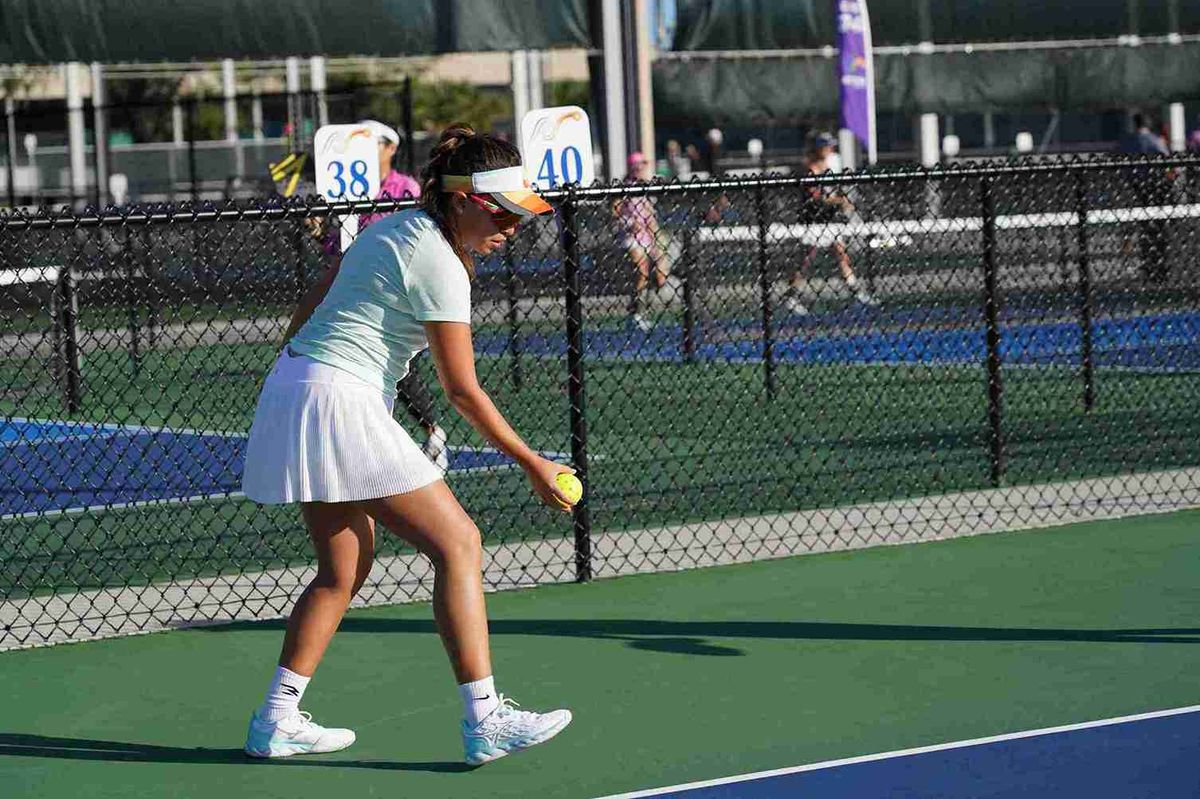
What Makes a Pickleball Serve Deceptive?
Deception means your setup and swing look identical no matter which target you have picked.
The Selkirk pro is explicit about it: "the positioning of my serve doesn't change whatsoever. I want to look the exact same to my opponents no matter where I'm going to be hitting this serve."
Returners read serves the same way you read dinks: from the server's body, not the ball.
If your wide serve comes with a different stance or a bigger windup, good opponents will be leaning before you make contact.
This is the same principle behind learning to disguise your dinks: one setup, multiple outcomes.
The three-cone drill trains it directly, because you are changing targets on every ball while your body does the exact same thing.
 The Dink Media Team
Power Without Over-Rotation
The power in this serve comes from the legs and the right hip, not the arm.
Start with a slight bend in your knees, then pull through with the right hip as you swing to add momentum forward.
The warning that comes with it matters just as much: "we definitely don't want to over-rotate. That's definitely going to lead to a lot more errors."
If your shoulders fly open and your follow-through drags across your body, you have traded ten percent more pace for a serve that sprays.
One more point worth stealing from coaching veterans: after you serve, stay back.
Creeping inside the baseline after contact is one of the stubborn mistakes coaches see at every level, because a deep return handcuffs you at your feet.
The follow-through is the key to a more powerful serve, but only when the rotation stays controlled.
 The Dink Media Team
How to Run the Pickleball Serve Drill in 20 Minutes
The drill itself is volume with intention.
Grab a basket of balls, set your three cones, and chase reps, because as the pro puts it, the goal is "to really get into a flow and a rhythm" of how you want to serve in tournaments.
- Minutes 1 to 5: middle target only. Groove the routine: bounce, paddle by the hip, rock back, swing over the shoulder.
- Minutes 5 to 10: alternate middle and T. Same look on every ball.
- Minutes 10 to 15: add the wide cone into a one middle, one T, one wide rotation.
- Minutes 15 to 20: call your target out loud before each serve, and mix in body serves.
Do not stress the misses. The instruction in the video is "definitely try to hit those markers if you can, but no pressure if you don't."
The routine is the rep; the cone is just feedback.
Twenty minutes fits neatly into the 12 drills you need to play your best pickleball in 2026, or as the opening block of a pro-style drilling sequence.
If you only drill before rec play, even a 15-minute pre-game drill with one cone beats walking on cold.
Pairing this routine with a broader look at the 5 pickleball shots you must master before 2026 gives you a complete skill-building block for your next practice session.
And if cone drills feel beneath you, consider that skipping targeted reps entirely is the first of the practice mistakes ruining your game.
The serve is the one shot you control completely. Drill it like it matters, because the scoreboard says it does.
Frequently Asked Questions
What is the most consistent pickleball serve target?
The middle of the service box. It gives you the largest margin for error on both sidelines and the baseline, which is why the Selkirk drill treats it as the default target and saves the T and wide serves for variation.
How often should you serve wide in pickleball?
About one in four serves. The wide serve pulls the returner off the court and disrupts their path to the net, but it also shrinks your margin for error. Used occasionally, it stays unexpected; used constantly, it becomes a predictable risk.
How do you make a pickleball serve deceptive?
Keep your stance, swing, and setup identical for every target. If your middle, T, and wide serves all start from the same look, the returner gets no early information and cannot lean. Change the target with small contact adjustments, never with a visibly different setup.
How can I practice my pickleball serve alone?
Take a basket of balls and three cones to an empty court: one cone middle, one at the T, one wide. Run the same five-step routine on every ball (bounce, paddle by the hip, rock back, swing over the shoulder, head still) and rotate targets. Twenty minutes once or twice a week is enough to see real change in your serving consistency.
Where does the power in a pickleball serve come from?
From the legs and hip rotation, not the arm. Bend your knees slightly, rock back to load, then pull through with your trailing hip as you swing low to high. Avoid over-rotating your shoulders; past a certain point, extra rotation adds errors faster than it adds pace.

Love Pickleball? Join 100k+ readers for free weekly tips, news & gear deals.
Subscribe to The Dink