
Pro Kyle Koszuta Shares One Secret for Faster Pickleball Hands
Your pickleball ready position could be the reason your hands feel slow at the kitchen line. This simple adjustment removes wasted motion and helps you react faster right away.
Your pickleball ready position might be the single biggest reason your hands feel slow at the kitchen line. Not your reaction time. Not your athleticism.
Your starting point.
Most players stand at the non-volley zone like they are waiting for a bus. Paddle low, arms by their sides, completely unprepared for a fast exchange.
Then a hard ball comes at them and they wonder why they couldn't get there in time.
This piece breaks down exactly what the correct ready position looks like, why it works mechanically, and how to apply it the next time you step on the court.
The tip comes from ThatPickleballGuy Kyle Koszuta on YouTube, and it is one of those adjustments that pays off immediately.
Love pickleball? Then you'll love our free newsletter. We send the latest news, tips, and highlights for free each week.
The Real Problem: You're Starting Too Low
The most common mistake is starting with the paddle down near your waist or thigh.
It feels natural because it is relaxed. But relaxed is not the same as ready.
When a hard ball comes at you and your paddle is low, you have to complete two movements before you can even think about hitting back.
You have to raise the paddle, then move it forward to make contact.
That is two steps where your opponent only needs one.
Pickleball at the kitchen line is a game of time, and your opponent is trying to take yours away.
Every extra movement you make is time you are handing back for free.
Think about a punch. A big wind-up looks powerful but it is slower than a short, compact strike from close range.
The same physics apply to your volley. Getting bodybagged is almost always a consequence of a paddle that starts in the wrong spot.
So Where Should the Paddle Actually Be?
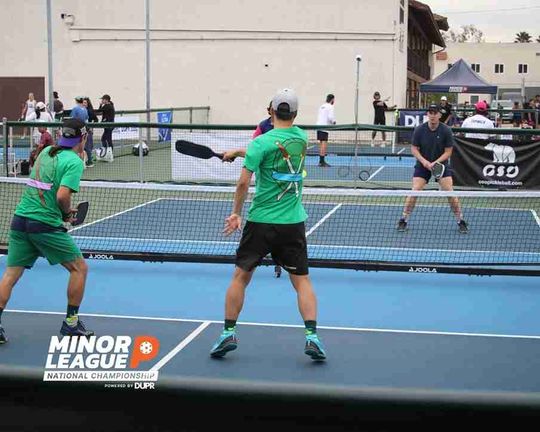
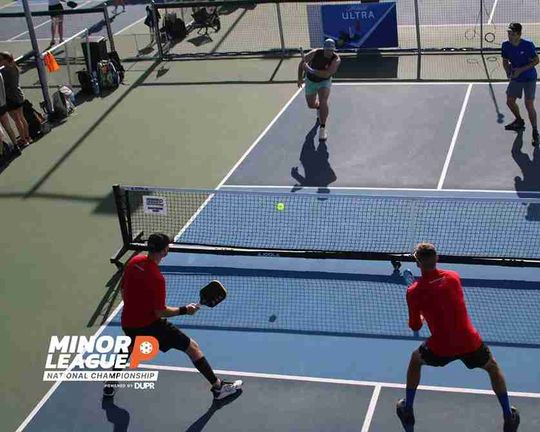
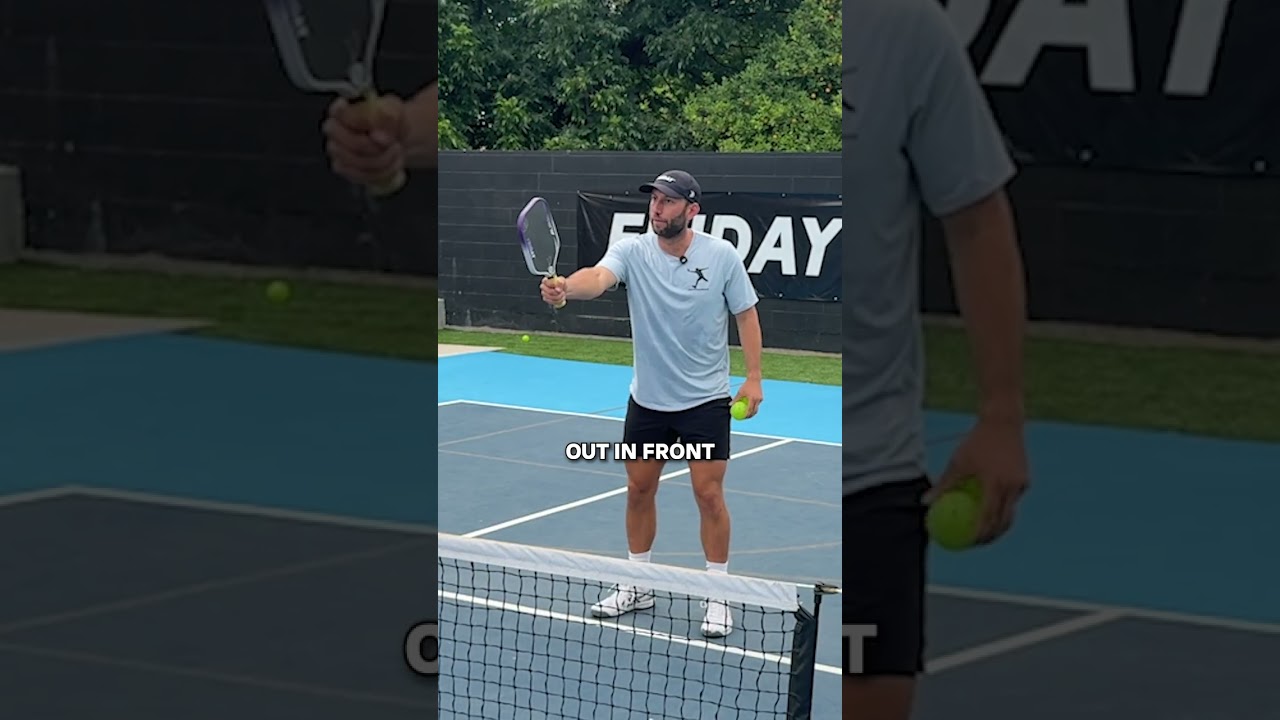
Keep the paddle below your chin with your arms slightly tucked in. Not straight out in front like you are hailing a taxi. Not up at Statue of Liberty height.
Somewhere in between, closer to your body than most players think.
Here is what a correct pickleball ready position gives you:
- Your paddle is already at or near contact height for most incoming balls
- Your arm only needs to move forward, not back and then forward
- The paddle stays out of your direct line of sight so you can track the ball clearly
- You are loaded and compact, ready to absorb pace or attack with minimal wasted motion
That last point matters more than most players realize.
When your arms are tucked and your paddle is up, you are pre-loading the motion you need. The only direction left is forward.
Why the "Paddle Way Out Front" Habit Is Tricky
Some players, especially those coming from tennis, like to hold the paddle extended well out in front of the body.
The thinking is that you get a head start on tracking the ball.
There is something to that logic. Having the paddle in your peripheral vision can help you track incoming shots. But the tradeoff is not worth it for most players.
Your arms get tired faster, your range of motion is compromised, and any ball that comes hard at your body becomes very difficult to handle.
The better tracking tool is your eyes, not your paddle position.
Improving your reaction time through deliberate practice will always outperform a compensatory paddle position.
 The Dink Media Team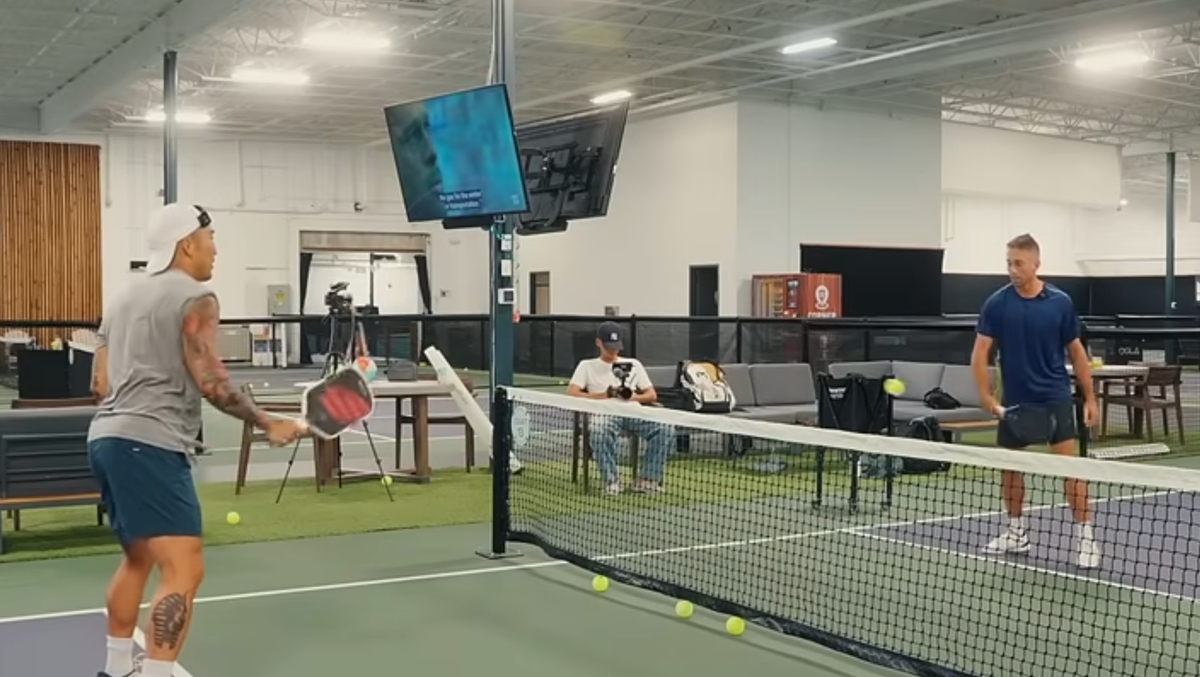
What Does "Tucked In" Actually Mean?
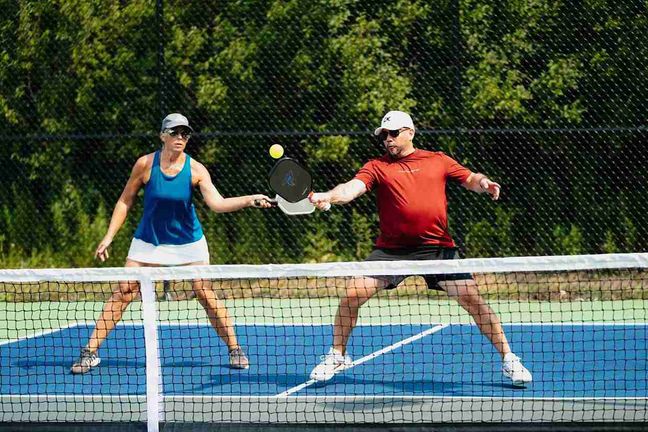
Tucked in means your elbows sit close to your body rather than flared out wide. Your paddle face is in front of your chest, angled slightly forward.
Think of it like a boxer's guard, compact and ready, rather than arms spread wide like you are trying to hug someone.
Your elbow should not be pinned to your ribs. That is too tight and will slow you down in the other direction.
A slight bend, arms a few inches from your torso, paddle face at roughly chest to chin height. That is the zone.
 The Dink Media Team
Is This Different for High Balls Versus Low Balls?
Yes, and this is where the ready position concept gets a little more nuanced. Your starting position should be tuned to the most likely incoming ball height.
At the kitchen line during a fast exchange, most attacks come at body height or above. That is why keeping the paddle at chest to chin level makes sense.
You can drop your paddle quickly to handle a low ball, but you cannot raise it fast enough when it is already down low and a hard shot comes at your shoulder.
If you are dealing with a lot of balls hit at your feet, your ready position may need to adjust slightly lower.
But the principle is the same: start close to where contact will happen.
Here is a simple checklist for your ready position based on situation:
- Fast exchange at the kitchen: Paddle at chin height, arms tucked, weight slightly forward
- Defending a banger from the baseline: Paddle at chest height, slightly more extended to absorb pace
- Dinking rally: Paddle lower, around waist to chest, but still forward of your body
- Transition zone: Paddle at mid-chest, ready to handle both the short ball and the drive
 The Dink Media Team
How Do You Build This Into a Habit?
The honest answer is that it takes conscious focus during practice before it becomes automatic.
Your old low-paddle habit has years of repetition behind it.
You are not going to override it in one session.
Start by simply checking your position every time there is a break in play. After every rally, reset. Paddle up, arms tucked, weight ready.
Do this a hundred times and it starts to stick.
You can also build it into your warm-up routine before you play.
Take a few minutes to shadow the motion, starting in the correct position and making short forward volleys. Groove the feel of it before the game begins.
Wall practice is another excellent tool here. Hit against a wall and force yourself to keep the paddle up between contacts.
The wall gives you immediate feedback because the ball comes back fast. You will feel instantly how much easier the exchange is when you start in the right spot.
 The Dink Media Team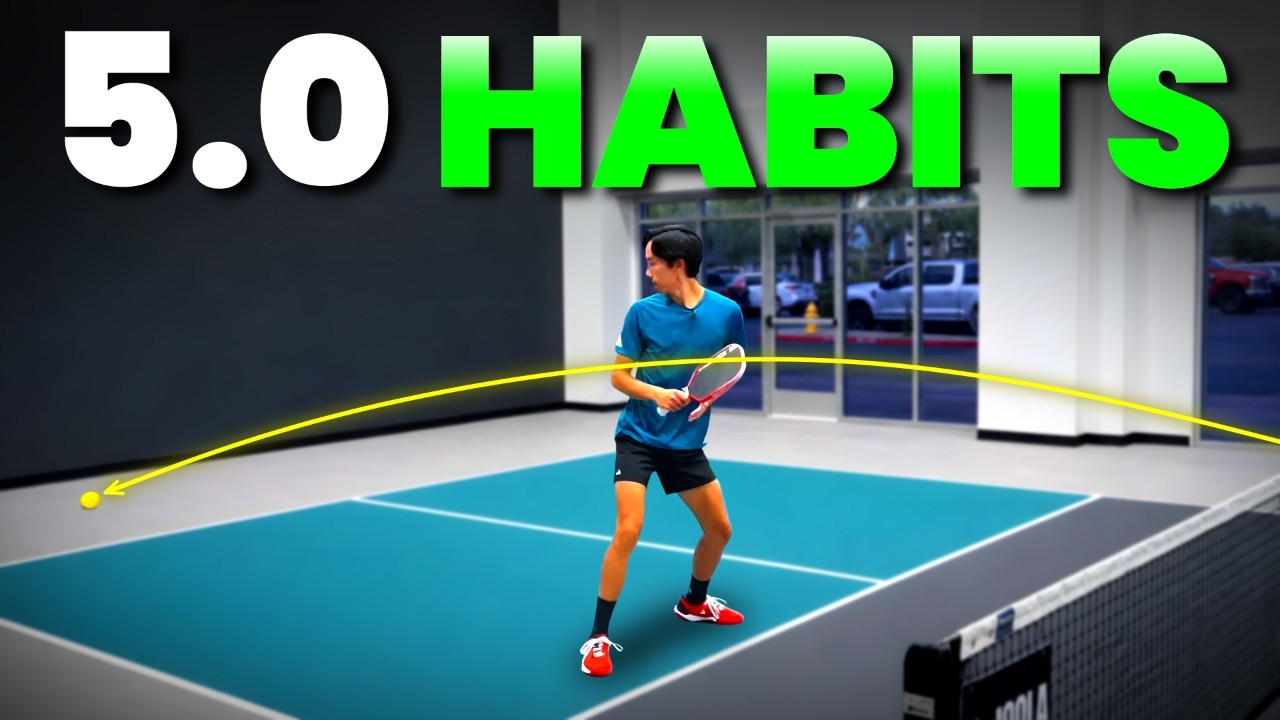
Why This Works: The Mechanics Behind It
The ready position is about minimizing wasted movement.
Every inch your paddle has to travel before contact is time your opponent has already used to recover or set up their next shot.
Think about it this way. A player with a low paddle has to cover maybe 18 to 24 inches of upward and forward motion to volley a chest-high ball.
A player with the paddle already at chin height only has to cover 4 to 6 inches forward.
That is three to four times more efficient.
At the pace of a kitchen exchange, that difference is enormous. It is not about having faster hands. It is about not wasting the speed you already have.
Creating offense becomes much easier when your starting position stops costing you half a second before every shot.
This is also why you see elite players like Ben Johns and Anna Leigh Waters look so calm and unhurried during fast exchanges.
They are not faster than everyone else. Their mechanics are just cleaner, starting from a better position and moving with less waste.
Higher-level players consistently maintain compact, efficient ready positions.
It is one of the first things that separates them from intermediate players who rely on athleticism to compensate for poor mechanics.
 The Dink Media Team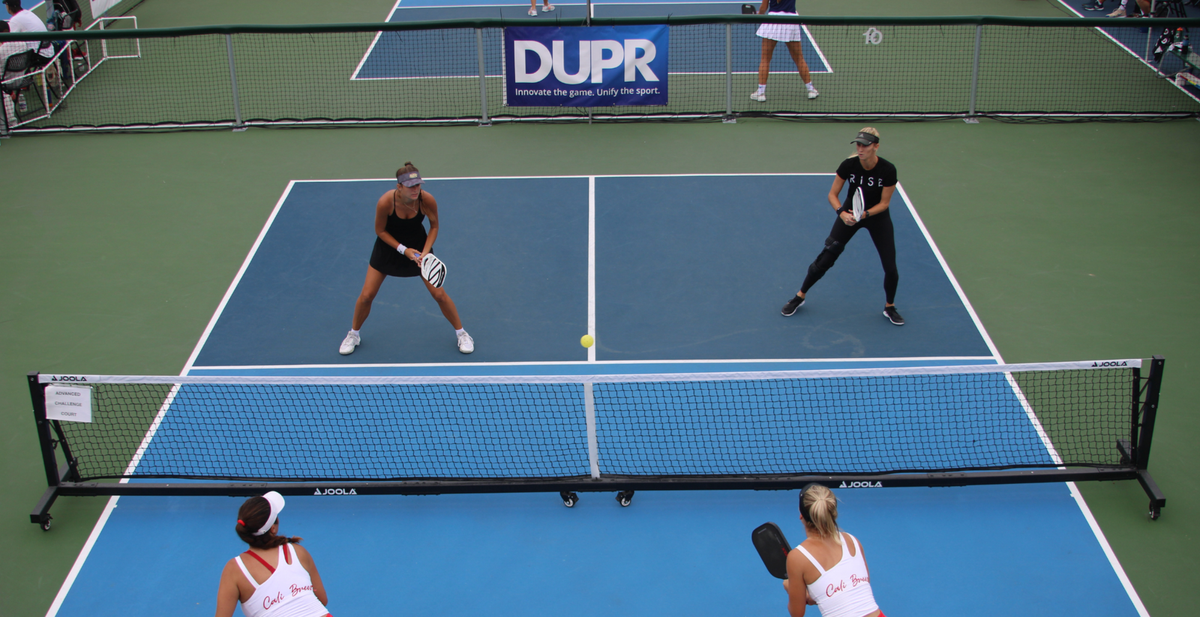
Common Mistakes to Avoid
Even players who understand the concept make the same handful of errors. Watch for these:
- Paddle too high: Eye level or above blocks your line of sight and makes low balls nearly impossible to handle cleanly
- Arms too straight: Fully extended arms remove your ability to absorb pace because you have no bend to give
- Weight on your heels: A good position means nothing if your weight is back, so stay on the balls of your feet
- Resetting too slow: Watching the ball you just hit instead of returning to ready is a common and costly habit
The split step works hand-in-hand with your ready position. If you fix one without the other, you are only solving half the problem. They are connected pieces of the same puzzle.
Your grip pressure also plays a role. A tight grip at rest means a tight grip at contact, which hurts your feel and slows your wrist.
Stay relaxed in your hand even as your position stays ready.
Put the paddle up. Tuck the arms in. Keep the weight forward. That is the whole fix.
Your level shows immediately in how you carry yourself between shots, and this is one of the fastest ways to look and play like someone who knows what they are doing.
Make this change in your next session and watch how many balls you start getting to that used to fly past you.
It is not magic. It is just better mechanics. Better habits win more points and this one is as simple as it gets.
Frequently Asked Questions
What is the correct pickleball ready position at the kitchen line?
The correct pickleball ready position keeps your paddle at roughly chin to chest height with your arms slightly tucked in toward your body. Your weight should be on the balls of your feet, and your paddle face should be angled forward so you only need to move toward the ball, not back and then forward.
Why do my hands feel slow in fast pickleball exchanges?
Slow hands in a fast exchange are almost always a result of starting with the paddle too low. When the paddle is at your waist or below, you have to raise it and then extend it forward before making contact, which takes significantly more time than a short forward motion from a high starting position.
Should I hold my paddle out in front of me or keep it tucked in?
Keep it tucked in rather than fully extended. A paddle held way out in front tires your arm faster and limits your ability to absorb hard shots. A compact position closer to your body gives you more control, better range of motion, and a quicker path to contact.
How high is too high for a pickleball ready position?
Eye level and above is too high. If your paddle is up at Statue of Liberty height, you are blocking your line of sight and making low balls nearly impossible to field cleanly. Chin height is the practical upper limit for your resting paddle position during a rally.
How long does it take to fix a bad ready position habit?
Most players see immediate improvement in the very first session they consciously focus on it, but the habit takes consistent reinforcement over several weeks to become automatic. Build it into your warm-up and check your position after every rally during practice until it stops requiring conscious thought.
Love Pickleball? Join 100k+ readers for free weekly tips, news & gear deals.
Subscribe to The Dink