How to Split Step in Pickleball: The Ready Position Most Players Skip
The split step in pickleball is a small hop that puts your body in the perfect ready position just before your opponent strikes the ball. Most recreational players skip it entirely, and that single habit is costing them more points than any other technique gap.
The split step in pickleball is the single most underused movement skill in the recreational game. Not the third shot drop. Not the reset.
This tiny hop that every pro does without thinking, and that most 4.0 players have never once practiced intentionally.
Love pickleball? Then you'll love our free newsletter. We send the latest news, tips, and highlights for free each week.
It sounds almost too simple. A small hop. A moment of suspension.
But the split step is what separates players who react from players who respond, and that gap shows up on every single point.
What Is the Split Step in Pickleball?
The split step is a small, two-footed hop you take just as your opponent is about to make contact with the ball.
Your feet land shoulder-width apart, weight balanced on the balls of your feet, knees slightly bent. You're not frozen. You're coiled.
Think of it like a sprinter's starting position, except instead of reacting to a gun, you're reacting to a paddle. The moment you land from that hop, your body is primed to explode in any direction.
Without it, your weight is probably shifting to one side, your heels might be down, and you're already half a step behind before the ball even crosses the net.
This concept comes directly from tennis, where it's been a coaching staple for decades. Research on reactive movement in racquet sports consistently shows that athletes who use a preparatory hop before their opponent's contact make significantly faster first-step movements than those who remain stationary.
Studies from the Journal of Sports Sciences have documented this across multiple racquet disciplines. Pickleball is no different.
Why Does the Split Step in Pickleball Actually Matter?
Here's the thing: most recreational players think their footwork problem is speed. It's not. It's timing.
You can be perfectly quick on your feet and still get caught flat-footed on a hard drive or a sudden angle change. Why? Because you're moving after you process where the ball is going instead of pre-loading your body before you need to move. The split step fixes this.
The mechanics are simple. As your opponent's paddle comes forward toward the ball, you initiate a small hop. Your feet hit the ground right at the moment of their contact.
That landing phase activates what sports scientists call the "stretch-shortening cycle" in your leg muscles, basically a built-in elastic energy system that makes your first step faster and more powerful. You're not adding time. You're stealing it.
Watch Ben Johns or Anna Leigh Waters during any slow-motion pro breakdown. Their feet are never flat and still at the baseline or in the transition zone.
They're constantly making micro-adjustments, and those adjustments are anchored by the split step before every major exchange. According to NBC Sports coverage of pro pickleball, elite players credit footwork and court positioning as the primary separators between the pro and amateur game, not shot mechanics.
 The Dink Media Team
How to Do the Split Step: The Technique Broken Down
Getting the mechanics right matters. A split step done poorly, too early, too late, or too high, can actually slow you down.
Here's the sequence:
- Watch your opponent's shoulder and paddle arm. This is your timing cue, not the ball.
- Initiate the hop as their paddle begins its forward swing. Not when they contact the ball. Slightly before.
- Keep the hop small and controlled. Six inches off the ground, max. This isn't a jump shot.
- Land with feet shoulder-width apart, weight forward on the balls of your feet, knees soft.
- Immediately read the ball's direction and push off your inside foot toward it.
The most common mistake is hopping too late. Players wait until they see the ball coming off the paddle and then hop, which puts them landing just as they need to already be moving.
Aim to land at contact, not leave the ground at contact.
The second most common mistake is hopping too high. A big jump takes too long to complete and leaves you briefly airborne and helpless. The split step isn't flashy. It's functional.
When Should You Be Split Stepping in Pickleball?
Every time your opponent is about to hit the ball. That's the honest answer.
In practice, here's when it matters most:
On the Return of Serve
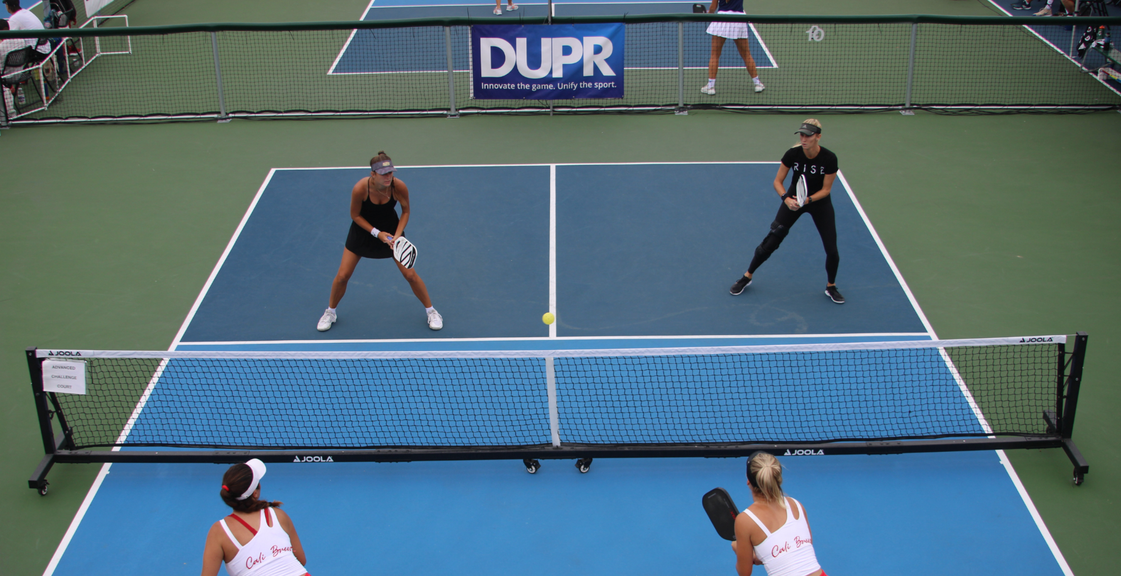
You're standing at the baseline and the server is loading up. This is the highest-leverage moment for a split step because a good serve can go wide, deep, or right at your body.
Pre-loading with a pickleball ready position split step gives you a fighting chance against all three.
When Should You Be Split Stepping in Pickleball?
Every time your opponent is about to hit the ball. That's the honest answer.
In practice, here's when it matters most:
On the Return of Serve
You're standing at the baseline and the server is loading up. This is the highest-leverage moment for a split step because a good serve can go wide, deep, or right at your body.
Pre-loading with a pickleball ready position split step gives you a fighting chance against all three. Miss the split step here and you're already playing catch-up before the point even starts.
During Dink Exchanges
This surprises people. Even at the kitchen, your weight needs to stay centered and ready.
A lot of players lean into their dink attempt and end up stuck when their opponent flicks to the opposite side. A subtle split step rhythm at the NVZ keeps you balanced and reactive throughout extended dink rallies.
Check out pickleball's hardest dinking drill to build this into your muscle memory.
Split Step Pickleball Strategy in the Transition Zone
This is where the split step earns its paycheck. The mid-court is the most dangerous place on a pickleball court and players caught flat-footed here get punished hard.
A good split step in transition means you're ready to block a drive or move forward for a drop, depending on what your opponent throws at you. The pickleball transition zone is where most recreational points are decided, and footwork is the difference.
When Your Opponent Is Attacking from a Strong Position
If they're at the kitchen and you're not, you need every millisecond you can manufacture. Use the split step. Every time.
The Dink Media Team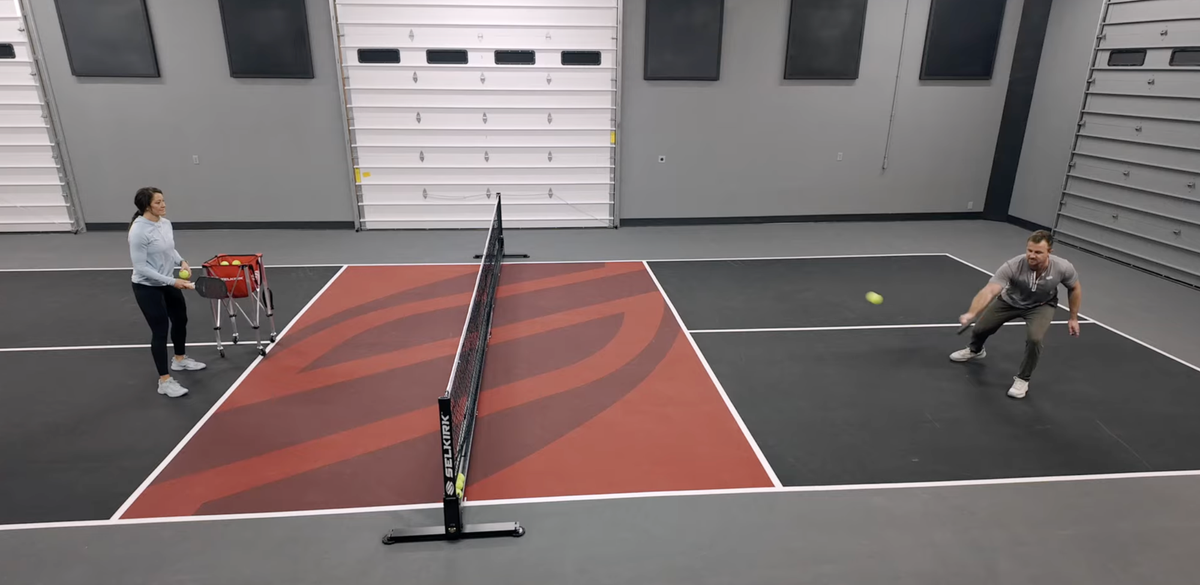
How to Train the Split Step Pickleball Habit
The hard part isn't learning the split step. It's making it automatic.
Most players intellectually understand it after the first five minutes of instruction. Then they walk onto a court, get caught up in shot-making, and completely forget about their feet. This is normal.
Footwork habits take repetition to wire in, and the split step specifically requires you to pay attention to your opponent's motion rather than just reacting to the ball.
Drill 1: Feed and Freeze
Have a partner feed balls randomly from the kitchen. Before each feed, they hold the ball visibly and then strike.
Your job is to split step on their strike and then move. Not before. Not after. On contact. Do this 20 to 30 times in a row until the timing feels natural.
The Dink Media Team
Drill 2: Shadow Movement for Your Pickleball Split Step Habit
On a court alone, practice rallying in your head. As you imagine your opponent striking, physically execute the split step hop and then shadow-move in one direction.
This wires the initiation timing without the distraction of tracking a real ball. You can combine this with solo pickleball drills to build a complete footwork practice session.
Drill 3: Return of Serve Focus
For an entire practice session, make the split step your only goal on return of serve. Don't worry about placement. Don't worry about spin.
Just nail the split step timing every single time before you even think about swinging. Once it's automatic there, it starts bleeding into the rest of your game. How much you drill versus play matters too, and a top pro has already done the math.
The figure-8 drill is another great tool to combine with split step work, forcing you to move continuously while maintaining ready position through each exchange.
The Dink Media Team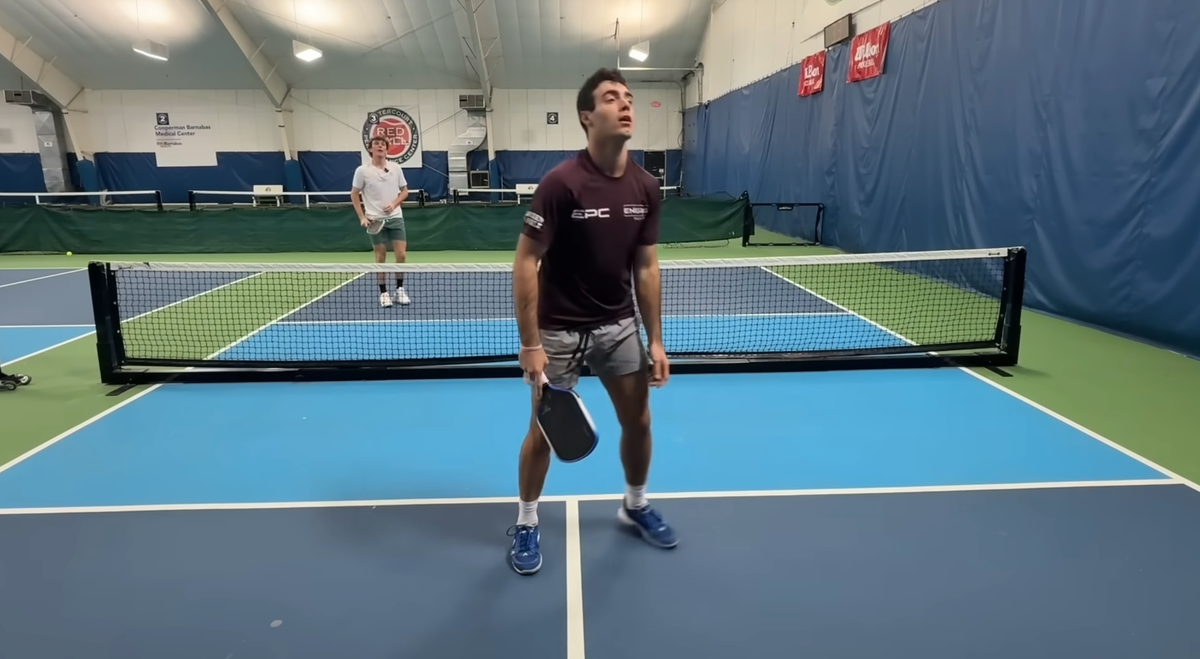
Does the Split Step Actually Improve Your Pickleball Game?
This is a fair question. It's a small, subtle move. Does it genuinely make a difference at the recreational level?
Yes. Without question.
The gap between a 3.5 and a 4.5 player isn't just shot-making. It's court awareness, positioning, and movement efficiency.
Players who split step consistently are almost always in better position. They get more balls back. They have more time to make decisions.
And they put opponents in awkward spots because their returns aren't desperate, lunging stabs at balls they barely reached. The split step is what makes everything else work.
There's a reason every high-level coach in the game teaches this before teaching advanced shots. Shot selection and court positioning are deeply intertwined, and footwork is the foundation under both.
If you're working on your third shot drop or trying to win more points from the kitchen, add the split step to your practice first. It will make every other skill more consistent, because you'll be in position to actually use them.
According to CBS Sports reporting on recreational pickleball growth, the fastest-improving recreational players share one trait: they prioritize movement patterns before shot mechanics.
Frequently Asked Questions
What is a split step in pickleball?
A split step in pickleball is a small, two-footed hop timed to your opponent's ball contact, designed to land you in a balanced, athletic ready position. It keeps your weight centered and your muscles pre-loaded so you can move quickly in any direction. It's borrowed directly from tennis and is considered a foundational footwork skill at every level of the game.
When should I do the split step in pickleball?
You should use the split step pickleball technique every time your opponent is about to make contact with the ball. The highest-leverage moments are during return of serve, in the transition zone, and during dink exchanges at the kitchen. Timing-wise, you want your feet to land right at the moment of your opponent's contact, not after you've already seen where the ball is going.
Is the split step in pickleball only for advanced players?
Not at all. The split step in pickleball is actually most beneficial for intermediate players who are trying to break through the 4.0 barrier. It requires no athleticism beyond a small hop and is entirely about timing and habit. Beginners can learn it immediately, but the real challenge is making it automatic, which takes deliberate practice.
Why do I keep getting caught flat-footed even when I know where the ball is going?
Flat-footedness in pickleball is almost always a timing issue, not a speed issue. If you're reacting to the ball's flight path instead of pre-loading with a split step before contact, your body hasn't had time to generate a quick first step. The split step solves this by putting you in an athletically ready state before you need to react rather than after.
How long does it take to make the split step a pickleball habit?
Most players see meaningful improvement in two to three focused practice sessions once they're intentionally training the timing. Making it completely automatic, where you don't have to think about it during a competitive rally, typically takes four to six weeks of consistent, deliberate repetition. The key is practicing it during drills before expecting it to show up in live play.


Love Pickleball? Join 100k+ readers for free weekly tips, news & gear deals.
Subscribe to The Dink