Why You're Always Late on Your Two-Handed Backhand (And How to Fix It)
Being late on your two-handed backhand is almost always a preparation problem, not a swing problem. Fix the unit turn and early paddle set, and the rest of the shot gets a lot simpler.
If your two-handed backhand keeps breaking down under pressure, the problem almost certainly starts before you ever swing.
Most players think being late is a swing issue. It is not. It is a preparation issue, and specifically a problem with when and how you turn your body.
This breakdown comes from ThatPickleballGuy Daily on YouTube, where the coach walks through the exact unit turn and early paddle set that separates players who consistently crush the two-handed backhand from those who are always scrambling to catch up.
Love pickleball? Then you'll love our free newsletter. We send the latest news, tips, and highlights for free each week.
The Real Reason You Are Late
Here is the honest answer: you are late because you are waiting too long to prepare.
Most recreational players start their backswing when the ball is already close. By that point, you are reacting to the ball instead of being ready for it.
The result is a rushed, arm-driven swing that produces inconsistent contact and zero power.
The fix is not to swing faster. The fix is to get your paddle set earlier, before the ball is anywhere near you.
What Is the Unit Turn and Why Does It Matter?
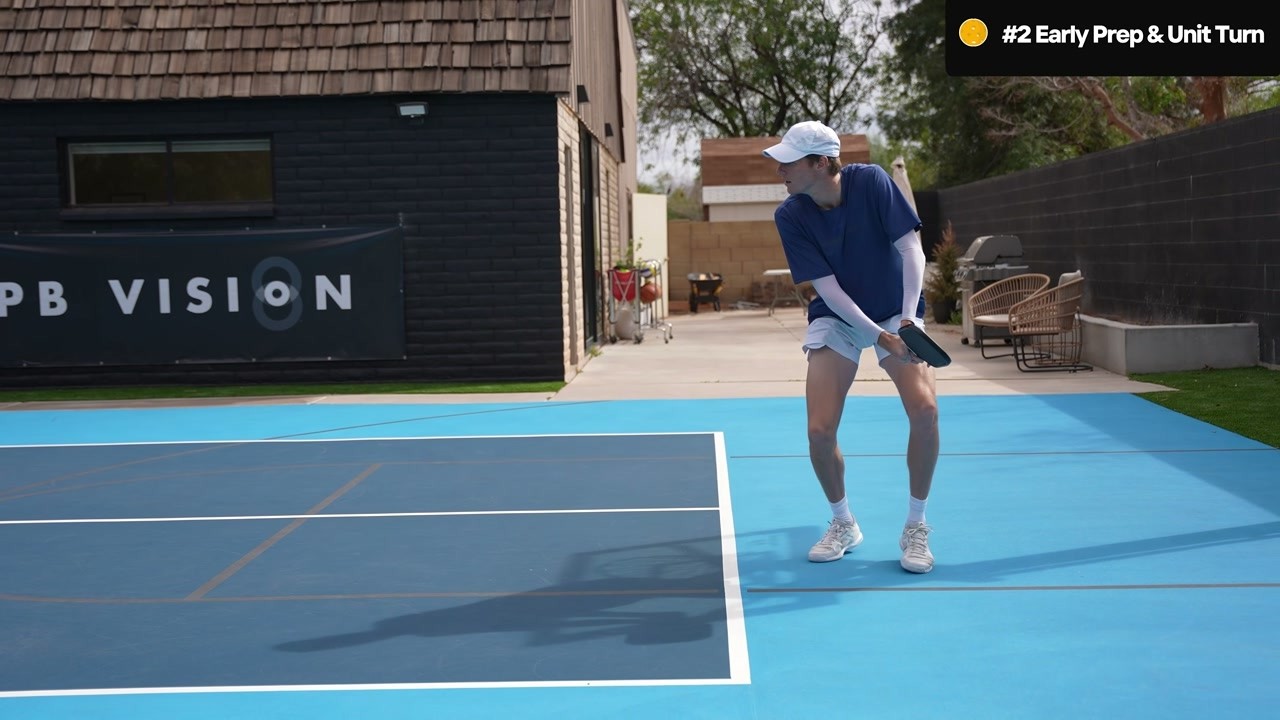
The unit turn is the coordinated rotation of your shoulders and hips together as a single unit the moment you recognize a backhand is coming.
This is not just about moving your arms. You are rotating your entire torso so your outside leg faces the direction you are about to move.
Your paddle gets set in the backswing position as part of that turn, not after it.
Think of it this way: the unit turn is your preparation. Everything that happens after is just the follow-through.
When you do the unit turn correctly and early, the actual swing becomes almost automatic.
Players who struggle with this are often doing what coaches call "arming it."
They leave their body square to the net and try to generate the entire shot with their arms.
That is a losing battle every time.
How Early Should You Be Turning?
The answer is earlier than you think. The second you read that a backhand is coming, your shoulders should already be rotating.
You do not wait until the ball is on your side. You do not wait until you have taken your first step. The turn happens the instant you identify the incoming shot.
Here is how to build that habit into your movement:
- Read the ball early. Watch your opponent's paddle face and body position so you know a backhand is coming before the ball crosses the net.
- Trigger the turn immediately. The moment you identify backhand, rotate your shoulders and turn your outside leg in the direction you will move.
- Set the paddle as part of the turn. Your backswing should be complete by the time you arrive at the ball, not after.
- Move parallel to the shot. Your footwork should get you into position while your upper body is already loaded and ready.
- Step in and extend through contact. At the ball, all you should be doing is stepping forward and following through. The hard work is already done.
This sequence puts the complexity of the stroke early in the process, so when contact actually happens, you are not thinking about anything except hitting through the ball.
 The Dink Media Team
Why Does It Feel So Foreign at First?
Getting your paddle set that early feels unnatural if you are used to preparing late. Your instinct will be to wait.
Push through that feeling. The discomfort is just your brain adjusting to a new sequence.
Within a few practice sessions, early preparation will start to feel like the only logical way to approach the shot.
A useful mental image: think about how Serena Williams loaded her racket on the backhand side.
She set it immediately, before she even started moving toward the ball.
That kind of commitment to early preparation is exactly what you are building.
For players coming from tennis, this concept is not entirely new.
But the shorter court in pickleball means the ball gets to you faster, which makes early preparation even more critical.
If you have tennis habits hurting your pickleball game, late preparation on the backhand is one of the most common ones.
 The Dink Media Team
What Does "Staying Closed" Actually Mean?
Staying closed means keeping your shoulders rotated toward the sideline rather than opening them back up toward the net prematurely.
When you open your shoulders too early, you lose all the stored energy from your unit turn. The shot becomes flat, weak, and hard to direct accurately.
Staying closed keeps that energy loaded until the moment you step in and extend.
The follow-through is what opens your body naturally, not an early rotation you force before contact.
This is one of the bad pickleball habits you might not know you have.
Opening early feels powerful in the moment, but it bleeds power out of the shot before you even make contact.
 The Dink Media Team
The Step-In and Extend Finish
Once your preparation is done, the contact moment should feel simple. You step into the ball and extend your arms through the contact point.
There should be no last-second scrambling. No arm-only flailing. No cramped swing because you are jammed and unprepared.
When the unit turn is complete and you are staying closed, the step-in and extension become the natural conclusion of a movement sequence that was already well underway.
This is why early preparation matters so much. It is not about any one thing you do at contact.
It is about everything you do before contact.
If you are working on your two-handed backhand overall, the step-in and extension phase is where all the earlier preparation pays off visibly.
The same finish shows up in the five essential two-handed backhand shots every advancing player should own.
 The Dink Media Team
Common Mistakes to Stop Making Right Now
Here are the errors that show up most often when players are being late on this shot:
- Waiting to turn until the ball is close. This is the root cause of almost every late backhand. Turn immediately when you read the shot.
- Keeping your body square. A square stance forces you to generate everything with your arms. Rotate early and stay rotated.
- Starting the backswing after arriving at the ball. If you are still loading when the ball reaches you, you have already lost the shot.
- Opening your shoulders before contact. Premature shoulder rotation kills power and accuracy. Stay closed until extension.
- Thinking about the swing at contact. By contact, you should only be thinking about the follow-through. All swing mechanics should be complete before then.
Each of these is a form of being late, just at a different stage of the process. Fixing the first one (waiting to turn) tends to clean up the others automatically.
You can pair this with work on your backhand dink consistency to build the full range of your backhand game, from baseline drives to net exchanges.
 The Dink Media Team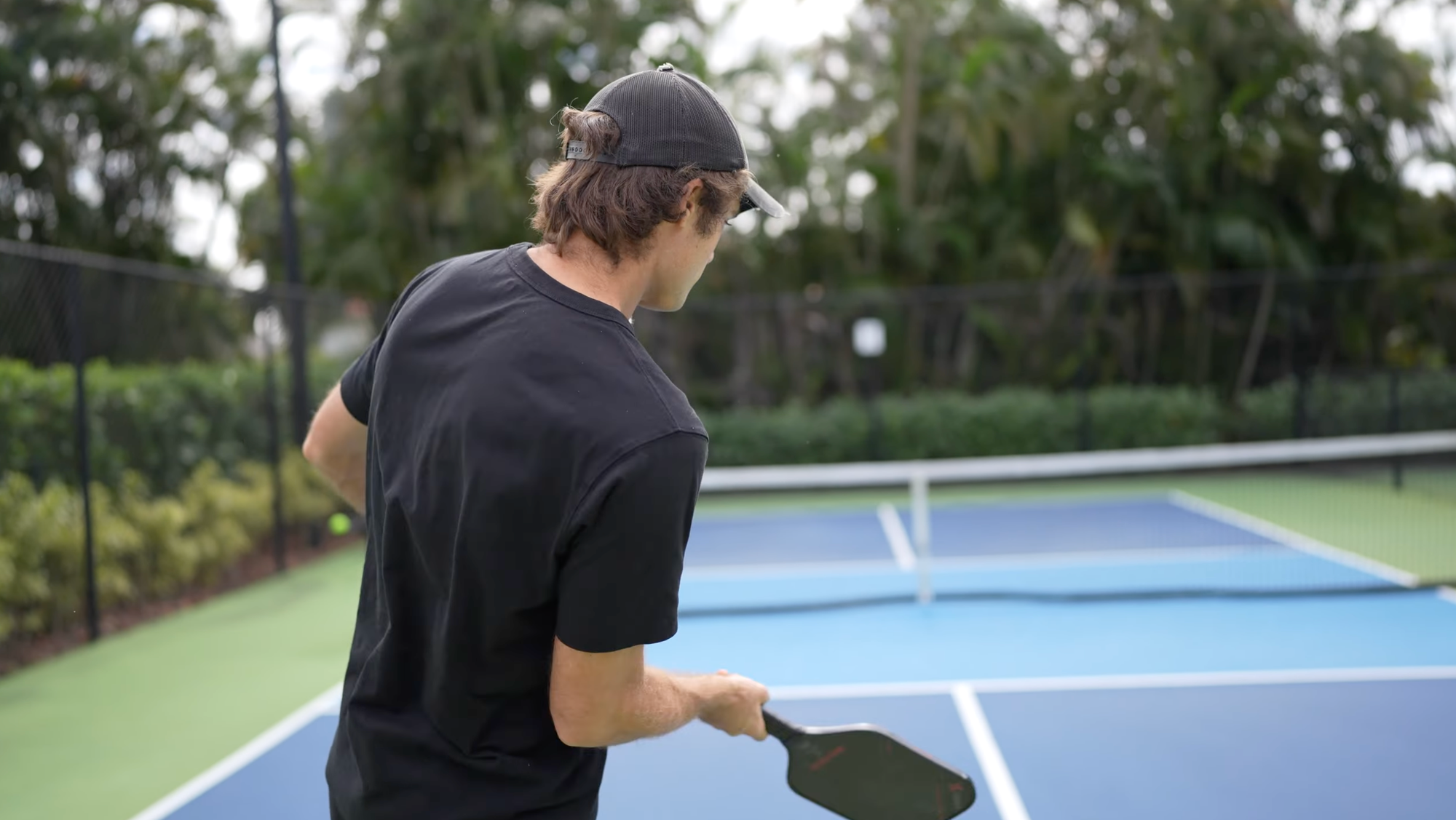
How Do You Practice This Until It Sticks?
The best way to build this habit is through repetition with a feeder. Have someone stand at the net and feed balls to your backhand side at medium pace.
Your only job on each rep is to trigger the unit turn before the ball crosses the net.
Do not worry about placement at first. Focus entirely on the timing of your turn and your paddle set.
Once that timing feels automatic, start adding intention to where you are hitting.
For solo practice options, wall practice drills can help reinforce the unit turn if you are disciplined about resetting your body position between each rep.
You can also use progressive pickleball drills that build this type of footwork and body rotation from the ground up, which is especially useful if you are working to move through skill levels.
 The Dink Media Team
How Does This Connect to the Rest of Your Game?
Everything that makes your two-handed backhand reliable is rooted in preparation. Swing mechanics matter, grip matters, contact point matters.
But none of those things show up consistently if you are always arriving late.
Early preparation also buys you time to read your opponent.
When your body is already loaded and you are not scrambling to set the paddle, your eyes can stay on your opponent longer.
That gives you better shot selection information before you commit to the swing.
Players who struggle with pickleball decision-making often find that the problem is not that they are choosing the wrong shot.
It is that they are choosing the right shot too late because their preparation is behind.
Fixing the unit turn addresses both problems at once.
If your backhand third shot drop is also breaking down, early preparation is worth checking there too.
The same principle applies across almost every backhand shot in the game.
And if you want to understand the broader context of how your overall shot mechanics connect to your rating and court performance, the pickleball personality test is a quick way to identify what is actually holding your game back beyond just the technical side.
The two-handed backhand is one of the most powerful shots in pickleball when it is working.
Getting it working starts with one simple commitment: turn earlier than you think you need to.
Frequently Asked Questions
Why do I keep being late on my two-handed backhand in pickleball?
Being late on the two-handed backhand is almost always caused by starting the preparation too late. The unit turn and paddle set should happen the instant you read that a backhand is coming, not after you have moved to the ball. If you are still loading when the ball arrives, you are already behind.
What is a unit turn in pickleball?
A unit turn is the simultaneous rotation of your shoulders and hips together as one unit when you recognize an incoming shot. In the context of the two-handed backhand, this turn gets your body closed and your paddle set before you arrive at the ball. It is the foundation of early preparation on this shot.
Should I use a two-handed backhand in pickleball?
The two-handed backhand gives you more stability and power on hard-driven balls, especially at the baseline. Many players find it easier to keep pace on fast exchanges because both hands share the load. It does require good footwork and early preparation to work consistently.
How do I stop arming my pickleball backhand?
Arming the backhand happens when your body stays square and your arms do all the work. The fix is to commit to a full unit turn that rotates your shoulders and hips before you swing. When your body is properly loaded and closed, your arms follow naturally rather than compensating for a lack of rotation.
How early should I start my backswing on a two-handed backhand?
Your backswing should be complete before you arrive at the ball. The moment you identify a backhand coming, your turn and paddle set should begin immediately. By the time you reach the hitting zone, you should only be thinking about stepping in and extending through contact.

Love Pickleball? Join 100k+ readers for free weekly tips, news & gear deals.
Subscribe to The Dink