Pickleball Net Height: Official Measurements and Why It Matters for Every Shot
Pickleball net height is 34 inches at the center and 36 inches at the sideline posts, and that 2-inch difference shapes every strategic decision you make on the court. Understanding the official measurements gives you an edge whether you're setting up a court or rethinking your shot selection.
Pickleball net height is one of those specs that sounds simple until you realize how much it actually shapes your game.
The net sits at 34 inches in the center and 36 inches at the posts, and that 2-inch sag in the middle isn't an accident.
It's a design feature, and if you're not already using it, you're leaving easy points on the table.
Love pickleball? Then you'll love our free newsletter. We send the latest news, tips, and highlights for free each week.
What Is the Official Pickleball Net Height?
The official pickleball net height, as defined by USA Pickleball's official rulebook, is 34 inches at the center of the court and 36 inches at each sideline post.
The net itself is 22 feet wide, spanning a 20-foot court with one foot of overhang on each side.
That's it. Simple numbers. But they matter every single time you decide where to aim.
The net is stretched across the court with a cable or rope threaded through the top, and a center strap pulls the middle down to that 34-inch mark.
This isn't optional. Per USA Pickleball Rule 2.C.4, the center strap is required in sanctioned play to maintain the correct measurement.
If you're setting up a pickleball court at home or playing in a recreational facility, getting this measurement right is non-negotiable.
A net that's too high or too low changes the geometry of every shot, and not in a subtle way.
How Does Pickleball Net Height Compare to Tennis?
A tennis net sits at 36 inches at the center, exactly where a pickleball net sits at the posts.
That means if you've ever wandered onto a tennis court to play pickleball without adjusting the net, you were playing with a center that was 2 inches too high.
Two inches doesn't sound like much. It is.
That extra height at center narrows your margin on cross-court dinks, makes it harder to clear the net on third shot drops, and generally rewards players who just bash the ball flat.
The lower center in pickleball is what creates the sport's unique geometry, the premium on keeping the ball low and targeting the middle is baked directly into the net's shape.
For reference, a volleyball net stands around 94 inches for men, and a badminton net is 60 inches at center.
Pickleball, with its 34-inch center, sits firmly in the "low net" category, and that's exactly by design. The sport rewards finesse and placement, not just power.
Pickleball, with its 34-inch center, sits firmly in the "low net" category, and that's exactly by design. The sport rewards finesse and placement, not just power.
If you're converting a tennis court to pickleball, adjusting the net height should be step one.
Many facilities use a center strap to drop a tennis net from 36 to 34 inches at the middle, which is an accepted workaround in recreational play.
Why Does Pickleball Net Height Matter for Your Shot Selection?
Here's the thing: every shot you hit is a negotiation with the net.
And understanding pickleball net height, specifically that lower center point, tells you exactly where to aim.
The center of the net is your best friend. With 2 fewer inches of net to clear, cross-court shots through the middle carry less risk than shots aimed at the sideline.
This is why you hear coaches constantly preach "down the middle" in doubles. It's not just about splitting opponents. It's geometry. The net is literally lower there.
This plays out in a few key scenarios:
The Third Shot Drop and Pickleball Net Height
The entire point of hitting a third shot drop is to arc the ball up and over the net, landing it softly in the kitchen. Your target? The center. Not because it's easier to aim there, but because the net height in pickleball at 34 inches gives you the most margin for error. Aim for the sideline posts at 36 inches and your margin shrinks.
Dink Placement and the Net Height in Pickleball
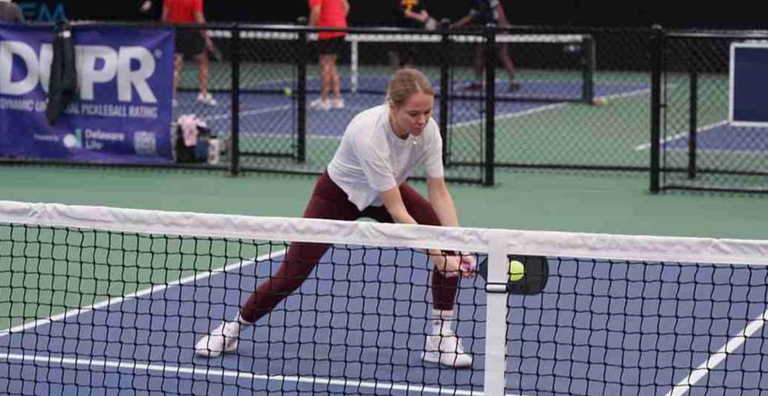
The dink game runs on this same principle. When you're positioned at the kitchen line, your dinks need to barely clear the net and die in the non-volley zone. Targeting the lower center portion gives you the best chance of keeping that ball playable but unattackable.
Drives, Speed-Ups, and Pickleball Net Height
Drives and speed-up shots are where players forget about net height entirely. If you're ripping a ball from the baseline, you need enough arc to clear 34 inches at center, and that arc is exactly what gives your opponent time to react. The net height is part of why raw power alone doesn't dominate in pickleball the way it might in other racquet sports.
 The Dink Media Team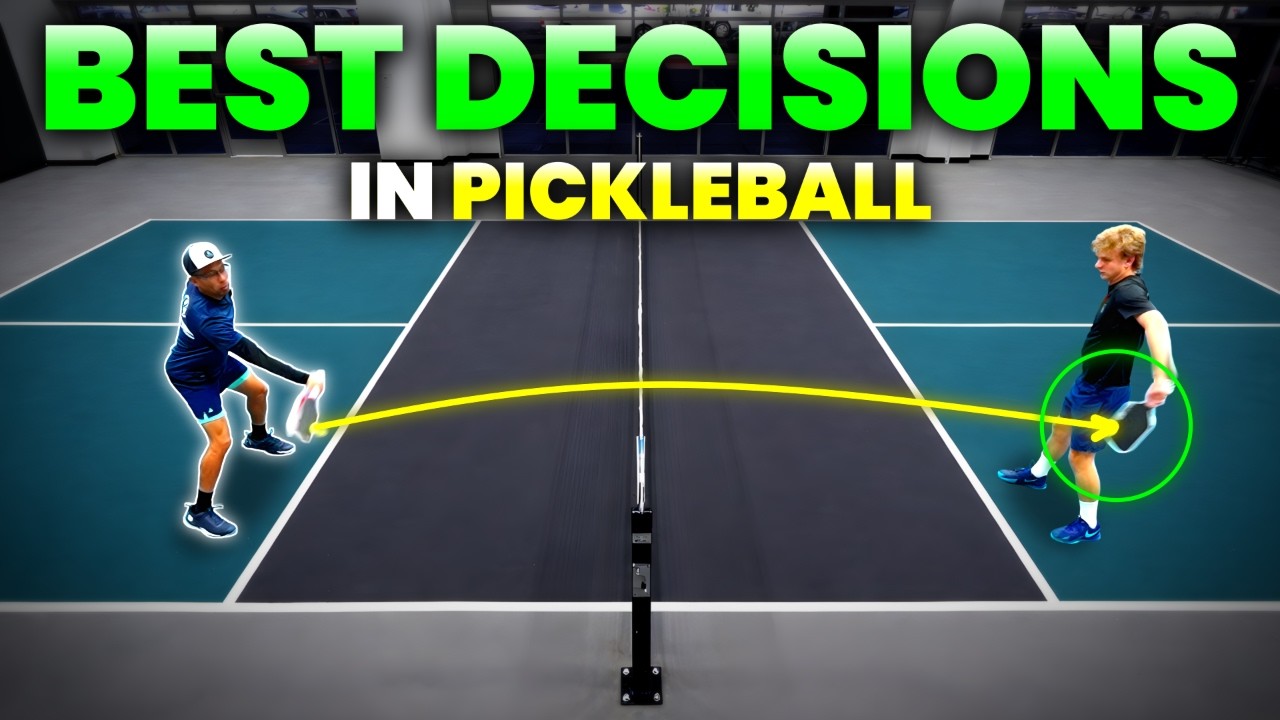
Can You Use a Tennis Net for Pickleball?
You can, with adjustments. This is a common question, and the answer matters for anyone playing on converted courts.
A standard tennis net is 36 inches at center and up to 42 inches at the posts. For pickleball, you need 34 inches at center and 36 inches at the posts.
The fix is straightforward: attach a center strap to pull the middle of the tennis net down to 34 inches.
The post height is trickier.
Tennis net posts typically sit higher, which means even with a center strap adjustment, the net at the sidelines may still be above the required 36 inches.
For casual recreational play, this is usually fine. For sanctioned or tournament-level competition, it's not legal.
The cleanest solution is a dedicated pickleball net and portable post system.
These are designed to hit the correct pickleball net height spec out of the box, no guesswork, no straps, no tape measures mid-rally.
Thomas Shields
How to Measure and Set Up a Pickleball Net Correctly
Getting your pickleball net height right takes two minutes and a tape measure. Here's how:
- Set your posts at 36 inches. The top of the net at both sideline posts should measure exactly 36 inches from the playing surface.
- Attach the center strap. Run the strap from the bottom of the net to the court surface anchor, pulling the net's center down to 34 inches.
- Verify with a tape measure. Measure from the top of the net to the ground at three points: left post, center, and right post. You're looking for 36 / 34 / 36.
- Check net tension. The net should be taut but not so tight it raises the center above 34 inches. A slight sag is normal and expected.
If you're playing on a home court setup, this process is the same. Portable net systems often include a center strap by default, use it every single time.
A net even an inch too high changes how your low dinks and drops behave, and you'll be making adjustments based on a measurement problem, not a technique problem.
One thing worth knowing: the playing surface matters.
On grass or uneven terrain, the effective net height can vary slightly along the baseline, which is why hard courts are the official standard for competitive play.
Alex E. Weaver
Pickleball Net Height for Beginners: Why It's the First Rule to Know
A quick definition for anyone newer to the game: the non-volley zone (NVZ), also called the kitchen, is the 7-foot area on each side of the net where you can't volley the ball.
It's directly connected to the net's design, because the net is low, a well-placed shot near the kitchen line becomes almost impossible to attack without stepping into the NVZ.
Understanding pickleball rules for beginners starts with the net because it governs so much else.
The kitchen rule exists precisely because a 34-inch net creates opportunities for put-away volleys if players could stand right at the net.
The NVZ takes that option away.
The lower net also explains why the serve in pickleball requires an underhand motion.
An overhead serve over a 34-inch net would be genuinely dangerous and nearly unreturnable, the underhand rule keeps serve returns in the game and rallies alive.
For anyone just getting started, commit these two numbers to memory: 34 inches at center, 36 inches at the posts.
Everything else, shot selection, kitchen strategy, serving mechanics, flows from those measurements.
The Dink Media Team
Key Takeaways
- Official pickleball net height is 34 inches at the center and 36 inches at the sideline posts, per USA Pickleball rules.
- The 2-inch sag in the middle is intentional and created by a required center strap.
- Pickleball nets are 2 inches lower at center than tennis nets, a difference that completely changes shot geometry.
- Targeting the lower center of the net reduces risk on third shot drops, dinks, and cross-court drives.
- Converting a tennis court to pickleball requires a center strap adjustment; dedicated pickleball nets are the more reliable option.
- Verifying net height with a tape measure takes two minutes and prevents hours of confusing play.
Frequently Asked Questions
What is the official pickleball net height?
The official pickleball net height is 34 inches at the center and 36 inches at both sideline posts, as mandated by USA Pickleball's rulebook. A center strap is required in sanctioned play to hold the net at the correct center measurement. These specs apply to both singles and doubles competition.
How is pickleball net height different from tennis net height?
A tennis net measures 36 inches at center versus pickleball's 34 inches at center. At the posts, a tennis net can reach 42 inches while a pickleball net sits at 36 inches. That 2-inch difference at center changes the geometry of nearly every shot, particularly low dinks and third shot drops that need to barely clear the net.
Can you play pickleball on a tennis court without changing the net?
You can play casually, but it isn't regulation. A tennis net is 2 inches too high at center for pickleball. The standard fix is adding a center strap to pull the middle down from 36 to 34 inches. For sanctioned play, the net must meet official pickleball net height specifications, and a tennis net with just a center strap adjustment may still have incorrect post heights.
Why does the pickleball net sag in the middle?
The center sag is by design, a required center strap pulls the net from 36 inches at the posts down to 34 inches at the center. This creates the lower center point that defines pickleball's geometry, encouraging cross-court play and rewarding precise placement over raw power. Per USA Pickleball rules, the center strap is mandatory in official competition.
Does pickleball net height affect shot strategy?
Yes, significantly. The lower center point at 34 inches is why players are taught to aim cross-court through the middle on drops and dinks, there's 2 fewer inches of net to clear compared to the sidelines. It also explains why the non-volley zone exists: without the kitchen rule, the low net would make put-away volleys at close range nearly automatic.

Love Pickleball? Join 100k+ readers for free weekly tips, news & gear deals.
Subscribe to The Dink