
Pickleball Court Dimensions: Every Measurement You Need (With Diagram)
Standard pickleball courts are 20' x 44'. Each side of the net features a 7' non-volley zone, commonly known as the "kitchen."
Pickleball court dimensions are officially standardized at 44 feet long by 20 feet wide, the same footprint as a doubles badminton court, which is not a coincidence.
The sport was literally invented on one. But knowing the total size is only part of the story.
If you're building a court, converting a tennis court, or just trying to understand why certain shots live and die in certain spots, you need the full breakdown. Here it is.
Love pickleball? Then you'll love our free newsletter. We send the latest news, tips, and highlights for free each week.
What Are the Official Pickleball Court Dimensions?
A regulation pickleball court is 44 feet long and 20 feet wide, used for both singles and doubles play.
That's the same court size for both formats, unlike tennis, where the doubles court is wider. The entire playing surface is 880 square feet.
According to USA Pickleball's official rulebook, the court lines are typically 2 inches wide and are included within the court boundaries, meaning the ball is in if it lands on any line except the non-volley zone line on a serve (which is a fault).
Here's the complete breakdown of every measurement on a standard court:
That last row matters more than most people realize. The court is 20x44, but the recommended total playing space, including buffer zones, is 30x60.
That's the number you need if you're building from scratch.
How Big Is the Kitchen, and Why Does It Matter?
The non-volley zone, universally called the kitchen, extends 7 feet from the net on both sides, running the full 20-foot width of the court.
It's the most strategically critical piece of real estate in the game.
Here's a definition worth keeping: the non-volley zone is the area where you cannot volley the ball (hit it out of the air).
You can absolutely enter the kitchen, you just have to let the ball bounce first.
The rules around this are more nuanced than most players think, which is why The Dink's breakdown of non-volley zone rules is worth a read.
The kitchen line itself is included in the non-volley zone. Land on it while volleying, and that's a fault.
The 7-foot depth is deliberate, it's far enough from the net to prevent pure net camping, but close enough that skilled players can still dominate from the line.
Why does kitchen size affect your game so much? Because every third-shot decision, every reset, every dink sequence is built around those 7 feet.
Knowing where you are relative to the kitchen line isn't just a rules thing. It's a positioning thing.
 The Dink Media Team
Does the Court Size Change for Singles Pickleball?
No. Pickleball court dimensions stay the same for singles and doubles, 44 feet by 20 feet, with the same kitchen, the same service boxes, the same net height.
That's one of the more interesting quirks of the sport. You're covering the same real estate whether it's two players or four.
Some players and organizations have experimented with narrower singles courts.
The PPA Tour tested a modified singles format with smaller court dimensions, and the conversation around narrower singles courts is genuinely ongoing.
But for now, official singles play uses identical pickleball court measurements.
That said, singles strategy is completely different precisely because the court is the same width.
Covering more ground solo changes everything about serve placement, return depth, and movement patterns.
If you're getting into singles, check out these essential singles tips.
The Dink Media Team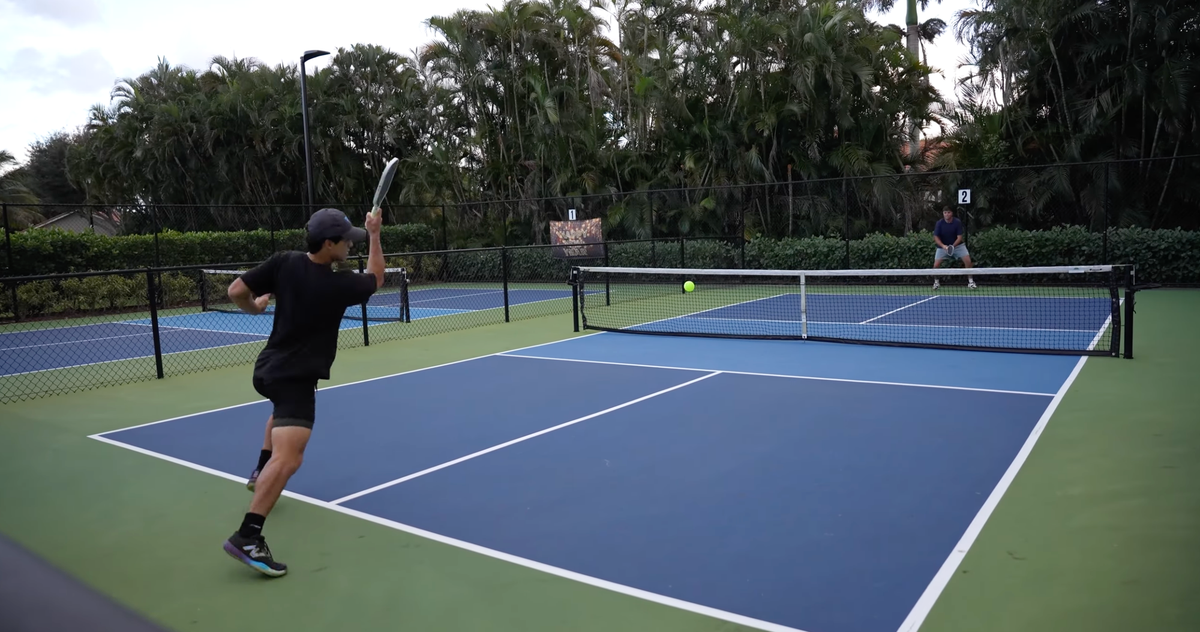
What Are the Pickleball Court Dimensions for Net Height?
The pickleball net is 36 inches tall at the sideline posts and 34 inches at the center of the court.
That 2-inch droop in the middle is intentional, and it's why so many shots are aimed down the middle line.
The center of the net is the lowest point, giving shots slightly more clearance.
For reference, a tennis net sits 36 inches at the center. That means pickleball's net is actually lower in the middle than tennis, but matches it at the posts.
The difference isn't huge in practice, but it absolutely shapes how you approach angles.
One more thing: the net posts sit 22 feet apart (one foot outside each sideline) and the net itself extends a minimum of 1 foot beyond each sideline on both sides.
That overhang matters, balls that clip the post extension are still in play if they land in bounds.
How Do Pickleball Court Dimensions Compare to Tennis?
This is one of the most practical questions for anyone thinking about converting or sharing a facility. The numbers tell the story:
- A tennis court is 78 feet long by 27 feet wide (singles) or 36 feet wide (doubles)
- A pickleball court is 44 feet long by 20 feet wide
That size difference is significant. You can fit four pickleball courts on a single tennis court, which is why so many tennis facilities have been converting.
Pickleball courts are roughly 1/3 the length and half the width of a tennis court, making them far more efficient per square foot.
Shared-use facilities typically use portable nets and tape to mark pickleball lines on existing tennis courts.
The kitchen lines, centerline, and baselines are all applied within the existing tennis court boundary.
Just know that the tennis net is 2 inches too tall at the center for pickleball, you'll need to adjust or use a purpose-built pickleball net for proper play.
Eric Roddy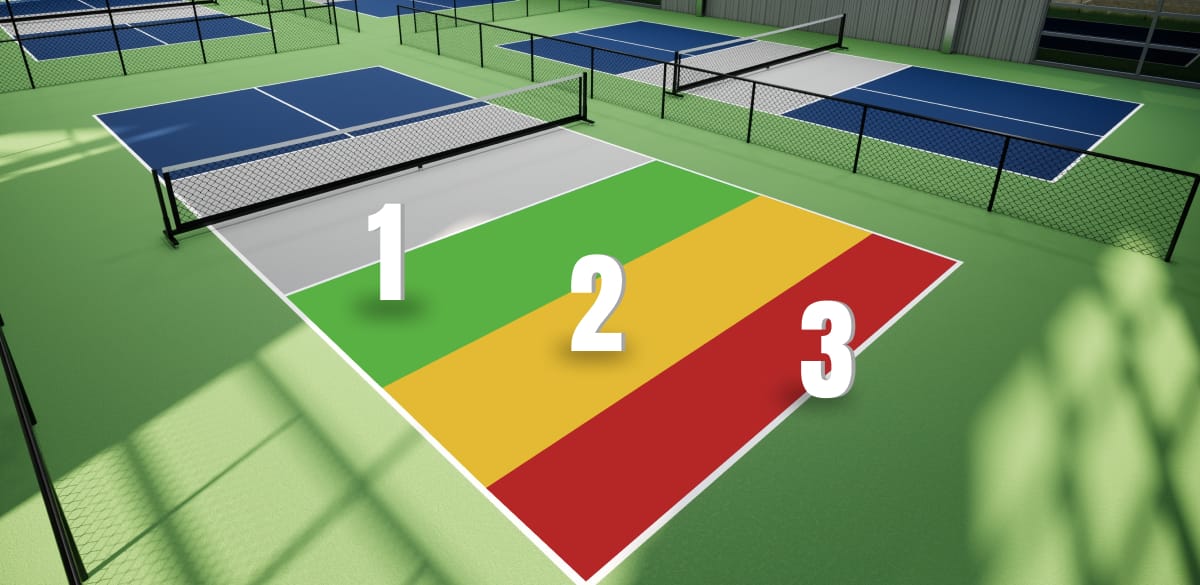
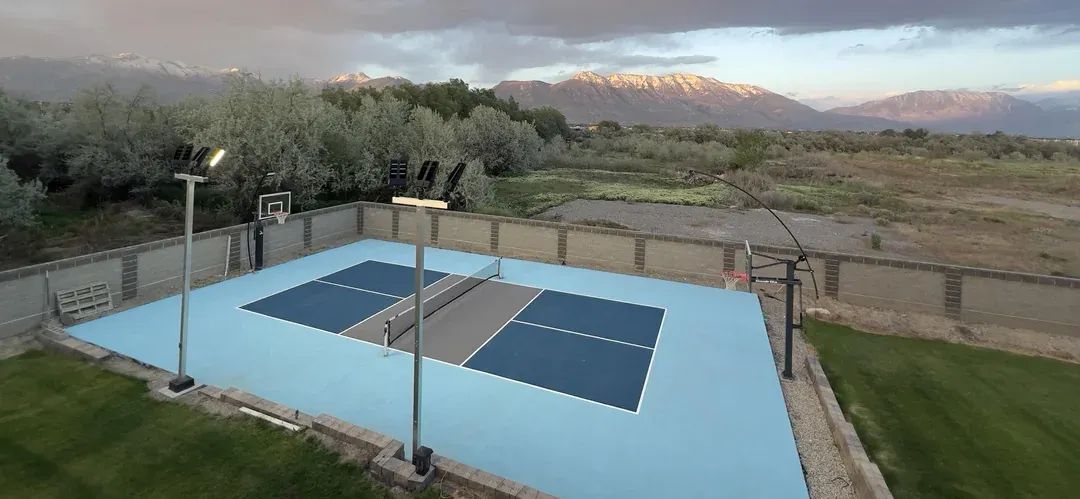
Can You Build a Pickleball Court at Home?
Yes, and more people are doing it. Zillow reported a 25% increase in listings mentioning pickleball courts, it's become a legitimate home amenity.
The minimum recommended footprint for a backyard pickleball court is 30 feet wide by 60 feet long.
That's the total playing area including the out-of-bounds buffer on all sides.
You need that buffer for safety and for reasonable play, getting within 6 feet of a fence on your baseline is not an ideal experience.
For surface material, concrete and asphalt are the most common.
Post-tensioned concrete is the premium choice, it's crack-resistant and holds up well in freeze-thaw climates.
Sport court tiles are popular for DIY installs because they don't require professional paving and can be installed over existing concrete.
The line markings are the same regardless of surface.
The total court dimensions don't change, you're always working with 44x20 for the playable area, laid out within your 30x60 total space.
Alex E. Weaver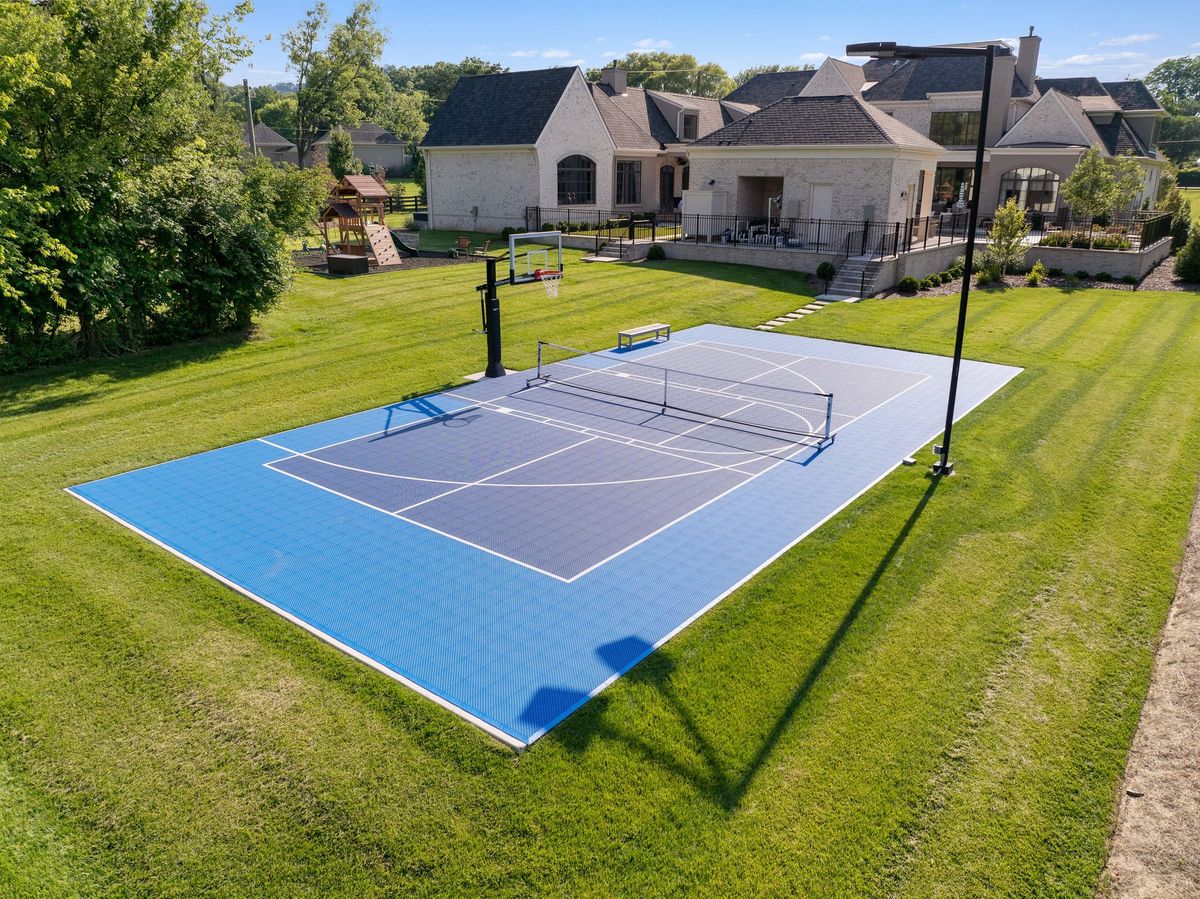
Key Takeaways
- Court size: 44 feet long, 20 feet wide, same for singles and doubles
- Kitchen depth: 7 feet from the net on each side
- Net height: 36 inches at the posts, 34 inches at the center
- Service areas: 15 feet deep on each side (between the kitchen line and baseline)
- Total recommended space: 30 x 60 feet including buffers
- You can fit four pickleball courts on one tennis court
Frequently Asked Questions
What are the official pickleball court dimensions?
The official pickleball court dimensions are 44 feet long by 20 feet wide, as standardized by USA Pickleball. This applies to both singles and doubles play. The total playing area including buffer zones is recommended to be 30 feet wide by 60 feet long.
How deep is the non-volley zone (kitchen) in pickleball?
The non-volley zone, the kitchen, extends 7 feet from the net on each side, running the full 20-foot width of the court. The kitchen line itself is considered part of the non-volley zone, so landing on it while volleying is a fault. The kitchen is the same depth for both singles and doubles.
How tall is a pickleball net?
A regulation pickleball net is 36 inches tall at the sideline posts and 34 inches tall at the center of the court. The slight drop in the middle is by design. Net posts are placed 22 feet apart, one foot outside each sideline, and the net extends at least one foot beyond each sideline on both sides.
How many pickleball courts fit on a tennis court?
Four pickleball courts can typically fit on one standard tennis court. A tennis court is 78 x 36 feet (doubles), which gives enough space for four 20x44 pickleball courts with room to spare. This conversion has driven widespread adoption at tennis clubs and recreation centers across the country.
What is the minimum space needed to build a backyard pickleball court?
The minimum recommended total playing space, including safety buffer zones, is 30 feet wide by 60 feet long. The actual court surface is 20x44 feet, but you need at least 5-10 feet of clearance beyond each baseline and at least 5 feet beyond each sideline for safe, playable conditions.

Love Pickleball? Join 100k+ readers for free weekly tips, news & gear deals.
Subscribe to The Dink