
How to Protect Your Shoulder During Pickleball Serves as You Age
Pickleball shoulder pain almost always traces back to the serve, the one shot players repeat hundreds of times without ever training for it. Here is what injury research and USA Pickleball mechanics suggest about protecting the joint as you age.
Pickleball shoulder pain almost never starts with one dramatic swing. It starts with the shot nobody thinks about.
You serve every point, hundreds of times a session, and it feels like the least athletic thing you do all day.
Underhand. Below the waist. No overhead torque like a tennis serve. Honestly, it looks harmless.
That's exactly the problem. The serve is the highest-volume, lowest-attention movement in the sport, and volume is where shoulders break down.
Players obsess over their reset game and treat the serve as the thing that starts the point.
Love pickleball? Then you'll love our free newsletter. We send the latest news, tips, and highlights for free each week.
Why Does Pickleball Shoulder Pain Show Up in the Serve First?
Pickleball shoulder pain in the serve is usually a load problem, not a trauma problem.
Clinical guidance on shoulder and rotator cuff injuries in pickleball points to overuse, sudden spikes in playing volume, and endurance deficits in the rotator cuff and scapular muscles as the primary triggers.
True tears show up far less often, and when they do, they tend to involve an acute high-force event or existing age-related tendon wear.
Think of it this way. Three sessions a week becomes six because a new court opened nearby.
Nothing changed about your technique. Everything changed about your weekly workload.
Here's the catch for older players.
Data from a 10-year review of emergency department visits, covering 2013 through 2022, found that roughly 91% of pickleball injuries treated in EDs involved players aged 50 and up, with a mean age of 64.
That figure covers every injury type, not shoulders specifically, and it reflects the age makeup of the people playing as much as anything else.
But it does mean the injury conversation in this sport is, statistically, a conversation about players over 50.
What the Injury Data Actually Says About Pickleball Shoulder Pain
Shoulders are not the most common upper-body complaint in pickleball. They are one of the most stubborn.
A retrospective study of 204 patients treated between 2015 and 2022 found shoulder injuries made up 4.1% of upper extremity cases reaching specialized hand and upper extremity clinics.
Wrist fractures dominated that dataset at 31.4%, a skew that partly reflects the setting: those clinics see hands and wrists by design.
Two details matter. Mean age was 65, and physical therapy showed up in 44.2% of non-surgical cases. That's not a population getting carried off on stretchers.
That's a population managing something that built up over months, the same way it does with knees.
Is Pickleball Shoulder Pain Really an Older-Player Problem?
It's an exposure problem that concentrates in older players. Players over 50 are the sport's most committed demographic.
They play more days per week, year-round, with the same swing pattern for years.
Programs like the AARP national clinic tour exist because that group drives participation growth.
More reps means more accumulated load on the same tendons, and age-related tendon changes add to it.
Neither makes injury inevitable, and neither is an argument for playing less.
 The Dink Media Team
The Kinetic Chain Is Your Shoulder's Best Friend
The single biggest protective factor on your serve is where the power comes from.
USA Pickleball's guidance on serve power is blunt about this: pace comes from ground reaction force traveling up through hip and trunk rotation, not from arm speed.
Rotating the hips open before the arm moves creates elastic torque in the torso, which means the shoulder delivers force rather than manufacturing it.
It's the same chain that powers a clean overhead or smash.
Definition, quickly: the kinetic chain is the sequence your body uses to move force from the ground to the paddle.
Legs push, hips rotate, torso uncoils, shoulder follows, paddle meets ball.
When a link is weak or skipped, the links downstream compensate.
On a serve, the shoulder is the last real link, so it absorbs whatever the legs and core failed to produce. Same principle behind every power shot.
A stable athletic stance does more for your shoulder than any stretch.
 The Dink Media Team
How Do You Serve Without Muscling It With Your Arm?
Serve from the ground up and let the paddle finish the job.
USA Pickleball's serve technique guidance describes a smooth pendulum motion originating at the shoulder joint, with contact below the waist, paddle head below the wrist, and a relaxed follow-through.
No wrist snap. No elbow flick. Let the paddle do the work.
Here is the sequence worth rehearsing:
- Set a closed or semi-closed stance so your hips have somewhere to rotate to. Feet parallel to the baseline gives your torso nothing to unwind from.
- Start the hips before the arm. If your paddle moves first, your shoulder is already working alone.
- Swing as a pendulum, not a lever. The arm hangs and travels. It doesn't snap at the wrist or elbow.
- Follow through toward your target and let the motion decelerate long. Short, abrupt stops load the rotator cuff on the brakes.
That last point gets skipped constantly.
Deceleration is when the rotator cuff works hardest, which is why players who chase extra spin with a violent cut-off finish feel it the next morning.
Zane Navratil's serve experiments made the same point years ago: mechanics beat effort.
 The Dink Media Team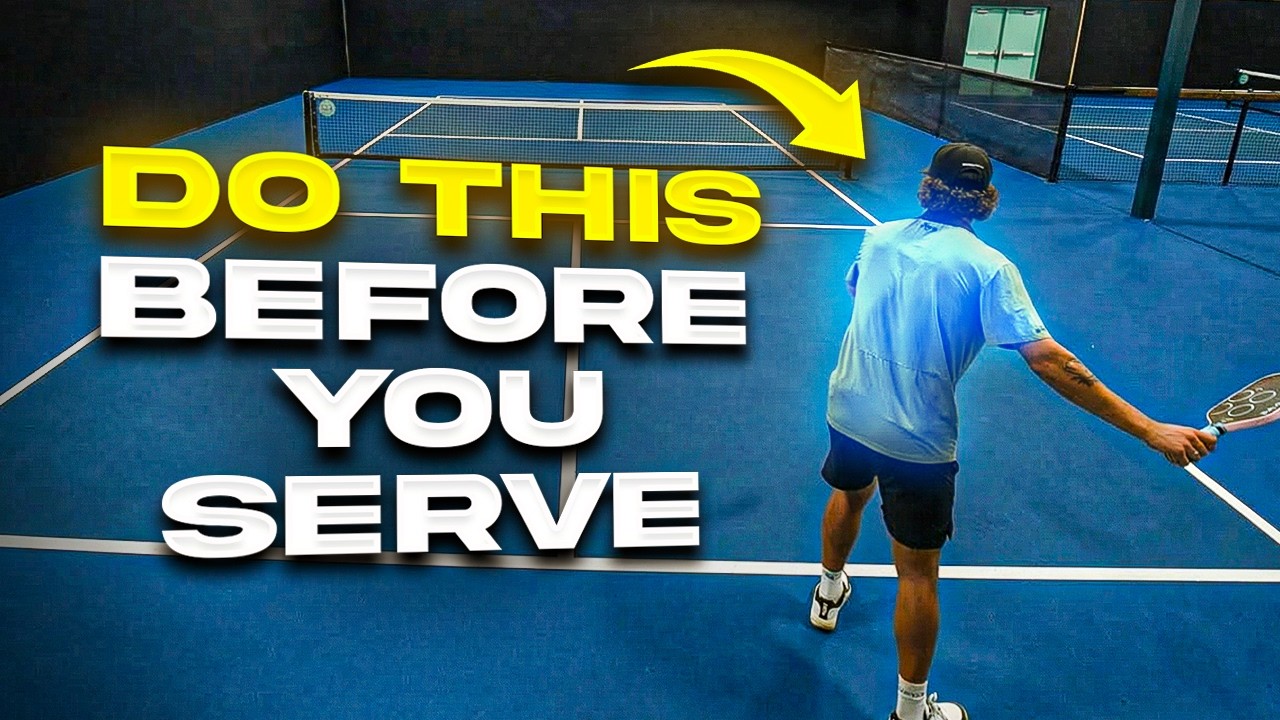
Three Habits That Quietly Wreck Your Serve Shoulder
Most serve-related shoulder trouble traces to load management, not technique alone. Even players newer to the sport run into these three.
- Jumping your volume overnight. Adding tournaments, a league night, and open play in the same month is the pattern clinical sources flag most often. If you're entering more tournaments, build to it.
- Serving cold. First serve of the day at full pace, straight out of the car. A few minutes of warm-up work beats any post-match ice.
- Hunting pace with your arm. Trying to weaponize the serve by swinging harder is what USA Pickleball's guidance argues against. Placement wins more points than speed anyway, especially serving wide near the sideline. Grip matters too, so check your serve grip.
 The Dink Media Team
What Helps Pickleball Shoulder Pain Besides Rest?
Research points toward rotational strength and scapular support as the main protective factors.
Physical therapy guidance on pickleball emphasizes rotational core work alongside external and internal rotation strengthening with resistance bands, plus attention to thoracic mobility.
The logic is straightforward: when the core and lower body can generate rotation, the rotator cuff isn't asked to produce force it was never built to produce.
None of that is a treatment plan.
Pickleball shoulder pain that is sharp, persistent, or paired with weakness sits outside what technique work addresses, and clinical sources are consistent that ignoring those symptoms is how mild tendon irritation becomes a longer problem.
That's a conversation for a qualified professional, not a blog post.
What you control is the input. Lower the arm-only load, raise the rotational strength, spread the volume out.
Solo drill sessions groove serve mechanics without the intensity of live points, and contact height awareness carries over to overheads, where the shoulder takes its other big hit.
 The Dink Media Team
Key Takeaways
- Pickleball shoulder pain from serving is typically an overuse pattern, driven by volume spikes and rotator cuff endurance deficits rather than acute tears.
- ED data collected from 2013 through 2022 found roughly 91% of pickleball injuries involved players aged 50 and older, across all injury types.
- A 2015 to 2022 clinic study found shoulder injuries accounted for 4.1% of upper extremity pickleball cases, with a mean patient age of 65.
- USA Pickleball guidance ties safe serve power to the kinetic chain: legs and hips generate, the shoulder delivers, as with any return of serve.
- Rotational core strength, scapular support, and gradual volume increases are what research points to as protective.
Frequently Asked Questions
What helps shoulder pain from pickleball serves?
Research and clinical guidance point toward reducing volume spikes, strengthening the rotator cuff and scapular muscles, and shifting serve power into the hips and legs. Warming up properly before competitive play is consistently emphasized. Persistent or sharp pain is a matter for a qualified medical professional, not technique adjustments.
Can you play pickleball with a bad shoulder?
Many players do, though it depends on the specific issue and is a question for a medical professional who can assess it. From a mechanics standpoint, serves that rely on trunk rotation rather than arm speed place less demand on the shoulder joint. Overheads and hard drives generally load the shoulder more than serves do.
Can I play pickleball with a torn rotator cuff?
That's a clinical question, not an editorial one, and it depends on the tear and the treatment plan. Research does show full tears are less common in pickleball than overuse conditions like tendon irritation. A study of upper extremity pickleball injuries found physical therapy was the most common non-surgical treatment, and recovery habits matter alongside it.
Does the underhand serve make pickleball shoulder pain less likely?
The underhand serve reduces the overhead torque a tennis serve places on the shoulder, since USA Pickleball rules require contact below the waist with the paddle head below the wrist. That's a real mechanical difference, and it shows up in serve strategy too. It doesn't eliminate the load, because repeated acceleration and deceleration without core stability can still stress the anterior shoulder.
How many serves is too many in one session?
There's no established number, and it varies with conditioning, mechanics, and history. What clinical sources flag is the rate of change: sudden jumps in weekly volume are a more consistent trigger than any single session total. Building gradually is the pattern most often recommended.

Love Pickleball? Join 100k+ readers for free weekly tips, news & gear deals.
Subscribe to The Dink