
Overuse, not accidents, drives most pickleball injuries, and older players carry the heaviest load. This pickleball recovery routine for seniors covers the cool-down, protein range, and joints that need the most protection.
Here's the uncomfortable part about building a pickleball recovery routine for seniors: what ends your season usually isn't a dramatic fall at the kitchen line.
It's the slow grind of playing five days a week and treating rest as something you'll get to later.
One survey of recreational players found overuse injuries made up 78% of all reported cases, against just 22% for acute traumatic events.
That's not bad luck, that's volume without a plan.
If you already track how many calories a session burns, you're closer to thinking like an athlete than you think.
Love pickleball? Then you'll love our free newsletter. We send the latest news, tips, and highlights for free each week.
Why Does a Pickleball Recovery Routine for Seniors Matter More Than Your Third Shot?
Because older players carry the heaviest injury load in the sport, by a wide margin.
One analysis of emergency department data collected between 2013 and 2022 estimated roughly 66,350 pickleball-related ED visits in the US.
Players aged 65 to 80 made up 61.1% of those injuries.
Falls were the most common mechanism at 65.5%, and fractures the most frequent diagnosis at 32.7%, followed by strains and sprains at 30.8%.
Worth being precise: that's a decade of data from about 100 sample US hospitals, not a snapshot of last season.
It also misses everything managed at home or in a PT clinic, which is most of what actually nags you.
 Connor Derrickson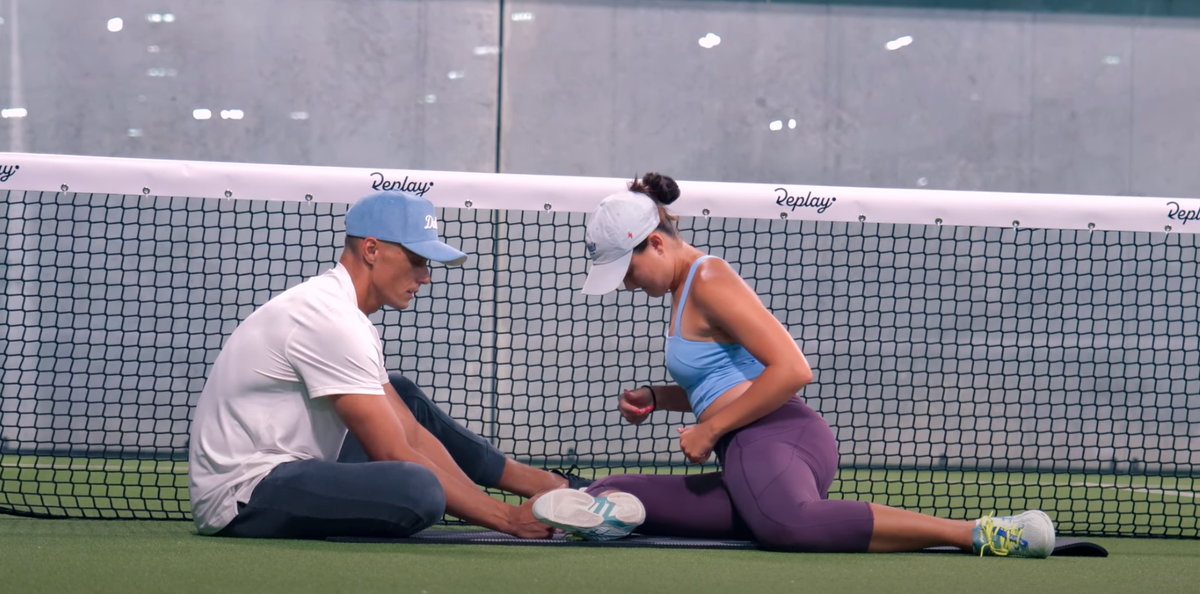
A pickleball recovery routine for seniors has to start from that reality rather than from a highlight reel.
Honestly, this is the part the sport undersells.
Pickleball's smaller court and underhand serve mean less full-sprint running and fewer hard-stop pivots than tennis, and that lower-impact movement pattern is something research has linked to easier strain on the knees and hips.
It's part of why the game keeps showing up in conversations about staying active later in life, and why AARP has run national clinic tours promoting pickleball for seniors.
But "lower impact than tennis" and "no risk" are different claims, and the data on wrist fractures and closed head injuries (8.6% of cases) makes that clear.
Which is why a smart pickleball recovery routine for seniors treats fall risk as a training variable, not a footnote.
What Actually Slows Recovery Down After 50?
Aging changes the repair timeline, and the mechanism is well described.
Muscle protein synthesis slows. Muscle mass drops. Tendons and ligaments lose elasticity.
Hormonal shifts add another layer. Guidance from ACSM notes these changes prolong post-exercise soreness and slow structural repair.
Translation: the 45-year-old across the net isn't tougher than you. She's just running a faster repair crew.
That gap in repair speed is the whole reason a pickleball recovery routine for seniors looks different from what a 30-year-old needs.
Quick definition: active recovery means low-intensity movement done on purpose between hard sessions.
Walking, easy cycling, light solo drills at half speed. It's not a day off, and it isn't training either.
The point is blood flow without added tissue stress, which is why it survives as the one habit players actually keep.
Your Pickleball Recovery Routine for Seniors Starts Before You Leave the Court
The highest-return move is the cool-down you're currently skipping.
Most of the payoff in a pickleball recovery routine for seniors is front-loaded right here, in the ten minutes before you reach your car.
Guidance from NCOA lays it out:
- Five minutes of low-intensity aerobic movement. Slow walking works. The goal is to let heart rate normalize gradually instead of going from a 12-point rally straight to the car seat.
- Static stretching, 30 seconds per muscle group. Target the four that do the most work in a pickleball match: calves, hamstrings, quadriceps, and shoulders.
- Do it while you're still warm. Warm tissue is more pliable, which is exactly why static work belongs after play rather than before it.
That's roughly eight minutes. Eight. If you've ever spent forty minutes arguing about paddles in a group chat, you have eight minutes for your hamstrings.
Build it into a fixed on-court ritual so it stops being a decision, and add a lunge and mobility pattern to cover the hips.
Building a Pickleball Recovery Routine for Seniors Around the Joints That Complain Most
Aim the strength half of your pickleball recovery routine for seniors at the four regions the literature keeps flagging.
A narrative review on geriatric sports injury identified the wrists, shoulders, knees, and ankles as the most frequently injured areas among senior players.
The review also raised a mechanism worth sitting with: part of that elevated rate is attributed to previously sedentary adults taking on the rapid-pivoting demands of the sport without baseline conditioning first.
The survey data lines up. Its most common injury sites were the knee (23.3%), elbow and forearm (18.1%), and shoulder and upper arm (17.2%).
Same message from both: the lower body and paddle-side arm are where your attention belongs.
Knee-specific strength work is the obvious lever, and since falls drive most senior emergency visits, footwear matters more than it gets credit for.
Both shoe choice and how you lock your heel in affect ankle stability when you change direction late.
 The Dink Media Team
How Much Protein Does a Pickleball Recovery Routine for Seniors Actually Need?
More than most players eat.
ACSM guidance for healthy active adults over 50 puts daily protein at 1.0 to 1.2 grams per kilogram of body weight, rising toward 1.5 g/kg in heavier training stretches.
For a 170-pound player, the lower end lands near 77 grams a day.
That guidance was written for healthy active older adults, and individual targets depend on kidney health and total calories, so treat it as a reference range and not a prescription.
Food is the least glamorous input in a pickleball recovery routine for seniors and probably the one that moves the needle most.
Fluids too: pickleball tends to pull more water out of players than they expect, and how you handle nutrition and what you drink mid-session shapes how the next morning feels.
 The Dink Media Team
The Cold Plunge Question Nobody Really Wants Answered
Here's the catch: the ice bath might be working against you. Cold plunges are a fixture in recovery culture, and we've covered the trend plenty.
But high-intensity cold exposure taken immediately after strength or resistance work has been associated with blunted local muscle protein synthesis and reduced adaptation over time.
The reasonable read: treat cold as a targeted tool for acute inflammation, not a daily ritual stacked onto every session.
For everyday soreness, the lower-tech options hold up fine.
Simple muscle care habits, topical relief products, and recovery footwear for the hours after you play all do quiet work.
The pickleball recovery routine for seniors that actually holds up over a season is the boring one you repeat, not the one you post about.
Is Static Stretching Before You Play Helping or Hurting?
It's probably hurting your first two games. Pre-game static stretching on cold muscles can temporarily decrease force production and power output.
Dynamic warm-ups are what's recommended before play: light jogging, lateral shuffles, arm circles, hand-eye work with mini balls. Save long holds for after.
If your warm-up is two dinks and a calf stretch against the fence, there's a better version.
On travel weeks, keeping baseline conditioning going beats arriving cold to a tournament with three matches on Saturday.
 The Dink Media Team
Key Takeaways
- Overuse, not accidents, is the real threat. One survey found 78% of reported pickleball injuries were overuse, versus 22% acute.
- Older players carry the biggest share of serious injuries. ED data from 2013 to 2022 found players 65 to 80 made up 61.1% of cases, falls the top mechanism at 65.5%.
- The cool-down is eight minutes. Five of easy walking, then 30-second static holds for calves, hamstrings, quads, and shoulders.
- Protein guidance for active adults over 50 sits at 1.0 to 1.5 g/kg per day, depending on load.
- Use cold plunges selectively, since routine post-exercise cold exposure has been associated with reduced muscle adaptation.
- Guard the wrists, shoulders, knees, and ankles. Those are the priority regions for any pickleball recovery routine for seniors.
Frequently Asked Questions
How long should a pickleball recovery routine for seniors take?
The on-court portion runs about eight minutes: five minutes of low-intensity walking, then 30-second static stretches for the major muscle groups. Nutrition and hydration happen across the rest of the day rather than in one block. Consistency beats duration here.
Is pickleball safe for seniors?
Pickleball for seniors is popular for good reason, but the injury data deserves respect. Emergency department records show meaningful rates of serious outcomes in senior players, including fractures from falls and closed head injuries. Framing the sport as risk-free doesn't match the data.
What are the most common pickleball injuries in seniors?
Fractures were the most frequent emergency diagnosis at 32.7%, with strains and sprains close behind at 30.8%. Survey data on recreational players points to the knee, elbow and forearm, and shoulder. A review of senior injuries highlighted the wrists, shoulders, knees, and ankles.
Should seniors stretch before or after playing pickleball?
After, for static stretching. Long holds on cold muscles can temporarily reduce power output, so dynamic movement is what's recommended pre-match: light jogging, shuffles, arm circles. Static work suits the cool-down, when tissue is warm.
How many rest days do older pickleball players need?
There's no single number, and it depends on how many sessions and how much intensity you stack. The aging-physiology research does support that repair takes longer after 50, since muscle protein synthesis and tissue elasticity both decline. Active recovery days, meaning easy movement rather than total rest, are the usual recommendation.

Love Pickleball? Join 100k+ readers for free weekly tips, news & gear deals.
Subscribe to The Dink