
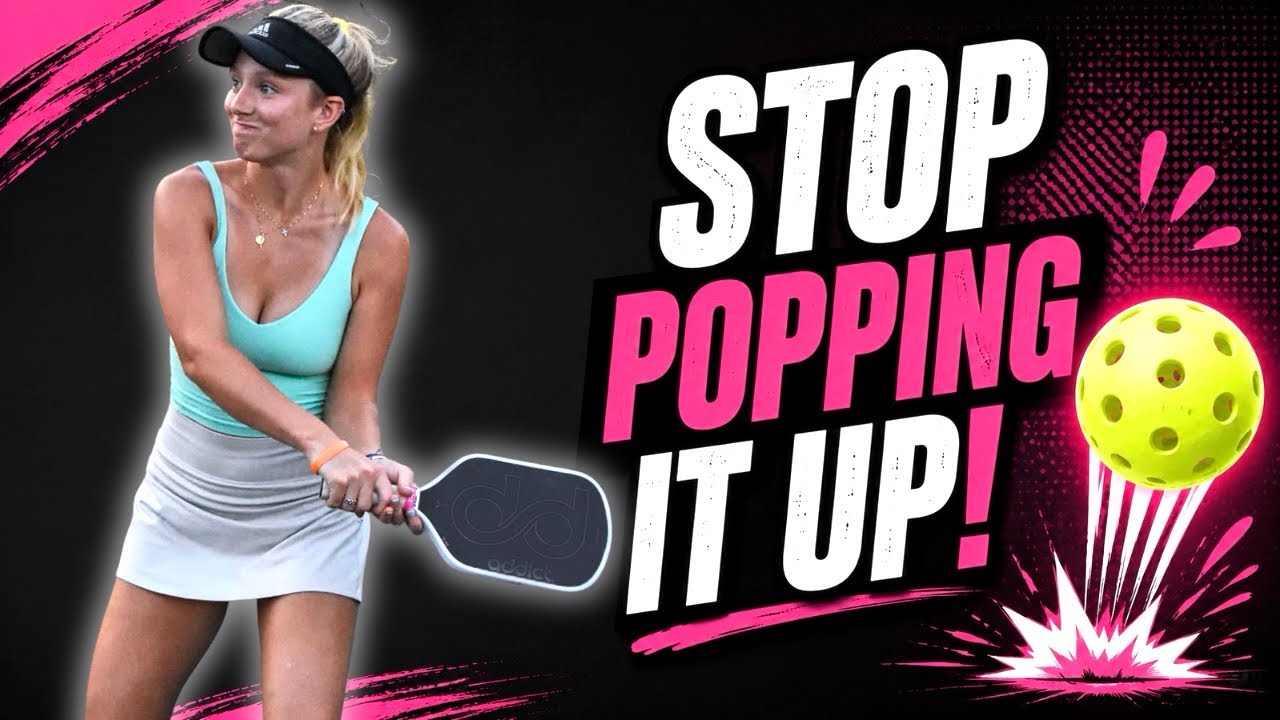
3 Reasons You Keep Popping the Ball Up in Pickleball (And How to Fix Them)
Popping the ball up in pickleball is one of the most common mistakes at every level, and it rarely comes from hitting too hard. Here are the three root causes and how to stop them fast.
Popping the ball up in pickleball is one of the fastest ways to lose a point you should have won.
You set up, you make contact, and suddenly your opponent is winding up for a put-away because you handed them a ball at shoulder height.
The frustrating part is that most players blame their power or their timing.
The real problem is almost always something more mechanical, and it is completely fixable.
PPA tour pro Ashley Greffrath breaks down the three biggest causes of pop-ups and gives specific, court-ready solutions for each one.
Here is what she found and how you can apply it right away.
Love pickleball? Then you'll love our free newsletter. We send the latest news, tips, and highlights for free each week.
The Real Reason Your Balls Keep Going High
Most players assume pop-ups come from swinging too hard or not being patient.
That assumption sends you chasing the wrong fix.
The three actual culprits are paddle angle at contact, late contact point, and a short choppy swing.
Fix any one of these and you will immediately start keeping more balls low. Fix all three and your opponents will notice the difference.
Fix 1: Your Paddle Face Is Pointing at the Ceiling
This is the most common cause of pop-ups and the one most players never even notice.
At the moment of contact, your paddle face is open, angled upward, and literally directing the ball into the air.
Think about what an open paddle face does. It acts like a ramp.
The ball rides up and off the surface and sails high every single time, regardless of how soft you try to hit it.
The fix is to keep your paddle face neutral or slightly closed at contact. You are not trying to muscle the ball down.
You are letting the direction of your swing do the work instead of your wrist.
How do you actually change your paddle angle?
The key is to think about swinging into the court rather than upward.
When your swing path moves forward and through the ball, your paddle face naturally closes a little.
That small adjustment is enough to drop your contact angle and start keeping balls out of the hitting zone.
Here is a practical checklist for fixing paddle angle:
- At the kitchen, swing crosscourt and forward, not upward
- On volleys, keep the face neutral even when you have to reach or get low
- In the transition zone, move into the ball smoothly and swing through rather than scooping
- Watch your wrist. If it is flipping upward at contact, the face will follow
The transition zone is where this mistake shows up most brutally. Players panic in no man's land and start scooping the ball to get it over the net.
The result is a floating ball that gets crushed.
Keep the swing path forward, stay calm, and let the court do the work.
If you want to understand how most pickleball mistakes happen in the transition zone, the pattern almost always traces back to a panicked swing and an open face.
Fix 2: You Are Hitting the Ball Too Late
Contact point is everything.
When you catch the ball behind your body or reach awkwardly across yourself, you lose the ability to control where that ball goes.
Late contact means your paddle angle is already compromised before you even swing.
The ball needs to be out in front of you, contacted in a balanced position with your weight stable. That is the only way to consistently control height over the net.
Why does late contact cause pop-ups specifically?
When the ball gets behind you, your body instinctively compensates. Your elbow rises, your wrist opens, and your swing path tilts upward to chase the ball.
All three of those adjustments send the ball high.
The pop-up is not really a swing mistake at that point. It is a footwork mistake.
Here is how to build a better contact point consistently:
- Start with your ready position. Low base, paddle out in front, weight slightly forward. If your starting position is upright and passive, you will always be late.
- Move your feet first, swing second. Get behind the ball before you think about hitting it. Your feet create the contact point, not your arm.
- Stay active between shots. Players who freeze in place after hitting are the ones who get caught late on the next ball. Keep moving, stay engaged.
- At the baseline, use your legs to get low. Getting behind the ball means getting your body level down, not just leaning your arm toward the ball.
This connects directly to shuffling mistakes that ruin your pickleball footwork.
Players who shuffle incorrectly arrive late to the ball constantly, and late arrival almost always produces a pop-up.
The most common version of this mistake looks like a player standing upright with a wide stance, reaching awkwardly for a ball that has already passed their hip.
They make contact, but everything about that contact is wrong. The fix is not a better arm swing.
It is moving your feet earlier.
 The Dink Media Team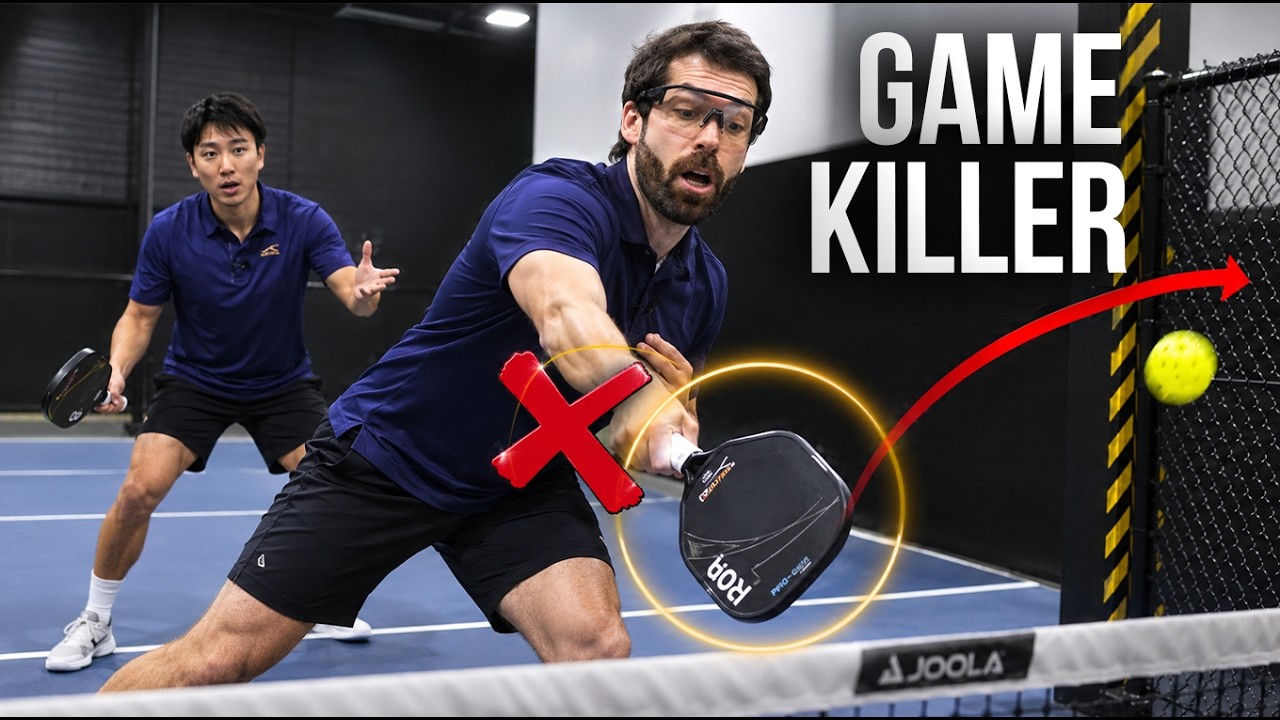
Fix 3: Short Choppy Swings Make the Problem Worse
Here is the counterintuitive one. Most players who pop the ball up try to fix it by making their swing shorter and more controlled.
Shorter punchy stabs at the ball feel safer.
They feel like they give you more control over where the ball goes.
They do not. A short, tense, pokey swing is one of the primary causes of pop-ups, not a cure for them.
Why does a relaxed swing actually give you more control?
Tension in your arm transfers directly to the ball.
When you grip tight and punch at the ball, the energy is unpredictable and the paddle face is harder to stabilize.
A relaxed arm that swings smoothly through the contact zone keeps the face consistent and gives you repeatable control of height and direction.
Think about the best dinks you have ever hit. They probably felt effortless, not forced.
That feeling is the result of a fluid, relaxed swing path rather than a tense stab at the ball.
This is also the mistake Ashley Greffrath calls out as the one she sees even advanced players making.
Experienced players know to move their feet and manage their paddle angle, but they still tense up in high-pressure moments and revert to short, defensive pokes that send the ball high.
The fix is committing to your shot. Let your arm come through naturally after contact. Finish the swing.
A full follow-through on your dinks is not reckless. It is what produces the topspin and control that keeps the ball low.
Players who struggle with this at the kitchen will also tend to struggle when the pace increases.
If you want to understand why your pickleball reset keeps popping up, the tense swing pattern is usually the reason.
Here is what a better swing feels like in practice:
- Relax your grip slightly before you swing
- Let your elbow lead rather than forcing your wrist
- Swing through the ball, not at it
- Allow a natural follow-through in the direction you want the ball to go
- Do not stop the swing at contact. That is where the poke happens
For dinks specifically, this relaxed swing is what generates topspin. Topspin pulls the ball down after it clears the net, which is exactly what you want.
Topspin dink keys that turn a soft shot into a weapon all start with a fluid, committed swing rather than a protective jab.
 The Dink Media Team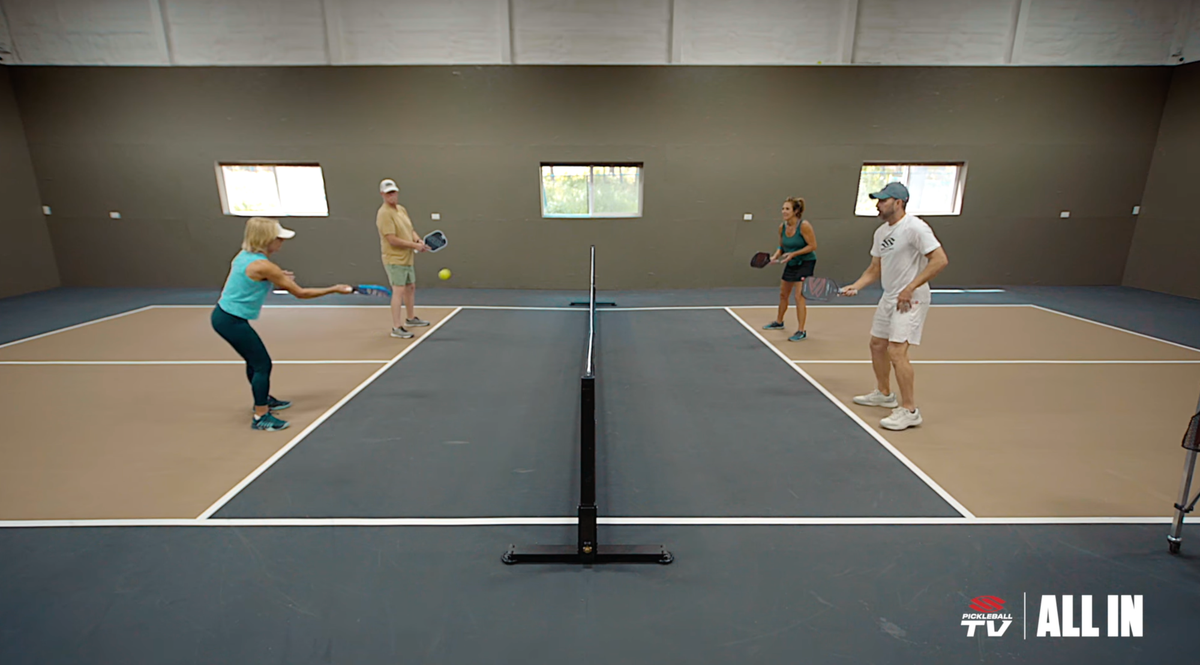
Putting All Three Fixes Together
These three mistakes compound each other.
A late contact point forces you into an awkward position, which opens your paddle face, which makes you panic and shorten your swing.
All three problems feed the same result: a ball floating up at chest height for your opponent to punish.
The good news is that the fixes compound too. When you move your feet and catch the ball out front, controlling your paddle angle becomes much easier.
When your paddle angle is neutral and your contact is clean, swinging through the ball with a relaxed arm feels natural rather than scary.
Start drilling these in crosscourt dink exchanges.
That context isolates the kitchen contact point, gives you repetition on paddle angle, and forces you to commit to a full swing rather than a poke.
It is also low-stakes enough that you can focus on mechanics rather than outcome.
If you want specific drills to sharpen your kitchen consistency, backhand dink drills to master the kitchen give you a structured progression that addresses all three of these contact issues at once.
Beyond the dinking game, the same principles apply to your volleys and your transition shots.
Volley mistakes amateurs make every game almost always trace back to one of these three root causes.
Fix them at the kitchen and the correction carries everywhere else on the court.
The goal is not to be perfect on every single ball. The goal is to give your opponents fewer free attacks.
Fewer pop-ups means fewer put-aways against you, and that translates directly into closer games and more wins.
One final thing worth noting: this is not about slowing down your game or playing scared.
Keeping the ball low actually lets you be more aggressive because you are not constantly digging out of defensive situations.
Unforced errors in pickleball drop dramatically when you fix these three mechanical habits, and your overall pace of play can actually increase.
For players working through these same patterns and wondering whether other habits are holding them back, habits keeping every 4.0 pickleball player stuck covers the broader picture of what separates good recreational players from consistently competitive ones.
Clean contact, neutral paddle face, relaxed swing. Get all three working together and the pop-ups become rare rather than routine.
Frequently Asked Questions
Why do I keep popping the ball up even on soft dinks?
Soft dinks pop up most often because of an open paddle face, not excess power. At contact, if your paddle is angled upward even slightly, the ball will ride up off the surface regardless of how gently you swing. Focus on keeping your paddle face neutral and swinging forward rather than upward.
What does a neutral paddle face mean in pickleball?
A neutral paddle face means the face of the paddle is roughly perpendicular to the court surface at contact, not angled up toward the sky or sharply angled downward. Think of it as the paddle face pointing directly at your target rather than lifting or pushing the ball in an unintended direction. A slightly closed face (tilted just a few degrees downward) is even better for keeping balls low.
How do I stop catching the ball behind my body in pickleball?
The answer is footwork, not arm adjustment. Get into a low, active ready position between every shot and move your feet toward the ball before you think about swinging. Players who freeze in place after hitting are always late on the next ball, which forces awkward contact and produces pop-ups.
Is it okay to punch the ball at the kitchen line?
A controlled punch volley has its place, but if you are using a short, tense poke on every dink, you are actually making pop-ups more likely. Tension in your arm makes the paddle face harder to control and removes the topspin that pulls the ball back down. Commit to a smooth, relaxed swing through the ball rather than stabbing at it.
What drills help fix pop-ups in pickleball?
Crosscourt dinking at the kitchen is the best starting point because it isolates all three mechanics at once. Focus on one fix per session: first just paddle angle, then contact point, then swing fluidity. Adding too many corrections at once makes it hard to identify what is actually working.

Love Pickleball? Join 100k+ readers for free weekly tips, news & gear deals.
Subscribe to The Dink