
Your third shot drop placement matters more than your technique. Land it in the wrong spot and even a perfect drop will get attacked every time.
Your third shot drop placement is the real reason your drop keeps getting punished, not your swing mechanics.
Most players spend hours working on their drop technique and never once think about where the ball is actually landing.
A technically average drop that lands in the right spot is safer than a beautiful drop that lands six inches too deep.
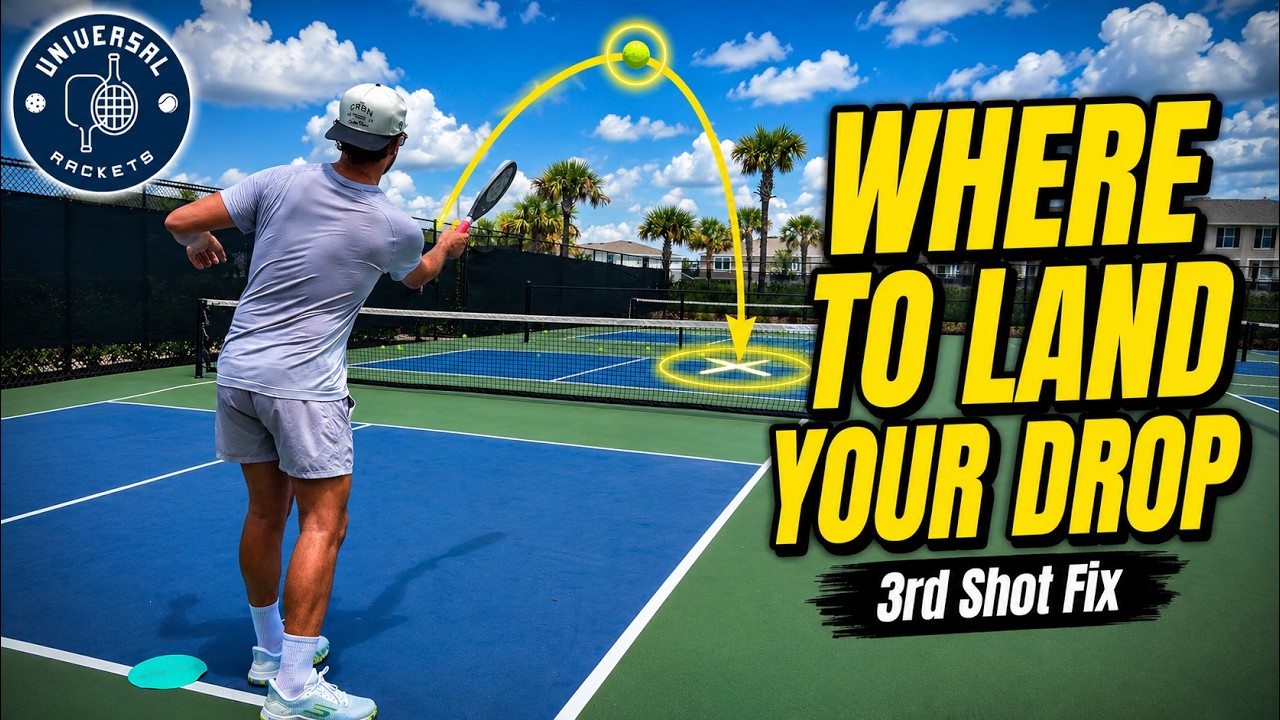
These three placement keys come from Universal Rackets on YouTube, and they cover exactly what separates a drop that gets attacked from one that forces your opponent to hit up every single time.
Love pickleball? Then you'll love our free newsletter. We send the latest news, tips, and highlights for free each week.
The Three Mistakes That Get Your Drop Attacked
Before you can fix your drop, you need to understand the three placement errors that cause most problems at every skill level.
- Mistake one is landing too deep. When the ball lands near the back of the kitchen or at your opponent's feet when they are standing at the line, they can lean over and drive an offensive volley right at you.
- Mistake two is floating the arc too high. The higher the ball travels over the net, the higher it bounces for your opponent. A ball bouncing up around hip height gives them a forehand or backhand they can swing through aggressively.
- Mistake three is hitting to the same spot every time. If you always drop to the same player or the same location, your opponents will read you immediately and set up early. Predictability is the fastest way to turn a good drop into a free point for the other team.
Key 1: Land It in the Front Third of the Kitchen
The single most important placement rule is this: your drop should land in the front third of the kitchen, closest to the net.
Not the middle of the kitchen. Not near the baseline. The front third.
When the ball lands there, your opponent has to let it bounce.
They cannot volley it out of the air because the ball is already past them by the time it drops into that zone.
That forces them to hit up through the net, which is exactly what you want.
Think about what the whole goal of the drop actually is. You are trying to neutralize your opponent.
You want them below the net, hitting up, with no attacking angle.
A ball landing in the front third does that automatically. A ball landing deeper gives them options.
The best way to train this is to place a physical target, a poly spot or a cone, about two feet from the net inside the kitchen.
Anything that lands beyond that target does not count as a good drop.
You are essentially shrinking the kitchen during practice so that when you play for real, the full kitchen feels massive and your drops land short with ease.
Here is the mental picture to carry into every match. Imagine a line across the kitchen two feet from the net.
Every drop you hit needs to land between that line and the net. Aim small, land short, stay safe.
Check out this breakdown on where to aim your third shot drop every time for more detail on kitchen targeting.
Key 2: Keep the Arc Low Over the Net
You can have the perfect landing zone picked out and still get attacked if your ball floats too high on the way there.
A high arc means a high bounce.
Even though a pickleball bounces at less than half its incoming height, a ball that crosses the net at chest level will still sit up enough for a skilled opponent to step back and attack it before it even touches the ground.
The target arc is about six inches above the net tape. Picture a line one paddle length above the net. Anything crossing above that line is attackable.
Anything below it is a threat your opponent has to respect.
The swing adjustment that makes this happen is simpler than you think.
Swing more forward, less upward. Most players who pop their drops too high are swinging upward through the ball.
If you shift that motion more horizontal, more outward, the ball stays flatter and drops faster on the other side.
A practical cue: instead of hitting through one ball, think about swinging through three balls in a row on a horizontal plane.
The more forward your paddle travels, the lower your drop will fly.
One built-in advantage is the crosscourt drop.
Hitting crosscourt gives the ball more distance to travel, which naturally flattens the arc and brings the ball down faster.
If you struggle with height, going crosscourt is an immediate fix that does not require any technique change.
Here is the quick self-correction system to use during a match or practice:
- Ball hits the net: swing more upward next rep
- Ball floats too high and bounces up: swing more forward next rep
- Ball lands too deep: aim for the front third and shorten your follow-through
For more on controlling your arc and wrist angle, this wrist fix changes how your drop comes off the paddle.
 The Dink Media Team
Does It Matter Where in the Front Third You Land It?
Yes, and this is where intermediate players leave points on the table.
Hit every drop to the same spot inside that front third and your opponents will cheat toward it. They'll anticipate the ball before it leaves your paddle.
Varied placement keeps them guessing.
Here are the six targets to rotate through in a doubles game, all inside the front third:
- Straight ahead at the near opponent
- At the near opponent's feet
- Down the middle between both players
- At the far opponent
- At the far opponent's feet
- Out wide to the sideline angle
The most dangerous spot of the six is directly at the opponent's feet.
A ball that's both low and jammed into the body takes away almost every offensive option.
Even Ben Johns can't do much with a ball below the net and pressed into his hip.
The practice sequence is simple. Hit five drops straight ahead, then five down the middle, then five out wide, so you can feel the paddle direction change.
Then mix them in random order to simulate match conditions.
For aiming, think of a laser coming out of the tip of your paddle. Point it wide, the ball goes wide. Point it at the middle, it lands middle.
For a deeper look at six third shot drop techniques that work at every level, that article pairs well with these placement concepts.
 The Dink Media Team
How Do You Know When Your Drop Is Actually Good?
A good drop forces your opponent into a dink or a pop-up. Those are the only two responses they have when the ball is short and low.
If they are speeding up or driving the ball back at you, your drop landed in the wrong spot.
Track your opponent's response during every rally. If they are dinking back or floating the ball up, your placement is working.
If they are stepping in and attacking, you are either landing too deep or floating the arc too high.
Use that feedback in real time. Your kitchen arrival percentage is one of the clearest indicators of whether your drop is working across a whole match.
 The Dink Media Team
One Thing to Get Right Before Placement Matters at All
Here's the part most technique videos skip: none of this matters if you're hitting the ball into the net.
A ball in the net is a guaranteed point for your opponent. A ball that floats a little high and lands in the kitchen at least gives them something to deal with.
They might still pop it up. You might still win the rally.
If you're missing drops into the net because you're scared of feeding your opponent an attackable ball, stop. If you play with some height, you're all right.
Get the ball over the net first. Then work on landing it shorter. Then work on dropping the arc.
That's the correct order, and these drop fixes build on each other in sequence.
Once your drop consistently clears the net and lands in the kitchen, bring in the placement targets. Then refine your arc, then start varying your spots.
The drills a PPA pro still uses every practice show how pros layer skills in exactly this order.
Putting the Three Third Shot Drop Placement Keys Together
Here's the full system in one place:
- Land in the front third of the kitchen, within two feet of the net, every time. Use targets in practice to shrink the kitchen.
- Keep the arc no more than six inches above the net. Swing forward to drop the trajectory, and go crosscourt for built-in arc control.
- Vary your placement across six zones inside that front third. Target the feet most often, but mix in the middle and the wide angle.
When all three work together, your drop becomes close to unattackable.
Your opponent has to let it bounce, hit up through the net, and hand you a neutral ball.
Work on one key at a time. Place targets. Point the paddle tip.
If your drilling isn't translating to match play, this two-step fix explains how to bridge that gap.
 The Dink Media Team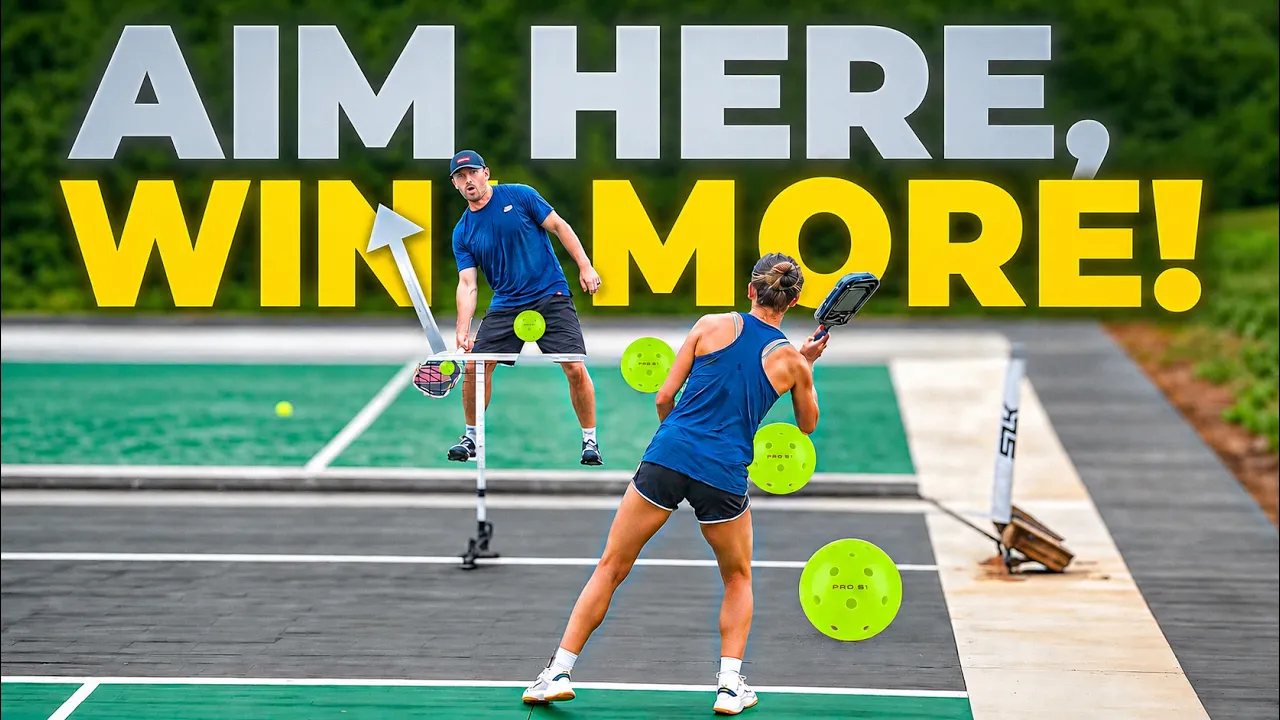
Putting the Three Keys Together
Here is the full system in one place:
- Land in the front third of the kitchen, within two feet of the net, every time. Use targets in practice to shrink the kitchen and sharpen your aim.
- Keep the arc low, no more than six inches above the net. Swing forward to drop the trajectory. Go crosscourt for built-in arc control.
- Vary your placement across six zones inside that front third. Target the feet most often, but mix in the middle and the wide angle so opponents never settle.
When all three work together, your drop becomes close to unattackable.
Your opponent has to let it bounce, hit up through the net, and give you a neutral or attackable ball to work with.
If you want to add technique to go with this placement work, the apex fix for the third shot drop covers exactly how to control the peak of your arc, which ties directly into keeping that trajectory low and tight over the net.
Work on one key at a time. Place targets. Point the paddle tip.
If your drilling is not translating to match play, this two-step fix explains why and how to bridge that gap.
Frequently Asked Questions
Where exactly should a third shot drop land?
Your third shot drop should land in the front third of the kitchen, within roughly two feet of the net. That short landing zone forces your opponent to let the ball bounce and hit up, removing their ability to attack. Anything landing deeper gives them angles and height to work with.
Why does my third shot drop keep getting attacked?
The two most common causes are landing too deep in the kitchen and floating the arc too high over the net. A ball that bounces above hip height or sits in the middle or back of the kitchen gives skilled opponents a comfortable ball to drive or speed up. Fix your landing zone first, then lower your arc.
How do I keep my third shot drop arc low?
Swing more forward and less upward through contact. Think of pushing the paddle horizontally through three balls instead of lifting through one. If the ball keeps going into the net, add a little more upward angle.
If it floats, add more forward push.
Should I always drop to the same player in doubles?
No. Dropping to the same spot repeatedly lets your opponents anticipate the ball and get comfortable. Rotate through six placement zones inside the front third of the kitchen, and target your opponent's feet most often since that location is the hardest to handle.
Varied placement keeps both opponents off balance.
What is the front third of the kitchen in pickleball?
The kitchen, also called the non-volley zone, extends seven feet from the net on each side. The front third of the kitchen refers to roughly the first two to two and a half feet closest to the net. Drops landing in this zone are nearly impossible to volley and force opponents into defensive upward contact.

Love Pickleball? Join 100k+ readers for free weekly tips, news & gear deals.
Subscribe to The Dink