The Scorpion Shot: 5 Keys to Punishing Speed-Ups From Below the Net
The scorpion shot turns an opponent's speed-up into your put-away by getting your paddle below the level of the net. Learn the five keys to hitting it, plus the one situation where it falls apart.
The scorpion shot is the answer to a problem you have felt a hundred times: an opponent rips a speed-up straight at your body and you run out of time.
You jam up, your paddle gets stuck against your ribs, and the ball squirts off your frame into the net or sails out.
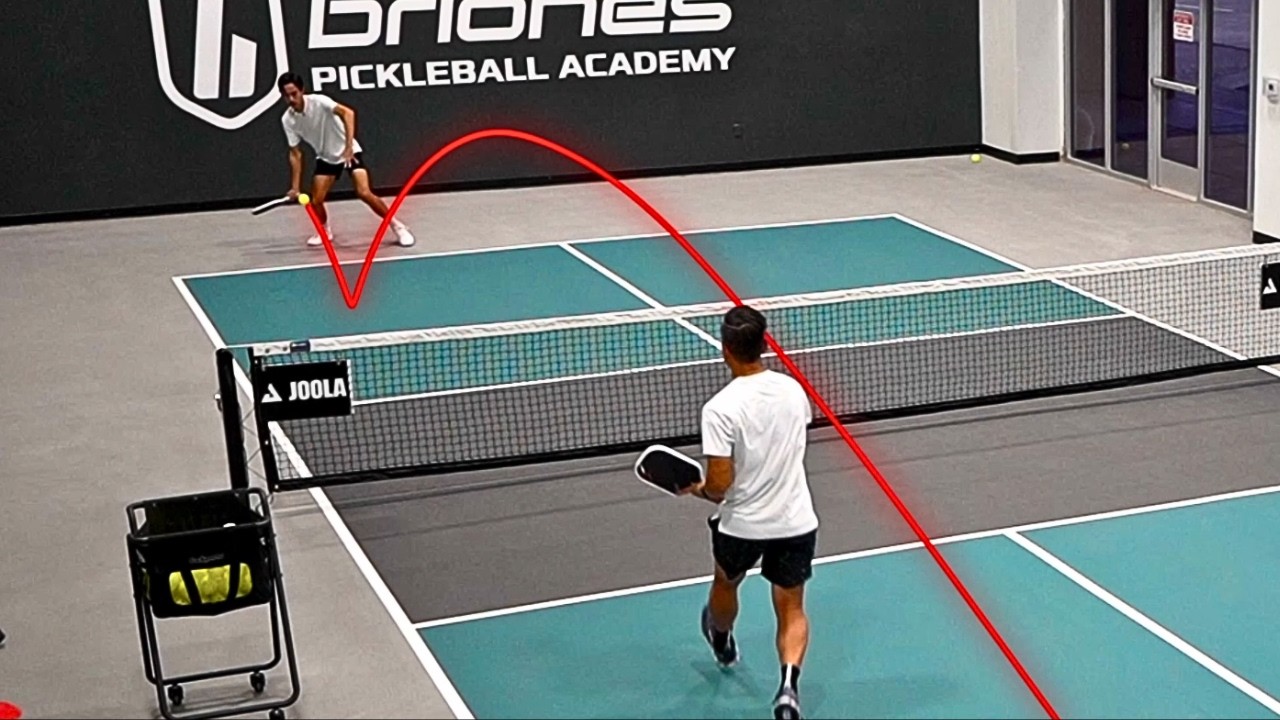
Zane Navratil calls it the scorpion because of how you look when you drop into it, paddle up and out in front of you like a scorpion's tail.
It is one of the strangest looking shots in pickleball, and against the right ball it is one of the most satisfying.
Here is what the scorpion shot actually is, the five keys to hitting it, and the one situation where you should never try it.
Love pickleball? Then you'll love our free newsletter. We send the latest news, tips, and highlights for free each week.
What Is the Scorpion Shot in Pickleball?
The scorpion shot is a counterattack where you drop your body below the level of the net and punch your paddle outward to redirect an opponent's speed-up.
Instead of defending from a normal upright stance, you get under the ball so the attack can no longer jam you.
Think about where speed-ups hurt the most.
The toughest place to defend is the right armpit, the spot Navratil describes as getting "caught in that chicken wing position."
When a ball comes hard into that pocket, your elbow folds, your paddle face closes, and you have no clean way to return it.
The scorpion removes that pocket entirely. "Now that I'm standing below the level of the net," Navratil explains, "my opponents could never chicken wing me."
Once your paddle is below the contact point, every fast ball has to travel up and out, and that is a ball you can punch instead of one that punches you.
Why Does the Chicken Wing Cost You Points?
The chicken wing is the cramped, elbow-up position you fall into when a ball is driven at your dominant hip.
Your arm has nowhere to go, so the paddle face tilts and the ball pops off it without control.
This is the same trap that makes hard drives so effective, and it is why so many players struggle to defend against a body bag.
The scorpion shot is one of the few shots built specifically to take that pocket away before the ball ever arrives.
The 5 Keys to Hitting the Scorpion Shot
The scorpion shot is hard, and Navratil is honest about that. It is a read, a position, and a punch, all in a fraction of a second.
Get these five keys right and it becomes repeatable.
1. Read the Speed-Up Early
The scorpion is an educated guess as much as a reaction. You have to anticipate that your opponent is about to speed the ball up through you, not to either side. As Navratil puts it, "you have to read this shot correctly." Learning to counter a speed-up at the kitchen starts with reading the body language that precedes it.
2. Drop Below the Net
Bend at the knees and lower your whole body so your paddle hand is beneath the height of the net tape. This is the entire point of the shot. If you stay tall, you have a normal block, not a scorpion.
Your ready position at the kitchen sets up this drop before the ball ever leaves your opponent's paddle. Players who are already low get there faster. That split-second difference is the entire margin on a hard speed-up.
3. Get the Paddle Up and Out in Front
From that low position, bring the paddle up and out so it sits right in front of your face. You want a stable wall the ball can rebound off, not a paddle buried near your chest.
This is the same principle behind every strong kitchen line defense. Space between the paddle and the body equals control.
4. Punch Outward, Not Down
This is where most players fail. Standing at the kitchen line, your instinct is to punch down. On the scorpion shot you must punch out. "If I hit downwards I'm going right into the net," Navratil warns. "If I hit outwards, boom, got him."
Think of it like the outward punch used in a push block at the kitchen line, only directed from a much lower contact point. The angle changes everything.
5. Stay Centered on Your Opponent
The scorpion only covers the angles directly in front of you. Keep your body lined up with the attacker so the ball has to come through you, not around you.
Court positioning is as much a part of this shot as the paddle mechanics. If you are even slightly off-center before the speed-up fires, the shot falls apart before you even drop.
Done right, the scorpion shot has a bonus that drives opponents crazy: nobody knows where the ball is going.
Because you are punching out from below, the reply can fly to almost any part of the court, which turns your defense into instant offense.
 Alex E. Weaver
How Do You Practice the Scorpion Shot?
You practice the scorpion shot the same way you build any reflex: high reps with a clear target. Navratil's advice is simple.
Have a partner feed you a steady stream of balls and groove the outward punch until it stops feeling unnatural.
Try this progression:
- Start with your partner feeding controlled speed-ups at your body from directly across the net.
- Drop into the low scorpion position before each feed so you are early, not late.
- Punch every ball outward and watch where it lands. If it hits the net, you punched down.
- Once the motion is grooved, mix in live dinks so you have to read the speed-up in real time.
The footwork here overlaps with everything else you do at the line, so it pays to also sharpen your footwork and your fast hands at the kitchen line.
A scorpion is only as good as the split second of reaction time that sets it up.
Drilling the outward punch now puts you ahead of that curve.
 The Dink Media Team
When Should You Not Use the Scorpion Shot?
Do not use the scorpion shot when your opponent has an angle on you, because from below the net you cannot cover the sideline and the middle at the same time.
This is the shot's one real weakness, and Navratil demonstrates it on purpose in the video.
When the players are lined up directly across from each other, the scorpion is lethal.
"He didn't have angles to hit the ball away from me," Navratil says of a point he wins clean.
The attacker is forced up and through, exactly where the paddle is waiting.
Pull that same defender off to one side, though, and the math collapses. "If he has angles I can't cover all the way off to one side or the other."
The opponent simply redirects down the line or back through the middle, and you are stranded in a crouch with no time to recover.
So the scorpion shot is a positional shot, not a default. When you are square to the attacker, drop and punch.
When you have been pulled wide, you are better off using a more conventional block or learning to reset when you get attacked at the kitchen.
Knowing when to block versus counter against pickleball bangers is the same decision-making framework that governs the scorpion.
Position first. Shot selection second. Get those two reversed and even the best technique falls apart.
 The Dink Media Team
Is the Scorpion Shot Right for Your Game?
For most recreational players, the scorpion shot is a fun tool rather than a foundation.
Navratil himself is blunt about it: is it right for you? "Almost certainly not." It is a high-risk, low-frequency shot that rewards elite anticipation.
That does not mean you should ignore it.
The principles behind it, getting under the ball, punching out, and staying square, will quietly improve the rest of your defense.
The same low, stable base is what lets pros like Ben Johns absorb pace and redirect it without flinching, which is a big part of what makes Ben Johns so hard to attack.
If you want to build the broader hand skills the scorpion sits on top of, study how the pros defend with two hands and drill the hands battle habits that win fast exchanges.
The scorpion is the flashy finish, but a clean two-handed counterattack technique will save you far more points over a match.
According to NBC Sports, the sport's fastest-growing competitive segment involves players actively seeking ways to neutralize aggressive speed-up games, which is precisely the problem the scorpion is built to solve.
One more reason to add it to your bag: speed-ups are only getting more common as players get more aggressive.
Coaches like Navratil keep handing out new answers, from the scorpion to his rules for beating bangers.
For more weekly ideas like this, even basic ones like covering for a partner, the weekly pickleball tips floating around are worth a skim.
And if you face a lot of overheads, pair the scorpion with these tips for defending a heavy overhead smash.
Frequently Asked Questions
What Is the Scorpion Shot in Pickleball?
The scorpion shot is a defensive counterattack where you drop your body below the level of the net and punch your paddle outward to redirect an opponent's speed-up. The low position removes the chicken wing pocket, so a hard ball at your body becomes a ball you can put away instead.
Why Is It Called the Scorpion Shot?
It is called the scorpion because of how your body looks in the position. When you crouch low with your paddle up and out in front of you, your posture resembles a scorpion with its tail raised. Zane Navratil says that resemblance is his best guess at the origin of the name.
When Should You Hit a Scorpion Shot?
Hit the scorpion shot when your opponent is lined up directly in front of you and is about to speed the ball up into your body. In that situation the attack has to travel up and through you, which is exactly where your paddle is waiting. Avoid it when you have been pulled wide and the opponent has open angles.
Is the Scorpion Shot Good for Beginners?
The scorpion shot is not a priority for beginners. It demands elite anticipation and quick hands, and even Navratil says it is probably not the right shot for most players. Beginners get more value from a solid ready position, clean resets, and reliable two-handed blocks before adding a high-risk shot like this.
How Is the Scorpion Shot Different From a Normal Block?
A normal block is hit from an upright stance with the paddle in front of your chest, and you absorb pace by softening your hands. The scorpion is hit from below the net with an outward punch, so it adds pace and disguise rather than just neutralizing the ball. The scorpion is offense disguised as defense.
How Do You Build the Reaction Time the Scorpion Requires?
The scorpion lives or dies on your ability to read the speed-up before it fires. Drill it by sharpening your fast hands with a partner at close range, focusing on the body language cues that telegraph a speed-up. Repetition builds the read. The read builds the shot.

Love Pickleball? Join 100k+ readers for free weekly tips, news & gear deals.
Subscribe to The Dink