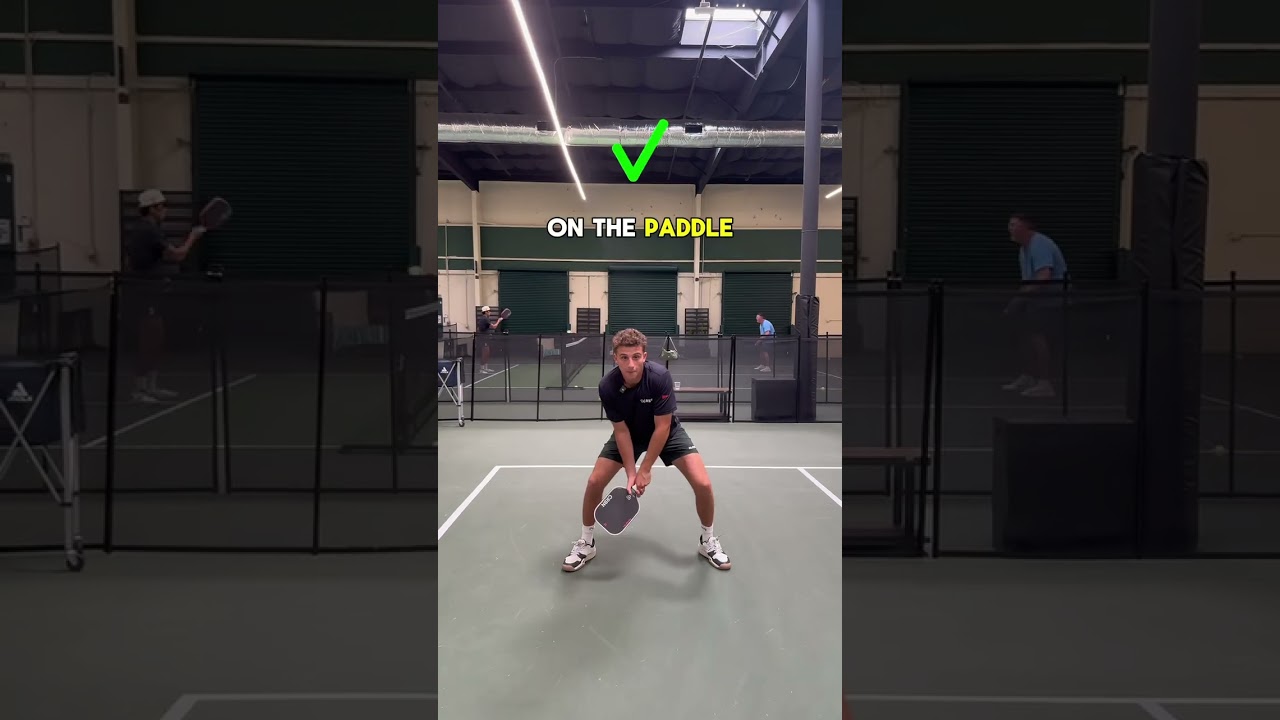
How to Return a Powerful Overhead in Pickleball With Two Hands
Most players get destroyed by overhead returns in pickleball because they rely on one hand and lose control of the paddle. Add your second hand and the shot becomes a wall your opponent can't power through.
The overhead return in pickleball is one of those shots that exposes a simple mechanical flaw faster than almost anything else in the game.
Your opponent winds up, hammers a smash straight at you, and the ball spins right out of your paddle hand.
It feels uncontrollable. And for most players, it is, because they are trying to fight power with one hand.
This article covers the exact fix: a two-hand paddle grip that turns your opponent's pace into your weapon.
Love pickleball? Then you'll love our free newsletter. We send the latest news, tips, and highlights for free each week.
The Real Reason Overheads Feel Impossible to Return
Here is the honest truth: your one-hand grip is not strong enough to absorb a hard overhead when the ball hits off-center.
When the ball contacts the paddle anywhere outside the sweet spot, the torque generated by that impact spins the paddle face.
Your wrist simply cannot hold it steady.
This insight comes straight from tanner.pickleball on YouTube, and it is one of the most straightforward mechanical explanations for a problem that plagues players at every level.
The fix is not stronger wrists or faster reactions.
It is changing your grip entirely before the ball even arrives, the same preparation principle that shows up in how early preparation buys time against fast hitters.
What Does the Two-Hand Grip Actually Do?
The two-hand grip on your paddle does one thing better than anything else: it eliminates the rotation that causes mishits.
When you place your non-dominant hand on the paddle face or shaft, you create a brace.
The paddle now has two points of contact instead of one. Physics does the rest.
Think of it like a wall. A wall does not generate power. It does not try to fight the ball.
It simply holds position and lets the ball bounce back. That is exactly what you want when you are staring down a 60 mph overhead.
Most players try to swing back at overheads. That approach fails because you are adding two power sources together and losing control of direction.
Absorbing pace is the smarter play, and it is the same logic behind how to defend with two hands just like the top pros.
How to Set Up the Two-Hand Overhead Return
Getting this right comes down to a few specific mechanics. Do not overcomplicate it.
- Place your non-dominant hand on the paddle. Your second hand should sit on the face or along the shaft, giving you a firm brace point. Some players prefer to cup the face lightly. Others grip along the side. Find what keeps the paddle from rotating. If your standard grip already feels unstable, review the three pickleball grips and when to use them before you layer this on top.
- Shorten your backswing to almost nothing. You are not trying to generate pace. A compact position keeps your paddle face stable and square to the incoming ball.
- Soften your arms. Stiff arms will send the ball sailing. You want your elbows slightly bent and your shoulders relaxed so the paddle can absorb contact like a cushion.
- Keep the paddle face flat and forward-facing. Angling the face on a hard overhead return almost always results in a mis-directed shot. Flat wins here.
- Let the ball load into the paddle. Do not rush forward to meet it. Let the ball come to you, press into the paddle, and use that stored energy to push the return back.
That last point is where most players struggle. We are trained to be aggressive and attack the ball. Against a powerful overhead, that instinct works against you.
 The Dink Media Team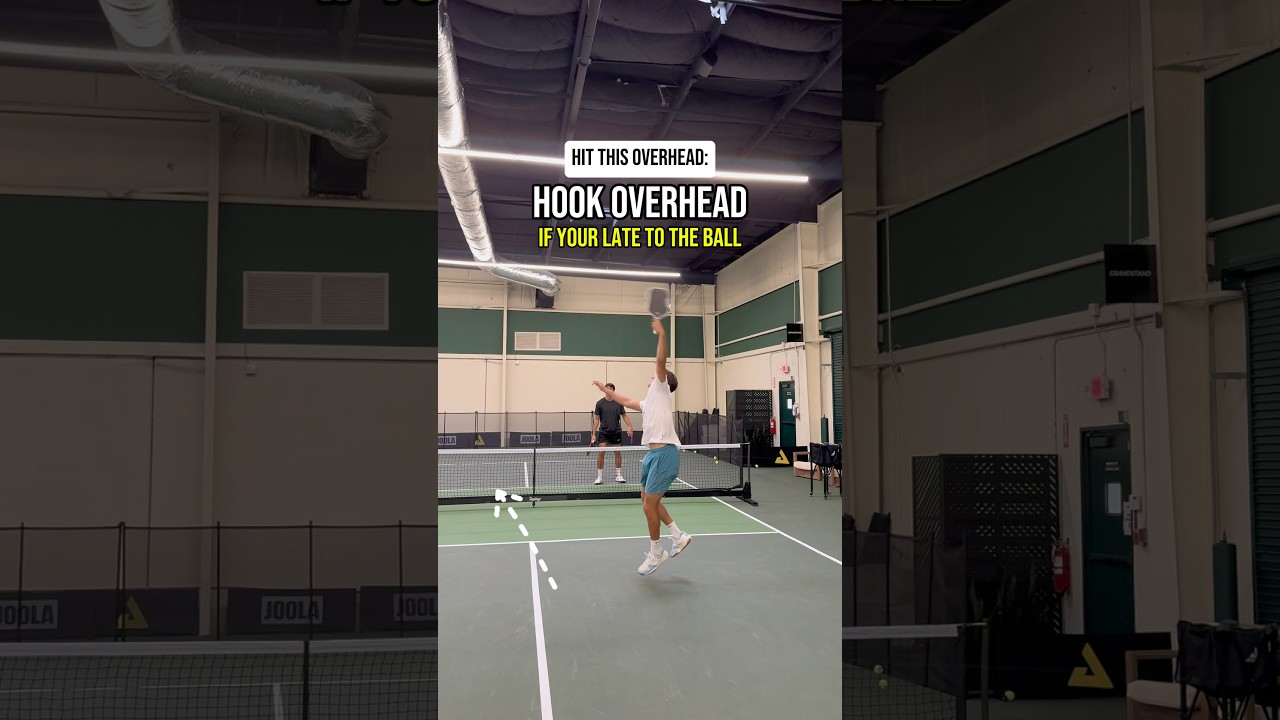
Why Are You Still Trying to Create Your Own Power?
This is the mindset shift that separates players who survive overheads from players who keep getting burned.
When a ball comes at you with significant pace, you do not need to add more.
Your opponent has already done the work. Your job is to redirect that energy, not multiply it.
Beating bangers by taking pace off follows the same logic.
The player who absorbs and redirects almost always wins the exchange over the player who tries to out-power a banger.
The two-hand overhead return is that concept applied specifically to smashes.
 The Dink Media Team
What Happens When the Ball Hits Off-Center?
Off-center contact is the single biggest reason your overhead returns go sideways. Literally.
With one hand on the paddle, an off-center hit creates a torque force that spins the paddle face in your grip.
Even with a tight grip, the physics of that rotation are usually stronger than your wrist.
The second hand eliminates that problem. It acts as a counter-brace, holding the paddle face in position even when the ball catches the edge of the sweet spot.
This is especially useful for players who struggle with overhead defense positioning, because you will not always be perfectly set up for every incoming smash.
 The Dink Media Team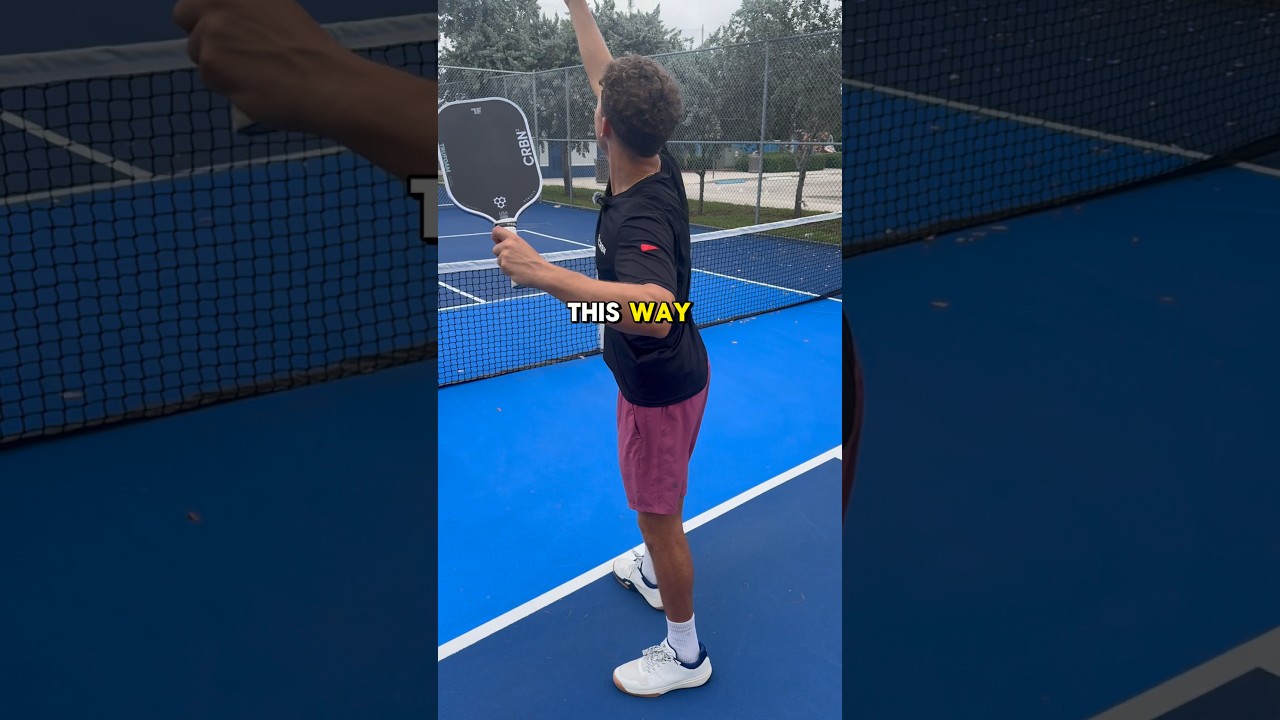
Does This Work on Every Type of Overhead?
The two-hand method works best on high-pace, direct smashes where your goal is survival and redirection, not aggression.
If the overhead is softer or mis-hit, you have more options. You can step in, use one hand, and attack the return.
But for any ball that arrives with real pace, default to two hands.
Understanding the full range of responses starts with the three-part motion behind overhead smashes and the fact that angles beat power on both sides of the shot.
There is no single answer for every overhead you will face.
But the two-hand grip covers the most dangerous scenario: the ball hit with power directly at your body.
 Alex E. Weaver
Common Mistakes Players Make With This Technique
A few errors show up repeatedly when players first try the two-hand overhead return.
- Gripping too tightly with both hands. A death grip creates tension that prevents absorption. You want firmness without rigidity. Reaching for the ball instead of letting it come changes your paddle angle and creates inconsistency. This is the same root cause behind four fixes to stop popping the ball up.
- Reaching for the ball instead of letting it come. Extending your arms changes the angle of your paddle face and creates inconsistency.
- Trying to aim for a winner on the return. Your goal is to survive and get the ball back in play. Keep it low and toward the middle of the court.
- Forgetting to reset your position after the return. After you absorb the overhead, get back to your ready position immediately. Do not admire the shot.
- Using this technique on every shot. Two hands are for power absorption. On slower, floaty balls, stay with your normal one-hand grip and take control of the point.
That last mistake is subtle but important. Context matters. Read the pace of the incoming shot and choose your grip accordingly.
 The Dink Media Team
How This Fits Into Your Broader Defense Strategy
The overhead is one piece of a larger defensive framework.
Players who are hard to beat have a consistent answer for every high-pressure situation.
They do not panic when a ball comes at them fast, because they have a pre-set response drilled deep enough to execute under pressure.
That is the same principle behind lob defense strategy and behind staying calm under pressure, where anticipating the shot matters more than reacting to it.
If you are always scrambling, you are reacting instead of preparing. The two-hand grip gives you a prepared response.
Combine it with smart positioning and a reliable reset shot, and your opponent's best shot becomes a neutral exchange instead of a point-ender.
 The Dink Media Team
Drilling the Two-Hand Overhead Return
You cannot take this tip from reading it to using it in a live match without some reps. Here is a simple way to build the habit.
- Solo wall practice first. Stand a few feet from a wall and practice holding your paddle with two hands in a brace position. Press the paddle into the wall lightly to feel how the second hand stabilizes it. This builds the muscle memory of the grip before you add a moving ball. You can find more wall drill ideas in this breakdown of pickleball wall drills you can do without a partner.
- Partner feed drill. Have a partner stand at the net and feed medium-pace overhead smashes directly at your body. Focus only on absorbing and keeping the ball in play. Do not try to aim. Do this for 10 minutes before you worry about placement.
- Add pace gradually. Once you feel comfortable absorbing medium-pace balls, ask your partner to increase the power. The goal is to feel how little you need to do when the technique is correct.
- Live point practice. In your next open play session, commit to using the two-hand grip on every hard overhead that comes at you. Expect imperfect results early. The consistency will come with repetition.
Drilling this way mirrors what good players do across all shot types.
Coaches fix the same mistakes over and over because players skip the drilling phase and try to apply new techniques in live games. Do not skip the reps.
 The Dink Media Team
Stop Trying to Out-Power Power
This tip is simple on the surface. Add a second hand. Absorb the pace. Keep the ball in play.
But it points to something deeper about how most rec players approach fast balls. The instinct is always to fight fire with fire: hit harder, swing faster, grip tighter.
The players who are hardest to beat figured out that absorbing pace is often more effective than generating it.
That applies to the overhead return in pickleball, to speed-ups at the kitchen line, and to hard drives from the baseline.
If you want the full case for why hitting hard costs you points, smart shot decisions beat power is worth your time.
Start with the two-hand grip. Build the habit.
Then watch how many points you save that used to slip away the second that ball came flying at your paddle.
Frequently Asked Questions
What is the two-hand overhead return in pickleball?
The two-hand overhead return is a defensive technique where you place your non-dominant hand on the paddle to brace it against powerful smashes. This prevents the paddle from spinning out of your grip on off-center contact. The goal is to absorb your opponent's pace and redirect the ball back rather than trying to generate your own power.
Why does a hard overhead spin the paddle out of my hand?
When a powerful ball hits outside the sweet spot of your paddle, it creates a rotational torque force. Your wrist alone usually cannot counteract that force with a single-hand grip. Adding your second hand to the paddle eliminates that rotation and keeps the face stable through contact.
Should I always use two hands when returning an overhead?
Use two hands specifically on hard, pace-heavy overhead smashes. If the overhead is soft or poorly hit by your opponent, you can stay with your standard grip and look to attack the return. Read the pace before you commit to your grip choice.
Where should I aim when returning a hard overhead in pickleball?
Aim for the middle of the court and keep the return low. Trying to hit a winner off a powerful overhead almost always results in an error. Your first priority is survival: get the ball back and reset the point.
How do I practice the two-hand overhead return without a partner?
Start with wall drills to build the muscle memory of the two-hand grip and the feeling of absorbing a ball into the paddle. Once that feels natural, find a partner to feed you controlled overhead smashes at increasing pace. Consistency comes faster when you isolate the technique before bringing it into live points.
Love Pickleball? Join 100k+ readers for free weekly tips, news & gear deals.
Subscribe to The Dink