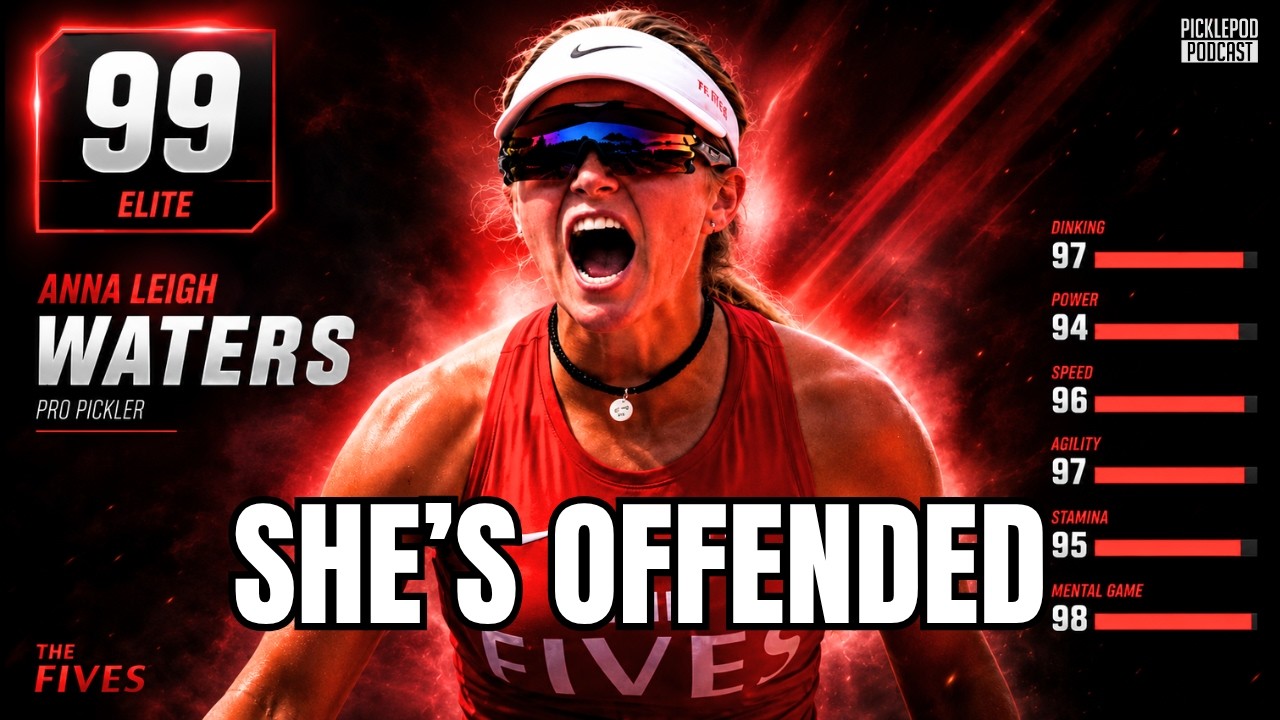
The Real Weaknesses in Anna Leigh Waters' Game (According to Her)
Anna Leigh Waters may be the best player in the world, but even she admits her serve needs work. Here's what her self-assessment reveals about elite pickleball.
If you've ever wondered what Anna Leigh Waters actually thinks about her own game, the answer is more honest than you'd expect from the best player in the world.
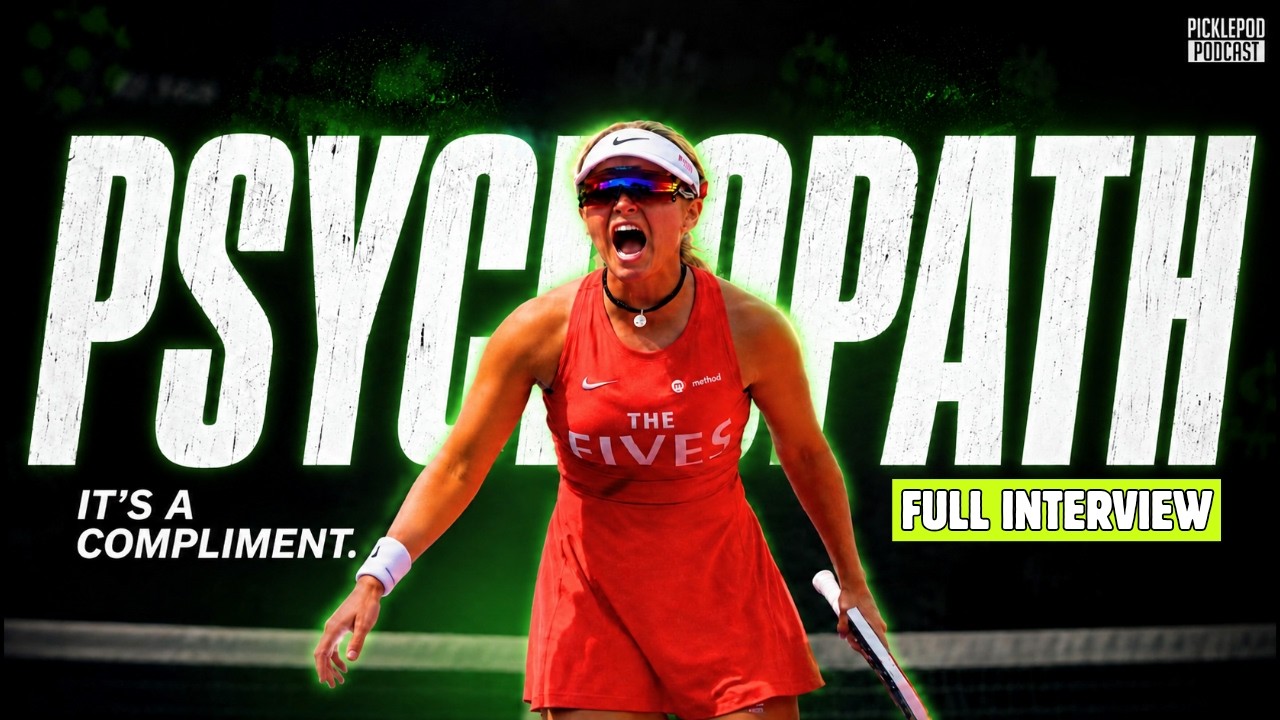
In a recent conversation with Zane and Nico in The Dink's PicklPod podcast, Anna Leigh sat down to react to a Madden-style 2K ratings breakdown of her skills.
The result was a candid, funny, and genuinely useful look at where even a 99-overall player sees room to grow.
This article breaks down what was said, what it means for how you should think about Anna Leigh's game, and what recreational players can actually take from it.
Love pickleball? Then you'll love our free newsletter. We send the latest news, tips, and highlights for free each week.
What Does a 99 Overall Actually Mean?
In the video, the breakdown puts Anna Leigh Waters at a 99 overall, the same tier reserved for Ben Johns at the men's level. That tells you something important right away.
The pickleball rating system covered categories like attacks, defense, dinking, groundstrokes, serve, and return.
Most of her scores were exceptional. But one number caused a reaction.
The put-away overhead was rated an 85, and Anna Leigh was quick to push back. That pushback is worth paying attention to.
Is the Overhead Really Her Weakness?
The honest answer is yes, relative to the rest of her game. The key word there is relative.
An 85 for an overhead on Anna Leigh Waters is still better than what most 5.0 players can do.
But compared to her dinking, her defense, and her attacking game, it is the part of her skill set that trails behind.
Here is the thing that gets misread about this: a weakness you rarely expose is not really a liability.
If your game plan is to lob Anna Leigh into overhead territory hoping she makes an error, you are already losing that point on positioning alone.
The smarter takeaway is this. Even at 99 overall, every player has a relative weak point. Knowing yours is not a problem. Ignoring it is.
What Did Anna Leigh Say Her Real Weakness Is?
This is where it gets interesting.
When asked directly, Anna Leigh bypassed the overhead conversation entirely and pointed to two things: her flick and her serve.
On the flick, she made a sharp observation. She said she almost never hits it, so it is not really a weakness in practice because she simply does not use it.
That is actually smart shot selection. If a shot is inconsistent, elite players eliminate it from their game rather than forcing it under pressure.
 The Dink Media Team
Why Does She Think Her Serve Is Average?
Anna Leigh's self-critique on her serve was specific and useful.
She said she hits it hard but tends to land it short, and she has been working for a while to get more depth and spin without losing consistency.
That is a real problem a lot of players share.
Power without depth is actually a disadvantage on the serve because it gives your opponent an easy ball to attack off the bounce.
She also mentioned switching up her technique frequently, which signals she has not locked in a repeatable motion yet.
If you want to understand the technical side of this, these three serve mistakes that kill power and depth apply directly to what she described.
 The Dink Media Team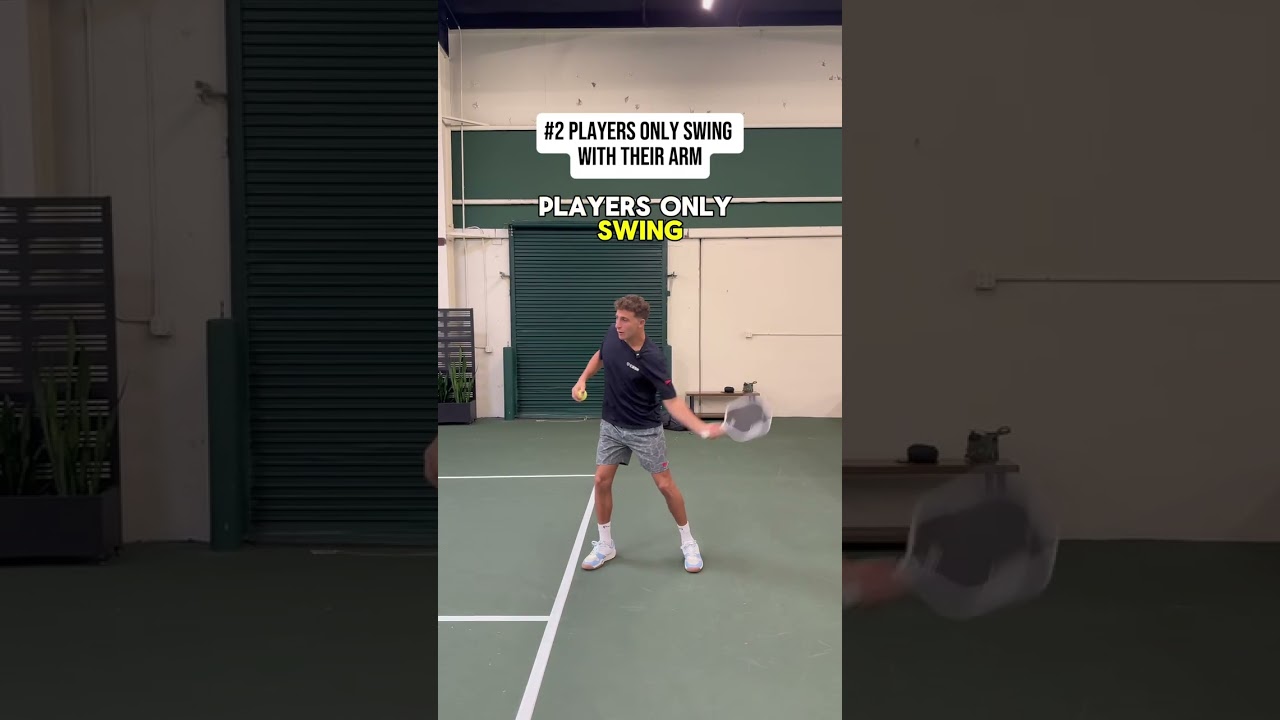
How Should You Use This Information Against Her?
Here is the blunt truth: you probably should not try to exploit any of this at the recreational level, because the gap between your game and hers is too large for tactical trickery to matter.
But if you are studying Anna Leigh's game to improve your own, the breakdown offers real structure. Think about your own skill categories the same way.
- Attacks: How often do you put away balls you should be finishing?
- Defense: Can you reset under pressure without popping the ball up?
- Dinking: Are you controlling the kitchen or just surviving it?
- Groundstrokes: Is your third shot consistent enough to rely on?
- Serve: Does your serve actually create pressure or just get the point started?
- Return: Are you neutralizing the serve or handing free points back?
Running this checklist on your own game will tell you more than watching match footage ever will.
The real reason Anna Leigh Waters is nearly unbeatable has been analyzed in detail, and the answer usually comes back to how few weak categories she actually has.
 The Dink Media Team
What Do the Other Pro Ratings Look Like?
The video also touched on where other top players might land in the same system. Here is the rough breakdown that was discussed.
- Anna Leigh Waters and Ben Johns: 99 overall, the top tier
- Anna Bright: projected around 98
- Gabe Tardio and Hayden Patriquin: projected around 97
- Most other tour pros: somewhere in the 90s
The 97 projection for Gabe Tardio tracks with how dominant the men's doubles scene has been lately.
If you want context on that, the question of whether anyone can beat Ben and Gabe gets into exactly why that pairing is so hard to crack.
 The Dink Media Team
What Can You Actually Learn From Anna Leigh's Self-Assessment?
The biggest takeaway from this conversation is not about overheads or serves. It is about how elite players think about their own games.
Anna Leigh did not deflect or give a generic answer. She identified specific technical problems with specific causes.
Short serve depth, inconsistent technique, a flick she has chosen not to rely on.
That level of self-awareness is a skill in itself. Most recreational players have a vague sense that something is off but cannot name it precisely.
Many bad habits go undetected exactly because players never sit down and honestly rate themselves category by category.
 The Dink Media Team
How to Build Your Own 2K Rating Card
Try this exercise after your next session. Rate yourself from 1 to 99 in the following categories, being brutally honest.
- Serve: Depth, spin, consistency, and pressure
- Return: Placement, neutralization, and depth
- Third shot drop: Success rate under pressure
- Dinking: Cross-court consistency and patience
- Attacking: Decision-making on speed-ups
- Defense: Reset quality after being attacked
- Overhead: Put-away rate on high balls
- Footwork: Transition zone movement and split step timing
Your lowest number is where to spend your next three practice sessions.
Not on your highest number, which is the trap most players fall into because it feels good to practice what you are already good at.
If your serve came back low, these three serve strategies can help you add real pressure without overhauling your entire motion.
If footwork was your weak spot, these footwork drills that make the game feel slower are a good starting point.
If defense is where you are losing points, understanding why your reset keeps failing is the fastest way to stop bleeding points at the kitchen line.
 The Dink Media Team
The Overhead Question Deserves More Attention
Let's go back to the overhead for a second because there is a useful instructional point buried in the conversation.
The claim in the video is that Anna Leigh's overhead is her most vulnerable shot relative to the rest of her game.
The counterpoint raised was that her overhead is still good enough that targeting it is a losing strategy.
Both things can be true at once. A shot can be your weakest and still be hard to exploit.
The reason is that weaknesses only matter when your opponent can consistently put you in that position.
At the recreational level, lob coverage and overhead positioning are far more impactful for most players than they are for pros.
Your overhead probably needs more work than Anna Leigh's does, and it is probably being attacked more often too.
If your put-away overhead is letting you down, these three put-away fixes address the exact mechanics that cause weak overheads at every level.
 Zane Navratil
Anna Leigh's Serve Inconsistency Is a Real Problem Worth Studying
Anna Leigh mentioned switching technique frequently on the serve, which is usually a sign that a player has not built a consistent, repeatable motion they trust under pressure.
This is not a knock on her. It is something almost every player at every level deals with.
The serve is the one shot in pickleball where you have complete control of the situation. No opponent is rushing you. The ball is in your hand.
Yet it remains one of the most inconsistent shots in recreational and even pro play.
Getting more depth without sacrificing consistency almost always comes down to contact point and follow through.
A three-step serve system focused on instant depth can help you build that repeatable motion faster than random technique changes will.
The broader point from Anna Leigh's honesty here is this: admitting your serve is average when everyone watching thinks you are elite takes self-awareness.
Build that same habit into your own game and you will improve faster than players who only focus on what they are already good at.
Frequently Asked Questions
What is Anna Leigh Waters' overall pickleball rating in the 2K-style system?
Anna Leigh Waters was rated a 99 overall, the highest tier in the system alongside Ben Johns. The rating covered categories including attacks, defense, dinking, groundstrokes, serve, and return.
What is Anna Leigh Waters' biggest weakness according to the ratings?
Her put-away overhead was rated an 85, which is her lowest individual category score. However, she personally identified her serve as the area she thinks needs the most improvement.
Why does Anna Leigh Waters say her serve is average?
She said she hits it hard but tends to land it short, and she has struggled to maintain consistency while adding depth and spin. She has experimented with different techniques over time without fully locking in a repeatable motion.
Should you target Anna Leigh Waters' overhead if you play her?
No, because even her weakest shot is strong enough that targeting it is not a winning strategy. The overhead is her lowest-rated category relative to the rest of her game, but it still requires you to consistently put her in that position, which is extremely difficult to do.
How can recreational players use Anna Leigh's self-rating exercise to improve?
Rate yourself honestly across the same categories Anna Leigh was evaluated on, including serve, return, dinking, attacking, defense, and overhead. Your lowest score tells you exactly where your next practice sessions should focus, not your highest score.
Love Pickleball? Join 100k+ readers for free weekly tips, news & gear deals.
Subscribe to The Dink