
Fix These 3 Pickleball Serve Mistakes and Watch Your Depth Improve Instantly
Most players blame their arm when their pickleball serve lacks power, but the real problem starts way before contact. Fix these three serve mistakes and your depth will improve immediately.
Your pickleball serve mistake probably isn't what you think it is. Most players blame their swing when the real problems are happening before the paddle even moves.
These three errors are everywhere at the recreational level. They kill your power, reduce your consistency, and hand your opponent an easy return every single rally.
The fixes below come from Tanner Tomassi on YouTube, and each one targets a specific mechanical breakdown you can correct the next time you step on the court.
Love pickleball? Then you'll love our free newsletter. We send the latest news, tips, and highlights for free each week.
Why Most Recreational Serves Lack Power
The serve is the one shot where you have total control. No reaction time, no opponent pressure, no chaos. You set up, you execute.
And yet most amateurs step up and float a weak ball that lands short and invites an aggressive return. The reason isn't effort. It's mechanics.
Three specific errors show up constantly, and they're the same ones behind several amateur habits that make you look like a beginner.
Fix all three and your pickleball serve becomes a weapon instead of a formality.
Mistake 1: Your Body Is Facing the Wrong Direction
Facing away from your target is the single most common serve setup error.
When your shoulders and hips are turned sideways or angled away from the court, you immediately limit how much power and accuracy you can generate.
Think about it this way. If you were throwing a ball to a specific spot, you wouldn't square your body away from it.
You'd line up your entire frame toward where you want the ball to go.
The fix here is simple. Before you even begin your swing, point your shoulders, hips, and feet directly at your target on the opposite side of the court.
This single adjustment does two things. It gives your swing a clean path forward, and it makes it much easier to direct the ball with intention rather than luck.
- Stand with your feet roughly shoulder-width apart
- Point your lead foot toward the target zone in the service box
- Keep your hips and shoulders square to the same target
- Check your setup before every serve, not just when things go wrong
A lot of players inherit this sideways habit from tennis. It feels natural, which is exactly why it quietly ruins serves for years.
Worth noting: your stance also affects legality, and the official USA Pickleball rules summary spells out exactly what the serve motion has to look like at contact.
If you want the full mechanical breakdown, the pickleball serve basics guide from Michael Loyd covers setup, rules, and technique in one place.
The same alignment principle drives forehand drive power and spin from a different angle.
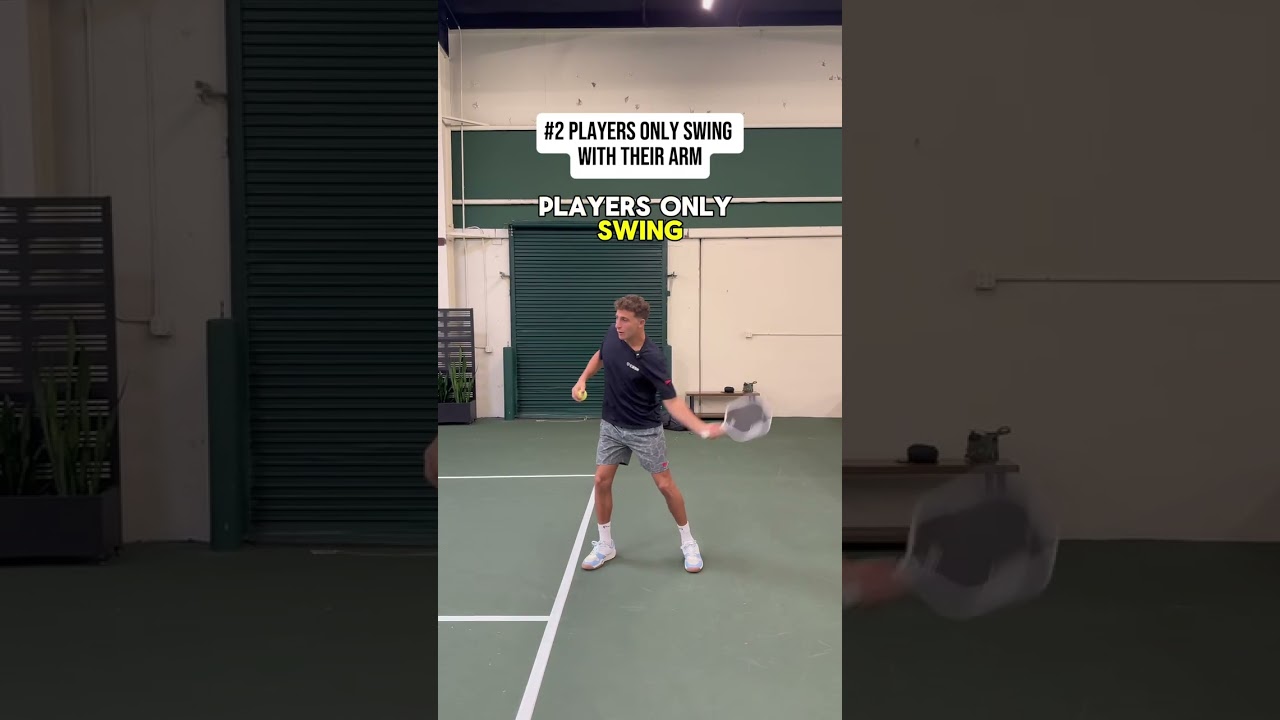
Mistake 2: You're Only Swinging with Your Arm
Arm-only serves are weak serves, every single time.
When your lower body stays passive and only your arm moves through the swing, you cut off the majority of the power available to you.
This is one of the most misunderstood things about the serve. Players think power comes from swinging harder with the arm. It doesn't.
Power comes from the ground up.
The real engine is your back hip driving through the swing.
When that hip fires forward and rotates into contact, it creates a chain reaction through your core and into your arm.
Watch any strong server. The hips rotate, the core engages, and the arm just delivers what the body already started. That's the same mechanic behind generating effortless power through proper body rotation.
- Start by loading your weight onto your back foot before the swing begins
- As you swing, push that back hip forward and through toward the target
- Let the rotation drive your arm, rather than forcing the arm to do all the work
- Finish with your weight transferred to your front foot after contact
If it feels unfamiliar, start slow. Practice the hip rotation separately before adding the full swing.
Fixing your serve for power and depth is exactly what the most important aspect of your serve breaks down in detail.
If you want a target to chase, this pro coach's method for hitting 60 mph serves shows where the ceiling actually is.
The other benefit of the hip drive is consistency. Larger muscle groups repeat more reliably than small ones, and they don't fatigue as fast.
That's why arm-swingers get worse the longer they play. The arm tires. The hip and core don't.
Building explosive lower body strength off the court makes that engine even harder to break down.
 The Dink Media Team
Is Your Ball Position Strangling Your Serve?
Holding the ball too close to your body at contact is the third mistake, and it may do the most damage.
A bent, cramped arm at contact gives you what coaches call "dinosaur arms." Short, stiff, powerless.
The fix is to let your arm fall naturally at your side before contact. Don't overreach, and don't pull the ball in tight.
That natural hang point is your optimal contact zone. Full extension, room to accelerate, real pace behind the ball.
Most players hold the ball close because it feels controlled. But control and cramped positioning aren't the same thing.
If you use a bounce serve, extension matters even more, and the drop serve fault most players don't know they're committing is worth a read before your next match.
 Eric Roddy
How Do These Three Mistakes Connect?
Here's what makes this urgent. The three errors compound each other.
If your body faces the wrong way, your hip rotation gets restricted.
If the hip can't rotate, the arm compensates. When the arm overworks, you pull the ball in close and lose extension.
One mistake feeds the next. That's why amateur serves look so disconnected from pro serves at identical effort levels.
Fix the setup, then add the hip, then check extension. In that order, the corrections build instead of fight.
For more on how small mechanical errors stack up, these serve mistakes costing you points pair well with this one, as does the number one mistake killing your shot-making consistency.
 The Dink Media Team
What Should a Correct Serve Feel Like?
A well-executed serve should feel almost effortless. Counterintuitive, but true.
When you're lined up, the hip is driving, and the arm is extended, the ball jumps off the paddle with very little strain.
If you're muscling the ball, something in the chain is broken. Usually it's the hip.
The simple secret to hitting the perfect serve every time is the right next step once these three foundations are clean.
 The Dink Media Team
Putting It Into Practice Before Your Next Match
You don't need a full practice session to start fixing these mistakes. You can work on all three during your warmup before your next game.
Here's a simple pre-match routine to cement the corrections:
- Take five serves focusing only on your setup, checking that your body faces the target before every single one
- Take five more serves focusing only on your hip, letting the lower body initiate the swing each time
- Take five final serves with your attention on arm extension at contact, finding that natural hang position
- Then combine all three and hit ten full serves without thinking about any single piece individually
That last step matters. You need to move from conscious correction to automatic movement.
The warmup routine gets the mechanics in place so you're not thinking about your hip rotation mid-rally.
If you want to build on this and start aiming your serve without overthinking it, this guide on aiming your serve without changing your swing is the right next read.
 The Dink Media Team
What Happens After You Fix Your Serve
A deeper serve changes more than the serve. It puts your opponent in a harder return position, which means easier third shots and a stronger arrival at the kitchen.
The serve is the first domino in every rally.
Weak and short, and every domino after it falls wrong. Deep and purposeful, and you're dictating the point before it starts.
For how it all connects forward, mastering the first four shots is exactly what to read next, and the four essential return targets covers the other half of the serve-to-return sequence.
And if you want the bigger picture, what elite 6.0 players think during every dink is one of the best reads on the site.
Fix the setup. Fire the hip. Extend the arm.
Three corrections, one serve, and a completely different start to every point you play.
Frequently Asked Questions
What is the most common pickleball serve mistake for beginners?
The most common pickleball serve mistake is standing with the shoulders and hips facing away from the target instead of squaring up to the court. This limits both power and accuracy before the swing even begins. Fixing your stance is the fastest single improvement most beginners can make.
Why does my pickleball serve have no power?
Your serve lacks power because you are swinging with your arm alone instead of using your back hip to drive the motion. Power in the serve comes from the ground up, with the hip initiating rotation and the arm following through. When the lower body stays passive, the arm cannot generate meaningful pace on its own.
Where should I hold the ball when I serve in pickleball?
You should let your arm hang naturally at your side to find the correct contact point, rather than holding the ball close to your body. Keeping the ball too close creates cramped extension and kills the speed of your swing. The natural hanging position of your arm gives you full extension and the best possible contact.
How do I get more depth on my pickleball serve?
More depth on your serve comes from combining correct body alignment, hip rotation, and full arm extension at contact. Each of these three factors contributes to the pace and trajectory that pushes the ball deep into the service box. Working on them in sequence, rather than all at once, is the fastest way to see consistent improvement.
Can fixing my serve actually change how a whole rally plays out?
Yes, a deeper and more purposeful serve forces your opponent into a harder return position, which directly improves the quality of your third shot opportunity. The serve is the first shot in every rally, so improving it creates a chain reaction that benefits every shot that follows. Treating the serve as just a formality is one of the biggest missed opportunities in recreational pickleball.

Love Pickleball? Join 100k+ readers for free weekly tips, news & gear deals.
Subscribe to The Dink