
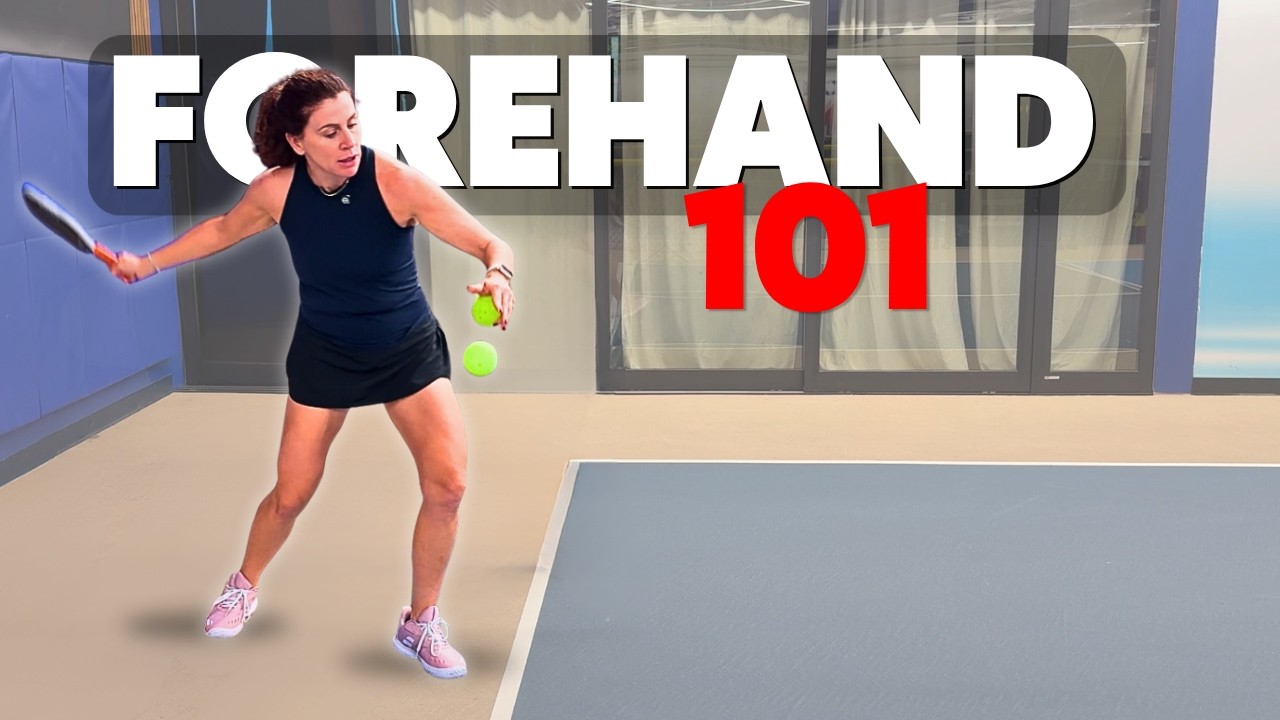
Why Your Pickleball Forehand Drive Has No Power (And How to Fix It)
Most players never learned the real mechanics behind a pickleball forehand drive. These five fundamentals will add power and consistency you can use right away.
Your pickleball forehand drive feels weaker than it should, and you probably already know it. You swing hard, the ball floats, and your opponents eat it alive.
The problem is almost never effort. It is mechanics. Most recreational players were never taught the actual fundamentals that generate power and keep the ball low.
This breakdown pulls directly from a coaching video by Coach Jess at Athena Pickleball on YouTube, who walks through how to build the forehand drive from scratch using the same principles top players rely on.
Here is exactly what you need to know.
Love pickleball? Then you'll love our free newsletter. We send the latest news, tips, and highlights for free each week.
Start Here: The Unit Turn Most Players Skip
The unit turn is where every pickleball forehand drive begins.
It is not flashy, but skipping it is the single biggest reason players lose power before the swing even starts.
A unit turn means your entire upper body rotates together as one unit.
Your shoulders, chest, and paddle all move at the same time. Nothing dangles separately.
Think of it this way: if your upper body were in a cast, turning your shoulders would put your chest at 90 degrees to the right with the paddle already back and ready.
That is the position you want.
What a Proper Unit Turn Looks Like on the Pickleball Forehand Drive
The common mistake is pulling the paddle back with the arm while the rest of the body stays square to the net.
That disconnected setup forces your arm to generate all the pace on its own. It cannot.
When you nail it, the paddle is visible on the right side of your body (left side for lefties), the elbow stays connected, and you are coiled and ready to fire.
Keep it compact. You do not need the paddle behind your body, and going back that far only complicates the swing.
Why Do So Many Players Struggle With Footwork on the Drive?
Most players wait for the ball to come to them. That is a losing strategy for the forehand drive.
Proper footwork is built around one simple idea: get your back foot behind the ball before anything else happens.
Coach Jess calls this the "quick quick slow" approach. Move fast to the ball, then slow down and load before you swing.
Here is the sequence broken down:
- Quick feet to the ball: Your right leg (for right-handers) drives you to position. You are always trying to stay behind the ball, not run into it.
- Load into the leg: Once you arrive, press into that back leg. Let it power up. This is called loading, and it is the source of most of your drive power.
- Step, then swing: The step happens first. The swing follows. Never swing at the same time as the step, and never swing before you step.
That loading leg is not optional. Even at 3.0, building the habit now means you will have real power available as your game develops.
The same footwork mistakes that hurt your third shot drop are destroying your drive too.
The Swing Path That Generates Topspin (and Keeps Balls From Floating)
Once you have loaded and stepped, the swing path determines everything about ball flight. The correct path is low to high with a closed paddle face.
Here is what that looks like in practice:
- Your paddle starts lower than the contact point, either naturally or with a slight C shape on the backswing.
- As you step forward, gravity helps the arm drop and accelerate. You do not need to muscle it.
- The paddle face angles toward the ground at contact, not open. This gets the back of the ball and creates topspin.
- You extend through the ball as if hitting through 10 balls in a row, not slapping at one and pulling off.
How to Close the Paddle Face on Your Pickleball Forehand Drive
If your balls keep flying high, your paddle face is open.
Think about your palm facing the ground at contact. That single cue fixes the face angle faster than anything else.
Topspin failures usually trace back to this exact problem.
Muscling the swing kills acceleration. When you tighten up and try to force power, you actually slow the paddle down.
Trust the kinetic chain from the ground up and let the swing flow.
 The Dink Media Team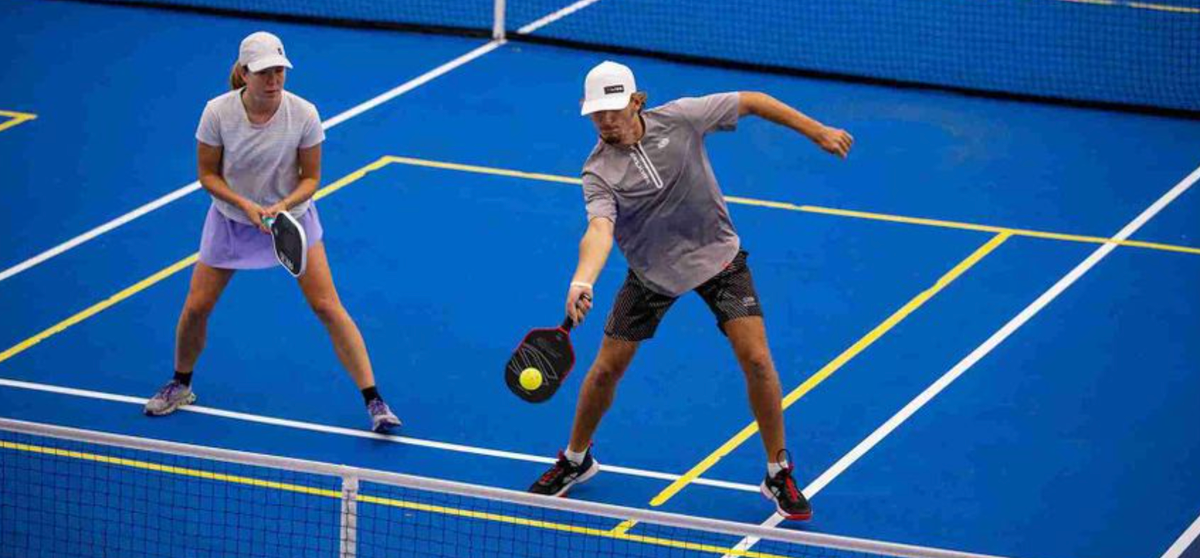
Where Exactly Should You Make Contact With the Ball?
Contact point is where players silently give away power on the pickleball forehand drive.
The correct answer is out in front of your body, roughly in line with your front knee.
The mistake is letting the ball get too close before you swing.
When that happens you are pulling the ball from the center of your chest, your paddle is decelerating, and there is nowhere for power to go.
A useful drill: after your unit turn, hold a ball in your hitting hand at the spot where you expect contact.
It should sit well out front, similar to a serve toss position. Then step into it.
That out-front feeling is what maximum paddle acceleration feels like at contact.
Stay behind the ball at all times. Your job is to get there fast, slow down, load, and let the swing reach full speed right at that contact point.
Where you make contact also shapes where the ball goes, so dialing this in pays off in accuracy too.
 The Dink Media Team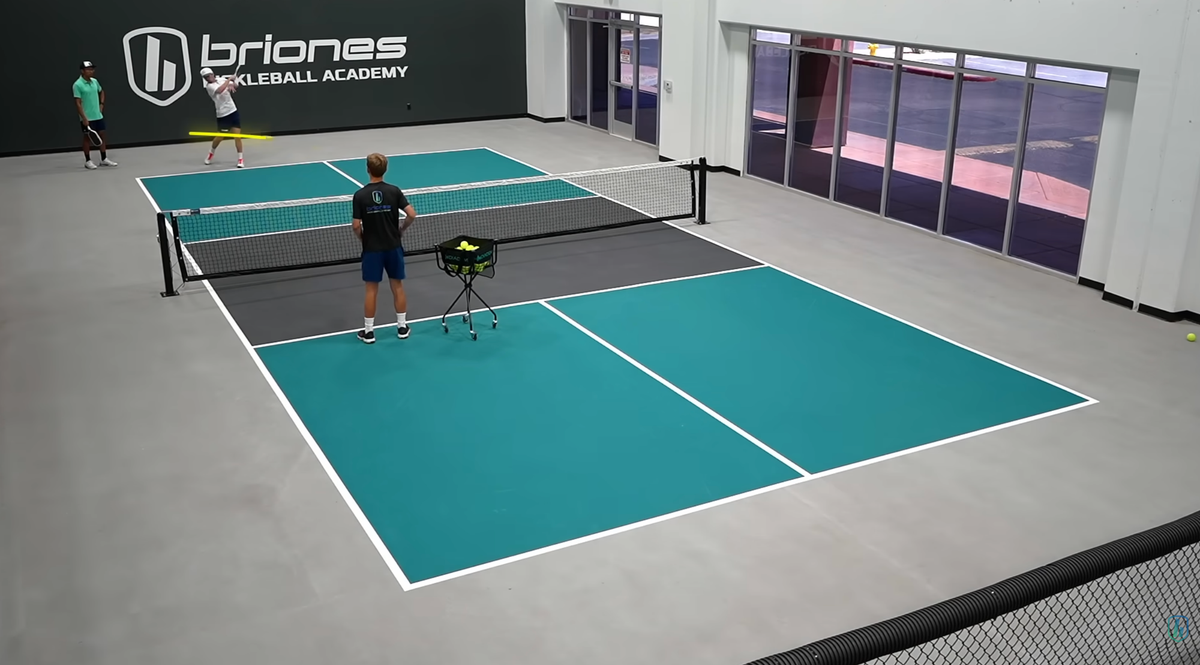
Is Your Follow Through Costing You Consistency?
The follow through is not just what happens after the ball leaves. It is what shapes the entire shot.
When you hit through those 10 imaginary balls with a low-to-high swing, your body weight transfers naturally from the loaded back leg forward.
That weight shift is not something you force. It happens on its own when the mechanics are right.
You might feel your back foot drag slightly as you drive through. That is a good sign. It means you are using your body weight the way you are supposed to.
Let that foot find its place naturally next to your front foot after contact.
As for where the paddle ends up, aim for around your opposite shoulder, roughly near your left ear if you are right-handed.
There is no need to choke yourself wrapping the paddle all the way around. A natural, extended finish with some wrist pliability is all you need.
 The Dink Media Team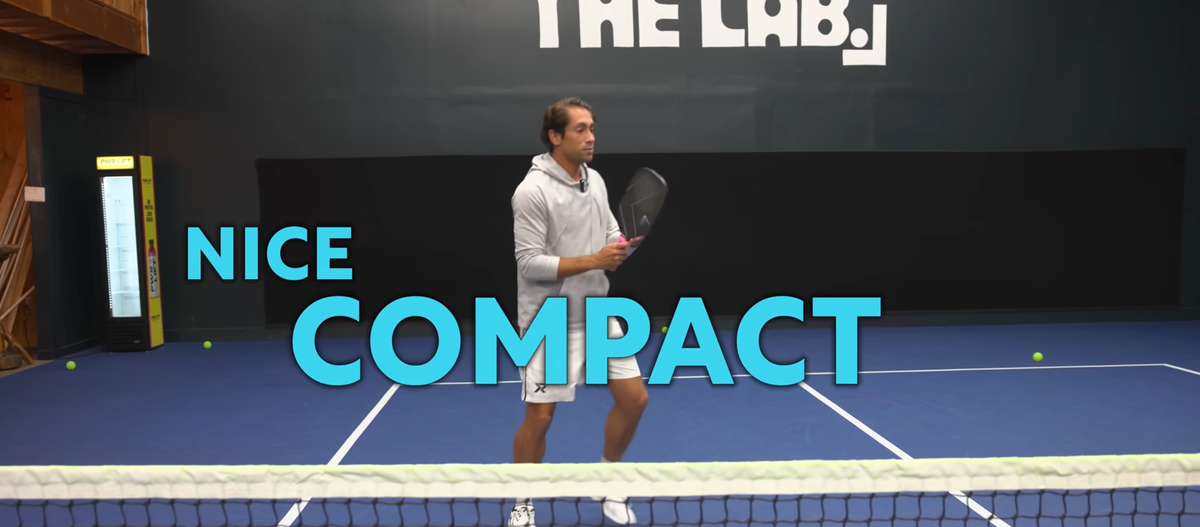
Putting It All Together: The Full Forehand Drive Sequence
Every piece of the drive builds on the one before it. If you skip the unit turn, the contact point suffers. If you skip the load, the follow through has nothing behind it.
Here is the complete sequence to rehearse:
- Unit turn: Rotate your whole upper body together. Chest faces 90 degrees to the side, paddle is compact and visible on your dominant side.
- Quick feet to the ball: Get your back foot positioned behind and to the side of the ball. Move fast.
- Load into the back leg: Press into it. Let it build power. Slow down here on purpose.
- Step forward: The step comes before the swing. Not at the same time.
- Low to high swing with closed face: Palm angles toward the ground. Extend through the contact zone.
- Contact out front: In front of the front knee, at maximum paddle velocity.
- Follow through to the opposite shoulder: Let the weight transfer happen. Let that back foot drag.
This is the same kinetic chain that gives professional players their power, and none of it requires elite athleticism.
It requires correct sequencing. Once your drive is dialed in, pairing it with a fifth shot drop becomes a real weapon.
If you are also working on your ready position before the drive, that is another piece that connects directly to how well you execute this sequence under pressure.
Players who try to hit the drive faster than their technique allows end up with less power and more errors.
Slow it down in practice, nail the sequence, and speed will come naturally.
For those who want to add to their attacking game, learning the forehand speed up is a natural next step after your drive mechanics are solid.
And if opponents start reading your drive, varying your placement keeps them guessing.
The drive also sets up the rest of the point.
A ball that stays low and has topspin forces your opponents into a defensive position and gives you time to move forward.
Fixing your third and fourth shot together is one of the fastest ways to move up in level.
One more thing worth knowing: muscling your shots is a pattern that shows up everywhere in recreational play, not just on the forehand drive.
The fix is always the same. Trust the mechanics, not the effort.
Drilling this in isolation before you try it in games is a smart move.
Wall drills give you rapid repetitions to groove the swing path and contact point without needing a partner.
Frequently Asked Questions
What is the most common mistake on a pickleball forehand drive?
The most common mistake is swinging from the arm without a unit turn, which strips most of the power from the shot. When your shoulders, chest, and paddle all rotate together before the swing, you tap into your whole body instead of just your arm. Fix the unit turn first and everything else gets easier.
How do I stop my forehand drive from going too high?
An open paddle face is almost always the cause when drives float high. At contact, your palm should be angled toward the ground, not facing up or out. A closed face combined with a low-to-high swing path generates topspin that pulls the ball down into the court.
Should I step into the ball before I swing on a forehand drive?
Yes, the step must come before the swing. Stepping and swinging at the same time, or swinging before the step, both rob you of the power that comes from the kinetic chain. The sequence is load, step, then swing.
Where is the correct contact point for a pickleball forehand drive?
Contact should happen out in front of your body, roughly in line with your front knee. Letting the ball get too close to your body means your paddle is already decelerating when you make contact, which kills power. Stay behind the ball and reach out to it.
How do I add topspin to my forehand drive?
Topspin comes from two things: a low-to-high swing path and a closed paddle face at contact. If your palm is angled toward the ground as you swing upward through the ball, you are getting the back of the ball and producing topspin. Open your face even slightly and the ball will flatten out or rise.

Love Pickleball? Join 100k+ readers for free weekly tips, news & gear deals.
Subscribe to The Dink