

Most players think their forehand drive pickleball mechanics are fine until the ball keeps sailing long or floating back soft. These specific fixes will change that fast.
Your forehand drive pickleball might look decent in warmups but fall completely flat in a real point.
The ball floats. It sits up. And instead of pressuring your opponent, it becomes an invitation for them to attack you back.
This breakdown covers the exact mechanical fixes from a coaching session with player Elaine, featuring coaching from Cori Elliott on YouTube.
The problems Elaine was dealing with are the same ones showing up in your game right now.
Love pickleball? Then you'll love our free newsletter. We send the latest news, tips, and highlights for free each week.
The Real Problem With Most Forehand Drives
The issue is almost never grip. It's not even swing path most of the time.
What's actually breaking down is the kinetic chain.
When your feet, knees, hips, and shoulder don't work together in sequence, you lose all the power that should be flowing through your paddle at contact.
Elaine's technique wasn't bad, and her spin was there.
But as the coaching session revealed, there was a disconnect between her lower body and upper body that was costing her serious pace and topspin dip.
The fix isn't one big thing. It's several small things stacked correctly, and they all build on each other.
Why Is Your Body Position Hurting the Shot?
Most recreational players hit the forehand drive from a neutral or open stance. That's the first place power gets lost.
You want to be in a fully closed position before you swing.
That means your non-dominant shoulder is pointing toward the target and your body is coiled and ready to rotate through the ball.
Here's what that setup should look like:
- Rotate your feet and hips so you are fully sideways to the net
- Load your weight into your back leg as you prepare
- Keep both knees equally bent, almost like the start of a squat
- Position your lead shoulder over your front foot
- Make sure the ball is slightly in front of you and close enough to reach without extending awkwardly
One thing Cori kept coming back to was that Elaine was sometimes letting the ball get too far from her body.
When that happens, you end up reaching, your weight can't transfer cleanly, and the swing gets rushed.
Getting the ball in the right spot starts with your feet. Your footwork determines your contact point, not the other way around.
The Non-Dominant Hand Is Doing More Than You Think
This is one of the most underused cues in recreational pickleball.
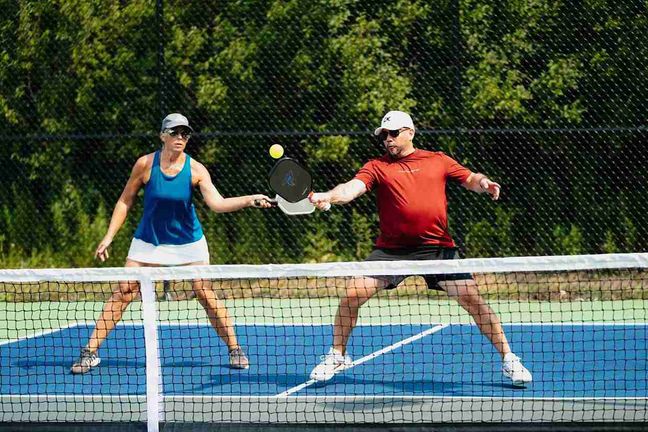
Your non-dominant hand should extend out toward the ball as it approaches, almost like you are about to catch it. This does two things at once.
- First, it keeps your shoulders from opening too early, which is what kills spin and flattens the drive.
- Second, it forces your body to track the ball more actively so you stop guessing where the contact point will be.
Think of it as a catch and release.
Your non-dominant hand guides you to the ball, and then at the last moment your dominant hand replaces it with the paddle and drives through.
This drill cue alone changed the quality of Elaine's drives immediately. If you keep missing forehand drives, this is often the fix.
 The Dink Media Team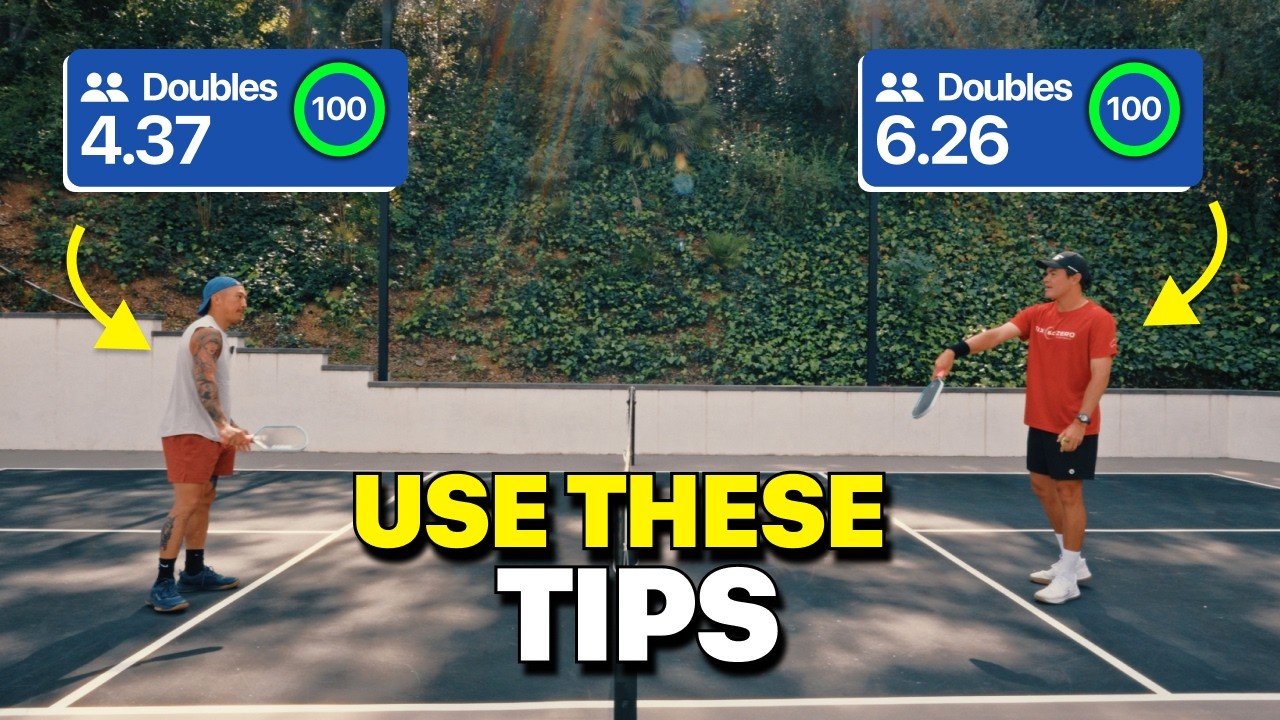
What Does Knee Bend Actually Do for Power?
Knee bend creates a loading platform. Without it, your drive is all arm.
When both knees are equally bent and you sink into that squat position, you create potential energy that transfers upward through your body as you swing.
That's where real pace comes from.
Cori pointed out that Elaine was inconsistent here, sometimes bending, sometimes staying half up.
The result was a drive that varied wildly between good and floaty, even when the arm swing looked the same.
The fix is committing to a lower position every single time, not just when the ball forces you down.
Bending from your knees, not your back, is the key to doing this without strain.
 The Dink Media Team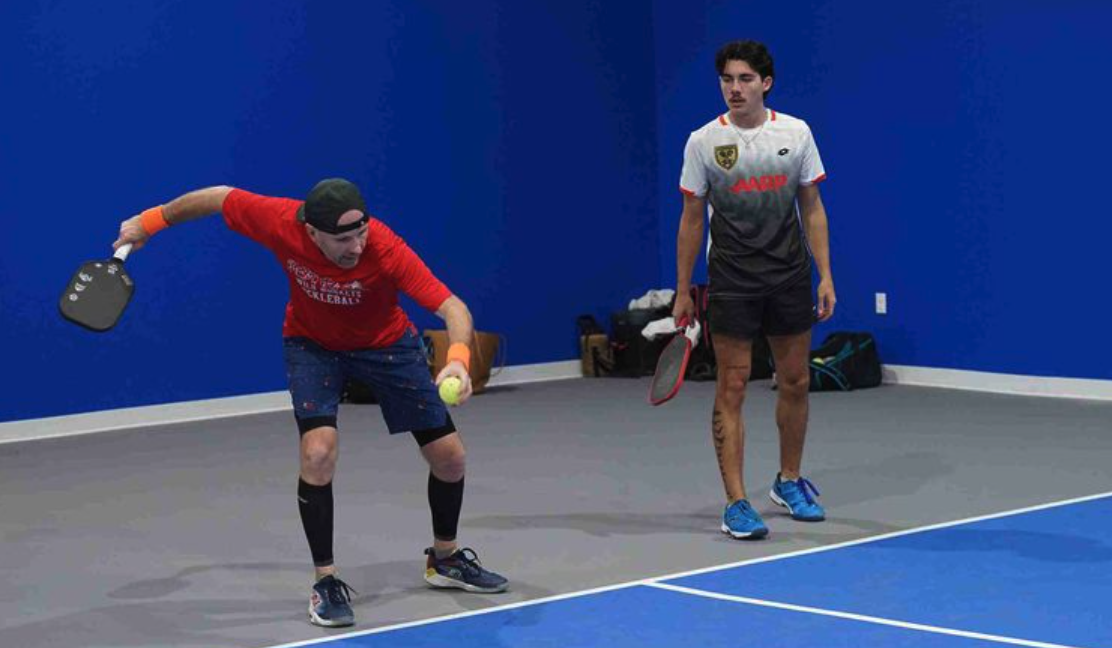
The Backswing Setup Most Players Get Wrong
Your backswing should not start as a big loop behind you. That works in tennis because you have more time.
In pickleball, especially when you are moving forward or when the ball is coming fast, a compact and ready backswing is what lets you be consistent.
Cori teaches a simple starting point: point the paddle toward the side wall before you swing.
From that position, all you do is snap through and rotate. There's no room for a massive backswing, and you don't need one.
This is the same principle Cori applies to teaching the serve. When the mechanics are similar across shots, your muscle memory builds faster.
Fixing your serve with this same compact mindset pays off across your whole game.
 The Dink Media Team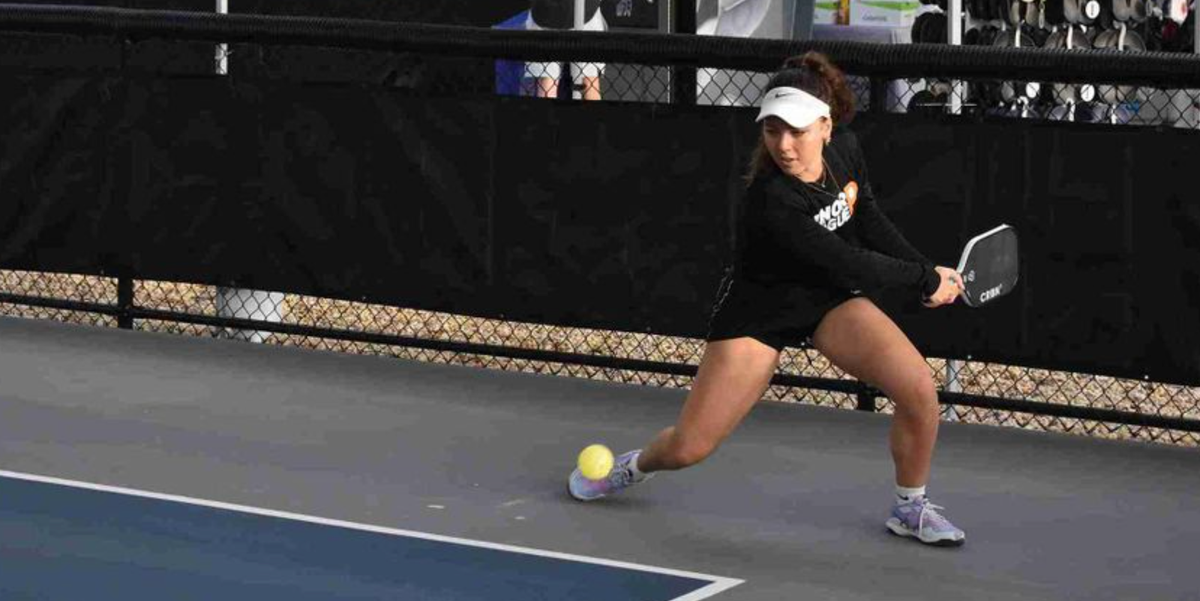
How to Build the Full Kinetic Chain
The kinetic chain is the sequence of body segments working together to create force, a principle well documented in sports biomechanics research.
Think of it like a whip: power starts at the ground and travels up through your body and out through the paddle.
When one link breaks, the whole chain loses speed. Here is the correct sequence for a pickleball forehand drive:
- Load your back leg and sink into your knees
- Drive your front foot toward the ball as you step into contact
- Rotate your hips toward the net before your shoulder follows
- Let your shoulder accelerate the arm through the contact zone
- Snap the wrist through at contact to add topspin
- Finish low, not high, to keep the ball from ballooning
Elaine's breakthrough came when she stopped thinking about swinging and started feeling the sequence from the ground up.
The footwork clicked, the ball started dipping, and the drives became genuinely threatening.
If wrist lag and snap are not part of your swing yet, you are leaving serious spin on the table.
 The Dink Media Team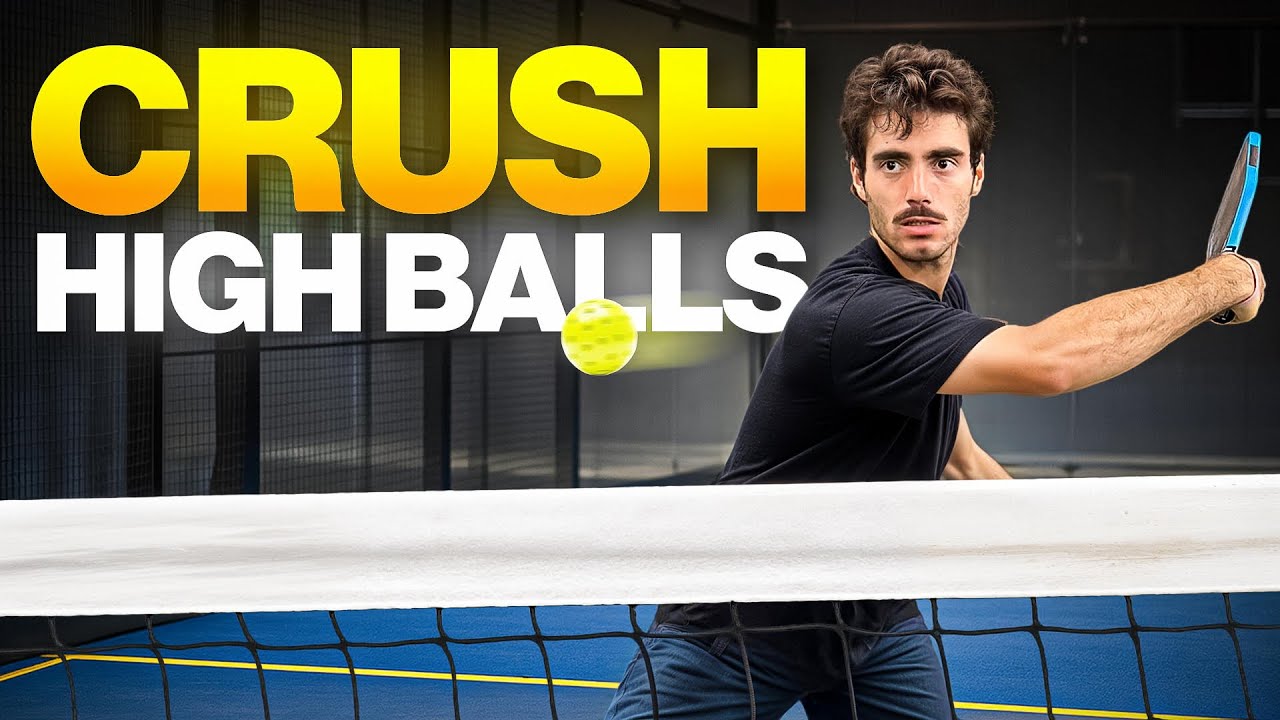
Why Is Your Drive Inconsistent Even When It Feels Right?
Inconsistency almost always comes down to one thing: you are not repeating the same setup before every swing.
The drive that works is the one where your feet are set, your position is closed, your knees are down, and the ball is in your strike zone.
When any of those four things are off, the result changes.
Cori pushed Elaine to commit with confidence rather than being hesitant.
Tentativeness shows up in the swing as a deceleration at contact, which is exactly when you need to be speeding up.
The contact point fix that adds real spin is worth working through alongside these footwork adjustments, because both need to be dialed in together.
 The Dink Media Team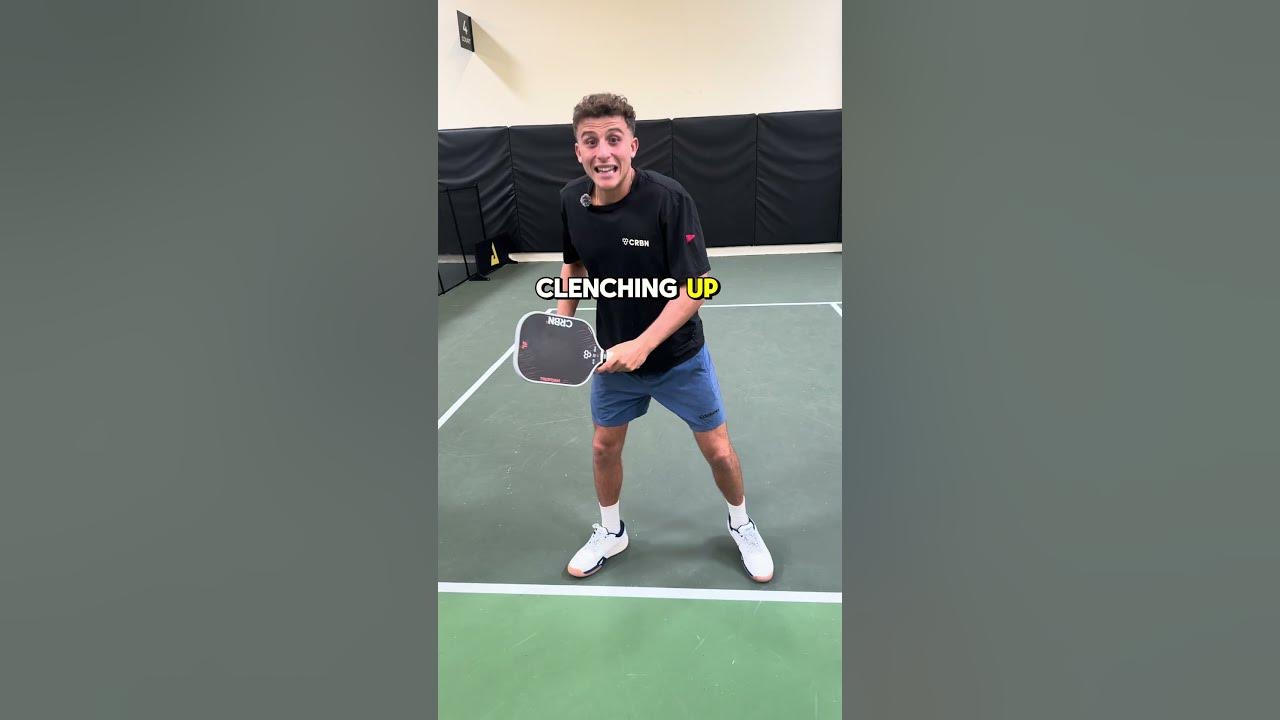
Knowing When to Drive and When to Drop
A powerful drive is only useful when you can actually execute it from the right position.
Cori made this point directly: if the ball is not in your strike zone, just drop it.
Too many players force a drive on a ball that's too low, too wide, or too close to their body.
The result is either an error or a floater that gets hammered back at you.
The best way to build trust in your drive is to only hit it when the setup is right and drop everything else.
That discipline raises the quality of every drive you do take, because you are only swinging at hittable balls.
Shot selection is the part of your game most players rush past.
When you start using the third shot drive strategically rather than reflexively, your opponent starts respecting it.
That is the difference between a drive that scares nobody and one that creates real problems.
 The Dink Media Team
Putting It Together in Practice
The fastest way to groove these mechanics is to use a catch and release drill before you ever swing the paddle.
Have someone feed you balls. Extend your non-dominant hand to "catch" each ball as it arrives. Get your feet set, get low, and let the ball reach you in a closed stance.
Then do it again with the paddle.
This slows everything down and forces the sequencing that your full-speed swing skips over.
Progressive drills like this build real mechanics that hold up under pressure.
Once the positions feel natural at slow speed, gradually bring the feed pace up.
Cori did exactly this with Elaine, starting with hand feeds and then moving to faster balls once the foundation was solid.
The goal is a repeatable drive that you can trust under pressure, not a flashy one you pull off sometimes.
When your drive is consistent, your opponent has to respect it. When it's inconsistent, they are happy to let you keep swinging.
Combining your drive with smart follow-up shots is what turns it into a real point-winning pattern.
Frequently Asked Questions
What is the most common forehand drive pickleball mistake?
The most common mistake is hitting from an open or neutral stance instead of a fully closed position. This takes away your hip rotation and forces you to use only your arm, which kills both power and topspin. Getting your feet set properly before you swing fixes most of this instantly.
How do I get more topspin on my forehand drive in pickleball?
Topspin comes from a low to high swing path combined with a wrist snap through contact. Your finish should be low, not wrapping high around your shoulder, which helps the ball dip down into the court. Closing your stance and using the kinetic chain through your hips and shoulder adds pace that supports that spin.
Should I use a western grip for my forehand drive?
A western grip is not a problem as long as your stance and setup are correct. The bigger factor is getting into a closed position and loading properly before you swing. Grip matters less than footwork and body position when it comes to drive quality.
Why does my forehand drive keep going long in pickleball?
A drive that sails long usually means the swing path is too flat or your finish is too high. Adding topspin by brushing up through the ball at contact will bring the ball down into the court. Finishing with a lower follow-through also helps keep the trajectory under control.
How can I make my forehand drive more consistent in pickleball?
Consistency comes from repeating the same setup every time: closed stance, bent knees, ball in your strike zone, and a compact backswing. When any one of those elements is missing, the result changes. Slowing down in practice with catch and release drills builds the muscle memory that holds up when the speed increases.

Love Pickleball? Join 100k+ readers for free weekly tips, news & gear deals.
Subscribe to The Dink