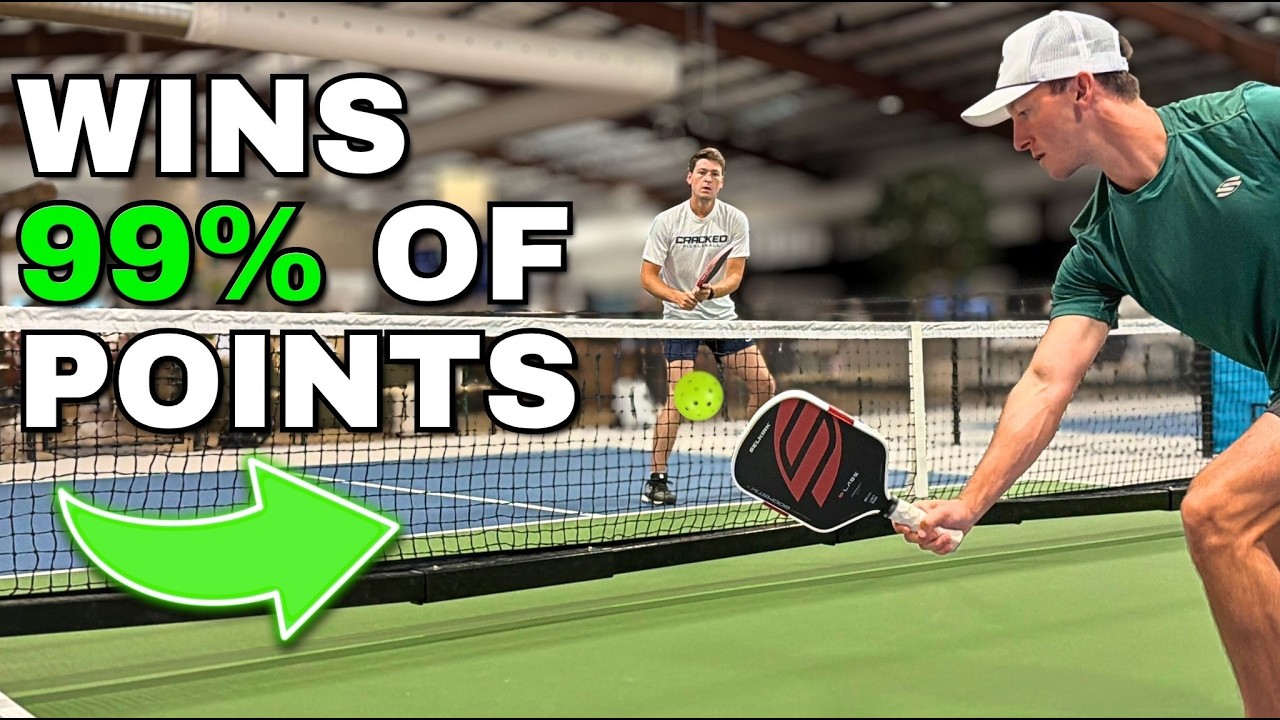
The most important pickleball shots aren't the flashy ones. Research shows just four shots decide 95% of all points, and most players are getting at least two of them wrong.
The most important pickleball shots aren't the ones you practice most.
They're the ones that end points before you ever get a chance to show off your dinking game or your speed-up.
Most players spread their practice time too thin, working on every shot equally.
But statistically, only four shots are responsible for ending the vast majority of rallies.
This breakdown comes from Cracked Pickleball on YouTube, and it's exactly the kind of shot-priority framework that separates players who improve fast from those who stay stuck at the same level for years.
Here's what actually matters, ranked from fourth to first.
Love pickleball? Then you'll love our free newsletter. We send the latest news, tips, and highlights for free each week.
Shot 4: The Reset
The reset keeps the rally alive when your opponent takes control.
If you don't have a reliable reset, the point ends the second anyone speeds up the ball at you.
It's also the clearest separator between intermediate and advanced players.
Advanced players use the transition zone effectively because they can reset under pressure and hold their ground while working toward the kitchen line.
Why the reset is the most important pickleball shot under pressure
The most common mistake isn't the swing. It's the body position before the swing.
Get low and bring your paddle to roughly waist height before the ball arrives. This guards the lower half of your body, which is exactly where smart opponents target.
If the ball is coming above your belly button, it's probably sailing out anyway.
How do you actually fix a bad reset?
Keep the motion short. A half-swing volley that redirects your opponent's pace back toward the kitchen is all you need. No big backswing, no full cuts at the ball.
Your only job is to decide how much power to send back, not how large a swing to create.
Here's the part most players miss: be ready to hit multiple resets in a row. Treat each one like a third shot drop rather than a guaranteed ticket to the kitchen.
Give yourself height and margin. Force your opponent to keep attacking, then reset again.
After each reset, snap back to ready position. Don't watch the ball float over the net.
Shot 3: The Third Shot
The third shot either earns your team the chance to compete at the kitchen or hands the point to your opponents before the rally even develops. That pressure causes a lot of players to try too much.
Drive or drop: how do you actually decide?
Default to dropping. That's the right starting mindset. The goal of the third shot is not to win the point from the baseline.
It's to get you to the kitchen line without giving away an easy put-away.
Drive when the return bounces at or above your knees and your feet are at or in front of the baseline.
If the ball is low and you're already pushed back behind the baseline, don't force a precision drop.
Instead, go with something between a drive and a drop, sometimes called a drip.
It's reliable, easy to get over the net, and doesn't require perfect technique under pressure.
 The Dink Media Team
When you do drop, aim toward the middle of the court and bias toward your opponent's backhand. Here's why that target works:
- The net is lower in the middle, giving you more margin
- A centered ball removes aggressive crosscourt angles for your opponents
- Balls aimed too wide risk going out of bounds and open up easy attack opportunities
Just like resets, you might need to hit multiple third shots before you reach the kitchen.
That's fine. Give your drops height and margin, especially early in transition. Aim for a consistent landing zone rather than trying to be a hero on a single shot.
When you drive, target the opponent's right hip or right shoulder. That's the forehand side of most right-handed players, but it's an awkward spot.
Their wrist bends, their stability drops, and the ball they send back will be easier to handle than a clean backhand punch.
Shot 2: The Return of Serve
Returns happen every single point, assuming the serve goes in. That makes the return of serve one of the highest-leverage shots in the game.
It's also one of the most commonly missed shots at every level below 5.0.
The problem is that players try to make too many decisions while the ball is already in the air.
They're reading the serve, choosing a target, adjusting for depth, and watching their opponents all at the same time. That's too much.
Something breaks down.
 The Dink Media Team
How do you stop overthinking your return?
Make the plan before the serve happens. Watch how your opponent has been serving. Are they hitting deep?
Step back and commit to a deep, safe return before they even toss the ball. Are they weak off their serve? Decide to target their backhand and advance quickly.
Whatever the plan is, lock it in before the rally starts. Then your only job during the return is to execute, not to think.
A few specific ways to clean up your return:
- Pre-plan your target based on the server's tendencies before each point
- Aim deep and crosscourt as your default, which gives the highest chance of clearing the net and buying time to reach the kitchen
- Get ready early, with feet set and paddle up before the serve arrives
The return does not need to be aggressive.
A high, deep ball that lands near the baseline gives you plenty of time to reach the kitchen line and start playing offensively from there.
Your return goal is to set up the kitchen battle, not win the point from the baseline.
Don't go for lines. Don't try to hit winners. Avoid the corners unless you've been consistently making that shot in warmups.
The return's only job is to give you a chance to compete from a strong position up at the net.
Readiness is the most underrated part of this. Between points, it's easy to zone out and then try to re-engage mid-serve.
Instead, stay locked in. Set your feet, watch the server, and be physically ready before the ball leaves their paddle.
Small readiness adjustments produce immediate consistency gains.
 The Dink Media Team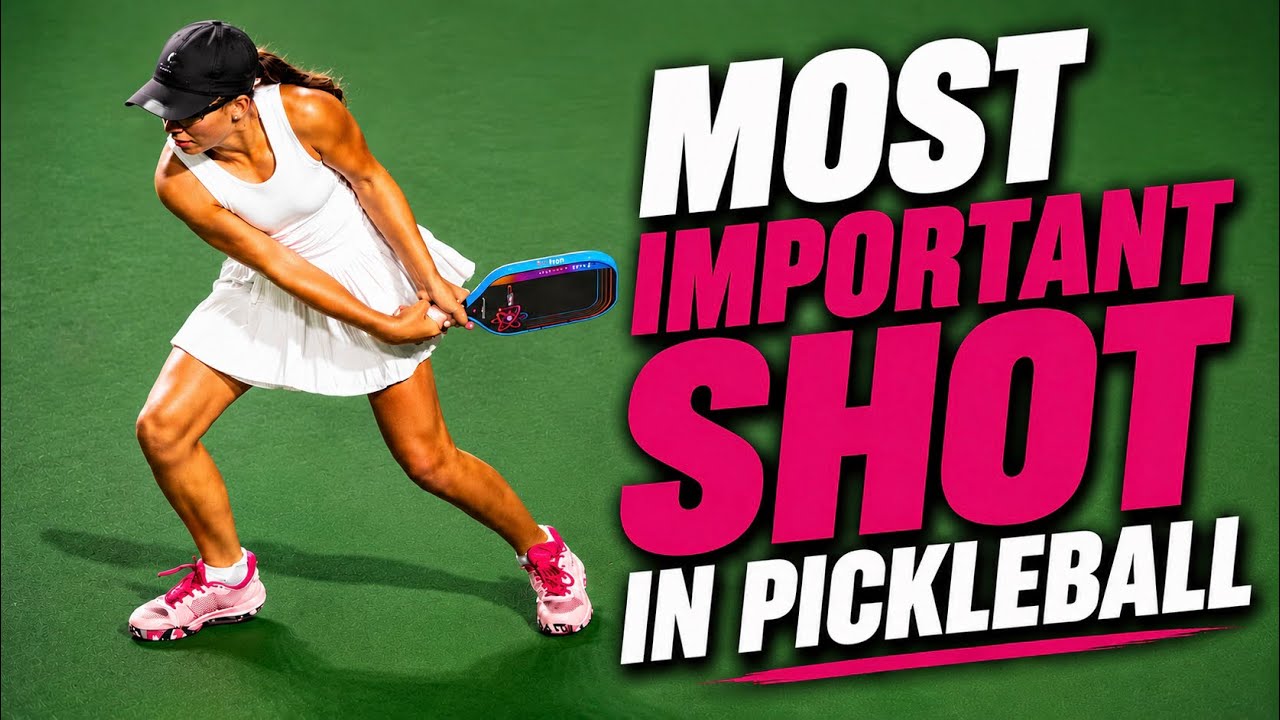
Shot 1: The Serve
The serve gives away more free points than any other shot in pickleball. And the reason isn't technique. It's overthinking.
Players add complexity to the one shot they have full control over.
They invent backswings they've never practiced, contort their body into awkward positions, and then wonder why they miss.
The serve is the only shot where you have 10 full seconds and no opponent pressure.
That should make it the most reliable shot in your game.
What makes a consistent serve routine?
Start by calling the score first. This is a real mistake that costs people serves. They call the score mid-routine, lose focus, and spray the ball.
Call the score, confirm everyone agrees, then begin your pre-serve routine.
A simple routine might look like this:
- Set your feet in a stable, slightly open stance
- Bend your knees, keep your back upright
- Bounce the ball two or three times
- Glance up to see where your opponents are standing
- Bring ball to paddle, look down at contact point, and execute
Don't aim for the back line every time. That's a recipe for long serves. Instead, aim for a zone about a foot inside the baseline.
If you go slightly long, you're still in bounds. If you go slightly short, it's still deep enough to do damage.
Aim for your opponent's backhand as a general rule, but don't chase the corner. Target a zone with margin, not the most difficult spot on the court.
Adjusting your serve target doesn't require changing your swing at all.
The biggest technical mistake is using unnatural movement. Anna Leigh Waters is a great example of this done right.
Her serve looks almost identical to her forehand. It's a motion she already trusts, so it's reliable under pressure.
Your serve should look like your forehand too.
If your serve motion looks nothing like your groundstrokes, you're adding unreliable mechanics to the one shot that should be automatic.
Fixing your serve mechanics is simpler than you think when you start from your forehand as the baseline.
Practice by feeding yourself forehands from a standing position. Toss the ball, hit a normal forehand, repeat. Then replicate that exact motion on your serve.
If you want to keep it even simpler, use a drop serve.
Drop the ball, let it bounce, and swing your forehand. The serve mistakes costing you points are almost always about added complexity, not lack of power.
The serve should be automatic. Set your routine, aim smart, use your forehand, and stop making it harder than it needs to be.
Frequently Asked Questions
What are the most important pickleball shots to practice first?
The most important pickleball shots in order of impact are the serve, return of serve, third shot, and reset. These four shots decide the outcome of 95% of points, so improving them will raise your game faster than working on advanced techniques like the Erne or overhead smash.
Why do I keep missing my third shot drop?
Most third shot drop errors come from two problems: aiming too close to the net without margin, or trying to execute a perfect drop in one attempt rather than being willing to hit several. Give your drops more height over the net and commit to a multi-shot approach to the kitchen rather than a single magic drop.
How do I stop double faulting on my serve in pickleball?
The fastest fix for serve consistency is building a repeatable pre-serve routine and making your serve motion match your forehand. Call the score first, set your feet, bounce the ball, and then execute. Removing unnecessary movements and overthinking is what stops double faults far more than adding new technique.
What is a reset in pickleball and when should I use it?
A reset is a short, controlled shot hit from the transition zone or baseline that redirects a fast ball back toward the kitchen with enough arc to land softly. You use it whenever your opponent speeds up the ball and you're not yet at the kitchen line. The goal is simply to keep the ball in play and buy yourself time to advance forward.
Where should I aim my pickleball return of serve?
Aim your return deep and crosscourt as a default target. This gives you the best margin over the net, the most time to reach the kitchen line, and limits your opponents' ability to attack aggressively with their third shot. Avoid going for corners or lines on the return unless you have a specific, practiced reason to do so.

Love Pickleball? Join 100k+ readers for free weekly tips, news & gear deals.
Subscribe to The Dink