
These 6 Pickleball Shots Are Shaping the Future of the Game in 2026
The pickleball shot landscape is evolving fast, and the players who master these six techniques will have a serious competitive advantage. From the two-handed backhand to the off-the-bounce combo, here's what you need to know to stay ahead in 2026.
The pickleball shot game is evolving faster than ever, and if you're not paying attention to what the top players are doing, you're already falling behind.
According to Your Pickleball Guideman, a leading voice in pickleball instruction, there are six specific pickleball shots that will define competitive play in 2026 and beyond.
If you want to see what's already working at the highest level, modern pickleball's four key strategies to winning in 2026 sets the broader strategic context these shots live inside.
These aren't flashy gimmicks or one-hit wonders.
They're fundamental pickleball techniques that separate the good players from the great ones.
Love pickleball? Then you'll love our free newsletter. We send the latest news, tips, and highlights for free each week.
1. The Two-Handed Backhand: Your New Weapon
Let's start with the most obvious shift in modern pickleball:
The two-handed backhand is no longer optional.
Almost every top player has added it to their toolkit, and it's become one of the biggest weapons in the sport.
One-handed backhands ruled the game for years, but that era is fading fast.
Why the change? The two-handed backhand gives you more control, stability, and power.
It completely changes how you handle fast exchanges and pressure situations.
The biggest reason this pickleball shot works so well is balance.
By getting your outside leg behind the ball and squaring up with both hands, you can handle any pace thrown at you without losing control.
You're using your legs and core, not just your wrist, which means your shot stays steady under pressure.
You also gain the ability to disguise your direction. You can go crosscourt, middle, or down the line just by leading with that front arm.
If you're still relying solely on a one-handed backhand, you're giving up a significant edge.
The 5 essential two-handed backhand shots with pro Connor Garnett is the complete progression guide for building this pickleball technique from scratch.
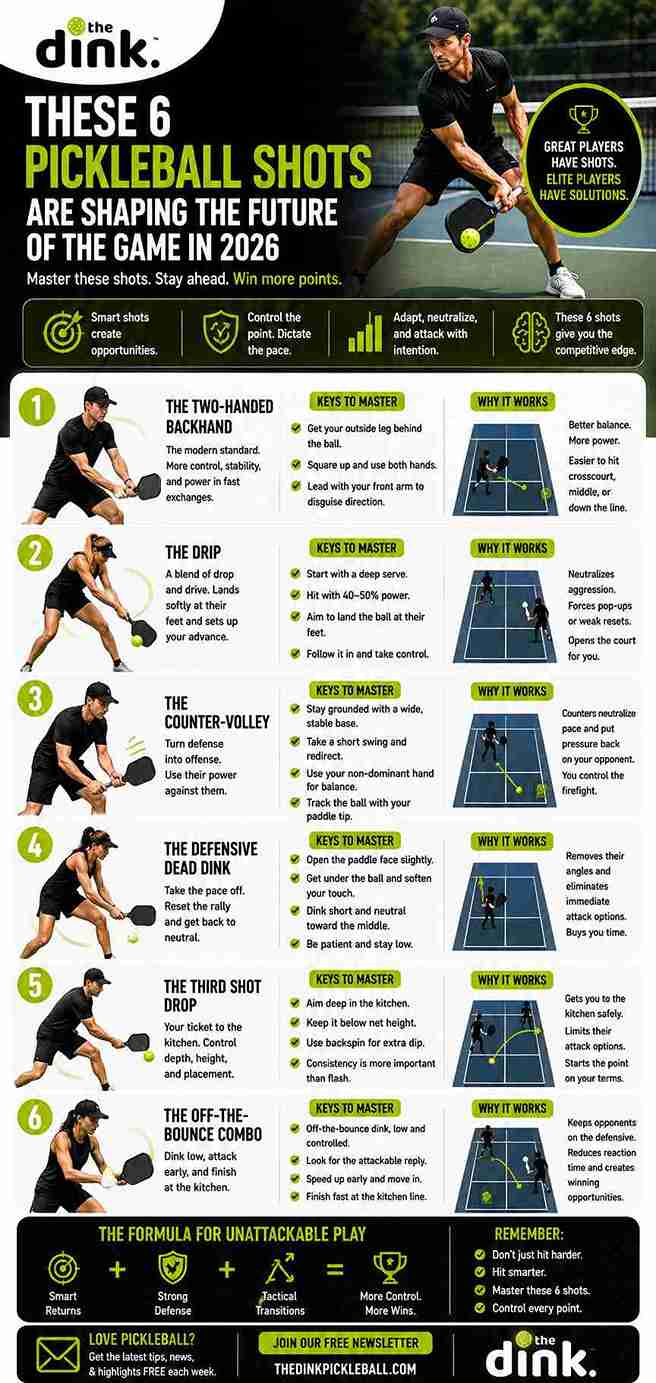
2. What's the Deal With the Drip Pickleball Shot?
The drip is basically a blend between a drop shot and a drive, making it one of the most versatile pickleball techniques in the modern game.
It's a controlled, low offensive pickleball shot that lands right at your opponent's feet.
This shot is changing the way players transition from the baseline because it gives you the perfect balance between aggression and safety.
Instead of taking huge swings and trying to blast the ball through your opponents, the drip is hit with about 40 to 50% power.
The goal isn't to crush the ball. It's to make it cross the net and fall quickly at their feet, forcing a pop-up or weak reset.
This lets you or your partner move in confidently while your opponents scramble to defend.
The key to mastering the drip is starting with a deep serve.
A deep serve pushes your opponent back, creating extra space for your drip to drop in front of them as they move forward.
Without that depth, the window closes and your shot loses its bite.
Once you land the drip, the next step is just as important: follow it in. That shot puts your opponent in a defensive position, so don't stand still and admire it.
Move up, close the gap, and be ready to attack the next ball. The hybrid roll is the new essential third-shot drop in advanced pickleball and shares the same philosophy as the drip: controlled aggression over reckless power.
3. How Do You Turn Defense Into Offense?
As paddles evolve and players hit harder, countering effectively has become a must.
The counter-volley pickleball shot is how you turn defense into offense.
It's what allows you to survive those high-speed firefights in competitive pickleball and come out on top.
The key to a great counter isn't fast hands. It's stability. Most players make the mistake of reacting with their upper body only.
They flinch, jump, or swing wildly.
But the best counters come from players who stay grounded. Your legs should be solid, your base wide, and your paddle steady in front of you.
You don't need a big motion. You just need to absorb and redirect.
Another pro-level trick is using your non-dominant arm for balance and power.
When someone speeds up at your backhand side, anchor your opposite hand on the paddle handle. It gives you instant stability and control.
You'll feel like you're blocking a punch instead of deflecting a bullet.
Here's the secret to anticipating attacks: use the paddle tracking technique. After every dink, keep the tip of your paddle following the ball.
If you dink to the left, your paddle should naturally move left.
This keeps you in position and ready for the next shot. You won't be caught flatfooted because your paddle is already where it needs to be. Stopping pop-ups with modern hand speed and paddle positioning explains exactly why paddle position before the attack lands is more important than reaction time after it.
4. Why the Defensive Dead Dink Is a Must-Know Pickleball Shot
This next pickleball shot doesn't get enough credit, but it's one of the most effective ways to reset a rally.
When you get pulled wide or stretched out on a dink, most players panic and try to hit something creative.
Maybe they aim sharp crosscourt or try to add spin, but that's exactly where mistakes happen.
Instead, a defensive dead dink is played soft, short, and neutral right in front of you toward the middle of the court.
It has no spin, no flare, just precision.
The goal is to take pace off the ball completely, giving yourself time to recover and removing your opponent's ability to attack. It's a tactical reset button.
By going toward the middle, you also remove their angles and eliminate threats like the Erne or aggressive counters.
To execute it, open your paddle face slightly and get under the ball.
You're not trying to push forward. You're trying to float it over the net and let it die.
Think of it as catching the ball with your paddle and just guiding it forward.
This simple, boring-looking dink shot frustrates aggressive players more than anything else.
It forces them to start over and gives you control of the rally again.
5. The Push Volley: Dominating the Kitchen Line
One of the most underrated yet powerful pickleball shots you can add to your arsenal is the push volley. This shot lets you take control of the kitchen line by taking the ball early out of the air without giving up ground.
When you lean in and take dinks out of the air, you effectively shrink the kitchen for your opponent.
They lose time, space, and rhythm.
Instead of retreating to let the ball bounce, you stay forward, poking the ball gently back at them.
You're not swinging, you're redirecting. The key to this shot is stability.
Keep a firm but not tight grip and hold your paddle tip slightly downward for control.
Then use small, compact pushes to redirect the ball. You don't need power here, just precision.
As you get comfortable, this move becomes a mind game.
You can disguise it, make it look like another soft dink shot, then suddenly speed it up when they're least expecting it.
It keeps your opponent off balance and constantly guessing.
The push volley lets you dominate neutral points without ever leaving your spot at the kitchen.
It's quiet, subtle, and brutally effective.
The push volley is one of those advanced pickleball techniques that looks simple from the sideline but requires precise timing and grip control to execute consistently.
6. The Off-the-Bounce Combo: Building Sequences, Not One-Shot Winners
The final pickleball shot you need to master this year is the off-the-bounce speedup combo.
The era of one-shot winners is over, and players' reflexes and counters have gotten too good. Now, it's all about combinations.
The idea is simple: your first attack isn't meant to win the point. It's meant to set up the next one.
You initiate with a speed-up that's about 60 to 70% power, targeting a weak area like your opponent's hip or backhand wing.
That first shot forces a weak counter, and that's when you finish the rally with your next ball.
This pickleball strategy takes patience and precision, but it's devastating once you get it down.
Instead of gambling on a single blast, you're building a sequence:
- Attack
- Anticipate
- Finish
The trick is to read the rebound. By learning these patterns, you can predict where the next ball will go and be ready to pounce.
When you master the off-the-bounce combo, you start playing chess while everyone else is playing checkers.
A simple 4-step system to win more pickleball games in 2026 shows how to string these kinds of sequences into a complete game plan that holds up under match pressure.
Putting It All Together: A Roadmap for 2026
Here's the thing: these six pickleball shots don't exist in isolation. Each one builds on the other.
The two-handed backhand gives you stability. The drip helps you attack smartly.
The counter-volley turns defense into offense. The dead dink resets the point.
The push volley keeps you on top of the kitchen, and the off-the-bounce combo finishes the rally with precision.
If you can start incorporating even a few of these shots into your game, you'll notice an immediate difference.
You'll move more confidently, control more points, and frustrate more opponents.
The pickleball landscape is changing fast, but with these advanced pickleball techniques in your toolkit, you won't just keep up. You'll lead. How to break 5.0: the 5 pickleball shots you must master before 2026 is the natural companion read once these six shots start clicking in your game.
Frequently Asked Questions
What's the Difference Between a Drip and a Drop Pickleball Shot?
A drop shot in pickleball is a soft shot hit from the baseline that lands near the net with minimal pace. A drip is a hybrid that combines elements of both a drop shot and a drive, hit with 40 to 50% power to land at your opponent's feet while maintaining slightly more aggression. The drip is designed to set up an offensive opportunity, whereas a drop shot is purely defensive.
Why Is the Two-Handed Backhand Becoming So Popular in Pickleball?
The two-handed backhand provides superior stability, control, and power compared to a one-handed backhand. It allows players to handle faster pace, disguise shot direction more effectively, and use their legs and core for better balance under pressure. Top players have adopted it as a standard weapon in their toolkit.
How Do I Practice the Counter-Volley Pickleball Shot Effectively?
Start by focusing on footwork and stability rather than hand speed. Practice staying grounded with a wide base, keeping your paddle steady in front of you, and using small, compact motions to absorb and redirect the ball. Use the paddle tracking technique after every dink to stay in position and anticipate incoming attacks.
When Should I Use the Defensive Dead Dink Instead of Other Reset Shots?
Use the defensive dead dink when you're pulled wide, stretched out, or in a defensive position and need to neutralize your opponent's attack. It's most effective when you want to remove pace from the rally, eliminate angles, and regain control without taking unnecessary risks.
What's the Key to Mastering the Off-the-Bounce Pickleball Shot Combo?
The off-the-bounce combo requires patience and pattern recognition. Your first attack should be 60 to 70% power, designed to force a weak response rather than win the point outright. Focus on reading the rebound, anticipating where the next ball will go, and finishing with a decisive shot. It's about building sequences, not relying on single winners.

Love Pickleball? Join 100k+ readers for free weekly tips, news & gear deals.
Subscribe to The Dink