The 4 Rules of a Successful Attack in Pickleball (Infographic)
Most intermediate pickleball players have the same shots as advanced players but don't know when to use them. The biggest culprit? A flawed pickleball attack strategy that costs you points.
Here's what separates a 4.5 player from a 5.0 player: it's not the shots. It's knowing when to use them.
According to professional PPA Tour player Ava Ignatowich, the biggest pickleball attack mistake holding intermediate players back isn't a technical flaw. It's a decision-making problem. If you want to understand the full framework for advanced pickleball strategy at the kitchen line, mastering the kitchen line attack like a 5.0 player is the essential companion to everything Ignatowich teaches here.
It's a decision-making problem.
Most 4.5 and below players attack the wrong balls.
That's the core issue. You've got the skills. You can hit a speed-up. You understand the mechanics of a pickleball attack.
But you're pulling the trigger at the wrong moment, against the wrong balls, from the wrong positions.
And every time you do, you're handing your opponents an easy counter-attack opportunity.
Love pickleball? Then you'll love our free newsletter. We send the latest news, tips, and highlights for free each week.
The Four Rules of a Smart Pickleball Attack
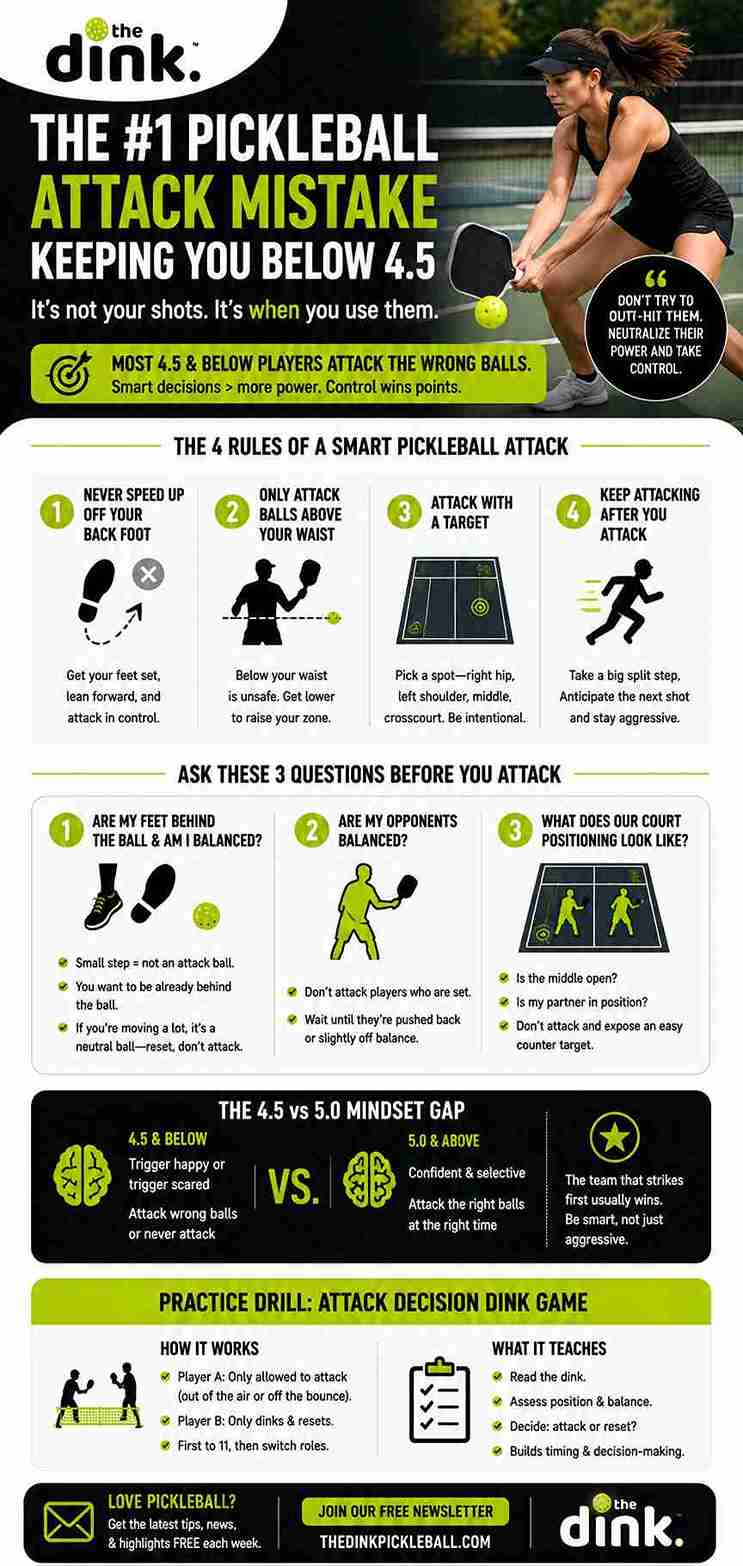
Let's start with the fundamentals. Ignatowich breaks down four non-negotiable rules for executing a pickleball attack that actually wins points.
Rule #1: Never Speed Up Off Your Back Foot
This is the most common mistake she sees, even at the professional level. Players feel pressured, back up, and then try to attack while moving backward. It doesn't work.
- Your balance is compromised.
- Your power is weak.
- Your opponent sees it coming from a mile away.
When you attack, your feet need to be set.
- You need to be leaning forward.
- You need to be in control.
The dos and don'ts of attacking in pickleball reinforces exactly why balance before contact is the non-negotiable foundation of any effective pickleball attack.
Rule #2: Only Attack Balls Above Your Waist
Below your waist is unsafe territory. The ball is too low to generate pace safely, and you're more likely to hit it into the net or pop it up for an easy put-away.
But here's the thing: if your opponents are hitting super low dinks and nothing's above your waist, that's not permission to give up on attacking.
It's a signal to get lower.
Drop your waist. The lower you are, the more balls enter your attack strike zone at the kitchen line. What is a dead dink and why you should be attacking it every time shows you exactly which ball height to look for before you pull the trigger.
Rule #3: A Smart Pickleball Attack Always Has a Target
Never speed up blindly. You're not just hitting the ball harder. You're hitting it somewhere specific.
- Are you going right hip?
- Left shoulder?
- Middle?
- Crosscourt?
When you make a pickleball attack with intention, you're already positioned for the next ball. Six spots to attack your opponents in pickleball maps out every high-percentage target so you're never guessing when that attackable ball arrives.
Rule #4: Keep Your Pickleball Attack Going
This might be the most important rule of all. Ignatowich sees players hit a great speed-up and then just stand there, watching, relaxing.
That's a wasted opportunity.
Once your foot is on the gas, keep going. Take a big split step after your pickleball attack. Sit where you think the next ball is coming.
If you hit crossbody, anticipate a backhand return and be ready to put it away. Learn how to counterattack like a 5.0 player is the natural next read once your attack sequence starts clicking.
How to Know If You're Attacking the Right Ball
This is where the real skill lives. Knowing when to attack separates the good players from the great ones.
Pickleball shot selection is the difference between winning and losing a dink exchange, and Ignatowich gives you three questions to ask yourself before you speed up.
Question #1: Are My Feet Behind the Ball and Am I Balanced?
If you're moving to a dink with just a slight step, that's not an attack ball. You want to be already behind the ball before you swing. Your feet need to be set.
If you're moving a lot, if the dink pulled you in one direction or another, that's a neutral ball.
Defend it. Don't attack it.
This pickleball shot selection discipline is what Ignatowich calls the real difference between 4.5 and 5.0 players.
Question #2: Are My Opponents Balanced?
Why would you attack a ball your opponents are sitting on? You're not going to do that.
You're waiting until you and your partner hit an aggressive dink that pushes them slightly back, slightly off balance.
Then you're ready to attack the next one.
Question #3: What Does Our Court Positioning Look Like?
You could have an easy dead dink perfect to speed up. But if the middle is open and your partner is out of position, wait.
If you attack and the middle is exposed, your opponents get an easy target for their counter.
Only attack when you and your partner are both recovered to a good position. Ball height and court positioning: your 1-2 checklist for pro-level shot selection gives you the complete pre-attack checklist in a format you can actually use mid-rally.
The Pickleball Attack Confidence Gap Between 4.5 and 5.0
At the 4.5 level and below, Ignatowich notices two types of players: the trigger happy and the trigger scared. One group attacks everything.
The other fears speeding up and doesn't know when to do it.
At the 5.0 level, you see confidence.
Players know when to strike.
Here's the nuance: being trigger happy isn't necessarily bad.
The team that strikes first usually wins the match.
Aggressive teams tend to have more points go their way.
But if you're losing points after your pickleball attack, it's because you're attacking from the wrong position, attacking a ball that's too low, or attacking when your opponents are expecting it.
The solution? Learn to disguise your attacks, especially off the bounce. Out of the air, your opponents will see it coming and step back. But a well-timed attack off the bounce is huge in modern pickleball.
It's unexpected. It's harder to defend. The set and snap technique for effortless flicks and speedups is the mechanical drill that makes disguise feel automatic.
The Dink Game That Teaches You When to Attack
Want to practice this without the pressure of a full match? Ignatowich recommends a variation of the classic dink game.
Here's how it works: only one player is allowed to attack. The other player can only hit dinks and resets.
The attacker gets to focus purely on deciding which balls to take out of the air and which to attack off the bounce.
The defender works on counters and resets. You switch roles after playing to 11 or whatever number you choose.
This drill forces you to make real decisions.
You're not just hitting balls. You're learning to read the dink, assess your position, check your opponent's balance, and decide: is this the moment?
Why This Pickleball Attack Framework Matters for Your Game
The gap between 4.5 and 5.0 isn't about new shots. It's about pickleball shot selection.
It's about understanding that a pickleball attack is only as good as the setup that precedes it.
You already have the technical skills. What you need is the decision-making framework. When to speed up. When to reset. When to defend. When to counter.
Master that, and you'll stop giving away easy points. You'll start playing smarter, more aggressive pickleball attack sequences. And you'll finally break through that 4.5 ceiling. Three keys to go from 4.5 to 5.0 is worth reading the moment you feel this framework starting to click.
And you'll finally break through that 4.5 ceiling.
Frequently Asked Questions
What Is the Difference Between a Speed-Up and a Pickleball Attack?
A speed-up is any shot where you increase the pace of the ball. A pickleball attack is a speed-up executed with intent, proper positioning, and a specific target. The key difference is that an attack comes from a position of strength, with your feet set and your opponent off balance.
Can I Attack a Ball Below My Waist in Pickleball?
Technically, yes. But it's risky. Balls below your waist are harder to control, and you're more likely to hit the net or pop it up. The smarter move is to drop your body lower so more balls enter your attack zone above the waist at the kitchen line.
How Do I Know If My Opponent Is Balanced Before I Attack?
Look at their ready position. Are they leaning forward with their paddle up and their feet set? If yes, they're balanced and ready to defend. If they've just hit a dink and are still recovering, that's your moment to execute a pickleball attack.
Should I Always Attack When I Have the Chance?
No. Pickleball shot selection matters as much as the shot itself. If the middle is open or your partner is out of position, wait. Only pull the trigger on a pickleball attack when both you and your partner are recovered and ready to defend the counter.
What's the Best Way to Practice Attacking Decisions?
Play the one-attacker dink game. One player attacks only; the other defends and resets only. This drill forces real pickleball shot selection under pressure, helping you learn which balls to take out of the air and which to attack off the bounce, without the noise of a full match.

Love Pickleball? Join 100k+ readers for free weekly tips, news & gear deals.
Subscribe to The Dink