How to Build a Pickleball Practice Routine When You Only Have 3 Hours a Week
A practice routine for limited time pickleball players doesn't have to be complicated, it has to be smart. Here's how to get the most out of just 3 hours a week on the court.
Building a practice routine for limited time pickleball players is less about how many hours you log and more about what you do with the ones you have.
Three hours a week sounds thin. But elite coaches have been saying for years: focused, deliberate practice beats junk volume every single time.
You're not behind. You just need a system.
Here's the thing, most recreational players who do have time to play five days a week aren't improving.
They're just reinforcing whatever they already do, good habits and bad ones alike. Three intentional hours will beat fifteen unfocused ones. Every time.
Love pickleball? Then you'll love our free newsletter. We send the latest news, tips, and highlights for free each week.
Why Most Practice Routines Fail (Even When Players Have More Time)
Most players don't have a practice problem. They have a focus problem.
Research from sports science is clear on this: deliberate practice, structured, feedback-driven repetition targeting specific weaknesses, produces far greater skill gains than equivalent time spent in casual play.
A 2025 study in the Journal of Sports Sciences reinforced what coaches already know: intentional skill-building sessions generate measurable improvement at a much faster rate than open play alone.
The same principle applies directly to building a structured pickleball training routine.
The failure mode is almost always the same: players show up, rally for a while, play a few games, go home.
No specific target. No feedback loop. No idea what they're actually working on.
If you've got 3 hours a week, you cannot afford that approach. But here's the upside: three structured hours will outperform ten casual ones.
You just have to be deliberate about it.
How to Structure Your 3 Hours: The Core Framework
A smart practice routine for limited time pickleball players runs on one principle: quality over volume, every session.
Here's the framework that works. Divide your 3 hours across the week into three distinct blocks, ideally on separate days, each with a specific purpose.
- Block 1 (60 min): Drilling with a partner or solo
- Block 2 (60 min): Structured, competitive play
- Block 3 (60 min): Targeted skill work on your identified weakness
That's it. The simplicity is the point. You're not trying to cover everything every week. You're building a system that compounds over time.
Solo pickleball drills can fill an entire Block 1 if a partner isn't available, and they're more effective than most players expect.
What Should You Actually Work On?
Which Skills Give You the Biggest Return in a Limited Time Pickleball Practice?
If you've only got three hours, spend the majority of your focused work on the two or three skills that most directly affect match outcomes at your level.
For most players, say, 3.0 to 4.0, that means the third shot drop and the dink.
Everything in pickleball flows from your ability to neutralize the serve return and win the kitchen battle.
Get those two things right, and your rating climbs faster than any other improvement path.
- The third shot drop is the shot that transitions you from the baseline to the kitchen line. Miss it and you're stuck defending.
- The dink game is where most points are actually decided at the recreational level. Master patience at the kitchen and your win rate will reflect it.
Secondary priorities: your serve return, reset mechanics, and footwork fundamentals.
These aren't as flashy, but they're the difference between giving away free points and forcing opponents to actually earn them.
 The Dink Media Team
Block 1: The Drilling Hour
This is your highest-value block. No games, no casual rallying, just reps with a purpose.
Start with a 10-minute warm-up. Light movement, easy dinks from close range, a few volleys to get your hands working.
The Bzer warm-up mini pickleballs drill is a solid option here if you want something structured.
Then 40 minutes of focused drilling. Pick one or two techniques max, not five. Some proven high-ROI drills:
- Cross-court dink rally, 10 minutes, counting consecutive dinks in the kitchen. Target 25+ before a miss.
- Third shot drop + transition, Feed from the kitchen, partner drops from mid-court, advance to the net. 10 minutes.
- The Fridge and Toaster drill, One of the most effective consistency-building exercises out there. 10 minutes.
- Volley-to-volley, Speed-up exchanges at the kitchen line. 10 minutes, hands only.
Finish with 10 minutes of free play, no pressure, just rhythm maintenance.
Notice what's not on this list: serving practice. The serve matters, but it's easy to self-practice in your driveway or against a wall during solo work.
Don't burn drilling block time on it.
 The Dink Media Team
Is Solo Practice Actually Worth It for Limited Time Players?
Yes, and it might be the most underused tool in recreational pickleball.
Solo drill work lets you get repetitions at your own pace, with zero downtime from partner rotations or game resets.
Wall work for dink consistency, shadow footwork patterns, serve repetition, these are all highly effective as part of a structured pickleball practice for players with limited time.
Advanced shot selection drills can even be adapted for solo work with some creativity.
According to research published via the National Strength and Conditioning Association (NSCA) in 2025, blocked repetition practice (repeating the same skill in focused chunks) significantly accelerates motor pattern acquisition in racket sports, which maps directly to what you're doing when you drill dinks solo against a wall.
 The Dink Media Team
Block 2: Structured Competitive Play
This block isn't open rec play. It's purposeful match play with a specific behavioral goal.
Before you step on the court, set one tactical intention.
Not "play better", something specific. Like: "I will move to the kitchen behind every third shot drop, even when I'm not confident the drop is good." Or: "I will reset every ball below the net before attacking."
That single intention creates feedback.
After each point, you either did it or you didn't. That's what turns competitive play into a learning environment rather than just a social one.
One hour of this kind of intentional match play is worth three hours of casual pickup for skill retention and habit formation.
It's not about grinding reps, it's about conscious decision-making under pressure.
 The Dink Media Team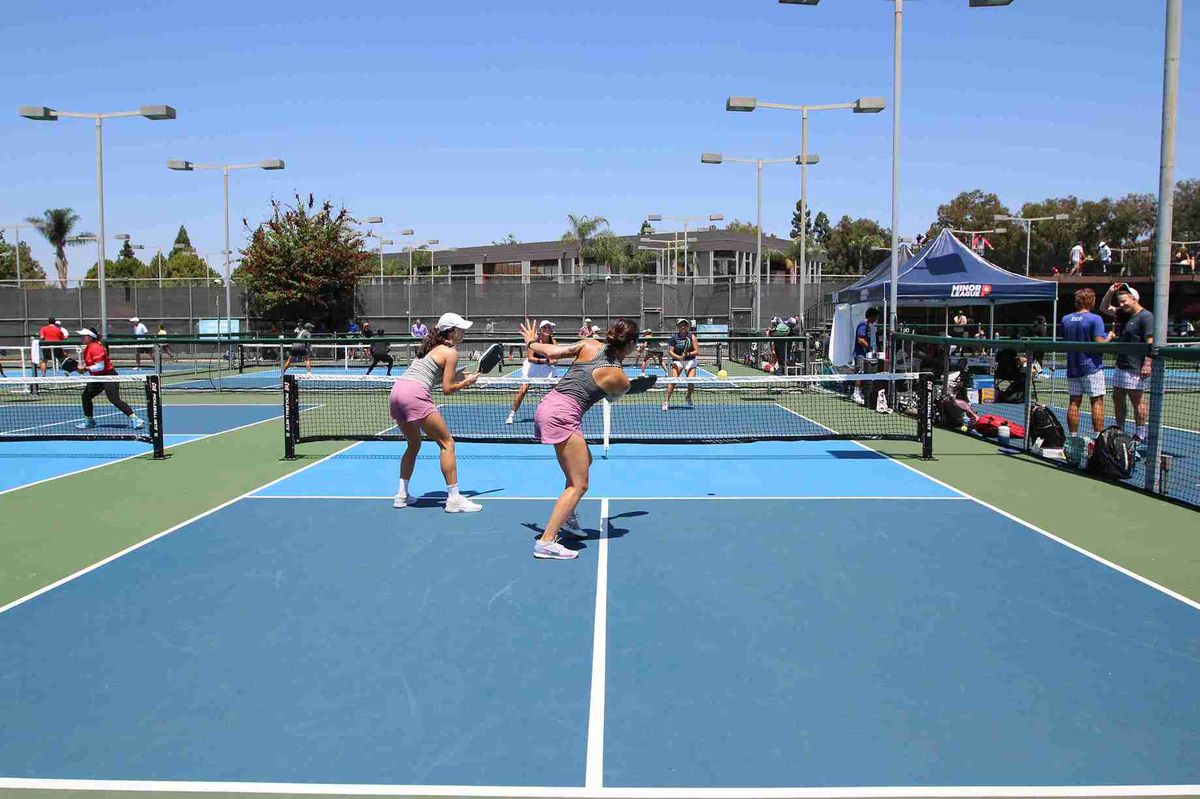
Block 3: Targeted Skill Work
This block changes every few weeks based on what you're actually identifying as the gap in your game. Think of it as your "problem solver" session.
Not sure what your biggest weakness is? Watch a video of yourself playing. It's uncomfortable, but it's the fastest way to identify the real issue.
Most players think their problem is their reset, it's usually their court positioning before the ball even arrives.
Mid-court positioning is one of the most overlooked skill areas in recreational pickleball.
This block works best when you're working with a hitting partner and using the session to identify specific skill investments that target your identified weakness, not just whatever happens to be fun that day.
Pick one area. Spend the whole hour there. Track whether it's improving week over week.
 Eric Roddy
Putting It All Together: Your Weekly Schedule
Here's what a real week looks like for someone with 3 hours and a purpose:
- Tuesday, 60 min: Drilling block, third shot drop + cross-court dink rally
- Thursday, 60 min: Competitive play with one tactical intention
- Saturday, 60 min: Targeted skill work, this week, working on kitchen line positioning and handling the perfect drop
Three sessions. Three purposes. No junk miles.
The dinking drill that has helped thousands of players get sharper at the kitchen is worth working into your Tuesday rotation as your skill base develops.
And when you're ready to level up your serve game specifically, return of serve positioning deserves its own dedicated session in your Block 3 rotation.
The key is not complexity. It's consistency and intention over time.
 The Dink Media Team
Key Takeaways
- A focused 3-hour weekly schedule beats unstructured play for skill development
- Split your time: 1 hour drilling, 1 hour structured play, 1 hour targeted skill work
- The third shot drop and dink game are the highest-ROI skills to prioritize first
- Solo drills and wall work count, you don't always need a partner
- Track your weak spots so each session has a purpose, not just a goal of "getting reps"
Frequently Asked Questions
What is the best practice routine for pickleball with limited time?
The best practice routine for limited time pickleball players divides available hours into three focused blocks: one for drilling, one for intentional competitive play, and one for targeted weak-spot work. Three hours a week, split this way, produces measurable improvement faster than casual open play for most recreational players.
Can you improve at pickleball by practicing only 3 hours a week?
Yes, absolutely. Research from sports science consistently shows that deliberate, focused practice produces greater skill gains than unstructured play, regardless of total time logged. Three hours of intentional work on specific techniques, especially third shot drops, dinking, and reset mechanics, will move your rating faster than five-plus hours of casual rallying.
What pickleball skills should I focus on with limited practice time?
Prioritize the third shot drop and the dink game first. These are the two skills that most directly impact your win rate at the 3.0 to 4.0 level. Secondary priorities include return of serve positioning, reset mechanics under pressure, and footwork patterns at the kitchen line.
Do solo pickleball drills count as real practice?
Yes, and most players underestimate how valuable solo work actually is. Wall drills for dink consistency, shadow footwork patterns, and serve repetition are all highly effective and let you accumulate quality reps without needing a partner or court time. Solo drilling is especially useful for motor pattern reinforcement in specific shots.
How do I track whether my pickleball practice is working?
The simplest method: pick one measurable indicator per skill and track it weekly. For dinks, count consecutive rallies before a miss. For third shot drops, track the percentage that land in the transition zone. If the numbers are climbing week over week, the practice routine is working. If they plateau, it's time to adjust the drill or get more structured feedback from a coach or video review.

Love Pickleball? Join 100k+ readers for free weekly tips, news & gear deals.
Subscribe to The Dink