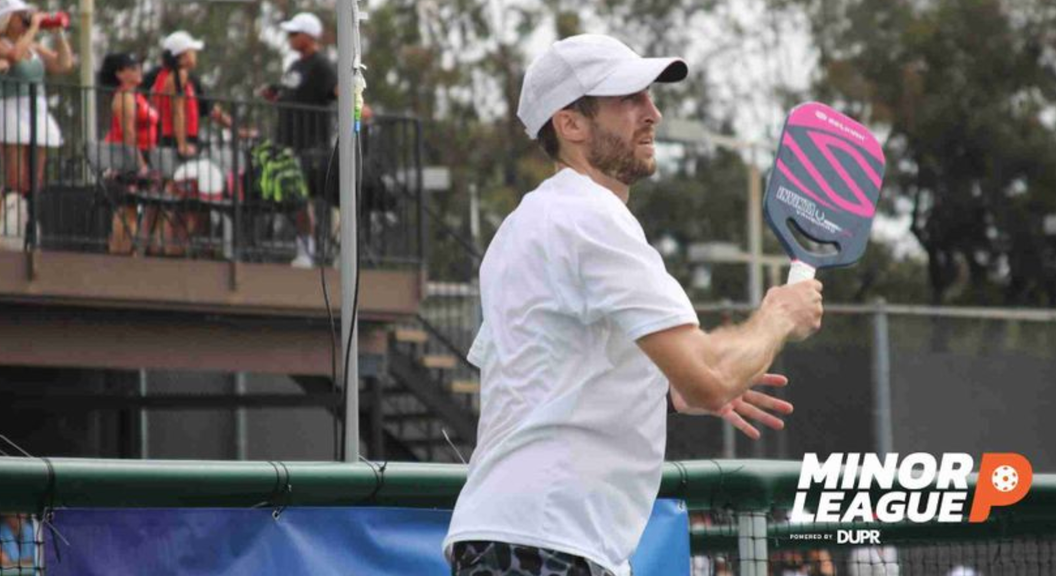
How to Build Pickleball Confidence After Losing a Close Game
Rebuilding pickleball confidence after losing a close match starts with a fast, honest audit instead of a week of replaying the same two points. Here's the 20-minute protocol, the process markers worth tracking, and the drill to run before your next session.
Losing 11-9 does more damage to your pickleball confidence after losing than getting run off the court 11-2, and anyone who has driven home in silence already knows it.
The blowout is easy to file away. You got outplayed, move on. But the close one sits there.
 Alex E. Weaver
You can name the exact two points you'd take back, and your brain will replay them at 2 a.m. for free.
Here's the thing. That replay loop feels like analysis. It isn't. It's rumination wearing analysis as a disguise, and it's the biggest reason good players show up flat to their next session.
Love pickleball? Then you'll love our free newsletter. We send the latest news, tips, and highlights for free each week.
Why Does a Close Loss Hit Your Pickleball Confidence After Losing So Hard?
A close loss hurts more because it feels reversible.
Your brain treats two or three swing points as the entire match, decides you personally lost it, and files the result as evidence about you rather than information about the game.
That's outcome bias, and it shows up in how elite players talk about their own errors too.
Outcome bias is the habit of judging a decision by how it turned out instead of whether it was right at the time.
Speed up on a ball at your opponent's hip, pop it, lose the point? Outcome bias says the speed-up was a mistake.
 Alex E. Weaver
It wasn't. It was the right read that didn't land.
Confusing the two is how players talk themselves out of good shots for three weeks, and it's the same trap behind most self-inflicted mental walls in this sport.
Close matches are dense with these moments. Gamepoint behavior is real: players tighten up at 9-9 and start hitting safe, which is exactly when opponents start attacking.
You didn't lose because you're not good enough. You lost because for four points you stopped playing your game, and that's a fixable problem rather than a character flaw.
The distinction matters. One version sends you to practice. The other sends you to the couch.
The 20-Minute Audit That Rebuilds Pickleball Confidence After Losing
The fastest way to restore pickleball confidence after losing is to time-box the review.
Give the match twenty minutes of honest attention, write down what you find, then stop.
Not "try to stop." Actually stop, because you've already extracted everything useful.
Do it within a few hours, while you remember patterns and not just feelings. Three questions:
- What pattern beat me, not what shot beat me? "I missed drops" is useless. "I missed drops from the backhand corner when they pushed me deep" is a practice plan. Track unforced errors by situation, not by count.
- Where did I stop playing my game? Name the score. Most players can pinpoint it instantly, and it's almost always somewhere in the 8-to-11 stretch where pressure changed their shot selection.
- What did I execute well that I'm about to forget? This one gets skipped, and skipping it is why the audit turns into a spiral. You hit good stuff. Write it down.
Then close the notebook. Genuinely. If you catch yourself relitigating point seven on Thursday, that's not diligence, that's a rut forming.
Pros do a compressed version of this mid-match. Quang Duong looks at his dad between points as a deliberate mental reset.
The six-second reset does the same job between rallies. The audit is just that habit stretched over one match instead of one point.
Rebuild on Execution, Not the Scoreboard
Pickleball confidence after losing recovers fastest when it's built on execution rather than results, because you control execution and you don't control winning.
Shift what you're grading yourself on and the close loss stops functioning as a verdict.
Worth being honest about the evidence.
A meta-analysis of 3,711 athletes across 24 sports found the link between self-confidence and performance was positive but small, at r = 0.25.
That's correlational and not pickleball-specific, and it cuts against the idea that confidence alone separates you from 4.5.
Which is good news, honestly. It means the fix is on the court and not in your head.
 The Dink Media Team
What Should You Track Instead of Wins?
Track three or four process markers you can count without a coach. Percentage of third shot drops that land in the kitchen.
Unforced errors in the transition zone. Number of resets you got back under pressure instead of popping up. Times you held your shot selection at 9-9.
These move faster than your record does, which is the whole point.
You can lose three matches in a row and still see your drop percentage climb, and that's the evidence your confidence actually runs on.
Players chasing more consistent pickleball figure this out early. Your DUPR can dip while your game improves. Both things are true at once.
How Do You Rebuild Pickleball Confidence After Losing in Doubles?
In doubles, you rebuild by having one short, specific conversation with your partner within a day, then dropping it.
The confidence hit in doubles is different because somebody watched you miss it, and the silence in the car afterward does more damage than the loss.
Keep it tactical. What did we default to at 9-9? Who was getting picked on, and did we switch? That's a strategy conversation, not an apology tour.
The questions worth asking your partner before a match work just as well after one.
And if you're the stronger player, skip the reassurance speech. Playing with a weaker partner well means giving them a job, not absolution.
 The Dink Media Team
Get Back on Court Before the Story Hardens
Play again within four days.
Pickleball confidence after losing erodes in the gap, not in the match, because the longer you wait the more time you have to build a story about it.
Stories are stickier than scores. This isn't a claim that time heals nothing.
Research on psychological recovery in athletes describes it as a dynamic process shaped by both protective and risk factors rather than something that resolves on a fixed schedule.
Recovery moves. What you do in the gap seems to matter more than how long the gap is.
Practically: make the next session a drilling session, not a competitive one. Rec games with a bruised ego turn into stubborn habits and safe shot selection.
Drilling gives you reps with no scoreboard attached, which is what you need when the scoreboard is the thing bothering you.
If motivation is the issue, drill alternatives beat skipping it.
 Anna Bright
The One Drill Worth Running After Every Close Loss
Run 9-9 games. Start at 9-9, play it out, reset, repeat. Ten of them.
That's it. You lost in the endgame, so train the endgame.
Most players have hit ten thousand dinks and maybe forty genuinely tight closing points, a strange ratio for something that decides matches.
Ten 9-9 games gives you more high-pressure reps in twenty minutes than a month of rec play.
Add a constraint: no speed-ups until the fourth shot, forcing patience under pressure instead of the panic attack that probably cost you the match.
Pair it with mental clarity work before your next tournament and the 9-9 score starts feeling familiar instead of terrifying.
Familiar is the goal. Confidence isn't a feeling you summon. It's what's left after you've been somewhere enough times that it stops being scary.
 The Dink Media Team
Key Takeaways
- A close loss hurts more than a blowout because outcome bias turns two swing points into a verdict about your ability.
- Time-box the review to 20 minutes. Find the pattern, note what you executed well, then close the book.
- Grade yourself on process markers, not results. Drop percentage and reset counts move faster than your record does.
- In doubles, have one tactical conversation with your partner and skip the apology tour.
- Get back on court within four days, and make it a drilling session built around 9-9 games.
Frequently Asked Questions
How long does it take to rebuild pickleball confidence after losing a close match?
Most players are fine after one good drilling session, usually within a few days. If a loss is still affecting how you play two or three weeks later, the issue is a pattern you haven't identified rather than the loss itself. Go back and do the audit properly.
Does losing lower my DUPR enough to worry about?
A single close loss to a similarly rated team moves your rating very little, and losing tight to higher-rated opponents can help it. Rating systems account for opponent strength. Avoiding tough matchups to protect a number is the faster way to stall out.
Should I watch video of a match I lost?
Yes, but once and with a specific question in mind. Watching film to confirm you played badly isn't analysis. Watch the 8-11 stretch only, look at shot selection rather than execution, then stop.
Is it better to take time off after a bad loss?
Taking a week off tends to let the story about the loss harden while your feel for the ball fades. Playing again within a few days, in a low-stakes drilling context, generally works better. Take time off for physical reasons, not emotional ones.
What if I keep losing close matches specifically?
Repeatedly losing 11-9 is usually a closing problem, not a skill problem, and it's one of the more fixable patterns in pickleball. Look at what changes in your shot selection after 8-8. Most players get passive right when their opponents get aggressive.

Love Pickleball? Join 100k+ readers for free weekly tips, news & gear deals.
Subscribe to The Dink