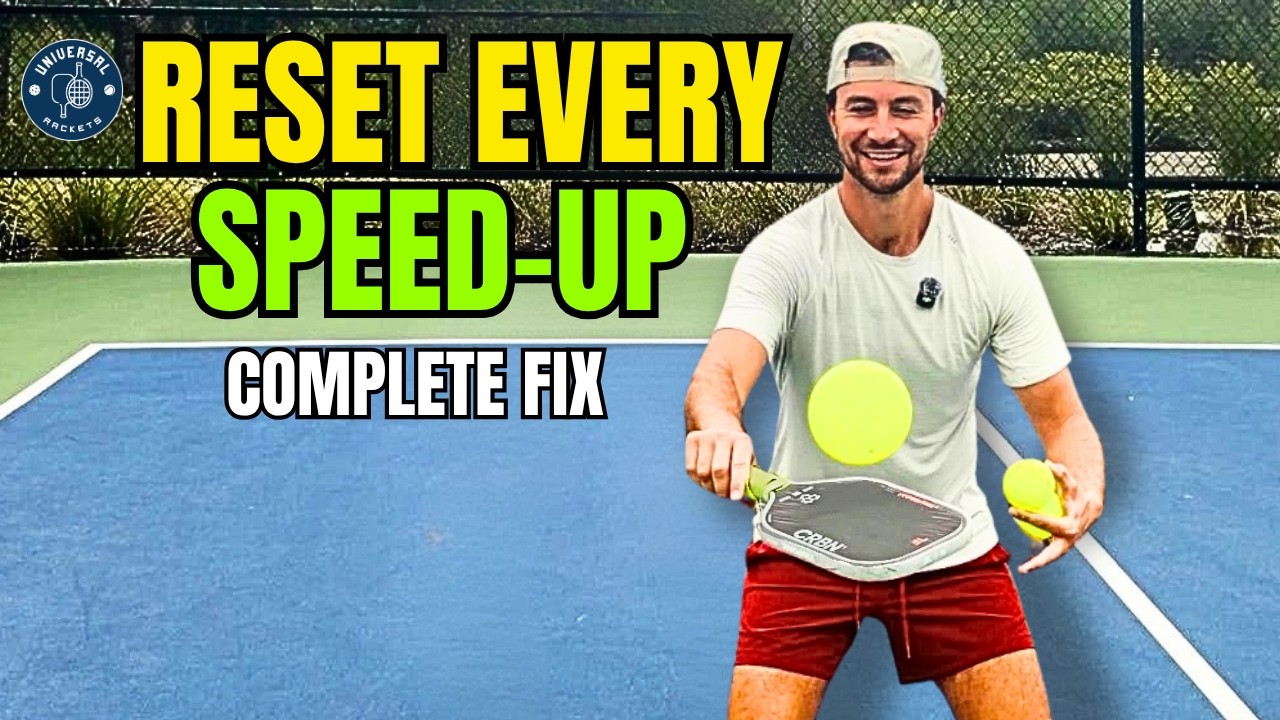
The pickleball speed-up reset is the skill that separates players who win from players who panic at the kitchen. These 3 fixes will help you absorb, redirect, and counter every speed-up thrown at you.
The pickleball speed-up reset is the skill that separates players who win rallies at the kitchen from players who flinch and pop the ball straight into the air for an easy putaway.
Most players make the same mistakes. They tense up, swing at the wrong balls, or keep their paddle way too low when the speed-up comes.
Every one of those habits costs you points.
This breakdown covers three specific fixes that will change how you handle every speed-up, including when to reset softly and when to shift your body and counter instead.
The instruction here comes from Universal Rackets on YouTube, a coaching channel packed with practical, court-tested technique.
Love pickleball? Then you'll love our free newsletter. We send the latest news, tips, and highlights for free each week.
What Is a Speed-Up and Why Does It Work?
A speed-up is when your opponent suddenly accelerates the ball during a soft dink rally. It is designed to catch you off guard and force an error.
It works because most players are not ready for it.
They either flinch and pop the ball up, or they try to counterattack a ball that was never in a good position to attack.
Both responses hand your opponent an easy point.
The fix is not faster reflexes. It is the right mechanics applied before the speed-up ever arrives.
Fix 1: Soft Hands Are the Foundation of Every Reset
Soft hands win every time. When the speed-up comes, your instinct is to tense up and fight the pace.
That is exactly wrong.
Think about catching a water balloon. You do not stab at it. You give with it so it does not burst.
The same principle applies to your paddle when you are executing a pickleball speed-up reset.
 Zoey Weil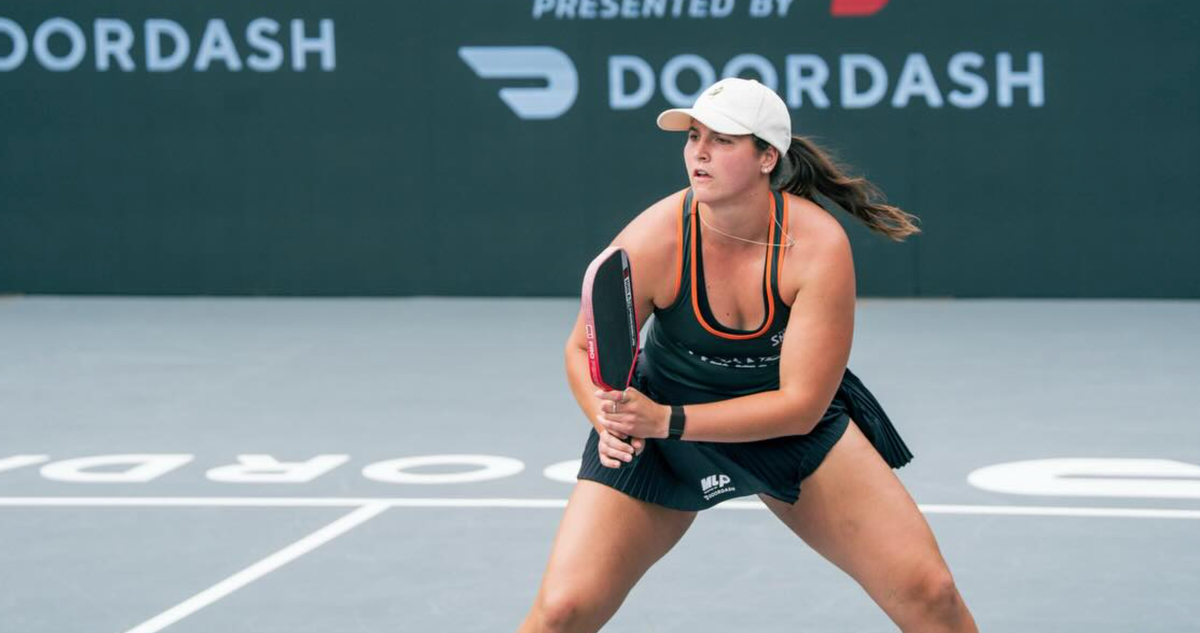
A tight grip acts like a trampoline. The ball hits your paddle and pops right back up into your opponent's wheelhouse.
A loose grip absorbs the energy and lets the ball die into the kitchen where it belongs.
Aim for a grip pressure of about three out of ten. Ten is a death grip, one is nearly dropping the paddle.
Three gives you control without tension.
The key mental image is this: do not just think "loose," think "absorb."
The faster the ball comes at you, the more you need to give with the paddle, not fight against it.
The Drill That Trains Your Pickleball Speed-Up Reset
Here is the best drill to lock this in:
- Have a partner feed balls at you, or self-feed
- Hold your paddle as still as possible and let it tap the ball into the kitchen
- Ask yourself how little you can do and still have the ball land softly
- Listen for the sound: a tight grip produces a pop, a soft grip produces a quiet kiss off the paddle face
- Hit 20 to 30 balls on the forehand, then repeat on the backhand
Less movement is more. If your pickleball speed-up reset keeps popping up, the first thing to check is always your grip pressure.
Fix 2: Your Paddle Has to Be Up Before the Speed-Up Happens
You have almost no time to react at the kitchen, and a pickleball speed-up reset only works if the paddle is already there.
The player hitting the speed-up is standing two feet away from you.
If your paddle is sitting at your waist when the ball comes, you will never get it up in time.
And if you do make contact, you are going to get jammed and pop the ball up anyway.
Your paddle needs to be up and out in front of your body at chest height at all times during a dink rally. Not after the speed-up, before it.
A simple cue that works: keep your non-dominant hand touching your paddle throughout the rally.
If your non-dominant hand drops, your paddle drops with it.
This keeps you in the correct ready position automatically.
Another cue that sticks: think of the Beyonce "put a ring on it" pose. Your non-dominant hand is up, your paddle is touching it, and you are ready.
It sounds silly, but you will never forget it.
Your timing and positioning before the ball arrives matters more than what you do after it. Being in the right position is not about athleticism.
It is just a habit.
How to Drill the Ready Position for a Pickleball Speed-Up Reset
- Stand at the kitchen with your paddle at chest height
- Have a partner throw or feed balls at you fast, randomly forehand and backhand
- All you do is deflect using the absorb technique from Fix 1
- Start with 20 backhands, then 20 forehands, then make it random
- Every rep starts and ends with the paddle up
Players who never get caught by speed-ups are not faster than you. They just always have their paddle ready.
Expect the speed-up on every single ball, even during a gentle cross-court dink rally.
 The Dink Media Team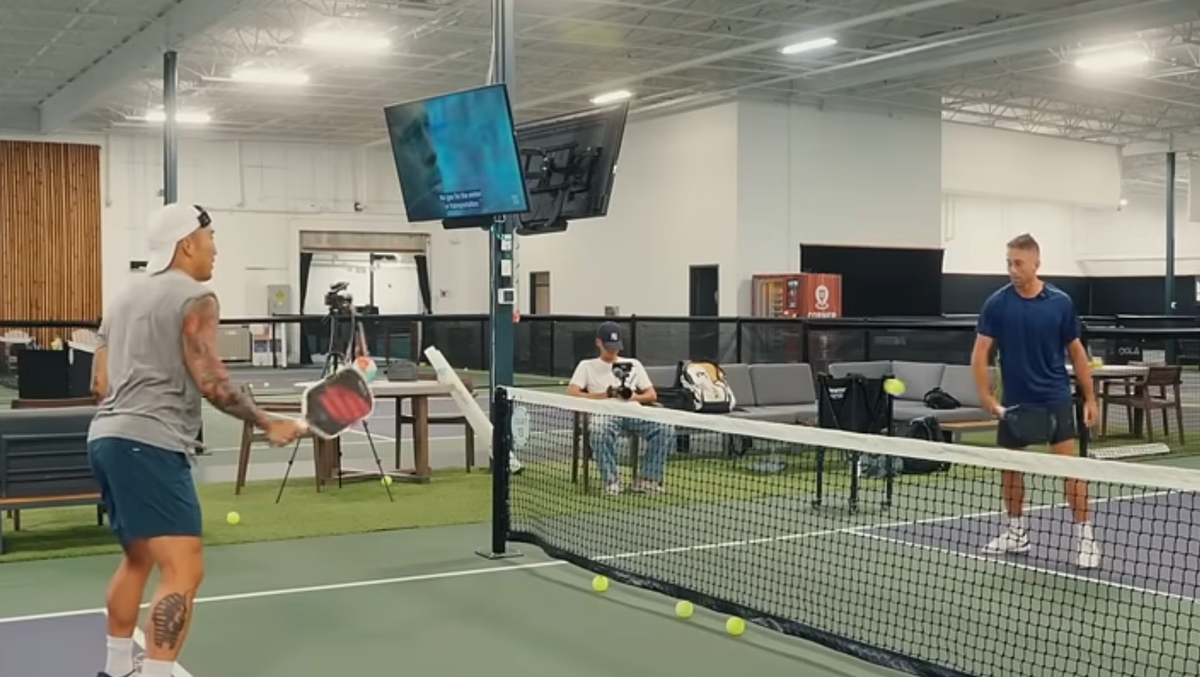
Should You Let Some Speed-Ups Go Out?
Yes, and more often than you think.
A lot of players are fighting speed-ups that would have gone long if they had just stepped back and watched.
One coach ran a study where he let every opponent speed-up go without touching it.
He won over 50 percent of those points because the balls went long.
That does not mean you ignore every speed-up.
But it does mean you should let one or two go early in a match to see if your opponent's speed-ups are actually landing in.
Recognizing out balls before you swing at them is one of the fastest ways to reduce errors in any rally.
Also pay attention to patterns. Some players only speed up on their forehand side.
Some speed up every ball regardless of whether it makes tactical sense.
Once you know the pattern, you can prepare your pickleball speed-up reset before the ball even leaves their paddle.
 The Dink Media Team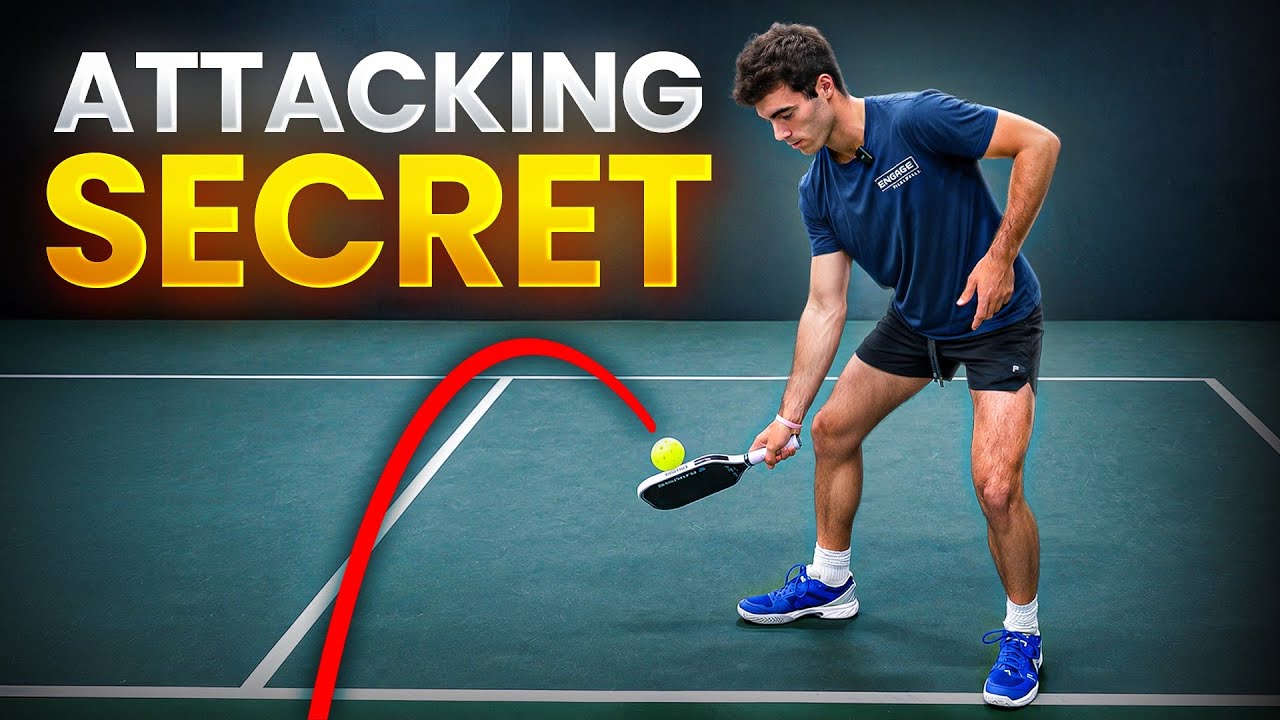
Fix 3: Know When to Reset Versus When to Counter
Not every speed-up should be reset. Not every speed-up should be countered.
Knowing the difference in a split second is a real skill, and most players get it backwards.
Here is the simple rule:
- Reset when the ball is low, close to your body, or you cannot clearly read it
- Counter only when the ball is high, away from your body, and sitting up to be attacked
Most players counter too often and lose the point. Default to the pickleball speed-up reset.
You can always reset a ball that was counterable, but you cannot counter a ball that needed a reset.
When you counter, keep your elbow tucked and use your wrist. Do not swing with your whole arm because you will be late.
The counter is a compact, controlled shot, not a full swing.
Fixing the pop-up on your counter shot starts with understanding where the contact point is relative to your body.
 The Dink Media Team
The Body Shift That Makes Countering Possible
Here is the part that almost nobody talks about, and it is the reason pros can counter shots that seem impossible.
If a ball is in your reset zone (close to your body, low), you cannot counter it from that position.
But if you shift your body laterally before contact, the same ball is now in your counter zone.
Think of it this way: your counter zone is away from your body with height. Your reset zone is close to your body or low.
By stepping to the side before the ball arrives, you move the contact point from one zone to the other.
This only works in two situations. First, when the speed-up is slow enough that you have time to move.
Second, when you can read the opponent well enough to move early. Understanding the mechanics of the backhand counter helps you know which option to use in real time.
If you are on the right side of the court and you know a right-handed opponent loves to speed up at you, shift toward the sideline.
Anything that falls on the other side of your body will likely go out.
Anything that comes to the outside is now in your strike zone.
Building lateral movement habits makes this shift automatic over time rather than something you have to think about during a point.
 The Dink Media Team
Putting All Three Fixes Together
These three fixes work as a system, not as separate isolated tips.
Soft hands absorb the pace. The ready position gives you the fraction of a second you need to decide.
And the reset versus counter decision determines whether you stay in the point or win it outright.
Start by drilling Fix 1 and Fix 2 separately until they feel automatic.
The rubber band drill is one of the best ways to train the reset feel on your own without a partner.
Once your soft hands and paddle position are habits, then you start working on reading opponents and adding the body shift for counters.
If you are newer to these concepts, these three foundational tips for dinking and resetting give you a strong base to build from.
And if you want to understand how to handle hard shots beyond just speed-ups, this breakdown on blocking hard shots covers the same soft-hand principles in a wider context.
The mental default is always reset. When in doubt, reset. Counter only when the ball is clearly begging to be attacked and you are already in position.
Mastering pickleball defense means trusting the reset more than the counter until your reads become sharp and automatic.
Speed-ups will keep coming. Now you know exactly what to do with them.
Frequently Asked Questions
What is the most common mistake players make when resetting a speed-up?
The most common mistake is holding the paddle with too tight a grip, which acts like a trampoline and pops the ball up. You want a grip pressure of around three out of ten so the paddle absorbs the pace instead of fighting it. Less movement and less tension at contact is what keeps the ball low.
Where should my paddle be when I am dinking to prepare for a speed-up?
Your paddle should be at chest height and out in front of your body at all times during a dink rally. Keeping your non-dominant hand touching your paddle is a reliable cue to stay in the correct ready position. If your paddle drops to your waist, you will not have time to get it up before the speed-up arrives.
How do I know when to counter instead of reset a speed-up?
Counter only when the ball is high and away from your body, meaning it is sitting up in your strike zone with room to swing. If the ball is low or close to your body, reset it. When in doubt, always default to the reset because a reset can always replace a counter, but a counter cannot replace a reset.
Should I ever just let a speed-up go without hitting it?
Yes, especially early in a match when you do not know if your opponent's speed-ups are landing in or going long. One coaching study found that letting every opponent speed-up go out resulted in winning more than 50 percent of those exchanges. Let one or two go to test whether the ball actually stays in bounds before committing to a response.
What is the body shift technique for countering and when should I use it?
The body shift is when you step laterally before contact to move a ball from your reset zone (close to the body) into your counter zone (away from the body with height). It works when you have time because the speed-up is slower, or when you have already read your opponent and know the ball is coming. Right-handed players on the right side of the court should shift toward the sideline to put more of the court out and bring the ball into a comfortable counter position.

Love Pickleball? Join 100k+ readers for free weekly tips, news & gear deals.
Subscribe to The Dink