3 Pickleball Return of Serve Placements That Set Up the Point
Smart pickleball return of serve placement wins points before the rally even starts. These three targets pin the server deep, open the middle, and hand you an easier fourth shot every time.
Good pickleball return of serve placement has almost nothing to do with how hard you swing and everything to do with where the ball lands.
Yet most rec players treat the return of serve like a chore. Get it in, sprint to the kitchen, hope for the best.
Here's the thing: the return is the only shot in pickleball where you get a full, unhurried swing at a ball that has to bounce first.
You know it's coming. You know roughly where it's going. That's a gift, and spraying it toward the middle wastes it.
Three targets do most of the heavy lifting.
Love pickleball? Then you'll love our free newsletter. We send the latest news, tips, and highlights for free each week.
Why Does Pickleball Return of Serve Placement Matter More Than Power?
Because placement controls how far the server travels before hitting their third shot, and distance is the one advantage you get for free.
A deep return pins the serving team at the baseline while you claim the kitchen line.
Power does none of that. A screamer that lands mid-court invites the server forward and makes their third shot drop easier.
Pickleball return of serve placement is the target you choose: the depth, the side, and the specific body position you're aiming at.
Not the general direction. The actual spot.
Every return writes the script for the next two shots. A deep one forces a low-percentage drop from 22 feet back.
A short one hands the server a drive they can rip at your feet while you're stranded in the transition zone. Same swing, wildly different point.
Placement No. 1: Deep at the Backhand Hip
Your default target is the server's backhand side, landing within three feet of the baseline.
This is the bread-and-butter pickleball return of serve placement, and it should account for roughly 70% of what you hit.
Why the backhand? Most players below 4.5 have a shakier backhand drop.
Ask any coach: backhands are where rallies go to die. Aim there until someone punishes it.
The hip part matters more than people realize. Don't aim at open court. Aim where their backhand meets their body, so they can't step in or rotate freely.
Cramped players hit floaters, and floaters get attacked at the kitchen line.
A peer-reviewed 2025 study of elite racquet-sport players found consistency in shot selection predicted winning more reliably than variety did.
Translation for your Tuesday league: pick the deep backhand and hit it over and over.
How Deep Does Your Pickleball Return of Serve Placement Need to Be?
Aim for the last three feet of the court and accept that a few sail long. If you never miss one deep, you're playing too safe.
A deep return landing at the server's feet is worth far more than a tidy one dropping at the service line.
Depth buys time, the real currency here. Two extra steps toward the kitchen is the difference between a balanced fifth shot and scrambling through midcourt.
Height helps too: a return with some arc hangs longer than a flat rocket. Our guide on where to return serve in pickleball maps the zones in detail.
Placement No. 2: The Deep Outside Corner
Your second target is the outside corner on the server's forehand side, pulling them wide and off the court.
Use it when the server camps in the middle or when their partner drifts toward center, a read our doubles sideline placement breakdown covers well.
This pickleball return of serve placement does what the deep backhand can't: it opens the middle.
When the server chases a ball wide, their third has to travel a longer diagonal to avoid your partner.
Hard shot from 20-plus feet back. It's also the ball your partner should be hunting, so make sure they're reading the server's shoulders for the poach.
Bonus against stacking teams: if the serving side is stacking to hide a weak side, the server is already moving laterally as they hit.
A wide return means running two directions at once.
When Should You Go Down the Line Instead?
Go down the line when the server commits to the middle early or slides toward their partner after every serve.
Honestly, this is a read, not a rule. Watch two or three points, find the habit, take the space.
One caution: the down-the-line ball travels over the higher part of the net and leaves less margin, so treat it as a change-up.
Missing more than one in five? Go back to the deep backhand. More situational options live in our return of serve tips piece.
 The Dink Media Team
Placement No. 3: The Body Jam
The third target is the server's dominant-side hip, straight at their body.
It's the most underused pickleball return of serve placement in rec play and the one that frustrates bangers most.
A jam creates a decision problem.
The server has half a second to choose forehand or backhand on a ball arriving at their sternum, and neither choice lets them extend their arms.
Expect mishits, chicken wings, and thirds that find the net.
It's brutal against players who love to drive with heavy topspin, because topspin drives need space to build paddle speed.
Take the space away and the drive disappears. That's the whole return of serve strategy in one sentence.
Why Does This Pickleball Return of Serve Placement Beat Bangers?
Because bangers rely on swing length, and a jammed body position shortens the swing whether they like it or not.
A player who normally hits a 65-mph drive will produce a soft, high ball when the return arrives at their hip.
That floater is your invitation to step in and take it out of the air.
Add slice and it gets worse for them. A low, skidding slice return at the hip forces them to hit up from below the waist, which is almost always an attackable third.
 The Dink Media Team
How Do You Drill Pickleball Return of Serve Placement?
Put targets on the court and keep score, because untargeted practice only reinforces what you already do.
Ten minutes twice a week beats an hour of casual rallying, and it pairs well with the rest of your doubles strategy work.
Here's a drill needing one partner and four cones:
- Set two cones in the deep backhand corner, about three feet in from the baseline and sideline.
- Set two more in the deep outside corner on that same half.
- Your partner serves ten balls. Return all ten to the backhand zone. One point per ball landing past the service line inside it.
- Switch to the outside corner for ten more.
- Finish with ten jam returns at your partner's dominant hip.
Track the number. Most 3.5 players start around 11 out of 30.
Get to 22 and your pickleball return of serve placement stops being random, because you'll arrive at the kitchen line on balance instead of lunging.
Sharp pickleball return of serve placement also falls apart when your feet are late, so pair the drill with better return footwork and check that your ready position isn't costing you points before blaming the paddle.
 The Dink Media Team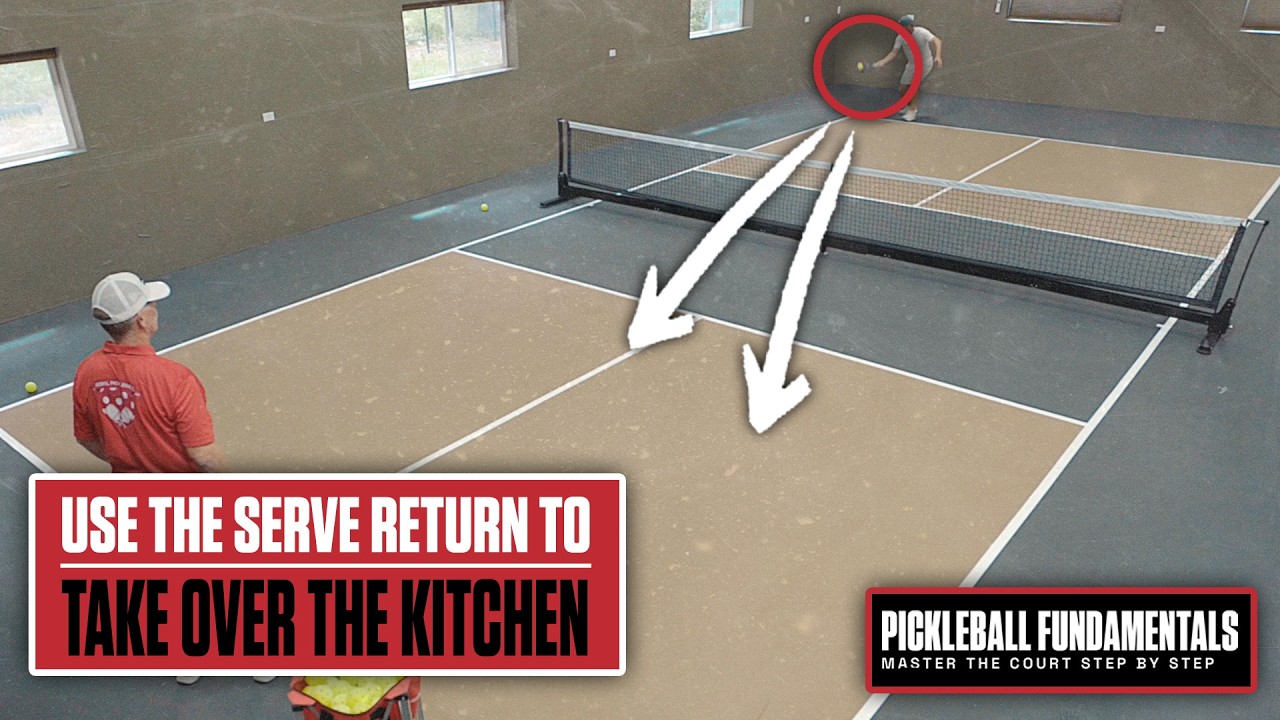
Key Takeaways
- Depth beats power. A deep return pins the serving team back and buys you time to reach the kitchen.
- The backhand hip is your default. Roughly 70% of returns should land deep at the server's backhand, aimed at the body rather than open court.
- The outside corner opens the middle. Pull the server wide and your partner gets a poachable third shot.
- The body jam kills drives. Taking away swing space turns a banger's weapon into a floater.
- Score your practice. Cone targets and a running tally improve pickleball return of serve placement faster than casual rallying.
Frequently Asked Questions
Where should you aim your return of serve in pickleball?
Aim deep to the server's backhand side, landing within three feet of the baseline and close to their body. That keeps the serving team pinned back and gives you time to reach the kitchen line. Against bangers, a return straight at their dominant hip works even better.
How deep should a pickleball return of serve be?
Target the final three feet of the court, just inside the baseline. Anything landing near or short of the service line lets the server step forward and attack. Adding arc to the return also slows the ball down and buys you extra steps toward the net.
Should you hit your return hard or soft?
Soft and deep beats hard and shallow almost every time. A high, floating deep return hangs longer, giving you more time to advance, and it forces the server to generate all their own pace. Save the harder return for when you've already pulled someone out of position.
Is it legal to return serve into the kitchen in pickleball?
Yes. The two-bounce rule only requires that the serve bounce and the return bounce before anyone volleys, so a return may legally land anywhere in the correct court, including the non-volley zone. See the official USA Pickleball rules for exact wording. Tactically, though, a short return is a gift to the serving team.
How do you return a hard or spinny serve?
Take a bigger backswing away from the body, meet the ball out front, and use a slight slice to neutralize topspin. Move a step behind the baseline if the server has real pace. More on this in our guide to making the most of your return of serve.
Love Pickleball? Join 100k+ readers for free weekly tips, news & gear deals.
Subscribe to The Dink