
Pickleball Dinking Over 50: The 3 Essential Pieces You Need to Know
The pickleball dink is the foundation of kitchen dominance, but most players over 50 are missing three critical pieces that separate consistent dinking from endless pop-ups. C.J. Johnson from Better Pickleball breaks down exactly what those pieces are and how to put them together.
If you've ever wondered why your pickleball dink keeps popping up or sailing into the net, you're not alone.
The problem isn't usually your paddle or your reflexes.
According to C.J. Johnson, founder of Better Pickleball, most players are missing three fundamental pieces that work together to create consistency at the kitchen line.
Love pickleball? Then you'll love our free newsletter. We send the latest news, tips, and highlights for free each week.
What Makes a Consistent Pickleball Dink?
Here's the thing: every shot in pickleball, whether it's a dink or a ground stroke, is built on the same foundation.
C.J. Johnson and his guest instructor Susie Hartfield, a former golf teacher and tennis convert, break down the framework that separates players who control the kitchen from those who give their opponents easy attacks.
The three pieces are
- Movement
- Paddle stroke
- Foundation
Each one matters equally. When they work together correctly on every single shot, you gain the consistency that wins points.
When they don't, that's when mistakes happen.
Piece 1: Movement and the Ready Position
Your pickleball dink starts before you even swing. It starts with how you stand.
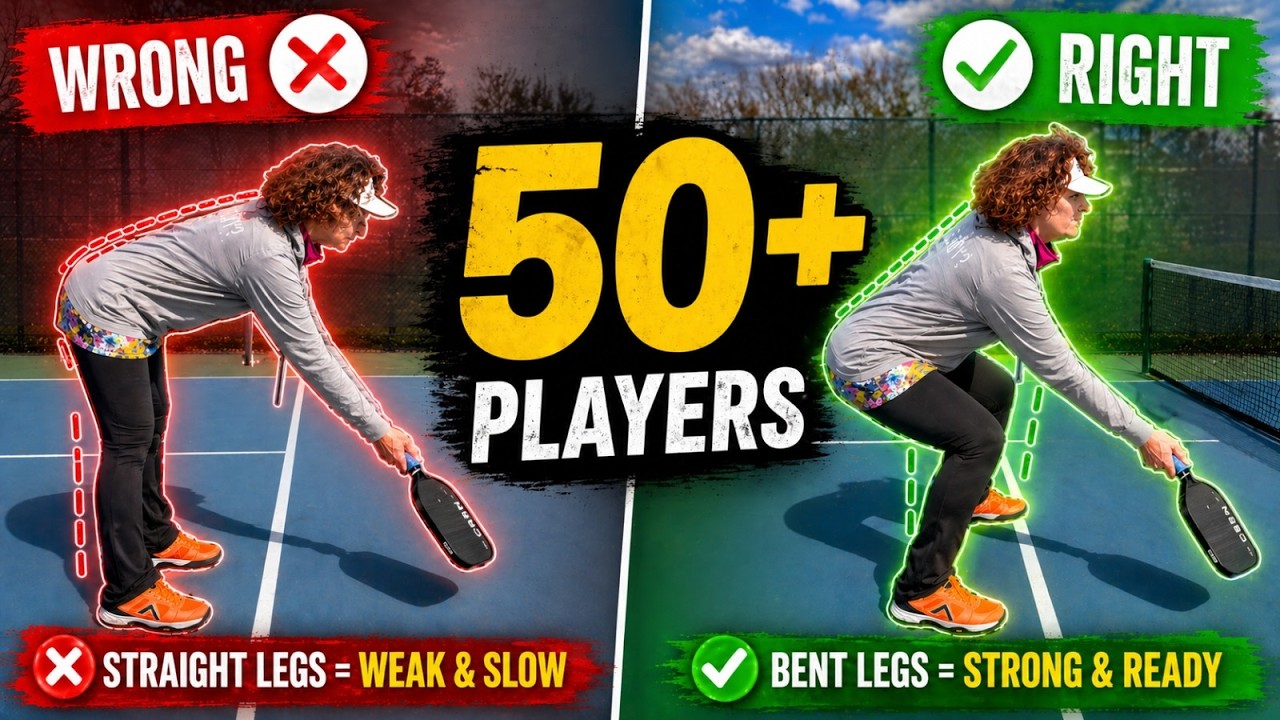
Most players over 50 make the same mistake: they stand with narrow feet, minimal knee flex, and bend forward from the hips.
This position makes it nearly impossible to see the ball and even harder to move laterally. Your neck hurts. Your eyes are looking down.
You're already losing the point before you hit it.
The fix is simple but requires intention.
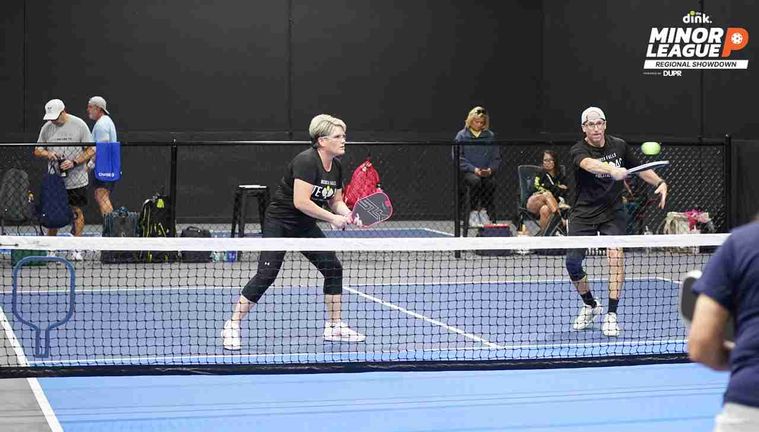
Step out so your feet are about shoulder-width apart. Land on the balls of your feet, what pickleball coaches call "the triangles."
Your shoulders should sit directly over your base.
This athletic stance does two things: it lets you move better laterally, and it allows you to get your eyes down to the ball without straining your neck.
Once you're in this ready position, movement at the non-volley zone becomes a shuffle. You're not taking big steps.
You're not crossing over your body.
You're moving one or two steps to your left, then one or two steps back to your right, keeping your hips parallel to the net the entire time.
The crossover step is tempting, especially on your backhand side. It gives you extra reach.
But as a foundational movement pattern, it opens up space behind you and takes longer to recover from.
Your goal is efficiency, not flashiness.
Piece 2: The Paddle Stroke
Here's a principle that applies to every sport:
The most consistent stroke is the simplest stroke.
For the pickleball dink, that means minimizing your backswing. A bigger backswing means more energy into the shot, which means the ball travels further.
At the kitchen line, you don't need distance. You need control.
Think about what you're actually trying to do: push the ball over the net to your opponent. That's it. You're not trying to hit a winner.
You're not trying to add spin (though spin naturally happens when the paddle brushes the ball). You're trying to keep the ball low and in play.
The stroke itself should feel like a push, not a swing.
Your wrist stays quiet. Your arm stays in a consistent relationship with your body. You move to the shot, then you hit it with a short, controlled motion.
No exaggerated backswing. No wrist flick. Just a simple, repeatable motion that you can execute the same way every single time.
 Alex E. Weaver
Piece 3: Foundation
Foundation is the connection between where your feet are on the court and the paddle swing you just made.
Think of it this way: you've moved to the ball correctly. You're in a good athletic position.
But then you have to reach or lean because the ball is slightly further away than you thought. You've just broken your foundation.
Your body and paddle are no longer in a consistent relationship, and your shot suffers.
The goal is to maintain a stable foundation on every shot.
- You don't want your arm too close to your body (that jams you up).
- You don't want your arm too far away (that forces you to reach).
- You want a consistent, comfortable distance between your body and your paddle that allows you to swing freely.
This is why movement matters so much. If you move your feet correctly to the ball, your foundation stays intact. You're not tilting. You're not leaning.
You're simply in position to make the shot.
Emily Visnic
Putting All 3 Pieces Together
Here's where it gets real: each of these three pieces needs to work together on every single shot.
- You move to the ball (piece 1).
- You swing with a minimal backswing (piece 2).
- You maintain a stable foundation throughout (piece 3).
Do this correctly, and your pickleball dink becomes predictable.
Predictable means consistent. Consistent means you control the kitchen.
The beauty of this framework is that it applies to every shot in pickleball, not just dinks.
Whether you're hitting a ground stroke, a volley, or a reset, these three pieces are always at work.
Master them at the kitchen line, and you've built a foundation for your entire game.
The Dink Media Team
Why Players Over 50 Struggle with the Dink
Age brings wisdom, but it also brings physical changes.
- Your knees don't flex as easily.
- Your neck doesn't rotate as freely.
- Your reflexes aren't quite as sharp.
But here's the thing: the pickleball dink isn't about reflexes. It's about positioning and consistency.
Players over 50 actually have an advantage if they understand this. You've played enough sports to know that fundamentals matter.
You know that shortcuts don't work.
The problem is that most instruction focuses on what to do, not why your body is struggling to do it.
When you understand that your ready position is the root cause of your inconsistency, everything changes.
You're not trying to fix your swing. You're fixing how you stand.
Alex E. Weaver
The Mental Side of Dinking
Consistency breeds confidence.
When you know you can hit the same shot the same way every time, you stop thinking about mechanics and start thinking about strategy.
This is where the pickleball dink becomes a weapon.
- You're not just keeping the ball in play.
- You're setting up your opponent to make a mistake.
- You're moving them around.
- You're waiting for them to pop the ball up so you can attack.
But you can't do any of that if you're worried about whether your dink is going to go in. The three pieces give you that confidence.
The Dink Media Team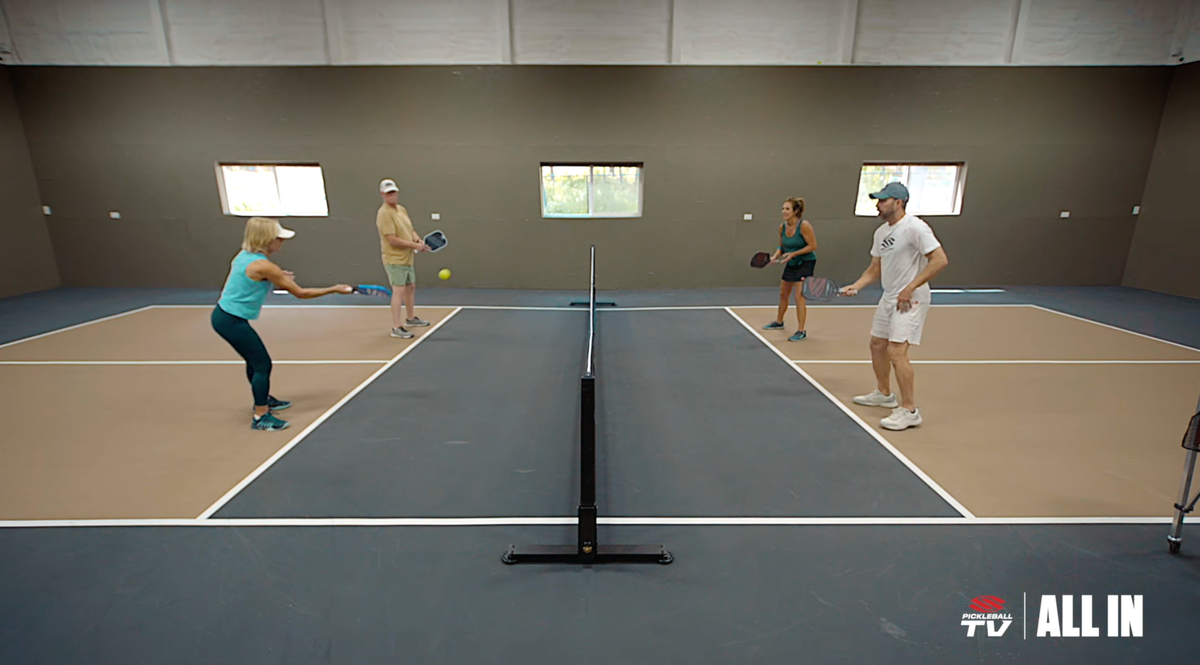
Common Mistakes to Avoid
- The narrow ready position is mistake number one. You see it constantly, especially in recreational play. Players stand like they're waiting for a bus, not like they're about to move in any direction.
- Mistake number two is the big backswing. Players think more backswing means more control. It's the opposite. A bigger backswing means more variables, more things that can go wrong.
- Mistake number three is breaking your foundation by reaching or leaning. This usually happens when you misjudge where the ball is going. The fix is simple: move your feet more. Trust your footwork.
Frequently Asked Questions
What's the difference between a dink and a drop shot in pickleball?
A dink is a soft shot hit from the non-volley zone (the kitchen) that lands in your opponent's kitchen. A drop shot is a soft shot hit from the baseline that also lands in the opponent's kitchen. Both require soft hands and good touch, but a dink is played at the net while a drop shot is played from deep in the court.
How do I know if my ready position is correct?
Your feet should be about shoulder-width apart, with your weight on the balls of your feet. Your knees should have a slight bend. Your shoulders should be over your base, not leaning forward from the hips. You should be able to move quickly in any direction without adjusting your stance first.
Why do my dinks keep popping up?
Pop-ups usually happen because of one of three reasons: your ready position is too narrow or too upright, your backswing is too big, or you're breaking your foundation by reaching for the ball. Focus on the three pieces: movement, stroke, and foundation. Fix one of these, and your pop-ups should decrease.
Can I add spin to my dink?
Yes, but it requires a slightly different motion than the basic dink described here. Natural spin happens when your paddle brushes the ball. If you want to add extra spin, you'll need to adjust your stroke, which makes it less consistent. For most players, especially those learning the game, a simple, spinless dink is more reliable.
How long does it take to develop a consistent dink?
Consistency comes from repetition. If you practice the three pieces correctly, you should see improvement within a few weeks. But true mastery takes months of deliberate practice. The good news is that the dink is one of the easiest shots to practice because you can do it with a partner in a small space.

Love Pickleball? Join 100k+ readers for free weekly tips, news & gear deals.
Subscribe to The Dink