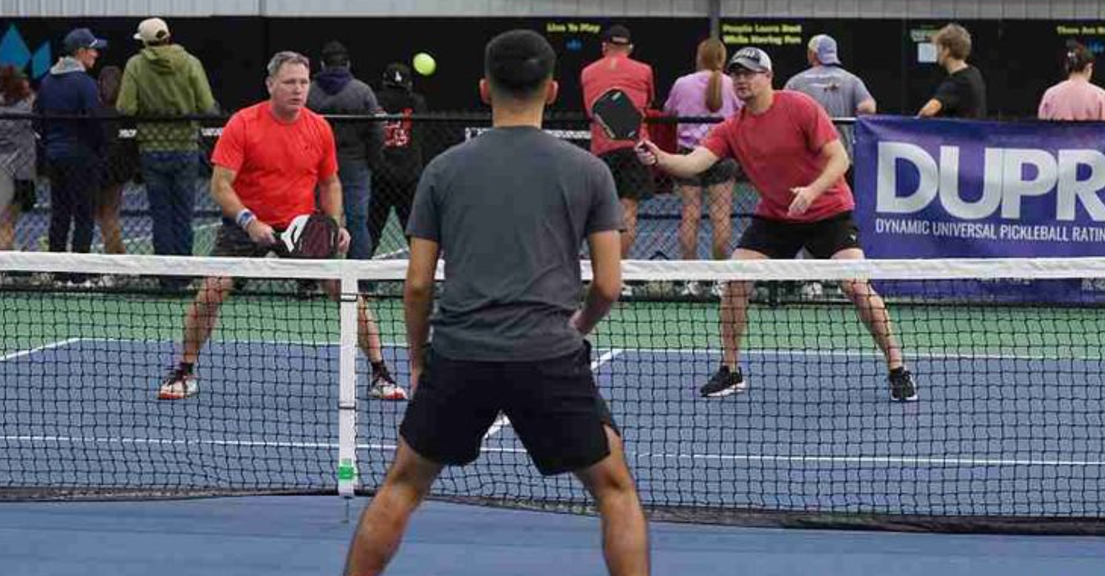
Stacking looks complicated, but it telegraphs exactly where your opponents are going. Here is how to defend against stacking in pickleball by reading the finish, returning to the vacating side, and hunting the middle during the switch.
Learning how to defend against stacking in pickleball starts with one unglamorous habit: looking across the net before the ball is in play.
Most rec players don't. They see two bodies shuffling around behind the baseline, assume something complicated is happening, and mentally hand the point over before the serve even lands.
 Alex E. Weaver
That's the real damage a stack does, and it's why so many players never learn to defend against stacking in pickleball at all.
It isn't magic positioning. It's a doubles positioning strategy built to put two forehands in the middle, and it has a very specific window where it's vulnerable.
Here's the thing. You beat a stack with information, not with a better paddle. Like most advanced doubles strategy, the fix is boring and repeatable.
Love pickleball? Then you'll love our free newsletter. We send the latest news, tips, and highlights for free each week.
What Is Stacking, and Why Do Teams Bother?
Stacking is when doubles partners line up on the same side of the court before the serve or return, then switch positions after contact so each player ends up where the team wants them.
That's the whole definition.
Teams do it to keep a lefty-righty pair's forehands in the middle, to protect a weaker backhand, or to keep their best middle coverage player in the ball's most common path.
It's completely legal. Stacking in pickleball breaks no rule because the rules only dictate who serves and who receives, not where the non-involved partner stands.
USA Pickleball's doubles rules breakdown is worth a skim if you've ever argued about this at open play.
Now the useful part: a stack is a promise. The team is telling you exactly where they intend to end up.
Most opponents never collect on that, which is why it lands on our list of doubles strategies nobody talks about.
The First Rule of How to Defend Against Stacking in Pickleball: Watch the Feet
Identify the stack before you strike the ball.
That's the whole first rule, and it's the one coaching resources keep circling back to, including PickleTip's stacking defense breakdown, which frames it as recognizing the finish of the stack rather than the start of it.
Starting positions lie. Finishing positions don't. Good footwork reading works both ways.
If the left-side player is drifting right as the server tosses, that player is vacating. Their half is about to be covered by someone arriving late.
You now know, with roughly two seconds of lead time, which square foot of court is least defended. That's a bigger edge than any third shot drop you'll hit all day.
Where Should You Look Before the Serve?
Look at the non-server's hips and feet, not the paddle. Hips point where a player is going.
- A stacking partner crouched just outside the sideline with hips angled toward the middle is going to cross the second contact happens.
- A stacking partner squared up and stationary is probably not stacking at all; they're just standing in an odd spot, which is a thing rec players also do.
The rope rule applies here in reverse. Instead of tracking your partner, you're briefly tracking theirs.
Why Does Returning to the Vacating Side Work So Well?
Return to the side your opponent is leaving, because whoever covers it is moving laterally and hitting off balance.
Nobody strikes a clean ball while completing a sprint. The result is a floaty reply you can step into, which is exactly the setup you want before you attack the middle.
Depth matters more than placement here. A deep, pacey return pushes both opponents back and eats the transition seconds a stack depends on.
Better Pickleball's stacking guide describes stacking movement as anchored and triggered by ball contact, which means the whole rotation is on a timer.
Take the timer away and the choreography falls apart.
So don't get cute. Where you return the serve is the single most important decision you make against a stacking team, and a heavy, deep ball to the vacating half beats a clever angle almost every time.
 The Dink Media Team
Defend Against Stacking in Pickleball by Owning the Middle
The middle is where stacks are strongest and weakest, sometimes on the same point.
Strongest because the entire design exists to park two forehands there, as Pickleball US notes in its stacking strategy guide.
Weakest because during the switch itself, nobody owns it.
That gap lasts maybe half a second. Hunt it anyway.
When you catch a stacking team mid-rotation with a ball up the seam, you usually get a collision, a "yours!", or a pop-up.
All three are fine outcomes, and all three come from the same habit: you defend against stacking in pickleball by punishing the rotation, not the formation.
 The Dink Media Team
How to Defend Against Stacking in Pickleball When You're the Serving Team
Serve into the body of the player who has to move, and serve deep. Your goal on the serve isn't an ace.
It's making the return a problem while their rotation is already underway.
A deep serve at the right hip handcuffs the returner and delays their run to the kitchen.
Now their partner is crossing into a half-formed position, and your team gets a fourth shot against opponents who are still sorting themselves out.
Honestly, that's the cleanest free point available in doubles.
One more thing worth saying out loud: your team should be talking. Stacks create confusion, and confusion is contagious.
A quick pre-point conversation with your partner about who's taking the middle against this specific team is worth more than three drills.
 The Dink Media Team
Three Habits That Quietly Beat a Stack
- Track the ball, not the bodies. Stacking teams generate a lot of motion, and motion pulls eyes. Watch the ball and the movement stops mattering. This is the same discipline that keeps you from getting beaten by a poach.
- Make them hit a fifth shot. Stacks are built around winning the first four. Extend rallies with resets and smart shot selection and the pattern loses its shape.
- Test the non-forehand side twice early. If the team stacks to hide a backhand, you'll know by point four. If they're hiding nothing, you've lost two points learning something useful.
Can You Defend Against Stacking in Pickleball Without Changing Your Game?
Mostly, yes. You're adjusting where you aim, not what you hit.
Your return stays the return you already own; you just send it to the half somebody is abandoning. That's it.
The players who struggle are the ones who invent new shots on the spot. Don't.
Your existing return of serve plus better targeting is a complete answer, and the teams running a nontraditional stacking setup are counting on you to overthink it.
The gut check is simple. Did you know where they were going before the ball crossed the net? If yes, you're already ahead.
If no, you're guessing, and guessing against an organized team is how 3.5 players stay 3.5 players. Go watch the feet.
Everything else about how to defend against stacking in pickleball follows from that one look.
For more on breaking these patterns down mid-match, unwinding the stack attack covers a few extra wrinkles.
 The Dink Media Team
Key Takeaways
- Read the stack before contact. Identify which player is finishing on which side while they're still moving.
- Return to the vacating side. The player leaving that half is rushing and off balance, and their reply gets weaker.
- Attack the seam during the switch. The middle opens briefly while both opponents are crossing.
- Go deep and with pace. Depth steals the transition time a stacking team needs.
- Don't ball-watch the movement. Track the ball, not the shuffle.
Frequently Asked Questions
Is stacking legal in pickleball?
Yes, stacking is entirely legal. The rules only govern who serves, who receives, and which service court the serve must land in. Where the partner positions themselves before or after contact is unrestricted, which is why stacking shows up at every level from rec play to the pro tour.
What's the fastest way to defend against stacking in pickleball?
Return deep to the side the opponent is vacating. That single adjustment forces the arriving player to hit while moving, which produces weaker, higher balls for your team. It requires no new shots and no new footwork, just earlier eyes.
Should I stack too if my opponents are stacking?
Only if it solves a problem you actually have, like a lefty-righty pairing or a partner with a much stronger forehand side. Stacking as a reaction usually adds confusion without adding advantage. Learn the mechanics first, then decide.
How do I stop getting distracted by all the movement?
Watch the ball and ignore the shuffle. Stacking teams move a lot before contact, and ball-watching your opponents is how you end up late on the return. Pick a focal point on the server's contact and let the peripheral motion stay peripheral.
Does stacking work against beginners more than advanced players?
It tends to work better against unprepared opponents at any level, because the advantage comes from the confusion as much as the geometry. Advanced players read the finish early and target the transition, which neutralizes most of the benefit.

Love Pickleball? Join 100k+ readers for free weekly tips, news & gear deals.
Subscribe to The Dink