Knowing what happens when the ball hits the line in pickleball is one of those rules that seems simple but causes more arguments than almost anything else on the court. Here's the official ruling, how it applies to each boundary, and how to handle disputed calls the right way.
If you've played more than a handful of games, you already know the moment: the ball lands right on the edge of the court, one player yells "out," the other says "in," and suddenly two friends are glaring at each other over a polymer ball.
Knowing exactly what happens when the ball hits the line in pickleball settles arguments before they start, and it's one of the rules that trips up players at every level.
The short answer? It's in.
If any part of the ball contacts the line, the ball is live.
Understanding what happens when ball hits the line pickleball rules define, and the exceptions to that rule.
That knowledge separates players who win arguments from players who just make them. Let's get into all of it.
Love pickleball? Then you'll love our free newsletter. We send the latest news, tips, and highlights for free each week.
What Happens When Ball Hits the Line Pickleball Rules Say Is Always In
The ball is in if it touches the line. That is what happens when ball hits the line pickleball: the shot is good, full stop.
USA Pickleball's official rulebook makes this clear: a ball contacting any boundary line is considered in play.
It doesn't matter if 95% of the ball landed out and just the edge kissed the line. The line counts.
This mirrors how most major racket sports handle it. Think tennis. Think badminton.
The logic is consistent: if the ball reaches the boundary, it's still in play.
Pickleball is no different. What happens when ball hits the line pickleball players love is exactly what you'd expect from that tradition.
For players learning the basics, this is one of the first rules to internalize. "When in doubt, it's in" is a decent default mindset, but you shouldn't rely on doubt.
Understanding where each line sits and what it governs keeps your calls sharp and your credibility intact.
Does the Kitchen Line Count? Here's Where It Gets Interesting
The kitchen, officially the non-volley zone, is where most of the confusion lives.
And honestly, that confusion is understandable, because the kitchen line behaves differently depending on the situation.
- During a rally: Any shot that lands on the kitchen line is in. Your opponent's dink that just clips the front edge of the kitchen? That's a good shot. You play it. The non-volley zone line is part of the kitchen for rally purposes.
- On the serve: This is the one exception everyone needs to know. According to USA Pickleball Rule 4.A.9, a serve that lands on the non-volley zone line is a fault. The serve must clear the kitchen entirely, landing in the opponent's service box, not on its line. A serve that just catches the kitchen line is dead. Side out.
That's the one time where what happens when ball hits the line pickleball players should memorize flips on them: "ball on the line" does not mean the ball is in.
Serve mechanics are already complicated enough without getting this wrong under pressure.
What About the Centerline and Sidelines?
Every boundary line on the court follows the same principle: ball on the line is in. That includes:
- The baseline (back boundary of the court)
- Both sidelines
- The centerline that splits the service boxes
If a serve lands on the centerline, it's good. If a third-shot drop catches the sideline by a thread, it's in.
Doubles strategy around the sidelines gets interesting precisely because the full width of that line is live territory, which is wider than most players realize once you're tracking a ball at speed.
The court dimensions themselves matter here. Standard pickleball court lines are 2 inches wide, per USA Pickleball specifications. That's not nothing.
A ball can land entirely on the line and be completely in bounds even though it looks like it's on the edge.
 The Dink Media Team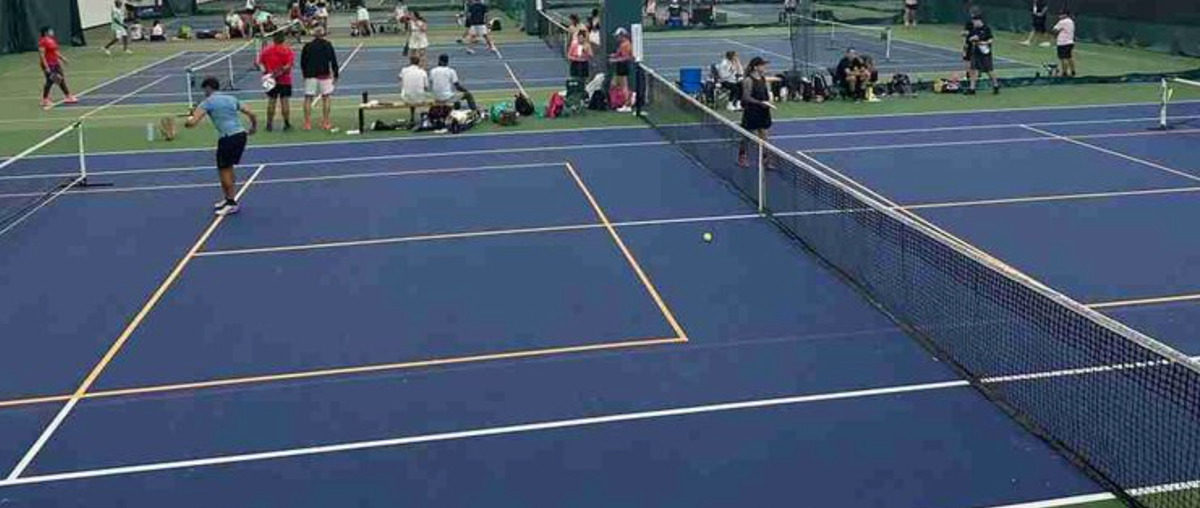
How Are Line Calls Made? Who Has the Authority?
In recreational play and most non-officiated matches, the player on whose side of the court the ball lands makes the call.
That's the standard in USA Pickleball's etiquette guidelines. You call the lines on your side. Your opponent calls theirs.
A few principles that should govern every call:
- Call "out" only when you're sure. If you have any doubt about whether the ball was in or out, it's in.
- Make the call promptly. Waiting to see your opponent's reaction before calling is bad sportsmanship.
- Don't ask your partner to overrule. In doubles, if one partner calls the ball out and the other saw it in, the ball is in, so the conflicting calls cancel each other.
At sanctioned tournaments, line judges and referees make the final calls.
But in the 99% of pickleball that happens at public courts, on-court etiquette and honest self-officiating are all you've got.
 Erik Tice
What Happens When a Line Call Is Disputed?
This is the real question, right? The rule is simple. The calls themselves? Not always.
When a line call in is genuinely contested and neither player can be sure of what they saw, USA Pickleball guidance recommends replaying the point.
This applies in recreational play. The rally gets a do-over, no harm done.
What you should not do: argue at length, demand a ball be placed where you think it landed, or let one bad call define the whole match.
The mental side of pickleball includes knowing when to let a point go. One rally is never worth the social cost of a court reputation for bad calls.
 The Dink Media Team
Let's Review
Let's run through the common scenarios:
- The dink that clips the kitchen line mid-rally: In. Play it. The dinking game is all about placing balls close to lines; that's the point.
- A serve that lands on the kitchen line: Fault.
- A return of serve that clips the baseline: In. The returner has the full depth of the court available, including the line.
- A third-shot drop that catches the sideline: In. This is why third-shot placement targeting the sideline can be effective; even a near-miss is a live ball.
- A smash that lands on the baseline: In. Keep playing.
 The Dink Media Team
Why This Rule Matters More Than You Think
Here's the thing: line calls affect more than individual points.
They affect momentum, trust between players, and how you're perceived on the court over time.
A player known for honest, accurate calls is someone people want to play with. A player who habitually calls balls "out" when they clip the line?
They get a reputation fast.
Beyond etiquette, understanding what happens when ball hits the line pickleball means you're a smarter player tactically.
Knowing the full width of the court is live territory means you can return from the baseline with more confidence and attack sideline targets without worrying you're leaving points on the table.
The rule changes that have shaped modern pickleball all reinforce the same principle: clarity and consistency in how boundaries work.
Line rules are foundational. Get them right.
 The Dink Media Team
Key Takeaways
- Knowing what happens when ball hits the line pickleball rulebook covers starts here: a ball that touches any part of the line is considered in (this applies to all court boundaries except one.)
- The one exception: a serve that lands on the non-volley zone line (the kitchen line) is a fault.
- On all other shots during a rally, the kitchen line is in.
- Line calls are the responsibility of the player on whose side the ball lands.
- In recreational play, if a call is genuinely uncertain, the rally should be replayed.
- USA Pickleball's official rulebook (Rule 6.A and surrounding sections) governs all of this.
Frequently Asked Questions
What happens when the ball hits the line in pickleball during a rally?
When the ball hits any boundary line during a rally, it is considered in play. That is what happens when ball hits the line pickleball: the ball is live. This applies to the baseline, sidelines, centerline, and non-volley zone (kitchen) line. The only exception to this rule involves the serve, not rally play. If any part of the ball makes contact with the line, the ball is live.
Is the kitchen line in or out on a serve in pickleball?
The kitchen line is out on a serve. According to USA Pickleball Rule 4.A.9, a serve that lands on the non-volley zone line is a fault. The serve must clear the kitchen and land entirely within the correct service box; the kitchen line itself does not count as in-bounds on a serve.
Who makes the line call in pickleball?
In recreational and non-officiated play, the player on whose side of the court the ball lands is responsible for making the call. You call the lines on your end of the court; your opponent calls theirs. When there's genuine uncertainty from both sides and neither player is sure, USA Pickleball etiquette recommends replaying the point.
How wide are pickleball court lines?
Standard pickleball court lines are 2 inches wide, as specified by USA Pickleball's court and equipment standards. That means a ball can land fully on a line, entirely within those 2 inches, and be completely in bounds. It's a meaningful amount of court real estate, especially on sideline shots.
What should you do if a line call is disputed in pickleball?
If a line call is genuinely disputed and neither player is certain, the recommended course of action in recreational play is to replay the rally. You should not call a ball out if you are not sure; when in doubt, the ball is in. In sanctioned tournament play, a referee or line judge makes the final determination, and players can formally request a review in some formats.
Love Pickleball? Join 100k+ readers for free weekly tips, news & gear deals.
Subscribe to The Dink