The Discipline of Resetting Your Mindset After Every Pickleball Game
Resetting your mindset after every pickleball game is the difference between losing one game and losing three in a row. This guide breaks down the 90-second routine, the one-cue rule, and the between-game habits that keep your level steady all session.
Resetting your mindset after every pickleball game is the single cheapest skill upgrade available to you, and almost nobody practices it.
You already know the feeling.
You drop an 11-4 game you had no business dropping, you walk to the other side of the net still replaying the two overheads you dumped, and twelve minutes later you've lost the second game too.
The paddle didn't change. The partner didn't change. Your pickleball mindset carried the damage across the changeover, and your level followed it down.
This video comes from Pickleball Daily on YouTube.
Here's the thing: your opponents aren't beating you twice. You're beating yourself the second time.
Love pickleball? Then you'll love our free newsletter. We send the latest news, tips, and highlights for free each week.
Why Does One Ugly Game Follow You Onto the Next Court?
Because you never stopped keeping score.
A finished game only ends on the scoreboard; in your head it keeps running, and every ball you hit in the next game gets graded against the last one.
That's the whole mechanism. You stop playing the point in front of you and start auditing yourself.
There's some support for the idea that a recent mistake can bleed into the next performance.
A study of elite surfers found that previous errors were associated with a drop in performance on the following ride, though that's surfing, not pickleball, and the researchers noted big individual differences.
Treat it as a useful parallel, not proof.
The tell is physical before it's mental. Your feet get heavy, your grip tightens, your third shot stops landing soft.
That's the same spiral that turns one rough outing into a full-blown rut, which is a much harder hole to climb out of than a single bad game.
What Resetting Your Mindset After Every Pickleball Game Actually Looks Like
It looks like a short, boring, repeatable routine you run between every single game, win or lose. Not a pep talk. Not a strategy summit.
A fixed sequence of about 90 seconds that closes the old game, resets your body, and gives your brain one thing to hold onto for the next one.
It's the same tool you'd use to get past a mental wall mid-session, only smaller and more frequent.
A between-game reset is a pre-performance routine: a set sequence of physical and mental actions you run before the next task starts, in the same order, every time.
A 2026 position statement on performing under pressure described pre-performance routines as systematic sets of task-relevant thoughts and actions and reported positive effects under experimental pressure conditions.
Same idea as a free-throw routine, just run between games instead of before a shot.
The 90-Second Rule for Resetting Your Mindset After Every Pickleball Game
Give yourself a hard window and stick to it. Ninety seconds is long enough to breathe and short enough that you can't hold court about what went wrong.
- Seconds 1 to 20: close the book. Say the final score out loud once, then don't say it again. Naming it is how you file it.
- Seconds 20 to 45: reset the body. Shoulders down, two slow exhales, shake the hands out, drink water. Tension travels from the forearm to the paddle face faster than any thought does.
- Seconds 45 to 70: pick one fix. One. The most common failure in resetting your mindset after every pickleball game is walking back out with six adjustments and executing none of them.
- Seconds 70 to 90: say the cue. Short, physical, and about what you're doing, not what you're avoiding.
Run the same sequence after an 11-2 beatdown and an 11-9 nail-biter, because the routine only works if it's unconditional.
Pros build this structure into their mental clarity work before a match, and the between-game version is just a compressed copy of it.
 The Dink Media Team
Pick One Cue, Not a Lecture
Your cue should be four words or fewer, and it should tell your body to do something.
Soft hands. Split step early. Let it bounce.
Compare that to the garbage most players mutter on the changeover: "don't miss the drop," which hands your brain the exact image you're trying to avoid.
Self-talk has real research behind it.
A meta-analysis of 32 studies reported a moderate positive effect of self-talk on sport performance, with stronger results for fine motor tasks and for athletes who'd actually been trained to use it.
That last part matters: repeating a phrase you've never practiced is not the same as having a cue you've drilled.
Build it on the practice court first, the way you'd build any habit that improves consistency.
Elite players are doing a version of this constantly.
If you want a window into it, the way 6.0 players narrate their own dinking is less emotional and way more procedural than you'd expect. It's all task cues, no commentary.
 The Dink Media Team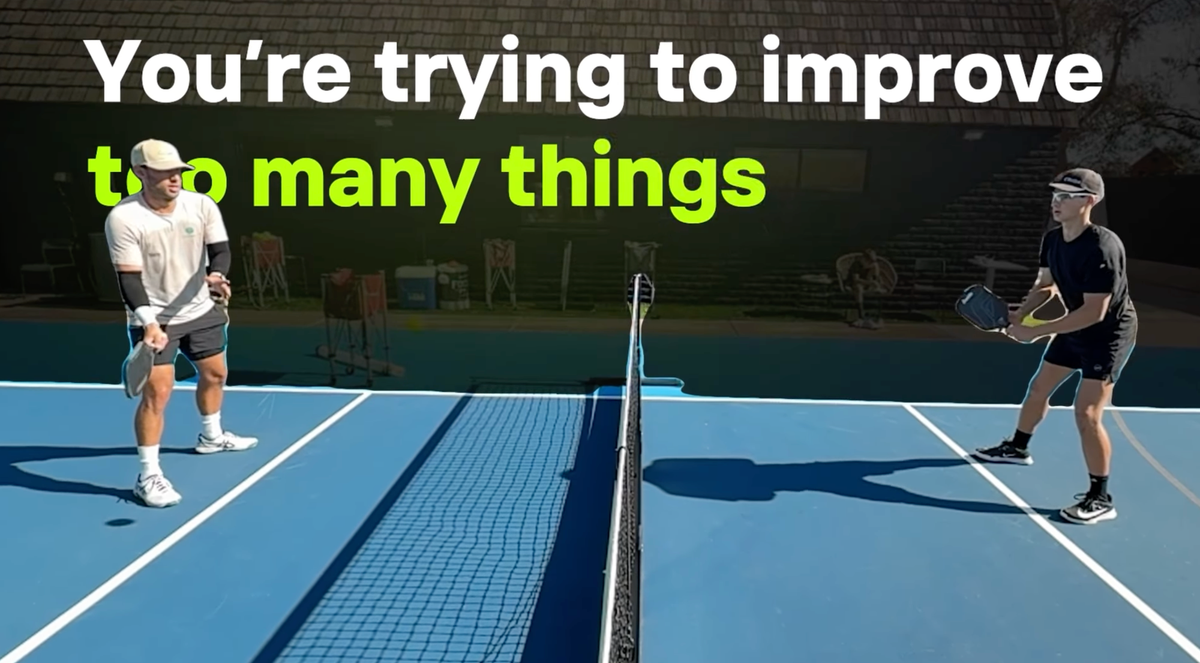
Resetting Your Mindset After Every Pickleball Game Starts Before the First Serve
The reset is easier when you've decided in advance what the session is for.
Most spirals start because you walked on with a fuzzy goal, so every lost game becomes a referendum on whether you're any good.
Set the frame early. Warm up your body and your mind together instead of hitting three dinks and calling it ready. Tell your partner one thing you're working on.
Then tell them how you want to be talked to when it goes sideways, because a partner who starts coaching you mid-session will torch your reset faster than any opponent.
A short pre-game conversation covers it.
The questions worth asking your partner and the things worth settling before the first point take 30 seconds and save you three games of guessing.
Resetting Your Mindset After Every Pickleball Game You Just Won
Winning needs a reset too, and this is the half everyone skips.
You win one 11-3 and suddenly you're ripping speed-ups from your shoelaces because you feel unstoppable.
That's not confidence; that's drift. Run the identical 90 seconds, pick the same kind of narrow cue, and go defend what actually worked.
Momentum is real, but it's something you manage, not something you ride, which is why controlling momentum point by point beats hoping the hot streak holds.
 The Dink Media Team
The Three Habits That Quietly Kill Your Reset
Most players don't fail at the pickleball mental game because they lack willpower. They fail because three specific habits reopen the game they just closed.
The first is the scoreboard autopsy.
Replaying points on the changeover feels productive and isn't, partly because the score doesn't tell you much about why you lost.
Do your review in the car, not on the court.
The second is blame, in either direction. Blaming your partner poisons the next game, and blaming yourself does the same thing with extra steps.
If the matchup is genuinely the problem, that's a tactical fix, not a character flaw, and there are calmer ways to handle pressure than self-flagellation.
The third is strategy churn. Changing your entire game plan after one loss is how good players stall out.
A rough game usually means one leak, not a broken system, and the fix is often just tightening the pressure points rather than blowing it up.
Players who churn tend to be the same ones stuck on a plateau for a year.
Honestly, the discipline is the whole point. Resetting your mindset after every pickleball game isn't a mood you summon.
It's a 90-second habit you run whether you feel like it or not, and it's the unglamorous base layer under every champion mindset piece you've ever read, and the players who run it finish sessions at the same level they started.
Everyone else just fades.
 The Dink Media Team
Key Takeaways
- Resetting your mindset after every pickleball game means closing the previous game before the next one starts, so old errors stop grading new shots.
- Run a fixed 90-second routine: name the score once, release physical tension, choose one adjustment, repeat one short cue.
- Cues should be four words or fewer and describe an action, not a mistake to avoid.
- Reset after wins too. Overconfidence costs as many games as frustration does.
- Avoid the three reset-killers: replaying points on the changeover, assigning blame, and rebuilding your whole strategy after one loss.
Frequently Asked Questions
How long should resetting your mindset after every pickleball game take?
About 90 seconds, which is roughly the natural changeover window. That's enough time to breathe, hydrate, and settle on one adjustment. Any longer and you drift back into replaying points, which defeats the purpose.
What's the difference between a mental reset and a reset shot in pickleball?
A reset shot is a physical skill, a soft ball that takes pace off and buys you time to get to the kitchen. A mental reset is the between-game routine that clears the last game from your head. Different tools, same goal: stop the bleeding before it compounds.
Does self-talk actually help your pickleball mental game?
Research on self-talk in sport has reported a moderate positive effect on performance, with better results for athletes who were trained in how to use it. It isn't magic, and a phrase you've never practiced won't carry you. Build one short cue, use it in drilling, then bring it to games.
How do I reset when my partner is the reason we lost?
Say nothing about the last game and ask for one thing for the next one, like "let's both take the middle ball." Blame is the fastest way to lose the second game too. If the partnership isn't working, that's a conversation for after the session, not the changeover.
Should I reset my mindset in casual rec play or only in tournaments?
Both, and rec play is where you build the habit. Running the routine during low-stakes open play is what makes it automatic when a tournament match gets tight. A routine you only use under pressure isn't a routine.

Love Pickleball? Join 100k+ readers for free weekly tips, news & gear deals.
Subscribe to The Dink