Building Chemistry With a New Doubles Partner: 3 Ways to Click Fast
Building chemistry with a new doubles partner comes down to three agreements: court roles, in-point communication, and a reset plan for ugly points. Make them before the first serve and your new team will play like it has months of reps together.
Building chemistry with a new doubles partner usually gets treated like luck. You either click or you don't.
That's nonsense. The teams that gel fast do three specific things, and none of them require you to become friends.
Chemistry is a stack of agreements: who takes the middle, who calls the lob, what happens after a shanked third.
Lock those down and you'll look like you've played together for a year by game two.
Skip them and you'll spend the whole match watching balls land between you while you both say "yours," which is the fastest way to not become a better doubles partner.
Love pickleball? Then you'll love our free newsletter. We send the latest news, tips, and highlights for free each week.
So What Is "Chemistry" in Pickleball, Exactly?
Partner chemistry is the speed at which two players make the same decision without discussing it. That's it.
It isn't friendship, it isn't matching outfits, and it isn't a personality match, though pro partnerships do tend to survive longer when the two people actually like each other.
Sports scientists call the underlying thing a shared mental model: both players holding the same picture of who covers what, so nobody hesitates.
Hesitation is the real opponent. A half second of "is that mine?" turns a routine middle ball into a paddle collision and a lost point.
Here's the good news. Shared pictures can be installed in about two minutes of conversation.
You don't need a season together. You need the right questions before the first serve, and that's where team chemistry work actually starts.
1. Have the Two-Minute Talk Before the First Serve
The fastest way to build chemistry is to pre-decide the three situations that cause the most confusion: the middle, the lob, and the switch.
Settle those during warmups and you've removed most of the hesitation before the match even starts.
Most rec players warm up by hitting cross-court dinks in silence, then walk on cold. Bad plan. Use that time for the conversation you should be having instead.
What Should You Ask When Building Chemistry With a New Doubles Partner?
Ask the questions that force a decision, not the polite ones. "Are you a lefty?" matters. "How long have you played?" does not.
- Which side do you want? Forehand in the middle usually wins the argument, and the right side assignment decides half your coverage. If you're a lefty-righty pairing, you already have a built-in advantage with two forehands in the middle.
- Do you want to stack? Say it now, not at 4-4. If either of you is shaky on it, run the basic stacking setup a few times in warmups.
- Who chases the lob? Default is the person on the side it goes to, but say it out loud anyway.
- How do you feel about poaching? Some players love it, some feel stepped on. Knowing when the poach helps and when it's just ego is a partnership question, not a shot question.
Four questions. Two minutes.
There's a reason a short list of partner questions outperforms an hour of small talk, and it isn't subtle: agreements travel onto the court, pleasantries don't.
 The Dink Media Team
2. Why Does Building Chemistry With a New Doubles Partner Depend on Talking More?
Because new teams under-communicate by a mile, and the gap shows up on the scoreboard.
In a study of collegiate doubles tennis, winning teams exchanged roughly twice as many messages as losing teams during matches, with over half of those messages being encouragement rather than tactics.
Different sport, same geometry, same human problem.
What that means for you: talk during points, not just between them. And keep it short.
Chatter is also how you hold momentum when a game starts tipping, which matters even more when you're still building chemistry with a new doubles partner.
The Three Calls Every New Team Needs
Early in the process of building chemistry with a new doubles partner, your vocabulary can stay tiny.
Three words cover 90 percent of in-point confusion: "mine," "yours," and "bounce."
Say them early and loud enough that your partner hears them over the court next door.
Mumbling is worse than silence, and most of the strategy mistakes quietly killing your game are communication failures wearing a tactical disguise.
"Bounce" is the underrated one. Calling a ball out while it's still in the air is how new partners lose points and trust in the same swing. Let it land, call it, move on.
Between points, swap one piece of information, not a coaching session. "Their backhand is weak" is useful.
A full breakdown of your partner's footwork is not, and coaching during rec play is the quickest way to kill a brand-new partnership.
If you want a shortcut, hand signals do the talking for you on serve. The server's partner flashes the plan, the server confirms, nobody tips off the other team.
It takes one session to learn and instantly makes a new pairing look organized.
One more layer: move together.
Chemistry is visible in footwork long before it's audible, so shadowing your partner side to side keeps the gap closed and the spacing at the kitchen line honest.
 The Dink Media Team
3. Decide How You'll Handle the Ugly Points
Agree in advance on what happens after a bad error, because that moment is where building chemistry with a new doubles partner either sticks or falls apart.
Not the strategy. The recovery.
Research on doubles racquet sports found that athletes report noticeably more anger and anxiety when they believe their partner is playing poorly, and more happiness when the partner is rolling.
Your mood is partly outsourced to the person next to you, whether you like it or not. So manage the handoff.
How Do You Keep Building Chemistry With a New Doubles Partner After a Blowup?
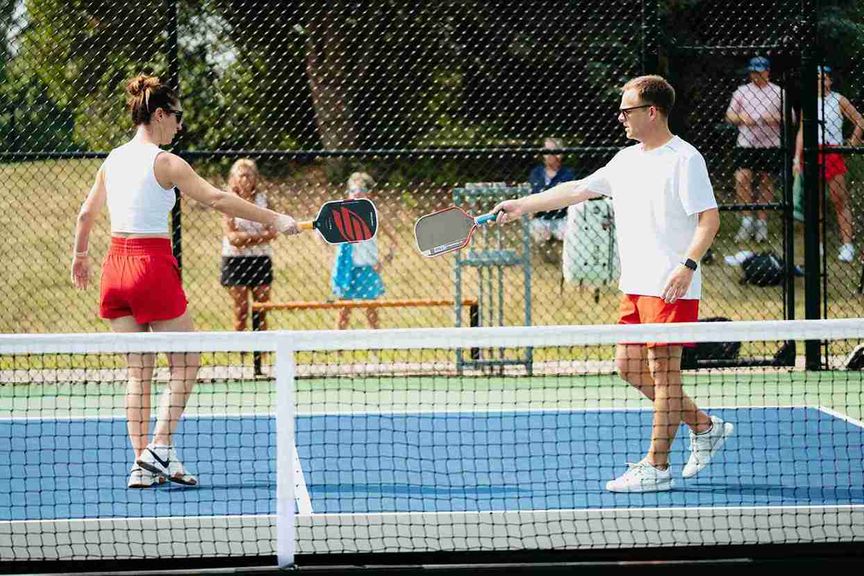
Use one phrase, every time, no analysis. "Next one." Paddle tap. Move.
The two habits that quietly destroy new teams are over-apologizing and silent sulking.
Both put your partner in charge of managing your feelings while they're trying to win a point.
If the wheels really come off, take the timeout and reset the plan instead of grinding through three more sloppy points.
And when your partner is struggling, play bigger, not smaller.
Covering more court for a struggling partner is a real tactic: take the middle, hunt the poach that protects them, and lean on resets to slow the game while they find their feet.
Honestly, that's the whole job description of a good partner.
 The Dink Media Team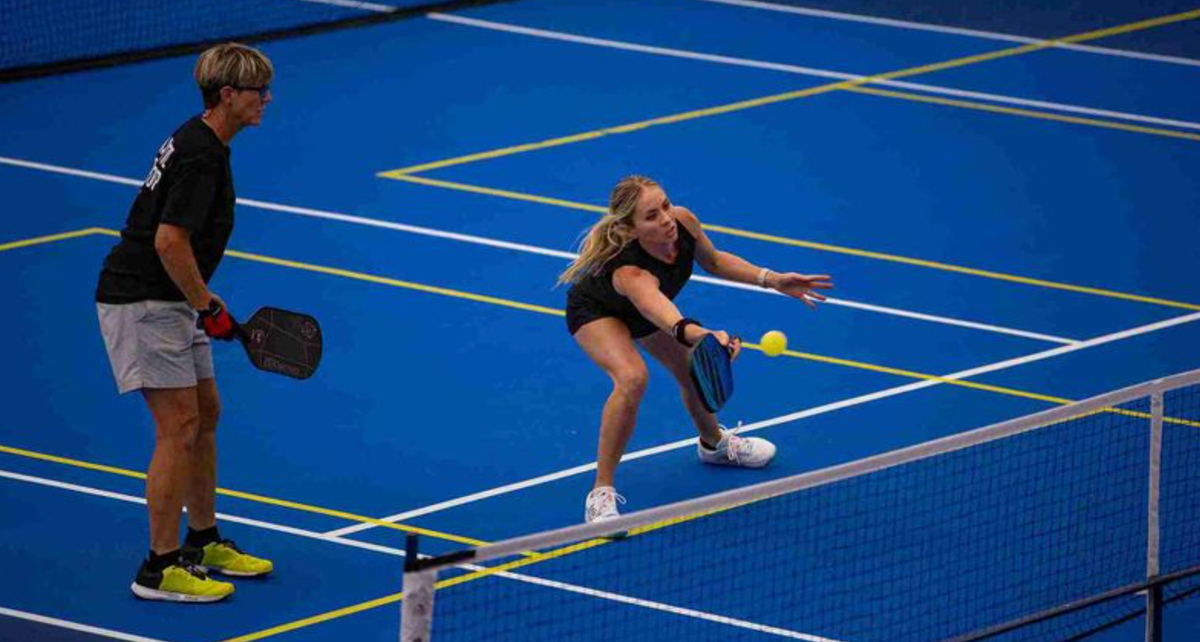
Your First Week of Building Chemistry With a New Doubles Partner
If you've got one practice session before your first tournament together, spend it on coordination, not shot quality.
You already know how to dink. What you don't know yet is where your partner is standing when you do.
Spend 20 minutes on middle balls and switches, 20 on serve-and-return patterns with signals, and 20 on live play where the only rule is that somebody calls every ball.
That's it. Drilling versus playing is a real debate, but for a new pairing, structured reps win, and a solid drill menu gives you somewhere to start.
Then play a tournament together before you judge it.
First-time partnerships often look rough in game one and fine by game three; that's normal, and it's why choosing a partner based on one bad session is usually a mistake.
 The Dink Media Team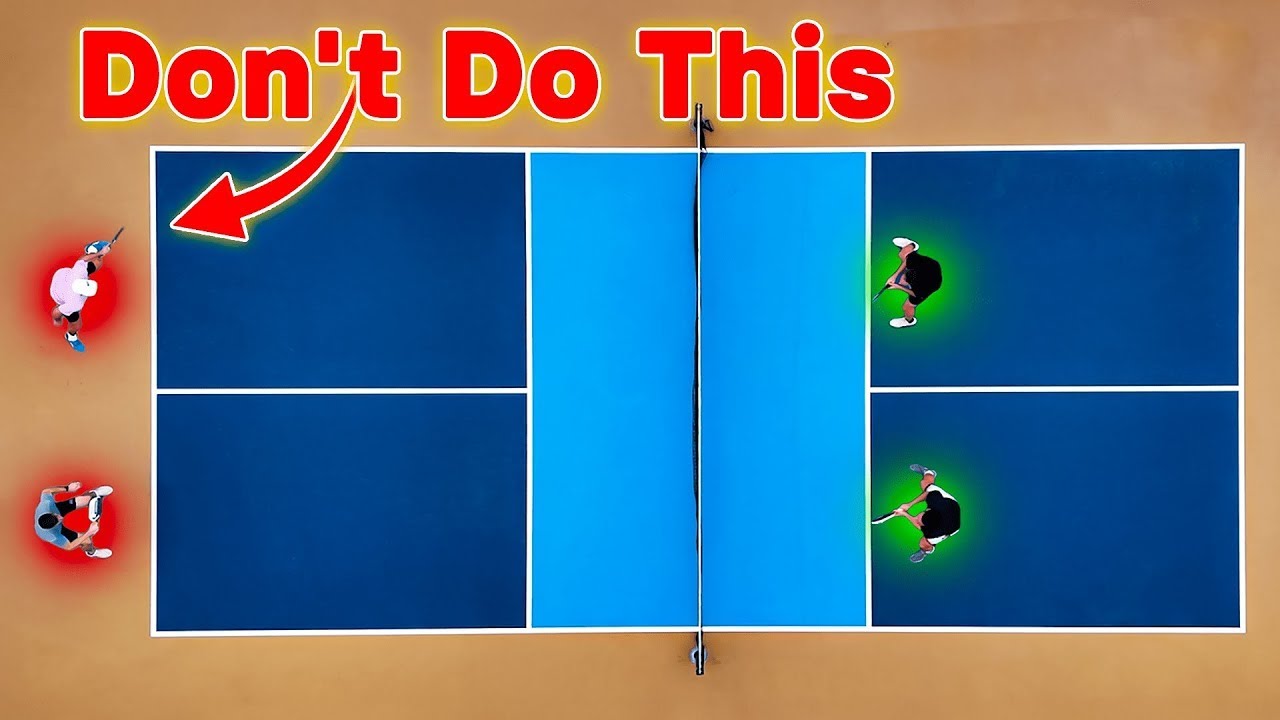
Key Takeaways
- Building chemistry with a new doubles partner means pre-deciding the middle, the lob, and the switch before the first serve.
- Winning doubles teams communicate about twice as much as losing teams, and most of it is encouragement.
- Three calls handle nearly every in-point moment: "mine," "yours," and "bounce."
- Agree on one recovery phrase for errors, and never coach your partner mid-match.
- Give a new pairing at least one structured practice and one full tournament before judging it.
Frequently Asked Questions
How long does building chemistry with a new doubles partner usually take?
Most pairings feel comfortable within two or three sessions if they talk through roles up front. Tournament-level timing, meaning the stuff that happens without a word, usually takes several months of regular play, which is why pros are picky about who they play with. The two-minute pre-match talk compresses a surprising amount of that timeline.
What should you talk about with a new doubles partner before a match?
Cover four things: which side each of you plays, whether you'll stack, who takes the lob, and how you both feel about poaching. Keep it to two minutes during warmups. Those four answers prevent most of the hesitation that costs new teams points.
Should you use hand signals with a brand-new partner?
Yes, if your partner knows them. Signals remove guesswork on serve and make a new team look organized immediately. If they're new to your partner, use two basic ones (switch and stay) rather than a full system you'll both forget by the second game.
What do you do when your new partner is playing badly?
Take more of the court and say less. Cover the middle, poach when you can do it safely, and stick to one short phrase between points. Analysis mid-match almost always makes it worse, because your partner is already aware the shots aren't landing.
Is it better to pick a partner at your level or above it?
Close to your level is better for building chemistry with a new doubles partner, because coverage responsibilities stay balanced and return positioning stays predictable. Playing up teaches you plenty, but the stronger player ends up covering for you, which slows down real partnership habits. If you want to improve fast, mix both: level partners for tournaments, stronger partners for rec.
Love Pickleball? Join 100k+ readers for free weekly tips, news & gear deals.
Subscribe to The Dink