Pickleball Doubles Communication: The Calls Every Team Needs to Win
Pickleball doubles communication is the hidden variable that separates teams that grind out wins from teams that implode on big points. Learn the exact calls, signals, and habits that keep you and your partner moving as one unit on the court.
Pickleball doubles communication is the difference between a partnership that feels like a well-oiled machine and one that falls apart the moment a ball lands down the middle.
Most players work on their dinks, their drops, their speed-up attacks. Very few work on what they say, and when they say it.
That's a mistake. And it's a correctable one.
Research on team coordination in racket sports consistently shows that verbal and non-verbal communication between partners reduces unforced errors and improves positional coverage (Journal of Sports Sciences, 2024).
In doubles pickleball, where court space is tight and decisions happen in fractions of a second, that margin matters enormously.
Love pickleball? Then you'll love our free newsletter. We send the latest news, tips, and highlights for free each week.
Why Pickleball Doubles Communication Breaks Down in Real Games
The breakdown happens because most players treat communication as a luxury, not a system.
They'll shout "yours" on a ball that's already hit the ground, or freeze in silence when a ball splits the middle and nobody moves. Sound familiar?
Here's the thing: the problem isn't that players don't want to communicate, it's that they haven't built the habit. Under pressure, untrained habits disappear.
You revert to instinct. And if the instinct is silence, you lose points.
Doubles pickleball strategy demands that you and your partner operate as a shared unit. Two separate players running their own programs is a losing formula.
The ball doesn't care who thought they were covering it.
The three main communication failures in recreational doubles:
- Middle ball confusion: both players expect the other to take it, nobody does
- Poaching without warning: one player crosses, the other is still moving the wrong direction
- Transition silence: no one calls out the kitchen line approach, leaving gaps in coverage
All three are preventable. All three require building a simple call system before you step on the court, not improvising in the middle of a rally.
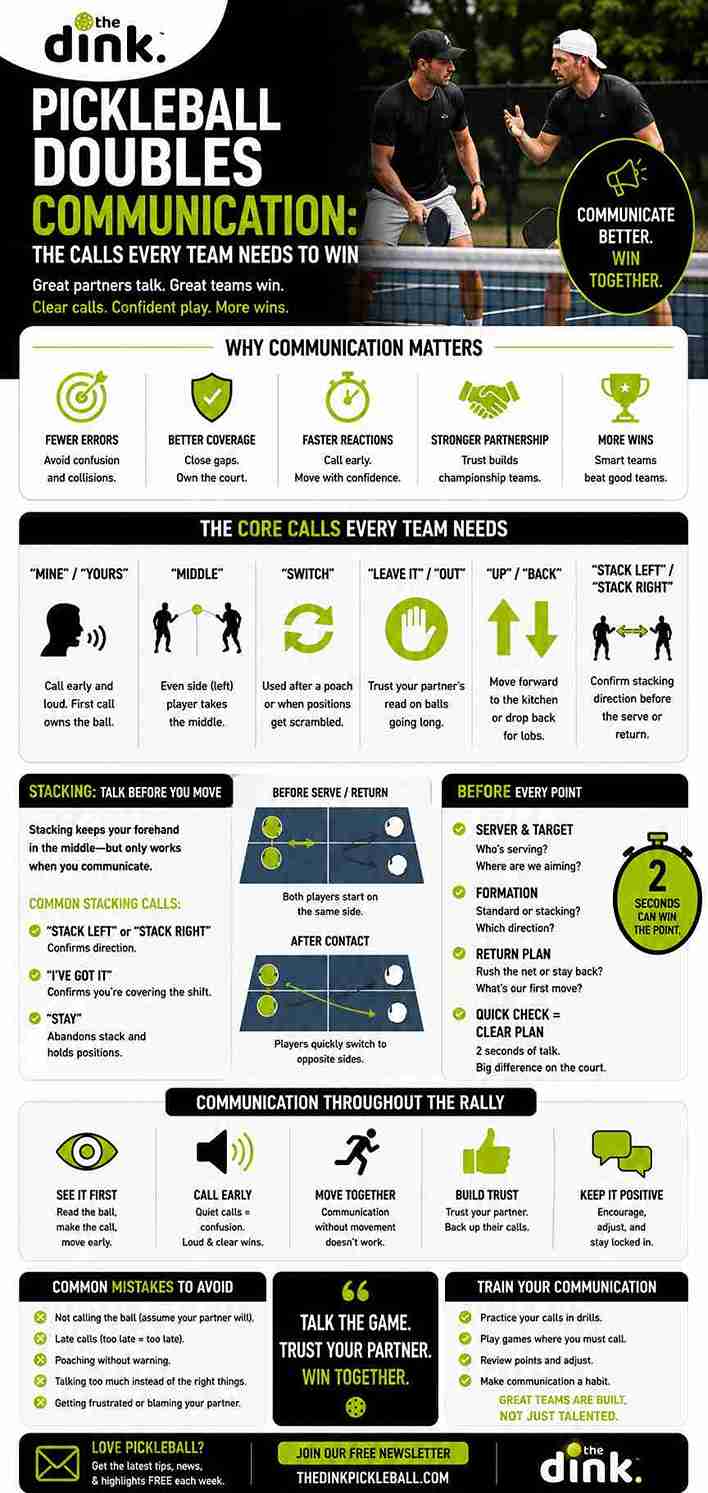
The Core Calls Every Doubles Team Should Use
Effective pickleball doubles communication starts with a shared vocabulary, a short list of calls that both players know, trust, and actually use.
You don't need a complicated playbook. You need five or six words that are fast, clear, and automatic.
Here's the foundational call set:
- "Mine" / "Yours" The most important calls in the game. Say them early, say them loud. The rule is simple: whoever calls it first owns the ball. Train yourself to say it the moment you read that a ball is coming to your side. Hesitating until you're sure costs you the rally.
- "Middle" When a ball is heading for the seam between you and your partner, someone has to call it immediately. Convention at most levels: the player on the left (even side) takes middle balls. But whatever your default is, verbalize it anyway. Covering the middle in doubles is one of the most contested decisions in the game, your voice resolves the argument before it starts.
- "Switch" Used after a poach or when positioning gets scrambled. One player calls "switch" to signal that roles are swapping. Without it, you end up with both players on the same side of the court.
- "Leave it" / "Out" Training your partner to trust your read on a ball going long or wide. This is a high-trust call, your partner has to believe you and let a live-looking ball bounce. Building that trust takes time and reps together, but it wins points when it works.
- "Up" / "Back" Positional awareness calls. "Up" means your partner should move to the kitchen line. "Back" means retreat for a lob or reset situation. These keep both players moving in the same direction without either person guessing.
What Is Stacking and How Does It Change Your Communication?
Stacking is a tactical formation where both players position on the same side of the court after the serve or return, then shift to their preferred sides once the ball is in play.
It's the most communication-intensive strategy in doubles pickleball, and it's worth understanding even if you only play recreationally.
When a team stacks, the serve and return still follow normal rules, but immediately after contact, the non-serving or non-returning player sprints laterally to take a different side of the court than where they started.
Without a clear verbal signal, this creates chaos.
Stacking in doubles works because it lets strong players keep their forehand in the middle (the most powerful coverage position).
But the only way it works is if both players confirm the movement before every single point. Common stacking calls include:
- "Stack left" or "Stack right", confirms which direction the non-hitter is moving post-contact
- "I've got it", the stacking player confirms they're covering the shift
- "Stay", abandons the stack and both players hold their positions (usually when the rally starts unpredictably)
If you're stacking without talking, you're not stacking, you're gambling.
How Should Pickleball Doubles Partners Communicate Before a Point Starts?
The best doubles communication happens before the serve, not during the rally.
A quick two-second check between partners before each point is the highest-leverage habit you can build.
Between points, get into the habit of confirming:
- Server: Who's serving and where are you targeting?
- Formation: Are we staying in standard positions or stacking?
- Return plan: Are we rushing the net after the return, or staying back?
Pro teams at the PPA Tour level are constantly talking between rallies.
Watch Ben Johns and Collin Johns on a big point, they're always in each other's ears before the serve goes up. It's not noise. It's a system.
For recreational players, even a simple hand signal works.
Some teams use behind-the-back paddle signals to indicate serve placement (a flat palm = down the middle, a pointed finger = out wide) without tipping off the opponents.
The signal itself matters less than the fact that you're using one consistently.
Pickleball Doubles Communication at the Kitchen Line
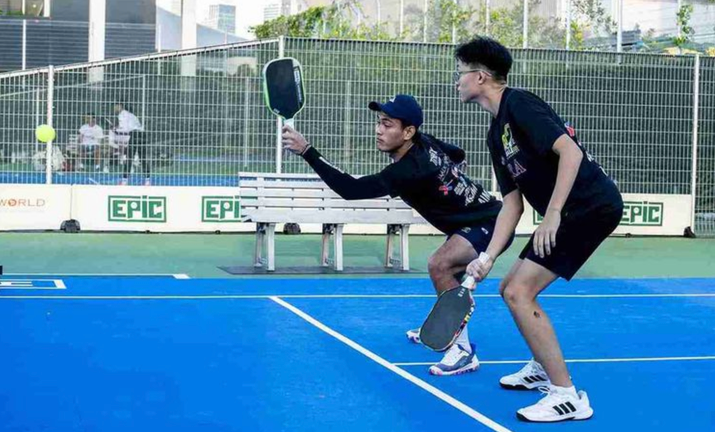
At the non-volley zone, doubles communication shifts from planning to real-time reaction. This is where games are decided, and it's also where most recreational teams go silent.
The kitchen line is a high-speed environment. Balls come fast, angles are tight, and neither player has much time to think.
That's exactly why your kitchen line strategy needs a communication layer on top of it.
Two key things to verbalize at the NVZ:
Poaching calls. If you're crossing to take a ball off your partner's side, say "switch" as you cross. Not after. Not while. As you're moving.
This tells your partner to cover your vacated side immediately.
Poaching effectively only works when the partner adjusts, and they can only adjust if they know it's happening.
Energy cues. These are underrated. Saying "stay low" or "be ready" between dink exchanges keeps your partner's focus sharp.
Research from the Journal of Sport & Exercise Psychology shows that verbal encouragement between teammates reduces error rates in high-pressure rally situations, even in sports as fast as squash and badminton. Pickleball is no different.
Common Doubles Communication Mistakes (and How to Fix Them)
The biggest mistake isn't calling the wrong thing, it's calling it too late.
Communication in doubles pickleball works on the same principle as defensive positioning: you have to be early.
A "mine" called before you're fully committed to the ball is infinitely more useful than one called after you've already swung.
Second most common mistake: inconsistent conventions.
If you call "out" sometimes and "leave it" other times for the same situation, your partner has to decode your language under pressure.
Pick one word for each situation and use it every single time.
Improving your pickleball game isn't always about technique. Sometimes it's about cutting out the chaos that lives between you and your partner.
A few fixes worth installing in your next session:
- Do a dedicated communication drill: play points where calling the ball is mandatory on every shot. If you don't call it, you lose the point automatically.
- Review scramble points after games. When you and your partner both went for the same ball or neither did, talk through what the call should have been.
- Play together regularly. Chemistry compounds. Partners who play 10 hours together communicate better than partners who've played 100 hours separately. Finding your pickleball partner and locking in consistent court time is one of the fastest ways to improve doubles play.
Key Takeaways
- Pickleball doubles communication is a learnable system, not just an instinct, build it deliberately with a clear set of shared calls.
- The five essential calls every doubles team needs: "mine/yours," "middle," "switch," "leave it/out," and "up/back."
- Stacking requires verbal confirmation before every point, if you're not talking through the stack, you're not actually stacking.
- Pre-point check-ins (serve target, formation, return plan) are the highest-leverage communication habit in doubles.
- At the kitchen line, poaching calls must come during the movement, not after, say "switch" as you're crossing, not when you've landed.
- Consistent vocabulary beats clever vocabulary. Use the same words every time so your partner never has to decode you under pressure.
- Communication is a skill that improves with reps, build drills that reward calling the ball and penalize silence.
Frequently Asked Questions
What does pickleball doubles communication actually include?
Pickleball doubles communication includes verbal calls during rallies (like "mine," "yours," "switch," and "out"), pre-point signals or check-ins about strategy and formation, and non-verbal signals like behind-the-back paddle signs for serve placement. It covers anything that keeps both partners informed and moving in the same direction. The goal is eliminating hesitation and mid-point confusion.
How do you handle middle balls in doubles pickleball?
The standard convention is for the player on the left side (even court) to take balls down the middle, since their forehand is typically centered. However, the more important rule is that whoever calls it first takes it. Build the habit of calling "mine" or "middle" immediately when you read a ball heading for the seam, don't wait to be sure. Verbal calls resolve the confusion faster than any positioning rule.
Should doubles partners communicate during the rally or only between points?
Both. Between-point communication is for strategy, formation, and target confirmation. During-rally communication is for real-time calls, who takes the ball, when to poach, when to leave a ball out. Strong doubles teams do both consistently. The between-point habits reduce the number of in-rally decisions you have to make under pressure.
How do you communicate when stacking in pickleball doubles?
Before the serve goes up, confirm the stack direction ("stack left" or "stack right") and who's covering the shift. Use a clear signal so both players know when to move and where. Mid-rally, "switch" tells the partner to hold their new side after the stack is complete. Without verbal confirmation, stacking creates more confusion than it solves.
Does talking to your partner during a match distract you from playing?
The opposite, actually. Teams that have automated their communication vocabulary don't have to think about it, the calls become reflexive. Sport psychology research from 2025 supports that shared communication habits reduce cognitive load, freeing players to focus on the ball rather than coordinating with their partner on the fly. The distraction comes from not having a system, not from using one.
Love Pickleball? Join 100k+ readers for free weekly tips, news & gear deals.
Subscribe to The Dink