

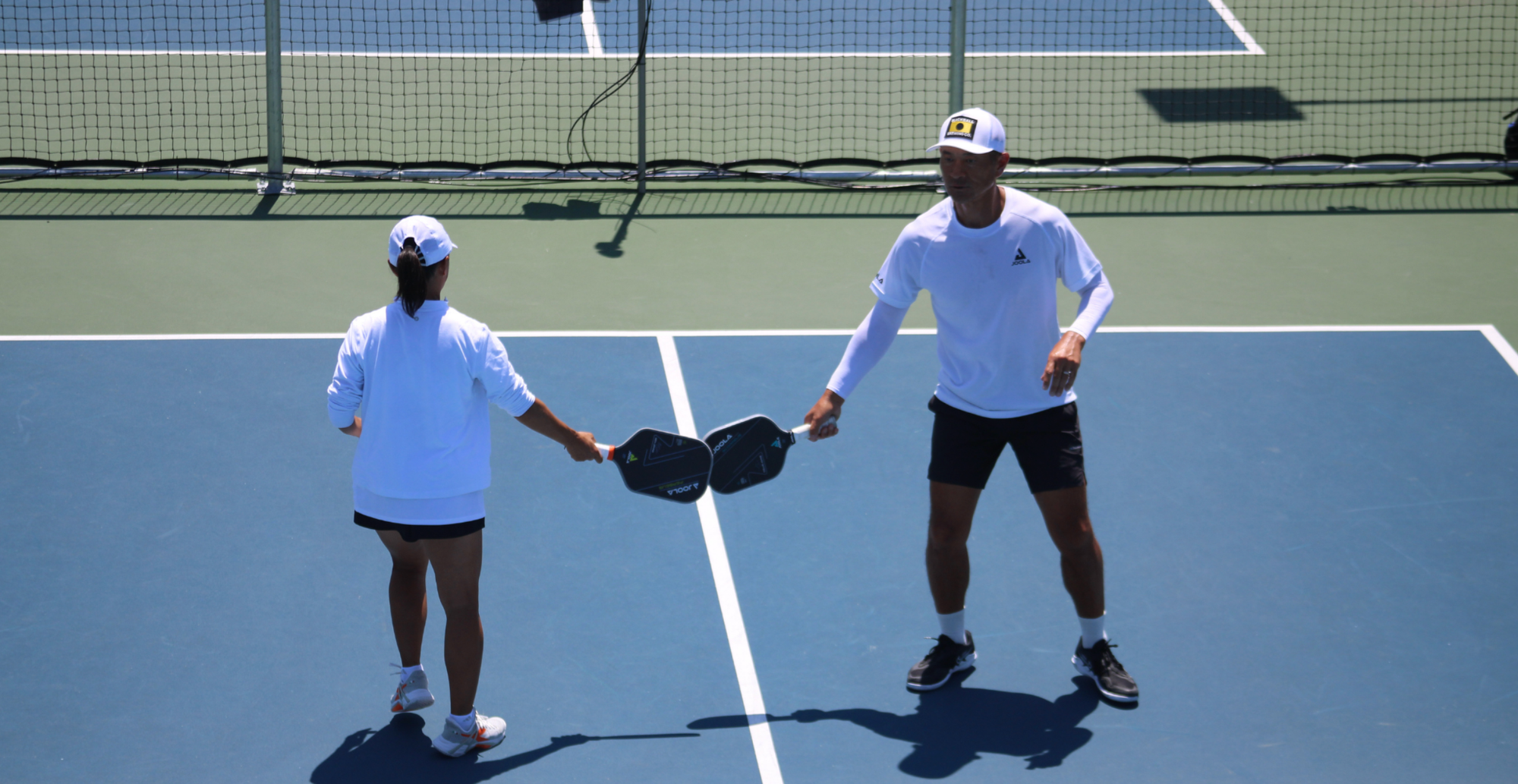
Pickleball tournament nerves hit almost every competitive player, even the ones who look ice-cold on court. This guide breaks down exactly how to manage pre-match anxiety with mental prep strategies that work when the pressure is on.
Pickleball tournament nerves are one of the most common and least talked about parts of competitive play.
You've drilled the third shot drop. You know your serve.
You've played this game a hundred times. And yet, the moment your name goes on a bracket, something happens to your hands, your breathing, and your brain.
You're not alone. Even seasoned players feel it.
The good news? You can train your mental game the same way you train your backhand.
It takes the same repetition, the same intention, and the same willingness to do the work before match day.
Love pickleball? Then you'll love our free newsletter. We send the latest news, tips, and highlights for free each week.
Why Pickleball Tournament Nerves Hit So Hard
Pre-match anxiety in pickleball is a physiological response: your body doesn't know the difference between a bear and a bracket.
When the stakes feel high, your nervous system triggers a stress response: elevated heart rate, shallow breathing, tightened muscles, and a brain that suddenly can't remember what "soft hands" means.
Researchers call this competition anxiety, and it's well-documented in sport science.
A 2019 study published in the Journal of Sports Sciences found that pre-competition anxiety significantly impacts motor skill execution: the exact skills you need to dink, reset, and serve under pressure.
Here's the thing: a little nervousness isn't the enemy. It sharpens your focus and activates your body.
The problem is when it tips over into panic, overthinking, or physical tension that locks up your swing.
Understanding the mental side of the game starts with accepting that pickleball tournament nerves are information, not failure.
What's Actually Happening in Your Body Before a Match
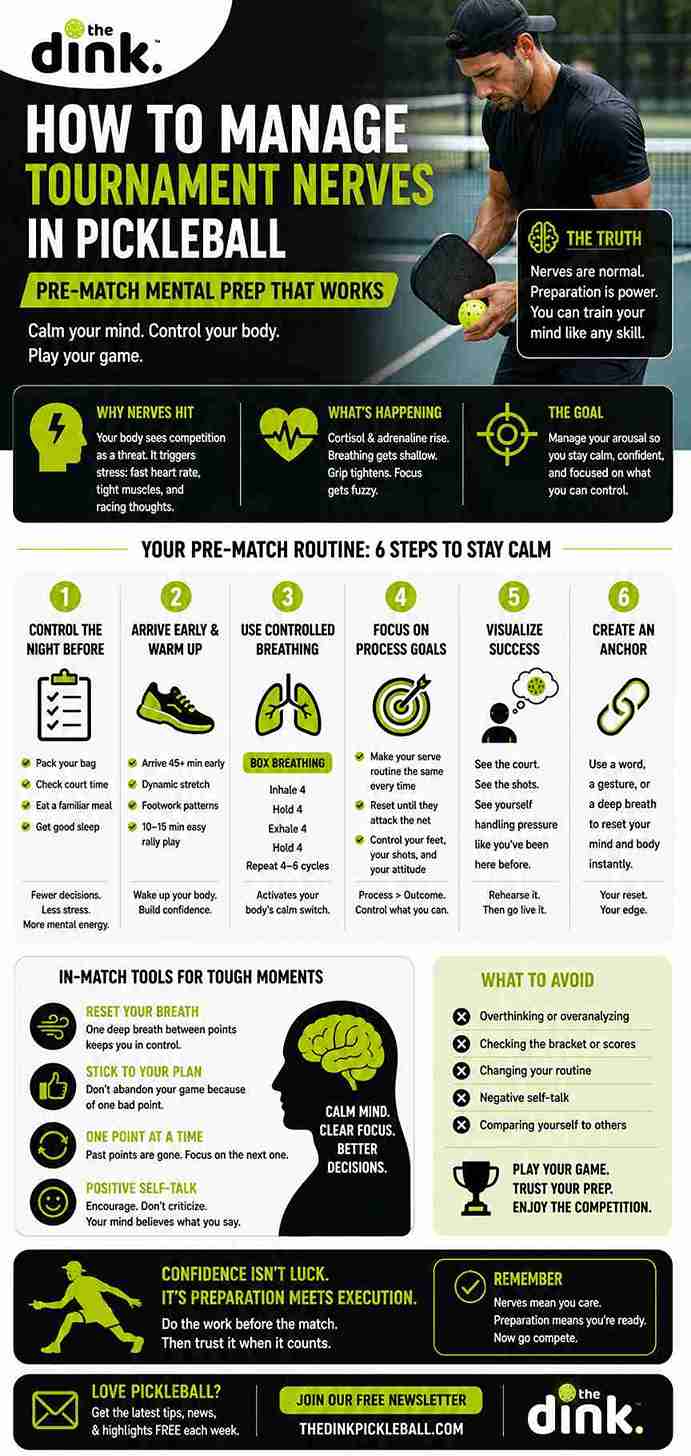
Before you can manage tournament anxiety, you need to understand what's driving it. Competitive stress triggers the release of cortisol and adrenaline.
Your heart rate climbs. Muscle tension increases.
Breathing becomes shallow and fast, reducing oxygen to the brain, which is the last thing you want when you need to make split-second decisions at the kitchen line.
The American Psychological Association notes that chronic activation of this stress response can impair cognitive function and decision-making.
In tournament pickleball, that shows up as unforced errors on easy balls, tentative resets, and serves that go wide when you're up 10-9.
Grip pressure is one of the first things that goes.
When anxiety spikes, players grip their paddle like they're trying to strangle it, which kills touch and generates the very errors they were afraid of.
If you've ever noticed your grip pressure getting tighter during tight moments, this is why.
The Pre-Match Routine That Actually Calms Pickleball Tournament Nerves
A structured pre-match routine is the single most effective tool for managing pickleball tournament nerves.
It tells your nervous system: we've been here before. We know what to do.
Elite athletes across every sport use pre-competition routines to regulate arousal, and pickleball is no different.
Here's a framework built specifically for tournament day.
1. Control What Happens the Night Before
Mental preparation for pickleball doesn't start an hour before your first match. It starts the night before.
Pack your bag, confirm your court time, eat a familiar meal, and get to bed at a reasonable hour. Decision fatigue is real: the fewer micro-decisions you make on game day, the more mental bandwidth you have for the actual match.
2. Arrive Early and Warm Up With Purpose
Rushing to your court with five minutes to spare is a fast track to anxiety. Arrive at least 45 minutes early.
Walk the facility, find your court, and get your body warm with light movement before you ever pick up a paddle.
A targeted warm-up routine should include dynamic stretching, footwork patterns, and at least 10-15 minutes of easy rally play that prioritizes feel over pace. Your goal isn't to work up a sweat: it's to remind your hands and feet what they already know.
3. Use Controlled Breathing to Calm Pickleball Tournament Nerves
Box breathing is a technique used by Navy SEALs, surgeons, and elite athletes to regulate stress response in real time. The protocol: inhale for 4 counts, hold for 4, exhale for 4, hold for 4.
Repeat 4-6 cycles.
Research from the National Institutes of Health shows that slow, controlled breathing activates the parasympathetic nervous system, your body's built-in calm switch.
Do it on the sideline before your warm-up rally. Do it during time-outs. Do it every single time you feel your shoulders creeping up toward your ears.
How to Manage Pre-Match Anxiety Through Process Goals
One of the fastest ways to amplify tournament nerves in pickleball is to focus on outcomes: winning, your rating, what other players think of you.
The fix is surprisingly simple: shift to process goals.
A process goal anchors your attention to something you can control right now.
Not "I need to win this match." Instead: "I'm going to make my serve routine the same every time" or "I'm going to reset until they attack the net."
This is exactly what building a champion mindset looks like in practice.
You can't control your opponent's speed-up. You can control your feet, your serve, and your reset attempt.
Players who focus on process goals consistently report lower pre-match anxiety, and they make fewer unforced errors because their attention is on execution, not evaluation.
Does Your Practice Actually Prepare You for Tournament Pressure?
Here's an honest question worth sitting with: does your practice look anything like tournament play?
If you're drilling soft shots in a pressure-free environment but expecting those skills to show up under tournament stress, there's a gap.
Simulated pressure in practice is one of the most underutilized training tools for competitive pickleball players.
Try this: introduce scoring into every drill. Make the last rally of a session count for something: winner buys coffee, loser runs a lap.
Tell your partner you're treating this like a match point.
Your nervous system doesn't care whether the stakes are real. It responds to perceived pressure the same way.
Want to take it further? Invest in skill sessions that deliberately create discomfort, then practice your reset breathing.
That's repetition for your mental game, not just your shots.
The American College of Sports Medicine supports stress inoculation training: gradually exposing yourself to competitive pressure in practice as a proven method for improving performance under stress.
What to Tell Yourself Between Points
The internal dialogue you have between points is either your biggest asset or your biggest liability.
Most players narrate their mistakes in real time ("that was so stupid," "I always miss that shot"), which fires the same stress response as the original error.
The alternative is a reset phrase or cue word: a short, neutral, or positive trigger you repeat after every point to interrupt the negative loop.
Pro tennis players use them. Basketball players use them at the free throw line.
And they work just as well for managing pickleball tournament nerves.
Good reset cues are short, forward-facing, and emotionally neutral:
- "Next point."
- "Play the ball."
- "Soft hands. Reset."
- "Breathe and move."
Say it out loud if you have to. Then take your position, bounce on your toes, and focus on your strengths, not the shot you just flubbed.
The Pressure Zone: Training Your Mind to Thrive, Not Survive
There's a concept in sport psychology called the Individual Zone of Optimal Functioning (IZOF), developed by researcher Yuri Hanin.
It describes the specific arousal level, not too calm, not too anxious, where each athlete performs best.
Your job in managing pickleball tournament nerves isn't to eliminate anxiety. It's to find and reproduce your optimal zone.
Some players need to get fired up. Others need to slow everything down.
Knowing which kind of competitor you are changes how you approach your pre-match mental preparation completely.
If you need to raise your energy: listen to hype music, do fast footwork patterns, talk through your game plan out loud with your partner.
If you need to lower it: deep breathing, quiet time, rhythmic dribbling of the ball before you serve.
Neither is wrong. Both are training.
Key Takeaways
- Pickleball tournament nerves are a normal physiological response, not a character flaw.
- Pre-match anxiety spikes when you focus on outcomes instead of process.
- A structured warm-up routine signals safety to your nervous system and anchors your game.
- Box breathing (4-4-4-4 pattern) activates the parasympathetic nervous system and reduces acute stress.
- Process goals, focused on what you can control, lower competitive anxiety and reduce unforced errors.
- Simulate pressure in practice to build stress tolerance before tournament day.
- Reset cues between points interrupt negative self-talk and restore focus.
- Find your Individual Zone of Optimal Functioning, then train to get there consistently.
Frequently Asked Questions
What Causes Pickleball Tournament Nerves?
Pickleball tournament nerves are caused by the body's natural stress response when it perceives high-stakes competition. Adrenaline and cortisol spike your heart rate, tighten your muscles, and shallow your breathing, all of which interfere with the fine motor control required for precise shots. The higher the emotional stakes feel, the more intense the response.
How Do I Manage Pickleball Tournament Nerves Before a Match?
Arrive early, warm up with purpose, and use box breathing (inhale 4, hold 4, exhale 4, hold 4) before you step on court. Establish a consistent pre-match routine: the repetition of familiar actions tells your nervous system that you've been here before and know what to do. Process goals and a reset cue word are also highly effective in the minutes before a match.
Do Professional Pickleball Players Get Nervous Before Tournaments?
Yes. Pre-competition anxiety is universal among competitive athletes at every level, professionals included. The difference is that experienced competitors have developed routines and mental skills to regulate that anxiety and stay in their optimal performance zone. Nervousness doesn't go away: it gets managed.
Should I Try to Eliminate Tournament Nerves Completely?
No. A moderate level of pre-match nervousness actually improves performance by sharpening attention and activating physical readiness. The goal is not to eliminate nerves but to keep anxiety within your optimal functioning zone, where you're alert and engaged without being overwhelmed or tense.
How Does Practice Help With Pickleball Tournament Nerves?
Practice helps when it deliberately simulates competitive pressure in pickleball. Adding scoring, raising the stakes, and introducing discomfort into drills trains your nervous system to stay regulated under stress. Stress inoculation, repeated exposure to moderate pressure in a controlled environment, is one of the most effective ways to reduce pickleball tournament nerves on actual tournament day.
Love Pickleball? Join 100k+ readers for free weekly tips, news & gear deals.
Subscribe to The Dink