Your pickleball serve doesn't have to feel weak and unreliable. Coach Jess breaks down three simple fixes that transform your pickleball serve in minutes, from toss consistency to proper weight transfer.
If your pickleball serve feels weak, inconsistent, or unreliable, you're not alone.
Most players between 3.0 and 4.0 level struggle with the same issues, and the good news is they're fixable once you know what to look for.
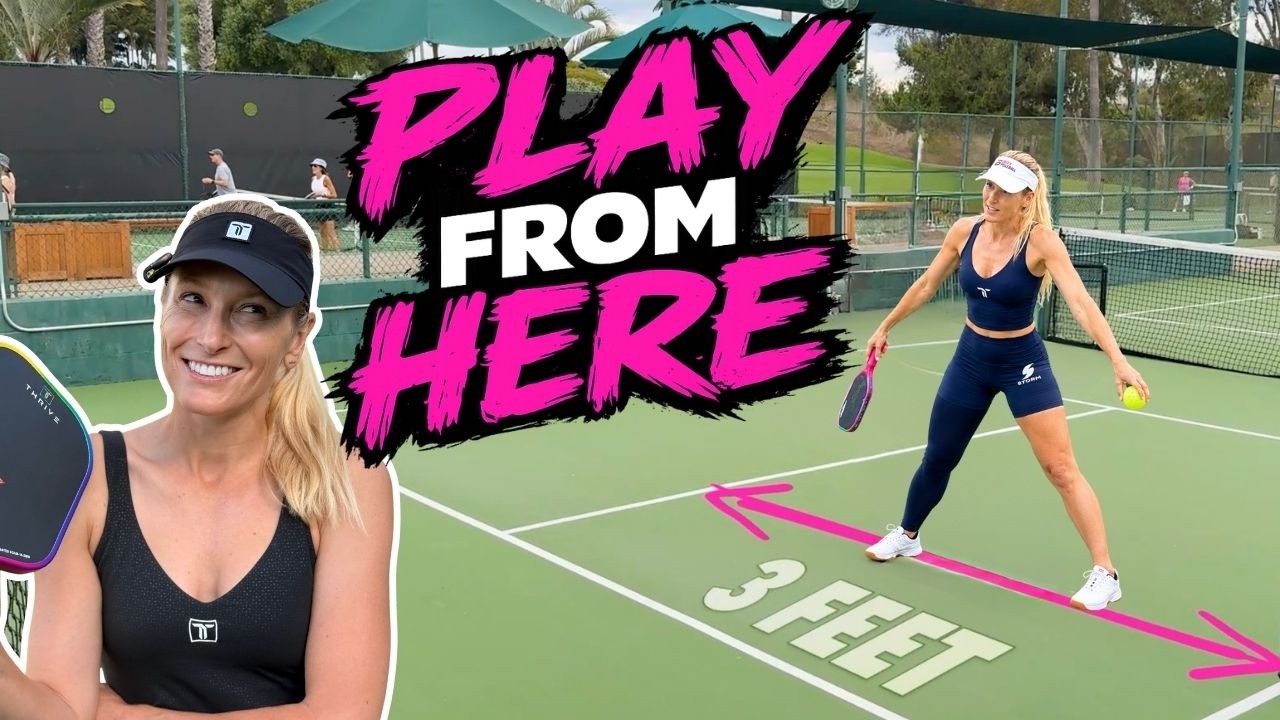
Coach Jess from Athena Pickleball, a former Division 1 tennis player and licensed psychotherapist, has identified three fundamental problems that hold players back from developing a dominant serve.
Love pickleball? Then you'll love our free newsletter. We send the latest news, tips, and highlights for free each week.
The Foundation: Why Your Serve Matters
Before we get into the fixes, let's talk about why your serve is so important.
Unlike every other shot in pickleball, the serve is the one moment where you have complete control.
Nobody's hitting at you. The ball isn't moving. You're not reacting to an opponent's shot. This is your chance to set the tone for the entire rally.
Yet most players treat the serve like an afterthought.
They step up to the line, toss the ball somewhere in the general vicinity of where it should be, and hope for the best.
Then they wonder why their serve lacks power and consistency.
The reality is this:
A weak pickleball serve isn't a strength issue. It's a technique issue. And technique can be fixed.
1. Master Your Toss for Consistency
The first mistake Coach Jess sees constantly is an inconsistent toss. Players step up to serve and drop the ball all over the place. Sometimes it's out to the side.
Sometimes it's behind the line. Sometimes it's two feet into the transition zone. Every toss is different, which means every contact point is different.
Here's the thing: if your toss isn't in the same spot every time, your contact point changes with every single serve.
Sometimes you're chasing the ball. Sometimes you're crowding it. This creates real inconsistency where you don't even know where the ball needs to be hit.
The fix is simple but requires discipline. You need to make your toss uniform. It should land in the same spot every single time.
Coach Jess uses a quarter as a target to illustrate this. When you step up to serve, imagine a small target on the court.
Your goal is to toss the ball so it lands on that exact spot, every time.
Why does this matter?
Because once your toss is consistent, you can essentially close your eyes and swing, knowing exactly where that ball will be.
Your contact point becomes predictable. Your swing becomes repeatable. And suddenly, your serve becomes reliable.
The spot you're looking for should be in front of your body, allowing you to move forward into the serve. This positioning sets up everything that comes next.
 Emily Visnic
2. Generate Power From Your Legs, Not Your Arm
The second reason your pickleball serve feels weak is that you're probably using only your arm.
Many players step up to the line, keep their lower body static, and just move their arm to get the ball over the net. They might get it in, but there's no pace on it.
Real power comes from sequencing, not effort. And sequencing starts with your legs.
Coach Jess demonstrates this with a simple throwing drill. When you throw a ball with just your arm, it doesn't go very far.
But when you load into your back leg, let it "juice up," and then drive forward, the ball travels significantly farther.
The difference is the heavy lift from your lower body that accelerates your hand.
Here's how to apply this to your serve: step up to the line and make sure your hips are turned slightly, with your body lined up in the direction you want to hit.
This gives you a clean line from your back leg to your target.
Then, instead of stepping straight forward, sink back into your back leg and transfer your weight forward as you swing.
This weight transfer is everything. You're not just moving your arm. You're loading energy into your back leg and then releasing it through your entire body.
The result is a serve with actual pace behind it.
Most players who can't generate power on their serve have their hips facing forward when they step up. This prevents them from sinking into their back leg.
If you find yourself chasing balls into the net, check your hip position. A small turn to the right (for right-handed players) gives you the torque you need.
The Dink Media Team
3. Clean Up Your Swing Path
The third and final problem is your swing path. This is where everything comes together.
- You've got a consistent toss.
- You've got power from your legs.
Now you need a clean, direct path from your paddle to the ball.
Coach Jess uses a tube to illustrate this concept. When you stand next to the tube, you have a clear line along your body.
If you place your toss just to the right of that tube and move your paddle along that lane, you create a clean line that directs the ball wherever you want it to go.
But when that tube isn't there, many players create a curved swing path.
- They cut across their body.
- They pull the paddle around.
- They start the paddle out to the right and bring it back inside.
All of this eliminates the clean line.
The problem with a curved swing path is that it creates unintentional spin. You might slice the ball when you didn't mean to. You might hook it.
You might send it out to the right or left without understanding why. These aren't intentional shots. They're accidents.
The fix is less is more.
Bring your paddle back, keep your toss in the same spot, and swing straight through the ball. Finish your paddle where you're aiming.
Don't come behind your body. Don't pull it around. Just a simple, direct movement from point A to point B.
When you combine a consistent toss, proper weight transfer, and a clean swing path, something magical happens.
You go from just getting the ball in to actually weaponizing your serve.
The Dink Media Team
Putting It All Together
The three fixes work because they build on each other.
- Your consistent toss sets up your contact point.
- Your leg drive generates the power.
- Your clean swing path directs that power where you want it to go.
Coach Jess emphasizes that power doesn't come from effort. It comes from sequencing.
If you load up your back leg, hold for a moment, and then drive into your waiting toss, you'll have a much bigger serve than you probably thought possible.
The beauty of these fixes is that they're not complicated. They're not about strength or athleticism.
They're about understanding the mechanics of a proper serve and then practicing them until they become automatic.
The Dink Media TeamWhy This Matters for Your Game
A stronger, more consistent pickleball serve changes everything.
- You get more serves in.
- You add effortless power.
- You start points on your terms instead of scrambling to recover from a weak serve.
Think about the last time you played.
- How many rallies did you lose because your serve went into the net?
- How many times did you hit a weak serve that your opponent attacked immediately?
A better serve eliminates those situations.
More importantly, a reliable serve gives you confidence.
- You step up to the line knowing you're going to get the ball in.
- You know you're going to have pace on it.
- You know you're going to start the rally in a position of strength.
For players looking to move from 3.0 to 4.0 level and beyond, serve improvement is one of the highest-leverage skills you can develop.
- It's the one shot you control completely.
- It's the one shot that happens the same way every time.
- It's the one shot that, when done right, puts immediate pressure on your opponent.
Frequently Asked Questions
How long does it take to fix a weak pickleball serve?
Most players see improvement within a few practice sessions once they understand the three fixes. Consistency comes with repetition, so dedicate 10 to 15 minutes per practice session to serve drills. Within two to three weeks of focused practice, you should notice a significant difference in both power and reliability.
Should I change my entire serve technique?
Not necessarily. These three fixes address the most common problems Coach Jess sees. If your serve is already solid in these areas, you might not need to change anything. The key is identifying which of the three fixes applies to your specific issues and addressing that first.
Can I use these fixes if I'm a beginner?
Absolutely. In fact, beginners benefit the most from learning proper technique from the start. If you're just learning to serve, focus on these three fundamentals before developing bad habits. It's much easier to build good technique than to fix bad technique later.
What's the difference between a slice serve and an unintentional slice?
A slice serve is intentional. You're deliberately creating spin to make the ball curve. An unintentional slice happens when your swing path is curved and you don't realize it. Coach Jess's point is that your swing path should be clean and direct so that any spin you create is on purpose, not by accident.
How do I know if my toss is consistent?
The simplest test is to toss the ball 10 times without swinging and see where it lands. If all 10 tosses land in roughly the same spot, you're good. If they're scattered, you need to work on toss consistency before worrying about anything else.

Love Pickleball? Join 100k+ readers for free weekly tips, news & gear deals.
Subscribe to The Dink