Almost every recreational pickleball player makes the same serve mistakes without realizing it. Fix these common pickleball serve mistakes and start winning more free points immediately.
The serve is supposed to be your easiest shot in pickleball. You control the ball, you control the pace, and you have all the time in the world to set up.
Yet somehow, recreational players struggle with it constantly.
Balls sail long, serves land in the net, and power feels impossible to generate. The frustrating part?
These pickleball serve mistakes are almost entirely fixable.
According to Your Pickleball Guideman, a popular pickleball coaching channel, the same serve errors show up again and again at local courts.
The good news is that if you clean up just a few key areas, you'll start winning more free points almost immediately. Think of this as a shortcut to better serving.
Love pickleball? Then you'll love our free newsletter. We send the latest news, tips, and highlights for free each week.
Your Grip Is the First Pickleball Serve Mistake to Fix
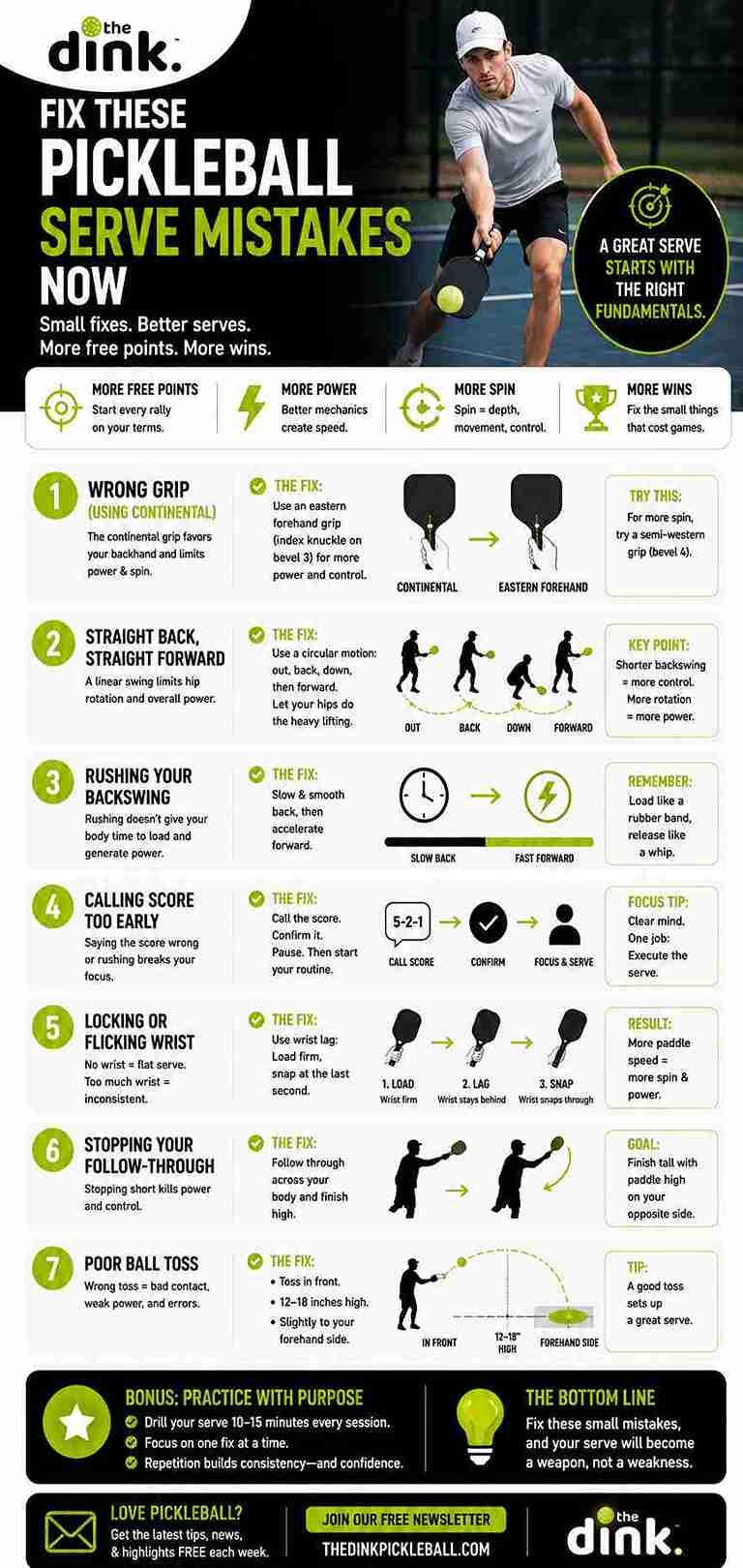
Here's the thing: almost every recreational player serves with a continental grip. It feels safe, it feels balanced, and it works fine for rallies.
But on the serve, that balance actually becomes a disadvantage.
The continental grip slightly favors the backhand side, which means you're not fully using your forehand mechanics to generate speed and spin.
Staying with the continental is a pickleball serve mistake that quietly limits your ceiling.
The key insight is that you have plenty of time to change your grip after contact, so there's no reason to limit yourself on the serve.
If you want instant improvement, try shifting to an eastern forehand grip. This means placing your index knuckle on the third bevel of the paddle.
Right away, you'll feel like the paddle naturally wants to accelerate through the ball.
Want even more spin? A semi-western forehand grip (index knuckle on bevel 4) can unlock heavier topspin.
Many high-level players quietly do this, even if they use continental everywhere else. If it works at the top, there's probably a good reason.
Why Your Backswing Matters More Than You Think
Most recreational players take the paddle straight back and then straight forward.
It feels natural, and it does involve your hips a little, but not nearly as much as it could.
When you watch elite servers closely, you'll notice something different.
Their motion isn't linear. It's circular.
The paddle goes slightly out, then back, then drops, and finally explodes forward.
This looping motion matters because it allows your hips to coil more fully instead of relying on your arm for power.
You're storing energy in your lower body and torso. When that energy releases, the serve feels effortless but explosive.
A straight back, straight forward swing forces your arm to do all the work, which limits both power and consistency.
Here's another common pickleball serve mistake: taking huge backswings. The logic seems obvious. Bigger swing equals more power.
In reality, it usually creates the opposite result. When the paddle travels too far behind your body, control starts to disappear.
Timing becomes harder. Contact becomes inconsistent.
Pros actually use surprisingly short backswings. The difference is that they're using their entire body efficiently.
With a compact backswing, you stay connected and balanced, and your hips do the heavy lifting.
The paddle accelerates because of rotation and sequencing, not because you're muscling the ball.
That's the 4-step system every recreational player should understand: less effort, more results.
What's the Right Tempo for Your Pickleball Serve?
Even players with decent mechanics often rush their backswing. Everything happens fast and the serve feels chaotic.
The problem with rushing is that your body never gets time to properly load weight and coil. You're leaving power and accuracy on the table.
Think about the serve like a golfer's swing or pulling back a rubber band.
The backswing should feel slow and deliberate.
You're loading energy. Then, once you transition forward, everything happens fast.
That contrast, slow back and fast forward, is where effortless power comes from.
When you get this timing right, the serve suddenly feels smooth instead of forced.
Working on this one rhythm shift is one of the 12 drills that can genuinely transform your game in 2026.
This might sound mental rather than mechanical, but it's one of the most common serving mistakes out there.
The Mental Game Is a Pickleball Serve Mistake Nobody Talks About
This one might sound mental rather than mechanical, but it's one of the most overlooked pickleball serve mistakes out there.
Many players call the score immediately before serving. If they say it wrong, their mind gets stuck on the mistake instead of the shot.
The fix is simple. Call the score, confirm it's right, then pause. Start your pre-serve routine after the score is settled.
That mental reset gives your brain one clear job: execute the serve.
Nothing else. Pairing this with modern strategy principles will sharpen your decision-making from the very first shot of every rally.
Your Wrist Needs to Work Harder to Fix This Serve Error
There are very few times in pickleball where the wrist should be actively involved. The serve is one of them.
Many players either lock the wrist completely and hit flat, or they overuse it with a windshield wiper motion.
Both limit power and spin, and either habit is a serve error that's easy to miss on your own.
What you actually want is wrist lag. During the backswing, your arm stays relatively straight and the wrist remains firm.
As you move forward, your elbow bends first while the wrist stays behind. At the very last moment, the wrist snaps through.
This creates massive paddle head speed.
The faster the tip of the paddle moves, the more spin and power you generate. Once you feel this, your serve will never feel the same again.
The Follow-Through That Separates Serious Servers
One of the easiest ways to tell if someone has worked on their serve is to watch their follow-through.
Players who haven't usually finish across their body or stop short. That kills topspin and caps power.
If your goal is a heavy topspin serve, your swing needs to travel from low to high and finish over one of your shoulders.
Some pros finish over the same side shoulder, others over the opposite shoulder. Both can work.
What matters most is consistency.
Pick a follow-through path and repeat it every time so your body knows exactly what to expect.
The Pre-Serve Look That Pros Take
Here's a subtle habit you might never have noticed. Right before starting their backswing, pros briefly look up at the returner. They're checking positioning.
Are they standing deep, crowding the line, leaning one way? That information can change your serve choice entirely.
A body serve, for example, only works if you know where the opponent actually is.
After that quick glance, your eyes lock onto the ball and stay there through contact.
Even if the returner moves, they won't have enough time to adjust meaningfully.
Where You Stand Is a Serve Mistake You're Probably Not Tracking
Where you stand when serving isn't random. It's a strategic choice.
Standing right on the baseline gives your opponent less reaction time, but limits how hard you can hit without going long.
Stepping back gives you more room to swing and generate power, but gives them more time to react.
The key isn't which option you choose, it's consistency.
Do the same thing every time so your body can calibrate.
Standing slightly off the line is a great compromise, and it also leaves you better prepared for the third shot instead of getting caught moving forward awkwardly.
It's also worth knowing that new USAP rules for 2026 include updates that affect serve positioning requirements, so make sure you're up to date before tournament play.
The Ball Drop: Your Foundation for Fixing Every Pickleball Serve Mistake
The serve starts before the swing. It starts with the drop. Skipping this step is a pickleball serve mistake that affects every other element of your motion.
Many players add unnecessary variability by dropping the ball differently each time. All of that changes where contact happens.
When the drop is inconsistent, everything downstream becomes a guessing game.
A simple fix is extending your arm straight out in front of you, wrist pointing down, and dropping the ball from the same height every time.
This ensures contact happens out in front where your swing is strongest and fastest.
Frequently Asked Questions
What is the most common pickleball serve mistake recreational players make?
The most common pickleball serve mistake is gripping the paddle incorrectly and rushing the backswing at the same time. Most recreational players use a continental grip and take a straight back, straight forward swing, which limits both power and spin. Fixing your grip and slowing your backswing are the fastest ways to see improvement.
What's the best grip for a pickleball serve?
The eastern forehand grip is ideal for most players because it allows you to generate more speed and spin than the continental grip. Place your index knuckle on the third bevel of the paddle. If you want even more topspin, try a semi-western grip with your index knuckle on bevel 4.
How long should my backswing be?
Your backswing should be compact and controlled, not huge. Pros use surprisingly short backswings because they rely on body rotation and sequencing for power, not arm strength. A shorter backswing also gives you better control and timing consistency.
Why does my serve feel rushed and inconsistent?
If your serve feels chaotic, you're most likely making the serve mistake of rushing your backswing. The backswing should feel slow and deliberate as you load energy. Once you transition forward, everything happens fast. This slow-back, fast-forward contrast is where effortless power comes from.
How important is the wrist snap on the serve?
The wrist snap is crucial for generating paddle head speed, which directly creates spin and power. During your backswing, keep your wrist firm. As you move forward, let your elbow bend first while your wrist stays behind. At the last moment, snap your wrist through to maximize speed and fix the flat-serve mistake for good.

Love Pickleball? Join 100k+ readers for free weekly tips, news & gear deals.
Subscribe to The Dink