Who Covers the Middle Ball at the Pickleball Kitchen? The Definitive Answer
Knowing who covers middle kitchen pickleball is one of the most decisive tactical questions in doubles. This guide breaks down the rules of thumb, situational exceptions, and how the best players settle it automatically, no guesswork required.
Knowing who covers middle kitchen pickleball situations is the single clearest dividing line between doubles teams that communicate and doubles teams that just coexist. Who covers the middle in pickleball doubles is the foundational reference — this article builds on it with situational exceptions and advanced applications.
The middle ball at the kitchen is where points are won and lost, where partners collide, and where a split second of indecision hands the other team a free winner.
Here's the short answer: the player whose forehand is in the middle takes the middle.
But that rule has exceptions, and knowing those exceptions is how you stop giving away easy points.
Love pickleball? Then you'll love our free newsletter. We send the latest news, tips, and highlights for free each week.
The Forehand Rule: Who Covers Middle Kitchen Pickleball by Default
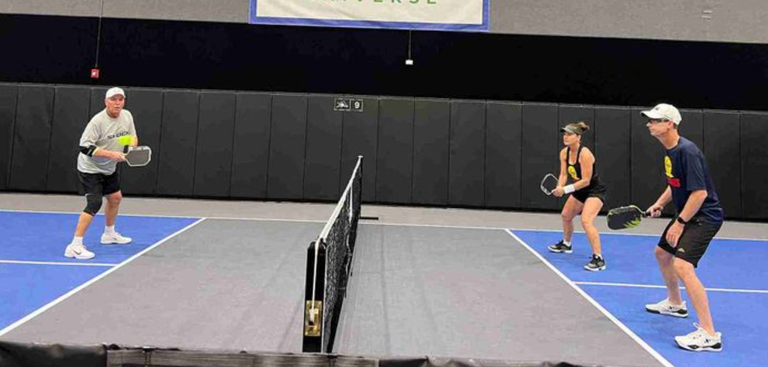
The default answer is the player with their forehand facing the center of the court.
In standard doubles positioning, the right-side player (even court) is typically hitting backhands cross-court and forehands down the middle, while the left-side player (odd court) mirrors that geometry.
The player with the open forehand to the middle takes it. Every time.
Why forehand? It's not tradition for tradition's sake. The forehand generates more power, more reliable direction, and more offensive potential from that angle.
A backhand jammed into the middle of your body is a defensive shot at best. A forehand attacking from center is a pressure zone point-winner.
Think of it this way: you want the stronger weapon facing the most contested real estate on the court.
The middle at the kitchen line is the most dangerous target an opponent can hit, low, fast, and splitting you and your partner.
The forehand is the tool best equipped to handle it.
This is not complicated once you internalize the geometry.
If your partner is on the left side (odd court) and you're on the right (even court), your forehand naturally faces the center.
Middle ball? That's yours. Understanding your court position at the kitchen line is the first step to claiming it and mastering who covers middle kitchen pickleball by default.

Why the Middle at the Pickleball Kitchen Is Such a Battleground
The middle of the court at the non-volley zone line is contested space for one simple reason: it's the lowest part of the net.
According to USA Pickleball's official rulebook, the net measures 34 inches at center, two full inches lower than the 36-inch height at the sidelines.
That means a ball aimed at the middle clears the net more easily, sinks faster once it crosses, and arrives in the gap between two players at the worst possible angle for both of them.
Opponents who figure out how to exploit the middle will make you hit the most difficult shots on the court.
You're forced into a contact point where both you and your partner hesitate. That hesitation produces soft, high replies that opponents can attack at will.
There's also the psychological component. A ball splitting two players creates a split-second "who has it?" moment.
By the time you settle it mentally, the ball has already beaten you or forced a pop-up.
The goal is to pre-settle that decision so you never have to think about it in the moment.
Here's the thing: the teams you lose to in rec play aren't always hitting harder or placing the ball better.
They're just hitting the middle more often and waiting for you to hand them the point.
Changing the way you think about doubles pickleball starts here, at the most contested 34 inches on the court. How to control the middle court in pickleball is the offensive companion to this defensive framework on who covers middle kitchen pickleball.
Three Situations That Change Who Covers the Middle at the Pickleball Kitchen
The forehand rule is the default, but three specific situations require you to override it.
Knowing these in advance keeps your team from blowing an easy middle ball at a critical moment.
1. Who Covers Middle Kitchen Pickleball When You're Stacking?
Stacking in pickleball flips conventional positioning entirely, so the forehand rule needs recalibrating. When both players shift laterally to keep their preferred forehand sides after a serve or return, the player who ends up with their forehand physically facing the middle of the court still takes it, regardless of which side they're on. Doubles stacking 101: the fool-proof positioning strategy that wins points is essential reading before applying this middle coverage exception.
The math doesn't change. The geometry does. Before you stack, pre-communicate who holds the middle. Staggering your positioning as you approach the kitchen while stacking creates coverage confusion, have that conversation before the rally starts, not during it.
 The Dink Media Team
2. Who Covers the Middle When One Player Is Pulled Wide?
This one catches teams constantly. You or your partner gets pulled wide at the NVZ, and the opponent immediately attacks down the middle. In this situation, the player still at the center of the court covers the middle. Your partner should scramble to recover position, not reach across to poach.
The non-pulled player must immediately slide toward the middle to cover the gap. It's a 4th shot court coverage adjustment made at the kitchen line. Slow lateral movement here hands opponents a free winner every time.
3. Who Covers the Middle During a Speed-Up Exchange?
When the tempo escalates and attackers start speeding balls at the middle, the forehand rule still applies, but you have to commit faster. Hesitation is a concession. During a hard-blocking counter-smash sequence, the player with their forehand positioned in the middle takes it.
If you're on the left side with a two-handed backhand, you may have strong middle coverage in that scenario. That's fine.
The rule is the rule, until your mechanics make the exception make sense.
The two-handed backhand volley breakdown tells you exactly when your backhand is well-positioned enough to hold the middle on who covers middle kitchen pickleball in a fast exchange.
The Dink Media Team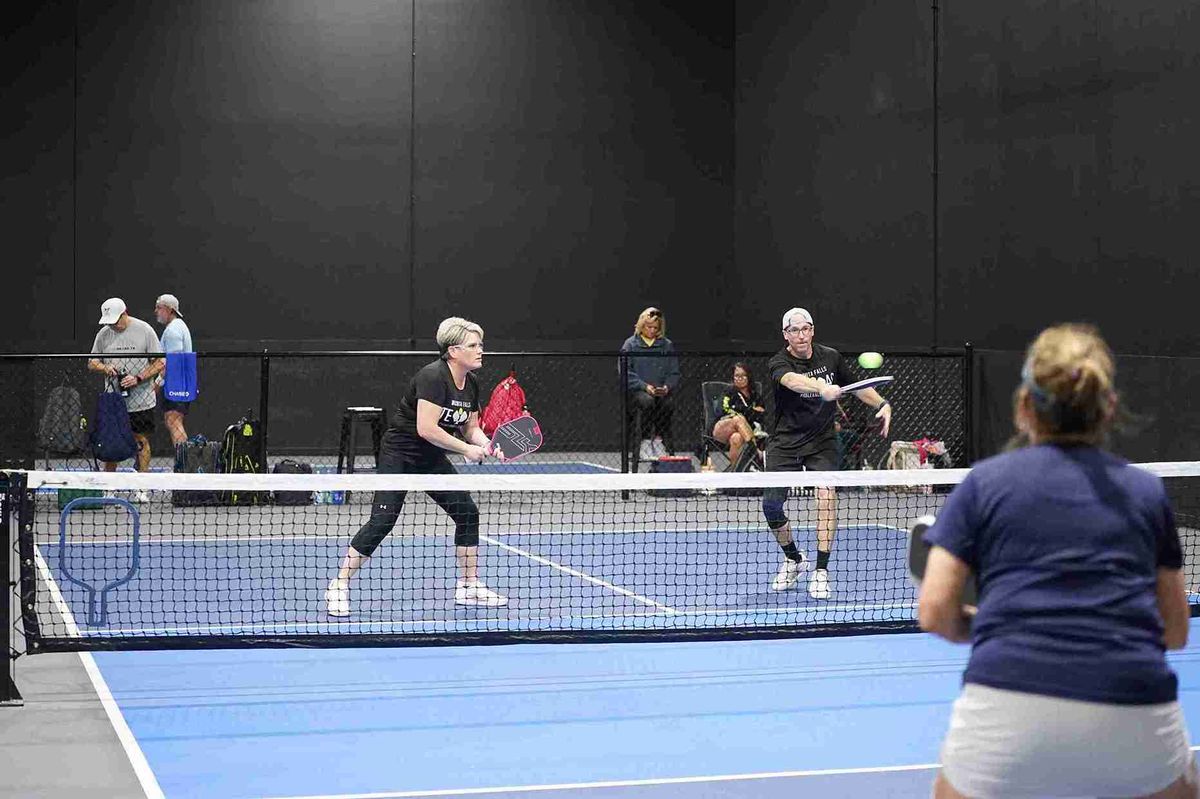
The X Rule: Who Covers Middle Kitchen Pickleball in Crosscourt Exchanges
The X Rule is the more advanced version of the forehand default, and it's what separates competent doubles teams from great ones.
The concept: when the ball is going crosscourt from your partner's side, your partner is covering more court by default.
Their forehand is likely positioned toward the middle as a result of that crosscourt angle.
Put simply: whoever is hitting the crosscourt dink owns the middle until the ball comes back down their line.
Alex E. Weaver
The covers middle X rule is exactly the kind of intermediate-level framework that makes who covers middle kitchen pickleball feel automatic rather than improvised.
This is where doubles strategy around T and sideline placement connects directly to the middle coverage question.
Directing the ball toward the T, the center-service line junction, forces the question of who covers the middle on the reply.
It's not just ball placement. It's positional pressure.
The X Rule also connects naturally to the three advantages of playing both sides of the court.
When your team moves well laterally together, the X Rule handles middle coverage automatically, no one has to call the ball because positioning makes the answer obvious.
The Dink Media Team
How to Use the Middle Against Your Opponents in Pickleball
This is the section most articles skip. They tell you how to cover the middle. They don't tell you how to exploit it.
Targeting the middle at the kitchen is one of the highest-percentage shots in doubles pickleball.
A ball aimed directly between two players is difficult to coordinate. Each player waits for the other.
By the time someone commits, the window for a clean, offensive reply has passed.
Here's how to do it deliberately:
- Aim for the partner who's moving. If one player is recovering lateral position, hit the middle immediately. They can't establish their forehand in time.
- Speed up down the middle. A fast drive between the two players at the kitchen is harder to defend than a drive at either player's body. Power shots aimed here with good timing win points outright.
- Slow it down first. Dink crosscourt, pull one player to the sideline, then redirect a soft middle ball. The cat-and-mouse game pickleball makes unavoidable. The opponent pulled wide can't recover in time to cover a redirected middle. How to set a 1-2 trap for through-the-middle winners is the specific tactical play that turns this into a repeatable point-winner.
The teams playing the percentages correctly know the middle isn't just a vulnerability to defend, it's a target to attack relentlessly.
The Dink Media Team
What the Pros Do Differently When Covering the Middle Pickleball Kitchen
At the pro level, nobody is deciding who covers the middle during a rally.
That decision is pre-committed through body positioning and court awareness before the ball even arrives.
Watch any top-level doubles match and notice: neither player breaks from their ready position to chase a middle ball.
They let the ball come to their forehand rather than lunging. The commitment to position is what makes coverage automatic.
Research on reaction time in racket sports published in the Journal of Sports Sciences confirms that pre-committed movement decisions are executed significantly faster than reactive ones, which is exactly why pre-setting middle responsibility is a physical advantage, not just a tactical preference.
The Dink Media Team
The simple tips to improve doubles teamwork at the pro level come down to three things specific to who covers middle kitchen pickleball:
- Pre-commitment: Both players know the default before the rally. No discussion needed.
- Verbal confirmation on ambiguous balls: One word, "mine" or "yours", called early, not after the ball splits you.
- Lateral discipline: Neither player cheats toward the sideline, which would expose the middle unnecessarily.
Pros also use the middle offensively more than recreational players. Becoming unattackable in pickleball doesn't mean hiding from the middle. It means owning it so firmly that opponents stop targeting it.
When you consistently cover the middle cleanly, opponents are forced into riskier sideline targets.
One more thing pros do: deliberate middle resets when pulled out of position.
Middle coverage pickleball: the 4th shot rule and a mid-court drill that simulates being pulled wide on the reply are both worth adding to regular practice if who covers middle kitchen pickleball is a recurring breakdown in your matches.
The Dink Media Team
Key Takeaways
- The forehand rule is the default: the player with their forehand facing the middle takes middle balls at the kitchen.
- The X Rule extends this: whoever hits crosscourt holds middle coverage until the ball redirects.
- Three exceptions override the default: stacking, one player pulled wide, and speed-up exchanges at the kitchen.
- Middle coverage must be pre-committed, not decided during the rally.
- The middle is also your best offensive target: the net is lowest here, it covers the seam between opponents, and it creates indecision.
- Communication is the fallback, not the system. Your positioning should make the answer automatic.
Frequently Asked Questions
Who covers the middle at the kitchen in doubles pickleball?
The player whose forehand faces the center of the court takes the middle ball at the kitchen. In standard positioning, this is typically the right-side player (even court), since their forehand naturally angles toward center. This is the default rule and is adjusted for stacking, wide pulls, and speed-up exchanges.
Does the forehand rule always apply to who covers middle kitchen pickleball?
No, three situations override it. When stacking, both players must pre-agree on middle coverage based on adjusted positions. When one player is pulled wide, the remaining center player covers the middle. During fast speed-up exchanges, whoever has the strongest and best-positioned shot commits. The forehand rule is the default, not a rigid law.
What is the X Rule in doubles pickleball?
The X Rule describes how coverage shifts during crosscourt dinking exchanges. The player hitting crosscourt naturally positions their forehand toward the middle as part of that angle, so they hold middle coverage until the ball redirects down the line. It's a positioning principle built into the geometry of the rally, not a verbal agreement.
How do you stop opponents from attacking the middle?
Stay centered together as a team. Don't cheat toward the sideline, stay close enough that your forehands cover the middle naturally. During dink rallies, avoid getting drawn wide before your partner has covered the gap. Clean footwork and a disciplined ready position at the kitchen make the middle far harder to attack.
Should you ever call "mine" or "yours" on a middle ball?
Yes, but early, not late. A call made before contact forces your partner to yield cleanly and gives you time to set up properly. A call made at the last second creates collision or hesitation. The call is a fallback for genuinely ambiguous balls. Your positioning should eliminate the ambiguity most of the time.

Love Pickleball? Join 100k+ readers for free weekly tips, news & gear deals.
Subscribe to The Dink