

The backhand roll dink is one of pickleball's trendiest shots, but it's also one of the most misunderstood. Here are the three specific things you need to fix to make this shot reliable and consistent.
The backhand roll dink is everywhere right now.
You see it on social media, you watch pros execute it flawlessly, and you probably think to yourself:
"I should be hitting that shot."
But here's the thing — if you're setting up for the perfect backhand roll dink only to watch it land in the net or pop up for an easy smash, you're not alone.
This shot looks deceptively simple, but it requires a more complex movement than a standard push dink, which means more opportunities for things to go wrong.
Understanding what separates average from advanced players starts with knowing exactly which shots demand more from your body and why. Master the backhand roll: a 5.0 player's guide is the high-level technical companion to this breakdown if you want to go deeper on mechanics.
Love pickleball? Then you'll love our free newsletter. We send the latest news, tips, and highlights for free each week.
Is the Backhand Roll Dink Even Right for You?
Before you start obsessing over the backhand roll dink, you need to understand what you're actually trying to do.
This isn't a beginner shot. You should already be comfortable executing a consistent backhand push dink before adding this to your arsenal.
Here's why: every time you hit a pickleball, you automatically put some spin on the ball.
A push dink is straightforward. A roll dink, though, requires you to make a more complex movement with both your body and your paddle.
That complexity creates greater inconsistency, which is why it's an advanced technique.
The roll dink works because the paddle travels from a low position to a high position, brushing up on the ball and creating topspin.
When that topspin hits the court on your opponent's side, it makes the ball jump up toward them, potentially forcing an error because it comes closer than they expected.
That's the whole advantage.
If you're still building your topspin fundamentals, master topspin in pickleball with this complete 3-step progression guide before layering in the backhand roll dink.
But if you can't execute the fundamentals, you're better off sticking with the push dink.
Mastering dink placement is a prerequisite to adding spin-based variations like the backhand roll dink that can disrupt your opponent's rhythm.
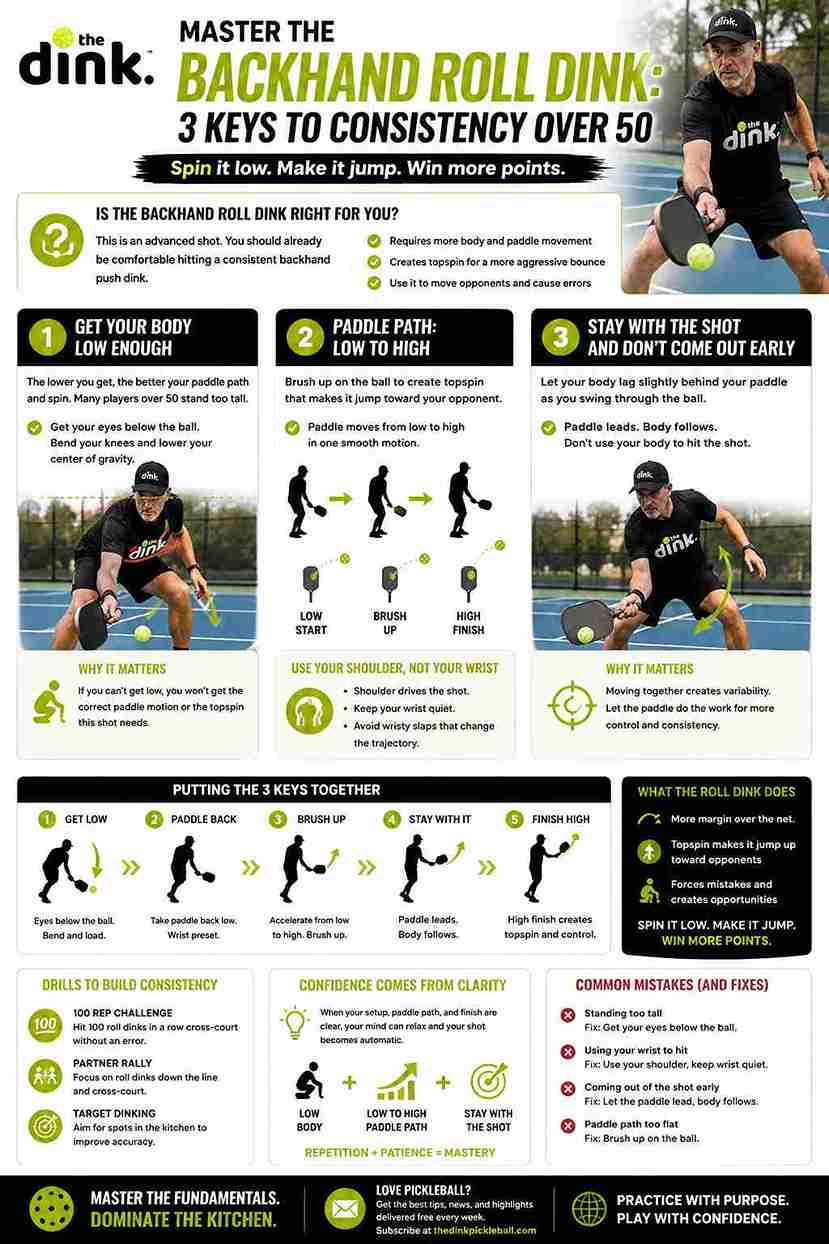
Key 1: Get Your Body Low Enough for a Consistent Backhand Roll Dink
This is where most players over 50 struggle, and it's not because they lack skill. It's because as we age, we tend to stand taller and not bend as much.
Your body naturally resists getting low, but that's exactly what the backhand roll dink demands.
Before you even think about hitting this shot, be honest with yourself: Can you bend far enough? Literally think about getting your eyes below the ball.
If you can't get that low, you're not going to get the correct paddle motion for this shot, and you'll be fighting an uphill battle.
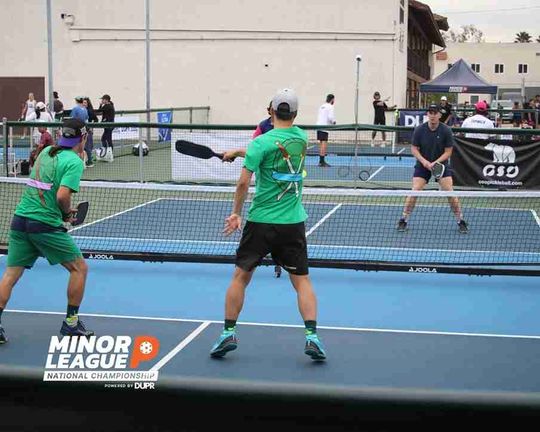
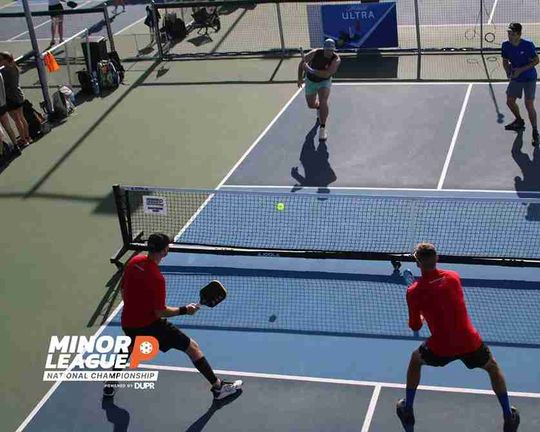
CJ Johnson demonstrates this by getting his eyes underneath the ball, which is the body position you need to achieve.
This isn't about flexibility alone — it's about commitment. You have to actively bend your knees and lower your center of gravity.
Perfecting your pickleball posture is the foundation that makes every advanced shot possible, including the backhand roll dink.
If you're struggling with your ready position or lateral movement to get low enough, senior pickleball mechanics drills for grip, footwork, and net play can help you build the physical foundation this shot requires.
The key is understanding that this foundational position determines everything that comes after it
Key 2: The Backhand Roll Dink Paddle Path Must Travel Low to High
Once you're in the right body position, your paddle needs to move correctly. As your body goes down, the paddle goes down as well.
What matters next is the paddle path itself.
The paddle needs to move from a low position to a high position in one smooth motion.
As it travels upward, it brushes up on the ball, creating that topspin that makes the shot effective.
This low-to-high motion is what separates a roll dink from other dink variations.
Understanding what wrist lag actually does in pickleball clarifies why keeping the wrist quiet during the backhand roll dink motion is so critical.
 The Dink Media Team
Why Your Shoulder — Not Your Wrist — Controls the Shot
Here's the most common mistake CJ Johnson sees players make: they use their wrist instead of their shoulder to drive the shot.
When you use your wrist, you're adding another source of energy to the shot, and you're potentially changing the trajectory of the paddle at contact.
That can make the ball go higher or float into the net.
The key driver of the backhand roll dink is your shoulder, not your wrist. Your shoulder controls the low-to-high paddle path.
Your wrist should stay relatively quiet.
This distinction matters more than you might think, because it's the difference between a consistent roll dink and a frustrating one.
Players who stop popping the ball up with modern hand speed and paddle positioning have already internalized this principle: the shoulder leads, the wrist follows on the backhand roll dink.
Once you feel the difference, there's no going back.
The Dink Media Team
Key 3: Stay with the Backhand Roll Dink Shot and Don't Come Out Early
This is the third piece that separates successful roll dink execution from failure.
As your paddle moves forward, your body should lag behind your paddle just a little bit.
If your body and paddle move at the same time, you create another variability that makes the shot less reliable.
In other words, don't use your body to hit the shot. Your body follows the paddle swing; it doesn't initiate it. This is a subtle but critical distinction.
Smart shot decisions in advanced pickleball almost always come down to this exact principle: the body reacts, it doesn't lead the backhand roll dink.
The Dink Media Team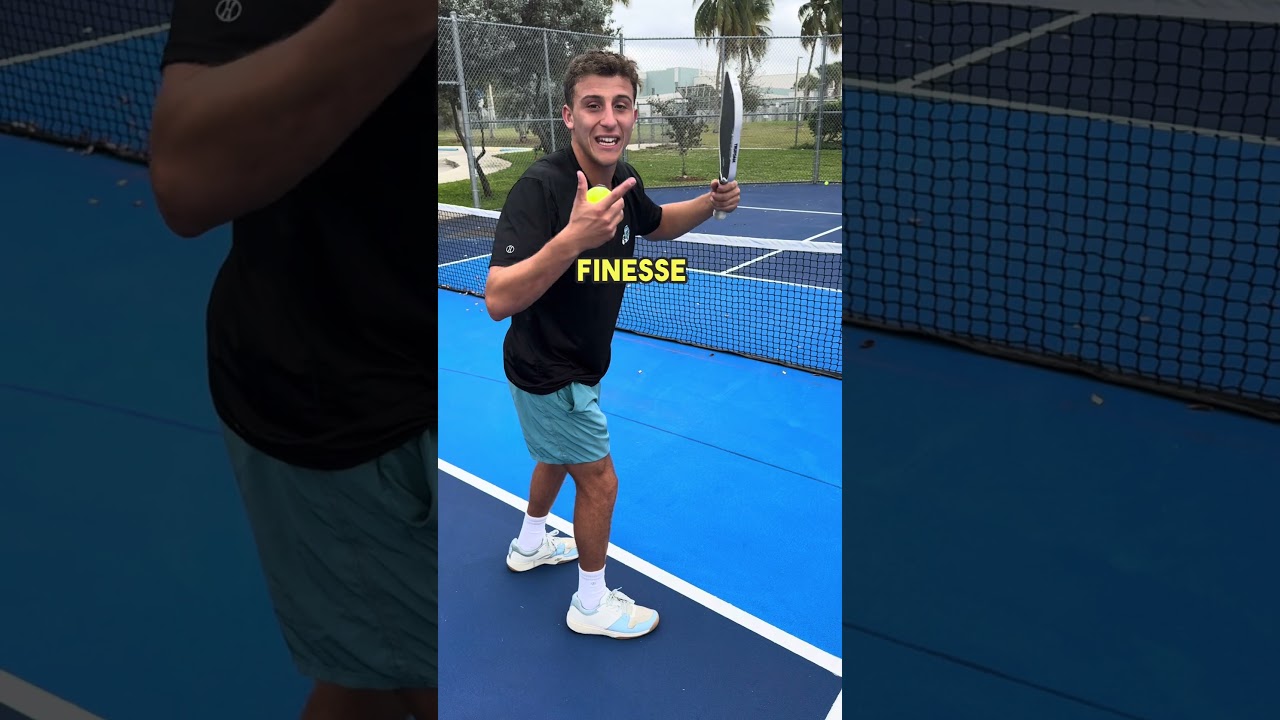
How Confidence Builds with a Clear Roadmap for Backhand Roll Dink Consistency
CJ Johnson emphasizes that confidence comes from clarity.
When you know exactly what you're working on and you have a roadmap, that's where real improvement happens.
The backhand roll dink isn't a mystery — it's a technique with specific, learnable components.
Players who avoid the 3 deadly mistakes in aggressive dinking understand that the mental side of shot-making is just as important as the mechanics on the backhand roll dink.
Staying with the shot is as much a mindset as it is a physical cue. Once you commit to the follow-through, the consistency follows.
The Dink Media Team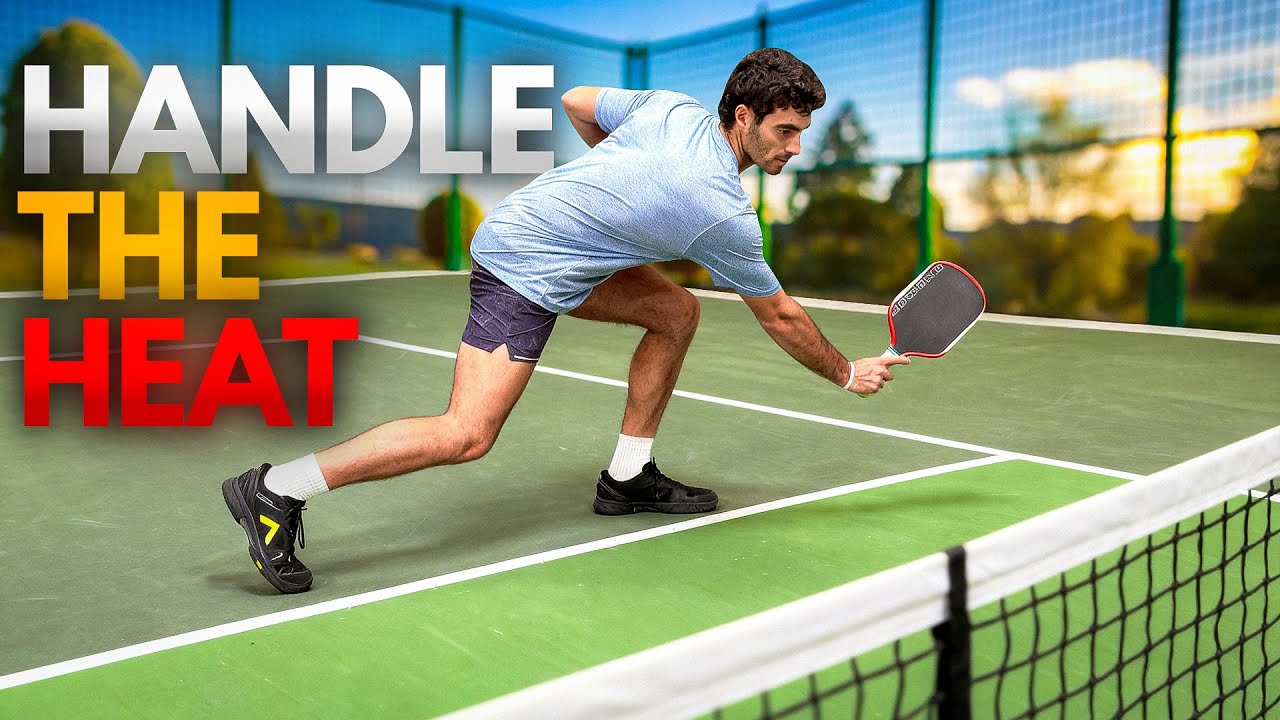
Putting It All Together: Your Backhand Roll Dink Checklist
So if you want to hit a successful backhand roll dink, remember these three things:
- Get your body low and get your eyes under the ball.
- Use your shoulder to move the paddle from low to high.
- Stay with the shot instead of coming out early.
Do those three things consistently, and you're going to have a great roll dink. It won't happen overnight, but the progression is clear.
- Start with your body position. Master that.
- Then focus on the paddle path.
- Then work on staying with the shot.
The backhand roll dink is a shot worth learning, especially if you're playing at the 3.5 to 4.0 level. It's a weapon that can change rallies in your favor.
For more shots that belong in every serious player's toolkit, the 6 essential pickleball shots to master for 2026 is required reading.
If you're over 50 and want more targeted technique breakdowns, 5 essential strategies for senior pickleball players pair perfectly with the backhand roll dink progression you just learned.
And if you want to drill your way to faster improvement, the 12 drills you need to play your best pickleball in 2026 will keep the momentum going.
Frequently Asked Questions
What is the difference between a backhand roll dink and a push dink?
A push dink is a straightforward, simple motion that keeps the ball low and controlled. A backhand roll dink requires a more complex movement where the paddle travels from low to high, generating topspin that causes the ball to jump up on your opponent's side. The roll dink is an advanced shot that should only be added to your game after you've mastered the push dink.
Why do I keep hitting my backhand roll dink into the net?
The most common reason is that you're using your wrist instead of your shoulder to drive the shot. Your wrist can alter the paddle trajectory at contact, causing the ball to float or dump into the net. Focus on keeping your wrist quiet and letting your shoulder control the entire low-to-high paddle path.
Can I hit a backhand roll dink if I can't bend very low?
It's very difficult. The backhand roll dink requires you to get your eyes below the ball so you can execute the correct low-to-high paddle motion. If you can't get that low, stick with the push dink and work on knee bend, flexibility, and mobility before attempting this shot.
At what skill level should I start learning the roll dink?
You should be comfortable executing a consistent backhand push dink before attempting the roll dink. Most players at the 3.5 to 4.0 level are ready to start learning this shot. If you're below 3.5, focus on mastering the soft game fundamentals first.
How long does it take to get consistent with the backhand roll dink?
That depends on your current skill level and how much deliberate practice you put in. Focus on one key at a time: body position first, then paddle path, then follow-through. Once you have a clear roadmap for each component, improvement accelerates significantly.

Love Pickleball? Join 100k+ readers for free weekly tips, news & gear deals.
Subscribe to The Dink