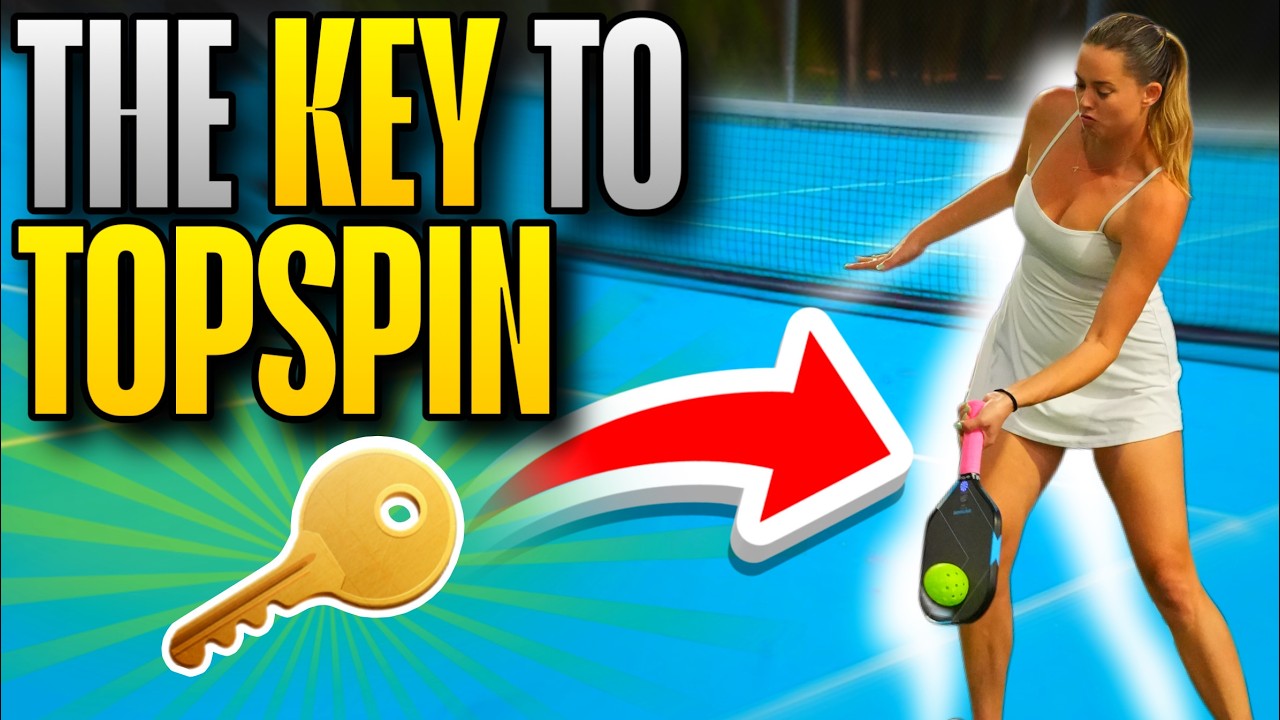
Pickleball Topspin Is Way Easier Than You Think: A Pro's Guide
Pickleball topspin doesn't have to be complicated. Professional player Ava Ignatowich reveals the simple wrist mechanics and paddle positioning that make pickleball topspin easier to learn than most players think.
If you've ever felt confused by pickleball topspin, you're not alone.
Most players either overcomplicate it or learn it completely wrong, which is why so many recreational players struggle to add spin to their drives, serves, and dinks.
But here's the secret: pickleball topspin is actually far simpler than coaches make it sound.
Professional PPA Tour player Ava Ignatowich recently broke down the mechanics of pickleball topspin in a way that strips away the confusion and gets straight to what actually works.
Instead of relying on vague coaching clichés like "brush up on the ball" or "pet the dog," Ignatowich explains topspin through a single, powerful concept: a ball rolling forward through the air.
Love pickleball? Then you'll love our free newsletter. We send the latest news, tips, and highlights for free each week.
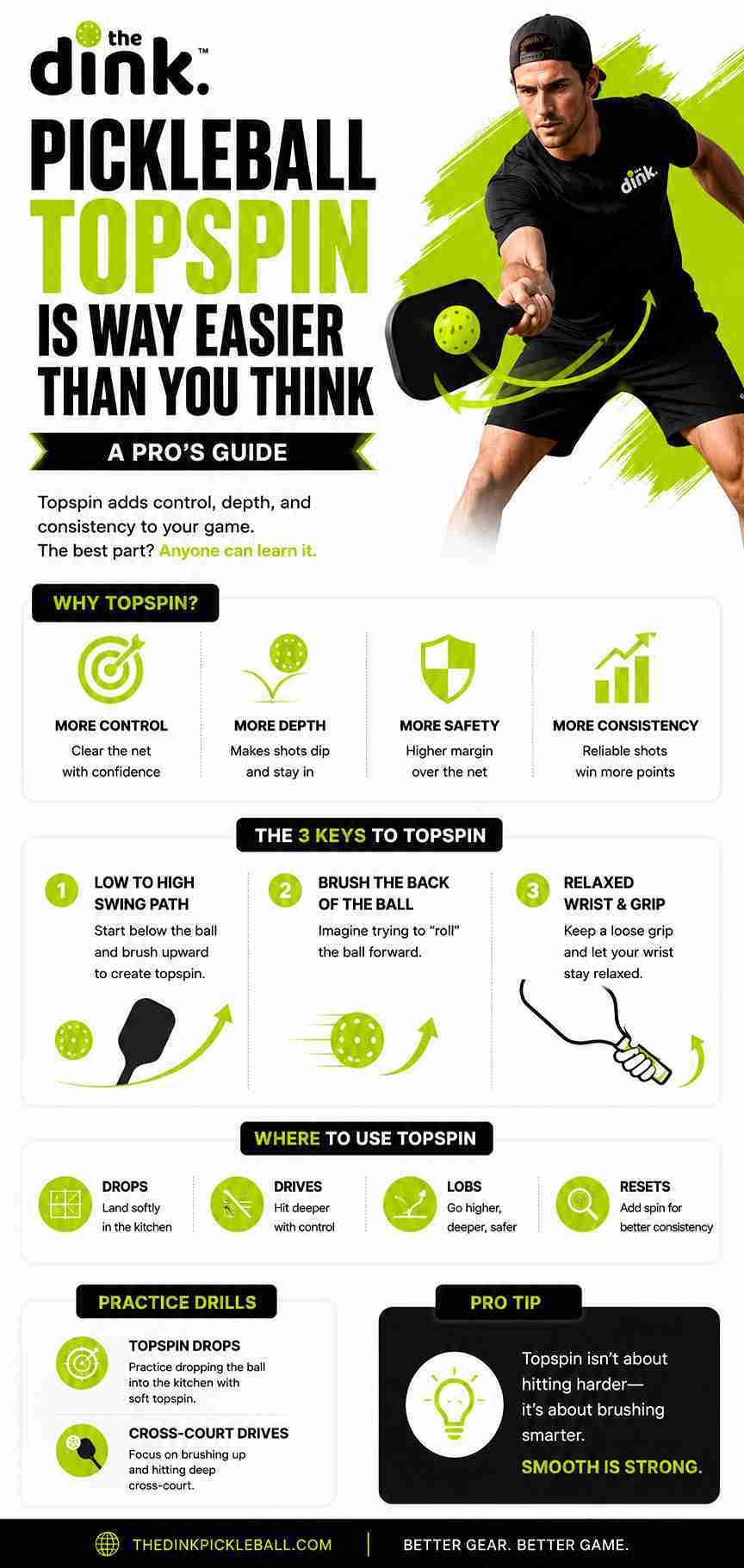
What Is Pickleball Topspin, Really?
The foundation of understanding pickleball topspin starts with the simplest possible image: a ball rolling forward. That's it.
When you roll a ball across the ground with your hand, you're creating forward momentum.
Pickleball topspin is exactly that same motion, except the ball is rolling forward through the air instead of along the court.
When a ball with topspin bounces, something magical happens. Instead of landing flat and dying, it springs up with forward momentum.
This is why pickleball topspin is so valuable. It keeps the ball in the court, even when conditions are unpredictable or when you're hitting with power.
The physics behind this is straightforward: the ball's rotation creates lift and control simultaneously.
- You can hit harder while keeping the ball in bounds.
- You can handle windy conditions better.
- You can speed up without sailing the ball into the fence.
The Wrist Is Everything in Pickleball Topspin
Here's where most coaching breaks down. Coaches tell players not to use their wrists.
But when it comes to pickleball topspin, the wrist is where the magic happens.
Ignatowich emphasizes that this spin technique doesn't come from your shoulder movement or the slant of your paddle alone. It comes from your wrist.
Specifically, it comes from a motion she calls "the wave."
Understanding what wrist lag actually does in pickleball can help you feel the difference between passive and active wrist action.
Imagine waving at a baby or a small ant. That's the feeling you should have in the middle of your stroke.
Your paddle comes back, and then you accelerate forward with a small, snappy wrist motion, almost like you're waving.
This isn't a big, exaggerated movement. It's controlled and compact.
The wristier you can be with your stroke, the better your pickleball topspin will be. This applies to drives, serves, drops, and dinks.
If you're not getting wristy with your motion, you're leaving spin on the table.
Why the Paddle Angle Matters for Pickleball Topspin
You can't generate pickleball topspin without the right paddle angle.
Ignatowich recommends starting with your paddle slanted at approximately a 45-degree angle at contact point.
Getting your paddle positioning dialed in is the essential first step toward consistent spin mechanics.
If your paddle isn't slanted down, you won't get enough spin.
The angle is what allows you to brush the ball forward and create that rolling motion through the air.
Without it, your attempts at pickleball topspin will either sail long or lack the rotation you need.
Think of it this way: if your paddle is flat or angled upward, where's the ball going to go? It won't travel straight. It'll either pop up or drift wide.
The slanted paddle face is the foundation of consistent pickleball topspin.
 The Dink Media Team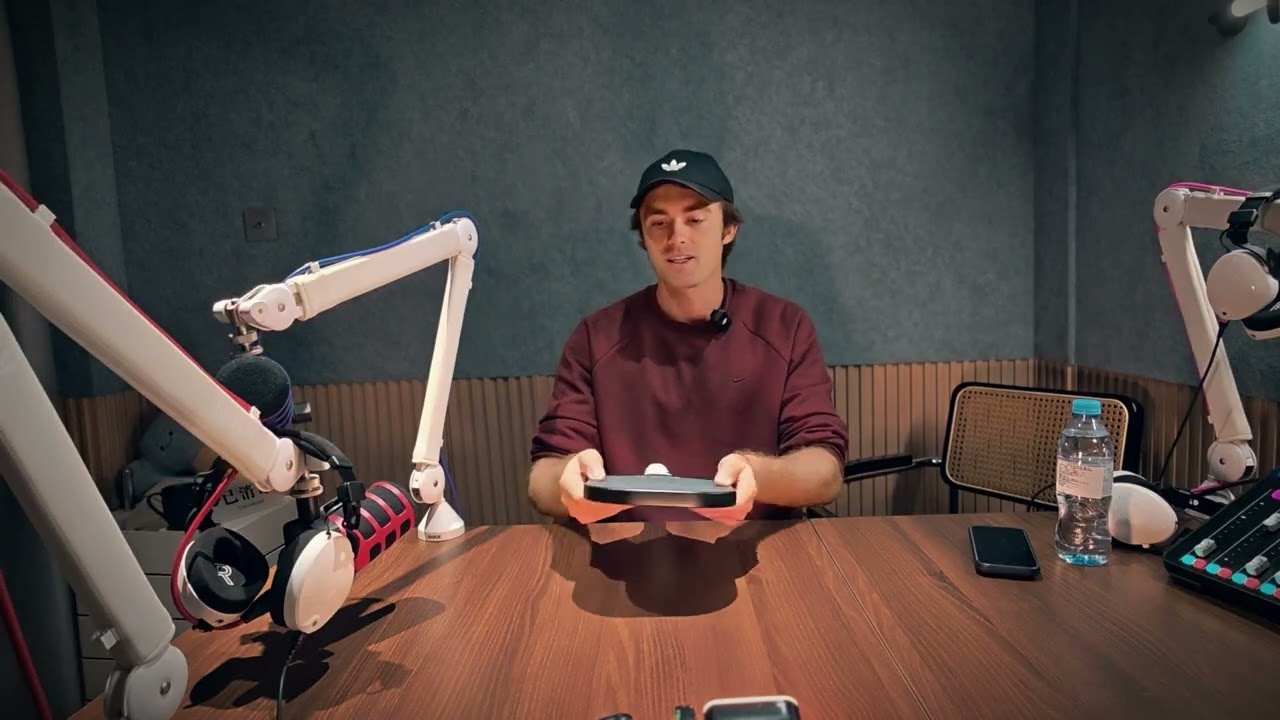
The Three-Part Stroke for Pickleball Topspin
Ignatowich breaks the pickleball topspin stroke into three distinct phases:
- Drop the paddle face — Take your paddle back and angle it downward
- Wave — Accelerate forward with that wrist motion, like waving at someone
- Finish over your shoulder — Complete the stroke by bringing your paddle over your shoulder
This three-part sequence is crucial.
The finish over your shoulder is especially important because it closes your swing, which helps the ball dip into the court rather than sailing long.
This same 3-step progression is used by coaches to build reliable topspin mechanics from the ground up.
Many players finish straight through the ball, which prevents them from closing their swing properly.
When you finish over your shoulder, you're naturally creating the trajectory that keeps pickleball topspin shots in bounds.
The Dink Media Team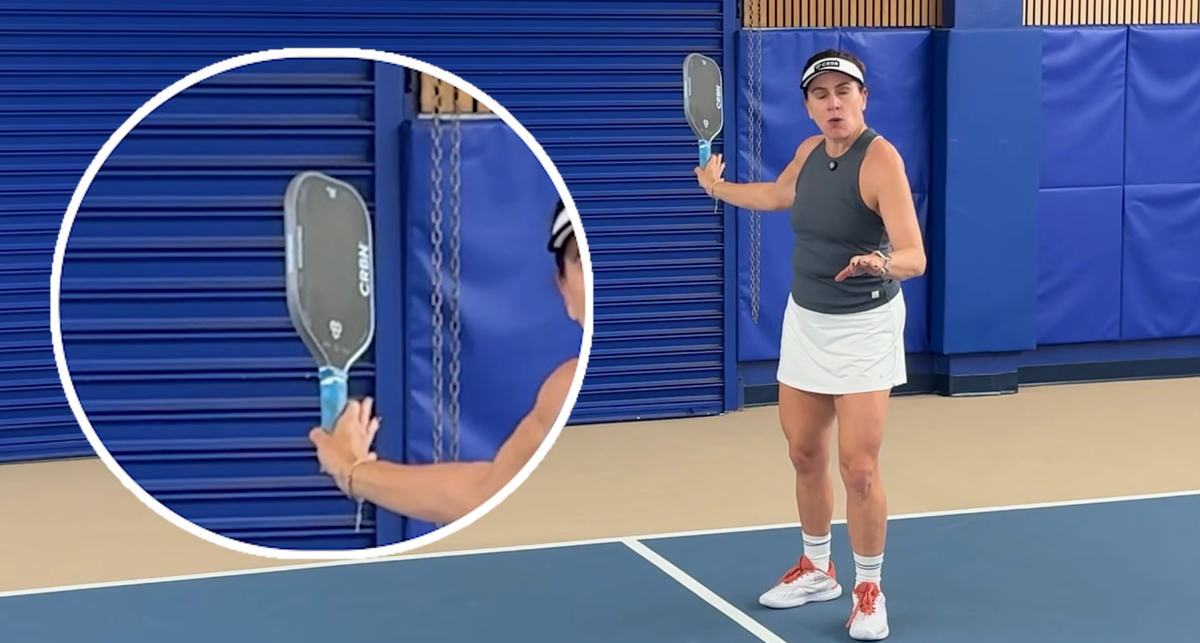
Positioning Matters More Than You Think
Here's something that doesn't get enough attention: where you stand relative to the ball directly affects your ability to hit pickleball topspin.
Ignatowich recommends standing slightly to the side of the ball, not directly behind it. The ball should be a little bit in front of you and to the side.
If you're directly behind the ball, your body gets in the way, and you can't brush the ball properly.
Perfecting your posture and balance on court gives you the stable platform you need to execute this positioning consistently.
You also want to maintain good arm's length distance.
This spacing gives you room to accelerate through the ball and create the brush motion that generates pickleball topspin.
The Dink Media Team
Practice Pickleball Topspin Against a Wall
The best way to develop a feel for pickleball topspin is to practice against a wall.
This removes the pressure of playing points and lets you focus purely on wrist mechanics.
Press the ball against the wall and practice rolling it using only your wrist. Feel the ball rolling on your paddle. Do this repeatedly until the motion becomes natural.
The wall will be there for you when no one else wants to practice hitting topspin dinks with you.
Ignatowich also recommends choking up on the paddle when practicing against the wall.
This makes it easier to feel the ball rolling on your paddle and to control the spin motion.
The Dink Media Team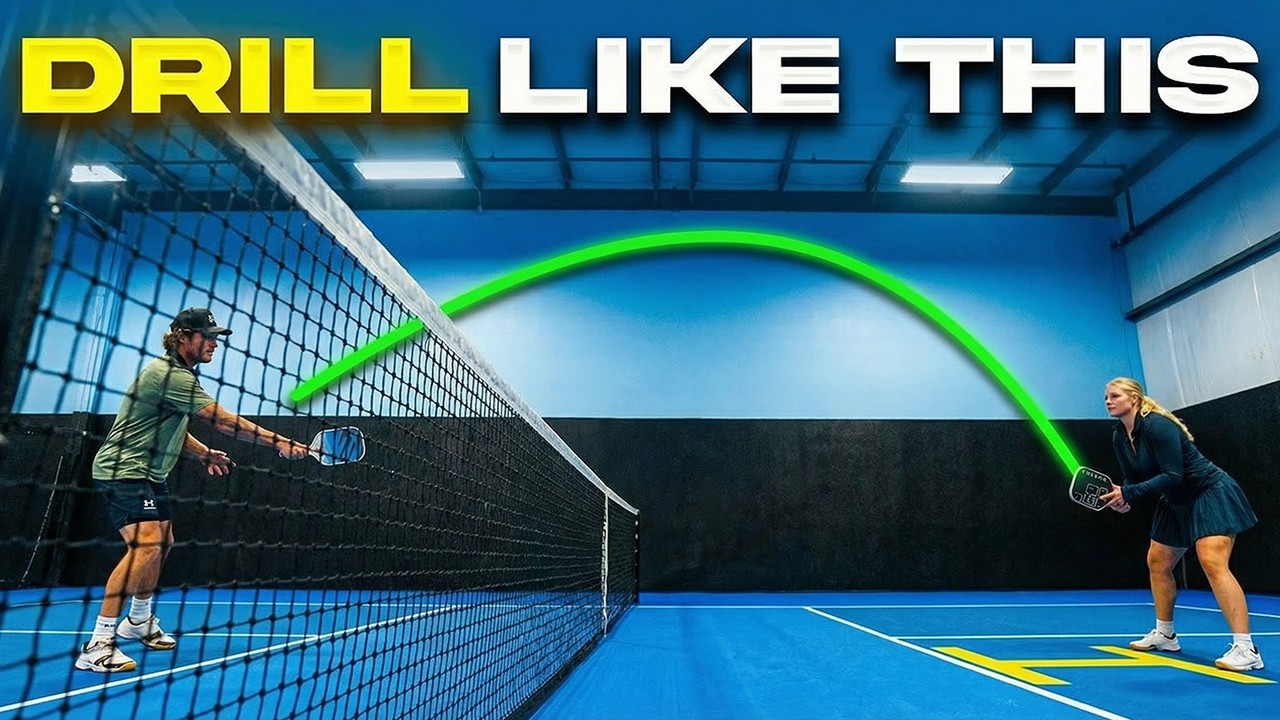
Pickleball Topspin on Drives and Serves
On drives and serves, pickleball topspin is generated almost entirely from wrist action. Your shoulder movement is minimal.
The power comes from that wave motion and the acceleration of your wrist through the contact point.
Generating effortless power through body rotation complements this wrist-first approach on bigger swings.
This is different from what many players expect. They think they need to use their whole body to generate spin.
In reality, the wrist does most of the work on drives and serves.
The Dink Media Team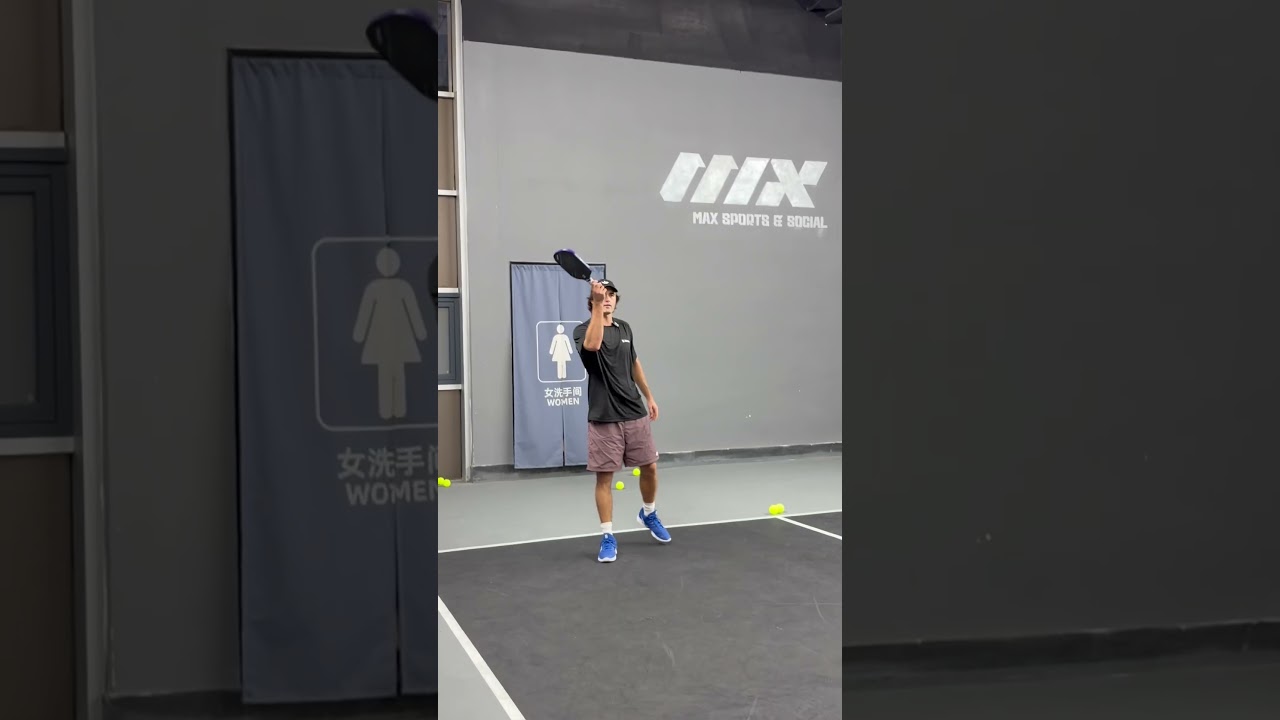
Pickleball Topspin on Dinks and Speed-Ups
Pickleball topspin isn't just for drives and serves. It's equally important on dinks and speed-ups.
If you're speeding up a ball without putting forward spin on it, your opponent can easily get out of the way and let it sail long.
Topspin keeps the ball in the court even when you're hitting with aggression.
This is why learning how to make your speed-ups work at the kitchen line is foundational to improving your game.
Understanding why your pickleball speed-ups fail often comes down to one thing: a lack of forward spin at contact. Fix that, and the speed-up becomes a weapon.
The Dink Media Team
The Backhand Pickleball Topspin Challenge
For the backhand, Ignatowich recommends using a two-handed backhand to generate consistent pickleball topspin.
The key is that your top hand (your non-dominant hand) is doing most of the work.
Start with a slanted paddle face, just like on the forehand. Then, use your non-dominant hand to create that wave motion and brush the ball forward.
Your dominant hand is mostly there for stability. Mastering the two-handed backhand drive requires that same wrist-driven spin mechanic Ignatowich teaches.
Ignatowich suggests practicing the backhand pickleball topspin motion with just your non-dominant hand a few times before adding your dominant hand to the paddle.
This helps you feel the correct motion without interference.
Learning the essential two-handed backhand shots with guidance from other pros reinforces the mechanics she describes.
The Dink Media Team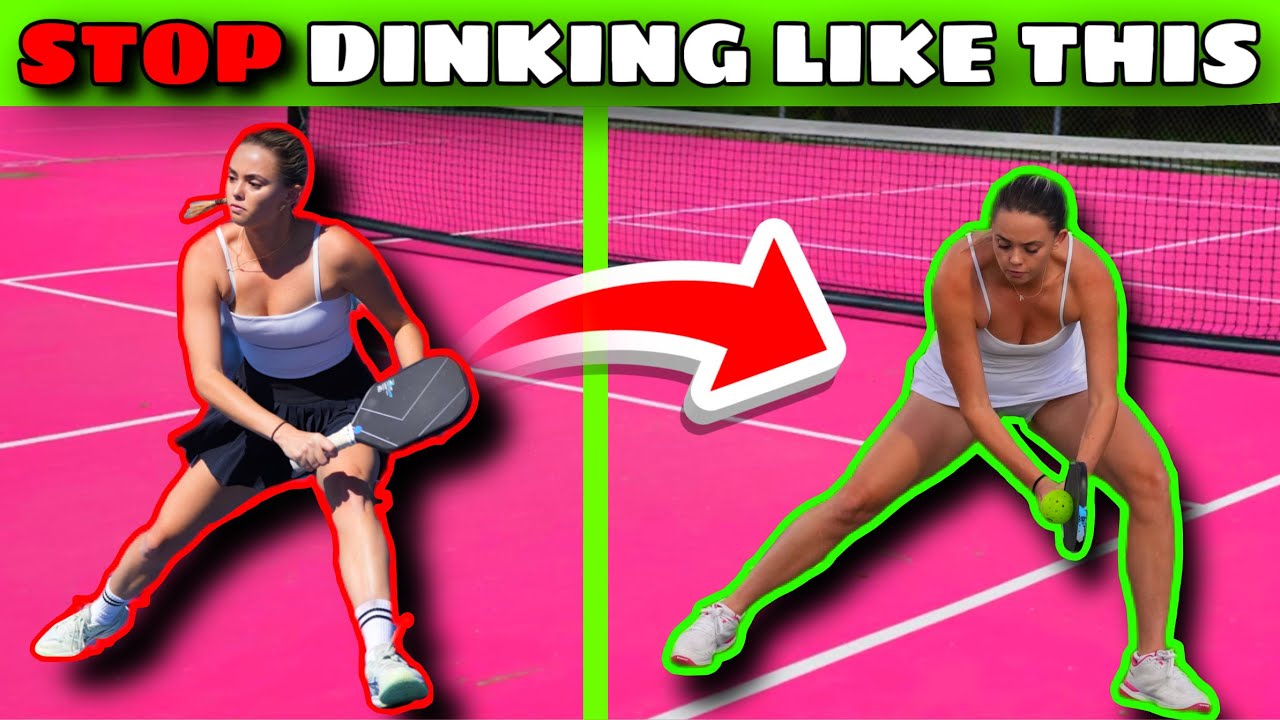
Why Pickleball Topspin Matters in Competitive Play
Pickleball topspin is one of the biggest game changers in the sport. It's not just a nice-to-have skill. It's foundational to playing at higher levels.
- When conditions are windy or unpredictable, topspin keeps the ball in the court.
- When you want to hit harder without sacrificing spin control, pickleball topspin makes it possible.
- When you're trying to speed up a dink or execute a drive, topspin gives you the margin for error you need.
Smart shot decisions beat raw power in advanced pickleball, and spin is a core part of that equation.
Professional players rely on pickleball topspin constantly. It's not an advanced technique reserved for pros.
It's a fundamental skill that every player should develop.
According to coverage of why pro players abandoned the slice shot in 2025, topspin-heavy play has become the dominant spin technique at the professional level.
The Dink Media Team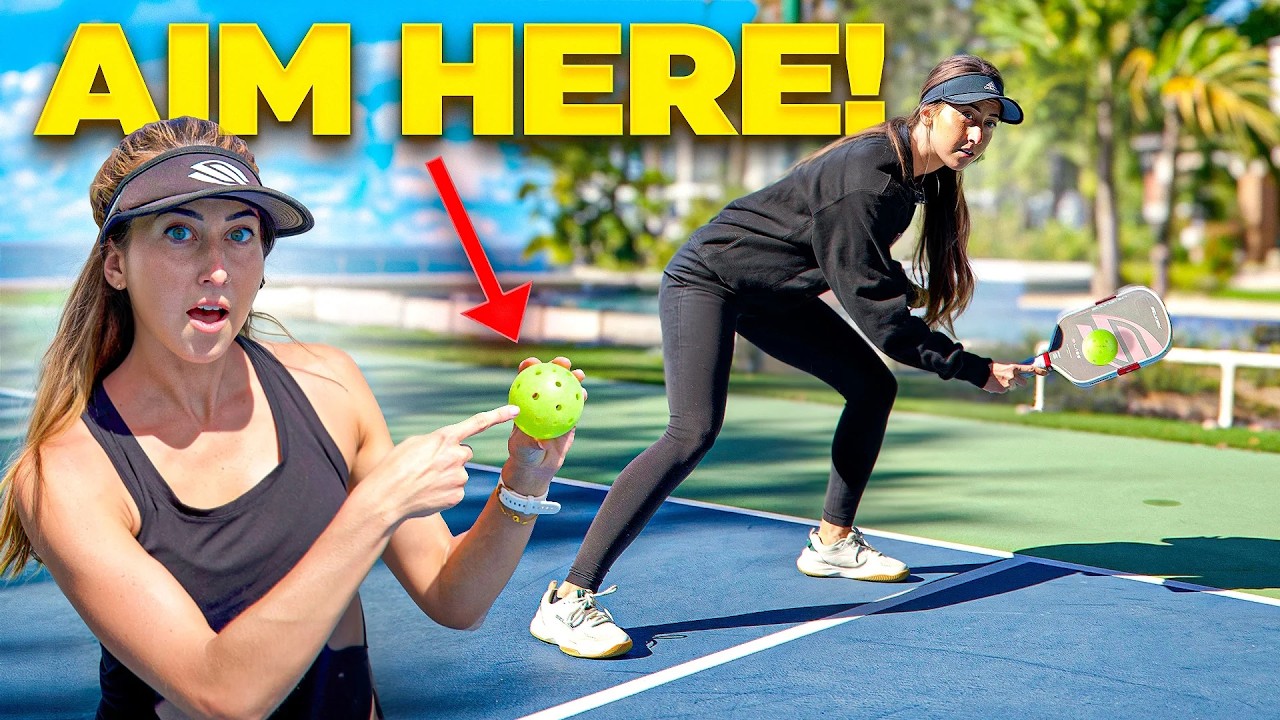
The Common Mistakes Players Make with Pickleball Topspin
Most players make one of two mistakes with pickleball topspin.
Either they overcomplicate it by trying to use their whole body, or they learn it completely wrong from the start.
A deeper look at the 5 most common topspin mistakes breaks down exactly where players go wrong in their spin technique.
The confusion often comes from vague coaching terminology. "Brush up on the ball" doesn't mean much to a beginner. "Pet the dog" is even more confusing.
These phrases don't give players a clear mental image of what they're supposed to do.
Ignatowich's approach cuts through this confusion by using a simple, concrete image: a ball rolling forward.
Once you understand that concept, everything else falls into place.
If you want to fast-track your development, these drills for 2026 include focused spin work to accelerate how quickly your topspin mechanics click.
Frequently Asked Questions
What's the Easiest Way to Start Learning Pickleball Topspin?
Start by practicing against a wall. Press the ball against the wall and practice rolling it using only your wrist. This removes the complexity of court positioning and lets you focus purely on feeling the ball roll on your paddle. Do this for 10 to 15 minutes several times a week, and you'll develop the muscle memory you need.
Do I Need to Use My Whole Body to Generate Pickleball Topspin?
No. Most of the work comes from your wrist, especially on drives and dinks. Your shoulder movement is minimal. The key is that wave motion with your wrist, combined with the correct paddle angle. Many players waste energy trying to use their whole body when they should be focusing on wrist action and spin control.
Why Does My Pickleball Topspin Keep Sailing Long?
You're probably not finishing over your shoulder. When you finish straight through the ball, you don't close your swing, which causes the ball to sail. Try finishing over your shoulder instead. This closes your swing and helps the ball dip into the court naturally.
Can I Hit Pickleball Topspin on My Backhand?
Yes, but it's easier with a two-handed backhand. Use your non-dominant hand to create the wave motion and brush the ball forward. Your dominant hand is mostly there for stability. Practice the motion with just your non-dominant hand first to get the feel right.
How Long Does It Take to Master Pickleball Topspin?
It depends on how much you practice. If you're hitting against a wall several times a week, you should feel noticeable improvement within 2 to 3 weeks. Full mastery takes longer, but the basics are learnable relatively quickly once you understand the concept of a ball rolling forward. Using the 70-rule to make practice skills stick can accelerate how quickly those pickleball topspin mechanics transfer to real match play.
Love Pickleball? Join 100k+ readers for free weekly tips, news & gear deals.
Subscribe to The Dink