
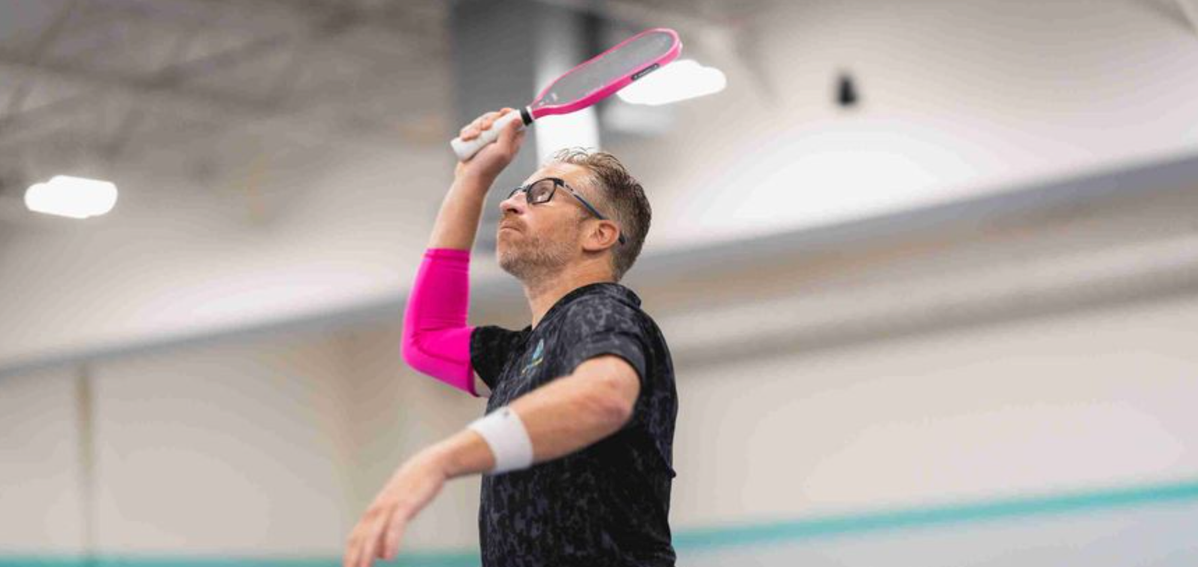
How to Hit the Overhead Smash in Pickleball: Footwork, Trophy Position and Finish
The overhead smash pickleball technique is one of the most decisive shots in the game, when it's dialed in, it ends rallies on the spot. This guide breaks down the footwork, trophy position, and finish mechanics you need to hit it with power and precision every time.
The overhead smash pickleball technique is the closest thing to a guaranteed point-ender in the sport, and most players are leaving it on the table.
Not because they're not athletic enough, but because they're missing the mechanics that turn a swinging attempt into a put-away shot.
This isn't about swinging harder. It's about setting up correctly, loading through a proper trophy position, and finishing with intent.
Get those three things right, and the power follows.
Love pickleball? Then you'll love our free newsletter. We send the latest news, tips, and highlights for free each week.
What Is the Overhead Smash in Pickleball?
The overhead smash is an attacking shot hit from above head height, typically in response to a lofted ball, a poorly executed lob, or a floater in the transition zone.
The goal is simple: redirect the ball down into the court with enough pace and angle that your opponent cannot respond.
Think of it like a baseball throw from above, not a tennis flat serve.
The motion pulls from the shoulder girdle, rotates through the torso, and snaps at the wrist at contact. It's a full-body shot, not just an arm swing.
Understanding when not to smash is just as important.
If the ball is dropping below shoulder height or you're still moving backward without control, resetting is the smarter play. The overhead is a weapon, not a reflex.
Why the Overhead Smash Pickleball Technique Starts With Your Feet
Here's the thing: most missed overheads are footwork failures, not swing failures.
You can have a technically clean motion and still dump the ball into the net if you're off-balance at contact.
The golden rule is this: get behind the ball, not under it.
When a lob goes up, your first move is backward, shuffle steps or a cross-step turn, never a backpedal with crossed feet.
Footwork drills for pickleball emphasize keeping your center of gravity low and stable, and that applies here too.
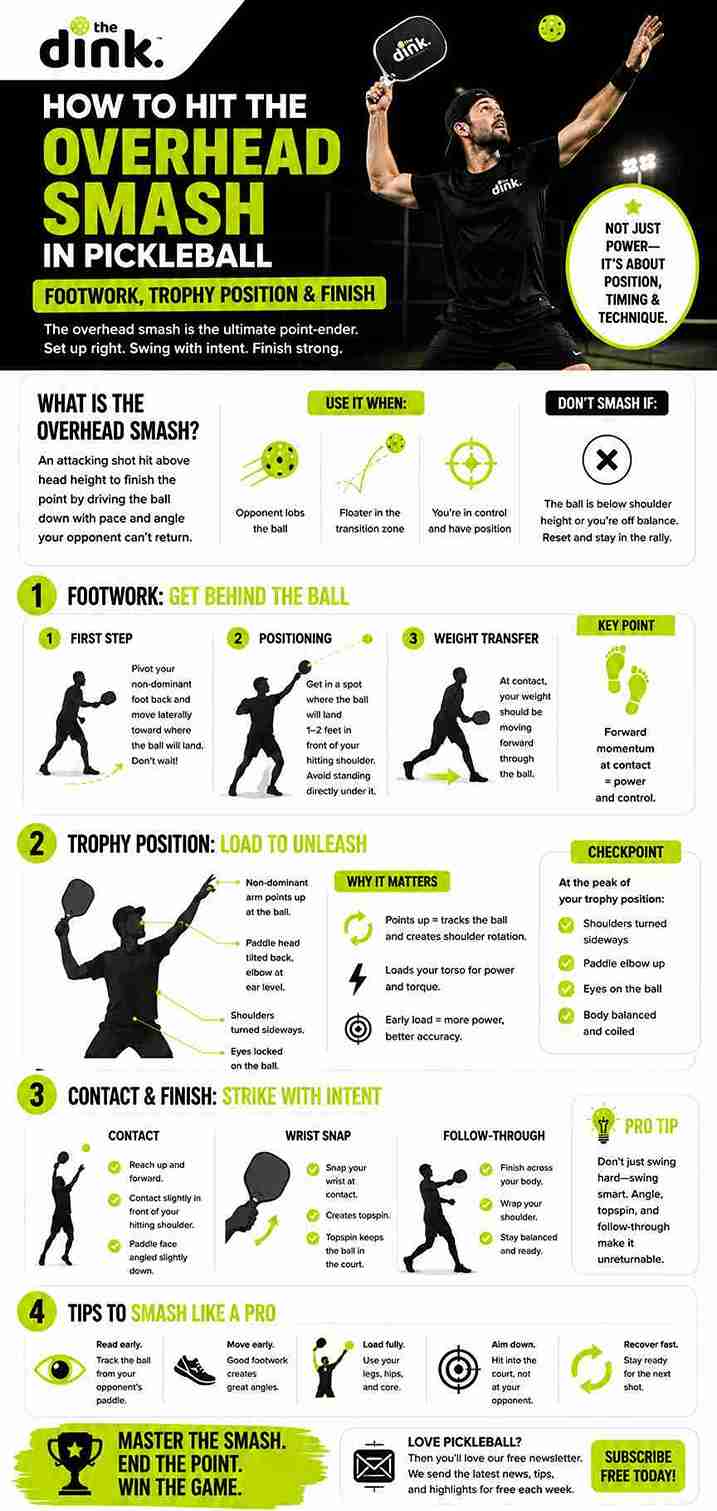
The Three Footwork Checkpoints
- First step: As soon as you read a lob, pivot your non-dominant foot back and begin lateral movement toward where the ball will land. Don't wait, that half-second matters.
- Positioning: Get to a spot where the ball will land roughly one to two feet in front of your hitting shoulder. Standing directly under the ball forces a cramped swing and kills power. You want room to extend.
- Weight transfer: At contact, your weight should be moving forward through the ball. If you're drifting backward, you're late. The power shots in pickleball that actually land in-bounds are almost always accompanied by forward momentum at the moment of contact.
Practice this footwork without a ball first. Shadow the movement, hit your position spot, and freeze.
If your front foot is slightly forward and your hips are open toward the target, you're in business.
 The Dink Media Team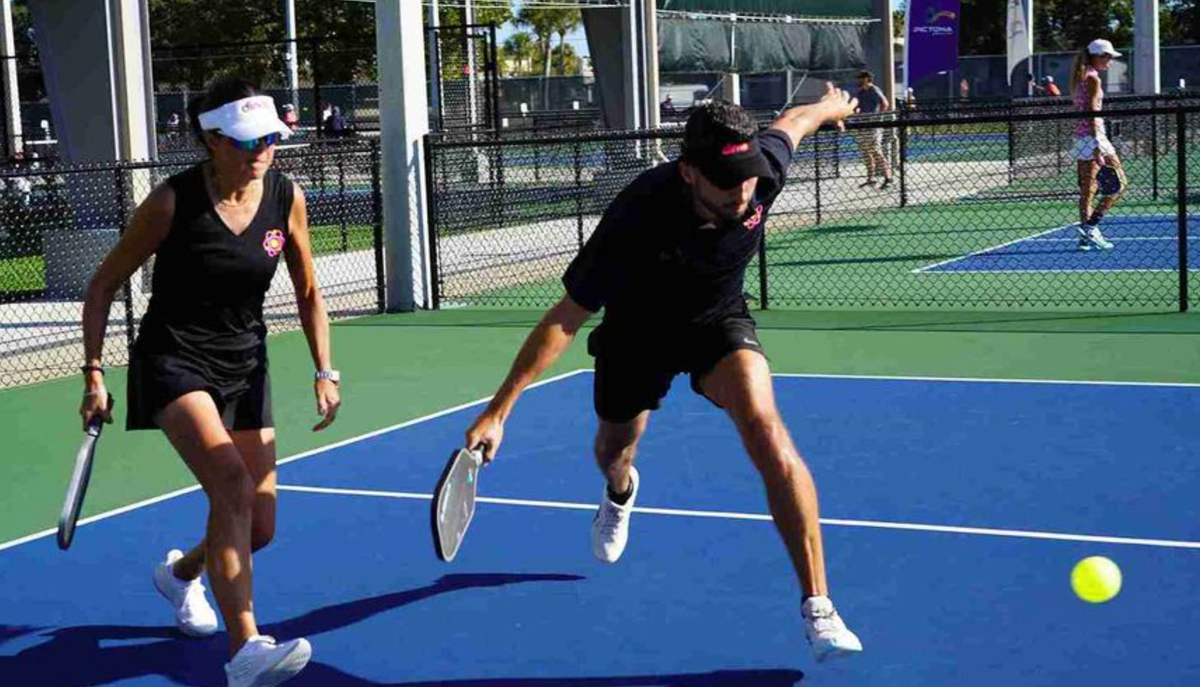
Mastering the Trophy Position for the Overhead Smash Pickleball Technique
The trophy position is the loaded, pre-swing posture that generates the energy behind every clean overhead.
Named after the pose you see on a tennis trophy, it looks like this: non-dominant arm pointing up at the ball, dominant arm bent with the paddle head tilted back behind your shoulder, elbow at roughly ear level.
Why Trophy Position Matters More Than You Think
Your non-dominant arm is not decorative.
When you extend it upward and point at the incoming ball, you're doing two things at once: tracking the ball with precision and creating shoulder rotation that loads your torso for the swing.
Drop that arm early, and you lose both tracking and torque.
The paddle arm needs to be set before the ball arrives. A late backswing is the single most common reason overheads go long or sail wide.
Alex E. Weaver
Advanced drill work reinforces getting the paddle set early, the same principle applies to the overhead smash.
According to USA Pickleball's coaching resources, proper shoulder rotation and early racquet preparation are foundational elements for attacking shots at the net.
The overhead smash is no different.
At the peak of your trophy position:
- Shoulders are turned sideways to the net (non-dominant shoulder slightly forward)
- Paddle elbow is up, not tucked
- Your gaze is locked on the ball, not the court
Hold that position mentally as a checkpoint before every overhead attempt.
The Dink Media Team
How to Execute the Overhead Smash Pickleball Contact and Finish
You've read the lob, moved your feet, hit your trophy position. Now it's time to swing.
Contact the ball slightly in front of your hitting shoulder, at the highest point you can comfortably reach without losing balance.
Here's the contact checklist:
- Arm extension: Reach up and forward, not straight up. Punching the sky is one of the most common swing flaws, it makes the shot go long. You want the paddle face angling slightly downward at contact.
- Wrist snap: At the moment of contact, snap your wrist through the ball. This is where topspin comes from, and topspin is what keeps a hard overhead inside the court. Mastering topspin on your overhead is what separates a scary shot from a rally-ender.
- Follow-through: Your paddle should finish across your body toward the non-dominant hip. A short, jabby follow-through robs the shot of pace and consistency.
The Dink Media Team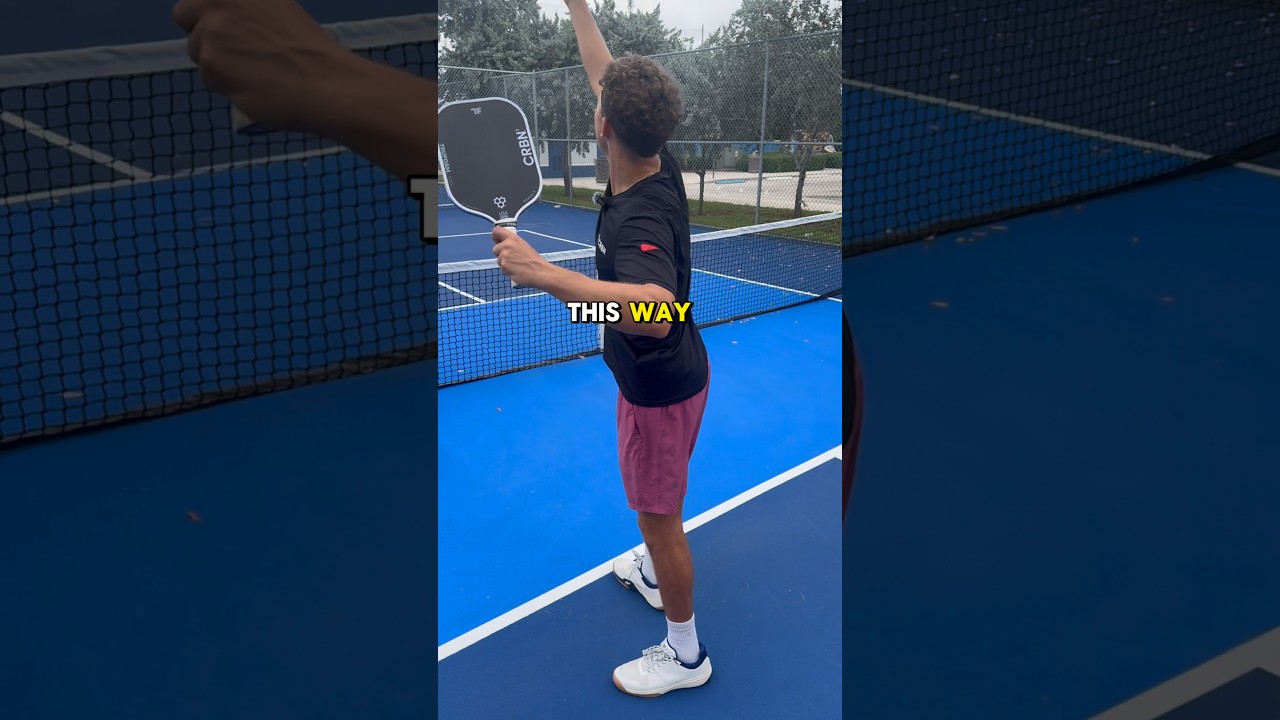
Where Should You Aim the Overhead Smash?
Direction matters.
The two highest-percentage targets are the opponent's feet when they're at the kitchen, and the open court when they're scrambling wide.
Trying to thread it past a player positioned at mid-court often results in an error.
Go for angles or go for their body, both are harder to handle than a chest-high ball with open court on either side.
The swing volley is a close relative of the overhead and demands similar directional discipline.
You're not trying to destroy the ball, you're putting it somewhere they can't reach.
In doubles, the overhead is often most effective cross-court toward the player who is off-position.
Doubles strategy rewards attacking the gap, and a well-placed overhead opens one up fast.
The Dink Media Team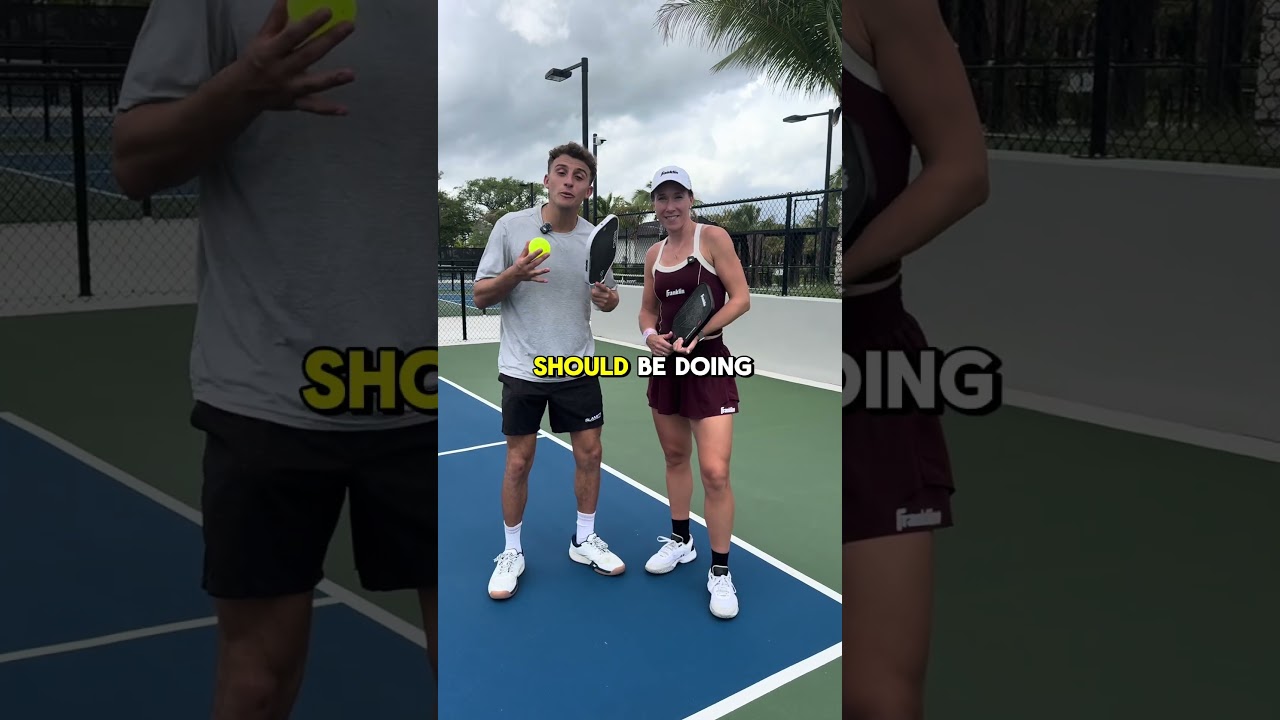
The Return Lob Situation: What to Do When They Lob You Back
Some players will recognize your overhead is loaded and attempt a return lob. Composure wins here.
If the second lob is attackable, reset your feet and go again. If it's deep and well-placed, don't chase it with an improvised swing.
When pushed back to the baseline, the three options from the baseline framework applies: drop, drive, or lob back.
The players who become unattackable stay composed through these exchanges. They reset, reposition, and wait for a cleaner look.
The Dink Media Team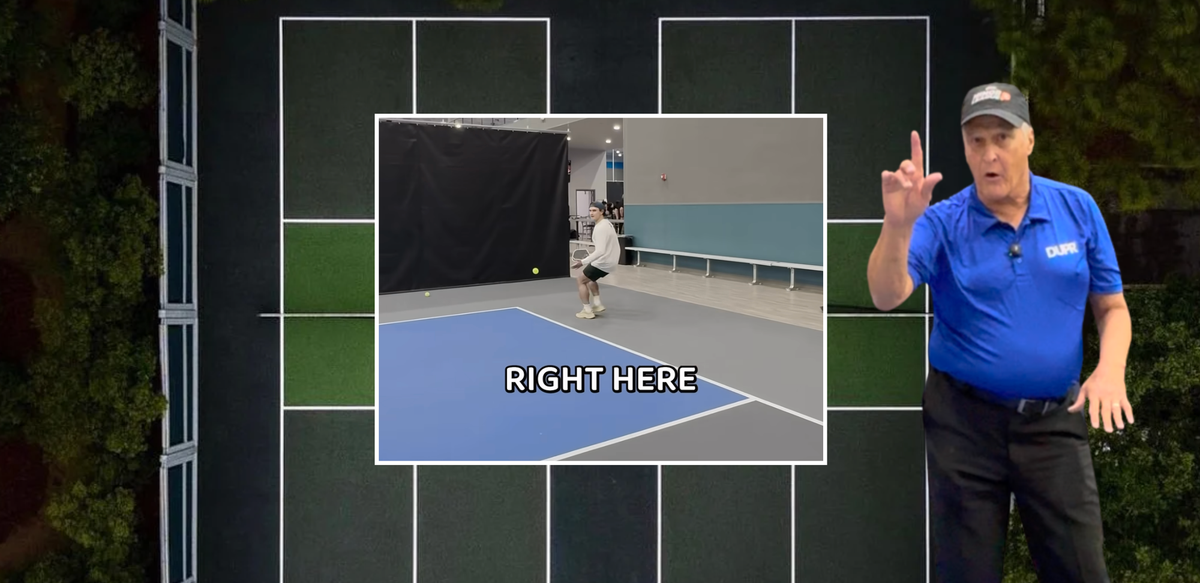
Overhead Smash Pickleball Drills to Build Real Reps
You can read about technique all day. Reps are what actually rewire your movement patterns. Here are three drills that target the overhead smash directly:
- Feed-and-smash: Have a partner or ball machine feed lobs from mid-court while you practice your footwork cue, trophy load, and finish. Start slow, footwork first, speed second.
- Shadow swings with a target: Hit overheads toward a specific target (a cone or a spot on the back fence) to train directional awareness. Research on motor learning in sport shows that external focus cues (targeting a cone) produce better long-term technique retention than internal focus cues (thinking about arm position). A 2022 study in the Journal of Sports Sciences confirmed that attentional focus on movement outcomes improves consistency across overhead striking tasks.
- Figure-8 lob and smash: The figure-8 drill can be adapted to include an overhead response anytime the partner's lob is attackable, simulating real-game unpredictability.
Pair these with solo pickleball drills for off-court footwork work, and your overhead smash will improve faster than almost any isolated swing drill.
Alex E. Weaver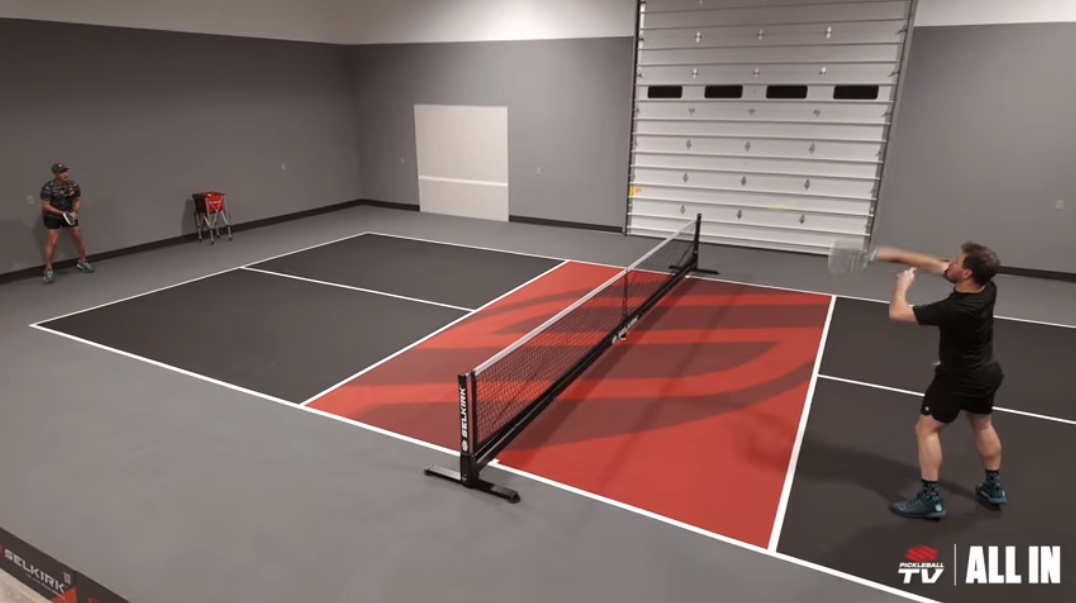
Key Takeaways
- The overhead smash pickleball technique is built on three pillars: footwork positioning, trophy position loading, and a controlled finish with wrist snap.
- Get behind the ball, not under it. Your feet set the ceiling for every other mechanic.
- The non-dominant arm pointing up serves a tracking AND torque-loading function. Don't skip it.
- Aim for the feet or the open court. Trying to overpower a set opponent often backfires.
- Topspin on the overhead is what keeps hard shots in-bounds, train your wrist snap separately if needed.
- Composure beats power. A well-placed overhead beats a maximum-effort swing that floats out.
Frequently Asked Questions
What is the overhead smash pickleball technique used for?
The overhead smash pickleball technique is used to put away high balls, typically lobs or floaters, with pace and downward angle. It's a point-finishing shot designed for situations where the ball is above shoulder height and you have time and space to set up properly. When executed correctly, it's one of the most difficult shots for an opponent to handle.
How do I stop hitting overheads long?
Overheads that sail long are almost always caused by contact happening too far behind the shoulder, with the paddle face angled upward. Move your contact point further in front of your body, add a downward wrist snap at contact, and make sure your follow-through is crossing toward your non-dominant hip rather than finishing high. Topspin development will also help keep hard overheads in the court.
Should I jump for the overhead smash in pickleball?
Only if you're completely under control and the ball is above your reach while flat-footed. Jumping overhead smashes are high-risk because they require you to generate power without ground contact. Most intermediate and advanced players keep both feet on the ground and instead focus on reaching up with a full arm extension. The swing volley is an alternative for balls slightly out of true overhead range.
What's the difference between an overhead smash and a swing volley in pickleball?
The overhead smash is hit with the ball above your head, using a full throwing motion with a high trophy position. The swing volley is hit at or slightly above net height with a more abbreviated swing, often used against mid-air balls in the transition zone. Both are attacking shots, but the overhead relies on pure downward angle while the swing volley uses horizontal pace. Knowing which one to deploy depends on ball height and your court position.
How can I practice the overhead smash pickleball technique without a partner?
Use a ball machine set to feed high lobs, or practice your footwork and trophy position mechanics as shadow swings. You can also use a wall drill: hit a ball upward off the wall and smash it as it drops. Solo pickleball drills can be adapted to include overhead-specific footwork patterns that reinforce the full movement sequence even without a live feed.

Love Pickleball? Join 100k+ readers for free weekly tips, news & gear deals.
Subscribe to The Dink