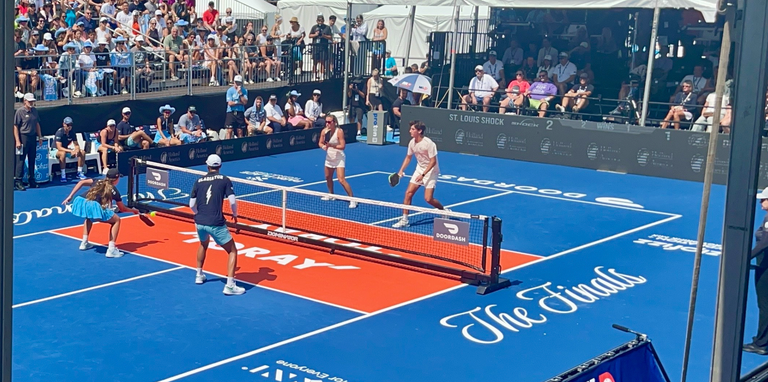


The Major League Pickleball format is built around a four-day event structure that combines round-robin group play with dramatic Super Sunday crossover matchups. Here's exactly how it works, from the opening draw to the final standings point.
The Major League Pickleball format is one of the most interesting competition structures in professional sports right now, and most fans still don't fully understand how it works.
Once you understand the Major League Pickleball format, everything about MLP becomes more interesting: the stakes, the seeding battles, the Super Sunday drama.
Here's the full breakdown of the 2026 structure, from the round-robin group stage to the DreamBreaker and the season-long standings points that decide who reaches the playoffs.
Love pickleball? Then you'll love our free newsletter. We send the latest news, tips, and highlights for free each week.
How the Major League Pickleball Format Is Structured
The Major League Pickleball format runs across a four-day weekend (Thursday through Sunday) for each regular-season event.
It's split into two distinct phases: a three-day group stage and a single decisive Super Sunday.
At every event, 10 to 11 teams are divided into two pools, Group A and Group B, with five or six teams per group.
This separation is the foundation of the entire MLP competition structure.
The group draws are announced before each event, so fans can track seeding races in real time.
The 2026 season runs nine regular-season events, plus a mid-season showcase and an end-of-season playoff, giving every team multiple chances to accumulate standings points.
MLP's official competition structure overview lays out the full framework.
This isn't a single-elimination bracket. It's a season-long standings race, and understanding that distinction changes how you watch every match.
What Is the Round-Robin Group Stage?
The round-robin group stage is where the first three days (Thursday through Saturday) are played.
Each team plays every other team in its group once, meaning four or five matches per team before Super Sunday.
A few things make this phase unusual compared to typical tournament formats:
All four games in every match are always played, even if a team goes up 3-0.
According to MLP's official rules, this preserves the point differentials needed for accurate tiebreaking.
 Erik Tice
Each match consists of Women's Doubles, Men's Doubles, and two Mixed Doubles games, each played to 11 points, win-by-two, using side-out scoring.
Teams switch ends at 6 points within each game.
The four-game-always rule is one of the smartest design choices MLP made.
It keeps every game competitive, gives fans more court time, and means teams can't just protect a lead and coast. You play all four. Every time.
After three days of round-robin group stage play, each group is ranked Seed 1 through Seed 5 or 6 based on win-loss record, points margin, and tiebreaker criteria. That seeding determines everything that happens on Sunday.
How Does Super Sunday Work in the Major League Pickleball Format?
Super Sunday is the payoff. After three days of in-group competition, the top seeds from Group A face their counterparts from Group B in direct crossover matchups.
First-place plays first-place. Second plays second. All the way down.
The full Super Sunday pickleball bracket looks like this:
- Seed 1 Group A vs Seed 1 Group B
- Seed 2 Group A vs Seed 2 Group B
- Seed 3 Group A vs Seed 3 Group B
- Seed 4 Group A vs Seed 4 Group B
- Seed 5 (and Seed 6, if applicable) matches follow the same cross-group logic
These aren't exhibition matches.
They're single decisive contests that award the season-long standings points that teams need to qualify for the playoffs and the MLP Cup.
The cross-group format creates the kind of narratives that make great sports television. The best team from one group against the best team from the other.
A true test of who earned their seeding over three days.
Forbes noted that the Super Sunday structure gives MLP a marquee weekly moment comparable to what other pro leagues have built around their signature matchups.
Erik Tice
What Is the DreamBreaker in the Major League Pickleball Format?
The DreamBreaker tiebreaker is MLP's signature format, and it's genuinely one of the most exciting things happening in professional racket sports right now.
If a match ends 2-2 after the four regulation games, a DreamBreaker decides the winner.
It's a rally-scoring race to 21, but the structure is unlike anything else in pickleball. Each player takes a rotation of four consecutive points as the server.
Win points only count on your own serve. Teams cycle through all four players (two women and two men), and the action is continuous.
The format creates individual accountability in a team context. One bad service rotation can swing the entire match.
MLP's official explainer has the full rules, but the short version is this: it's chess with a paddle, played at full speed.
The DreamBreaker tiebreaker applies in both the round-robin group stage and on Super Sunday. Same format, same rules, same drama.
Which means every 2-2 match, at any point in the week, can end in one of those sequences.
Alex E. Weaver
How Does the MLP Standings Points System Work?
This is the part that makes the Major League Pickleball format different from almost every other team sports league operating at this level.
Teams don't just win or lose events. They earn MLP standings points at every event, and those points accumulate across the entire season.
Your finish at Event 1 adds to your finish at Event 2, and so on, all the way to the playoffs.
The points payout is tied directly to your Super Sunday pickleball seeding matchup result:
Here's what that means in practice:
A team that consistently finishes third at every event will accumulate 10-point payouts all season.
A team that wins some events but crashes out in sixth at others will have a volatile totals column. Consistency is rewarded. Variance is punished.
The loser of the first-place matchup still earns 18 points, more than winning the third-place matchup.
So even if you drop the Seed 1 vs Seed 1 battle on Super Sunday, finishing first in your group all week wasn't wasted.
The seeding chase through the round-robin group stage has real value built into the structure.
The updated 2026 rules expanded the playoff field and adjusted roster usage rules, making late-season standings races even more competitive than prior seasons.
20 Teams, One Division
This year, MLP has done away with the Challenger division, instead condensing all play into one 20-team competition structure.
Below are all 20 MLP teams for 2026 with their complete rosters listed (please note: rosters are subject to change):

Key Takeaways
- The Major League Pickleball format is a four-day event structure split between a three-day round-robin group stage and a Super Sunday crossover.
- 10 to 11 teams compete per event, split into Group A and Group B with five or six teams per group.
- All four games in every match are played, preserving point differentials for seeding.
- Super Sunday pits same-seeded teams from opposite groups against each other in head-to-head matchups.
- MLP standings points (not event wins) determine playoff qualification. Points accumulate across all regular-season events.
- The DreamBreaker tiebreaker is a rally-scoring race to 21, used when a match ends 2-2.
- The 2026 season includes nine regular-season events, a mid-season event, and expanded playoffs.
Frequently Asked Questions
How many teams compete in a Major League Pickleball format event?
Each MLP event features 10 to 11 teams, split into two groups of five or six teams each. The groups play a full round-robin against their own pool during the first three days, then cross over for seeded matchups on Super Sunday. MLP's individual team schedules are published before each event so fans can preview the matchups.
What happens if a team goes up 3-0 in a match?
The match keeps going. In the Major League Pickleball format, all four games are always played regardless of score. This rule preserves the points differential data used for group seeding and tiebreakers. A team that goes up 3-0 still has to play game four, meaning every game on every day has real stakes.
How does MLP decide which teams make the playoffs?
MLP teams qualify for the playoffs based on cumulative MLP standings points earned across all regular-season events, not by winning any single event. Teams earn points based on their Super Sunday pickleball matchup result at each event, and those points stack through the season. The top-ranked teams at the end of the regular season advance. The 2026 rules expanded the playoff field compared to prior seasons.
What is the DreamBreaker in the Major League Pickleball Format?
The DreamBreaker tiebreaker is MLP's signature format, triggered when a match ends 2-2 after the four regulation games. It's a rally-scoring format to 21 where players rotate in four-serve cycles, and points only count on your own serve. Every player on the roster takes part. It's used in both group-stage and Super Sunday matches, and it's widely considered one of the most exciting formats in professional pickleball.
How are MLP teams drafted and rostered?
MLP uses a draft system to build rosters, with teams selecting players from a pool of available professionals. The 2026 season introduced full-roster usage rules requiring teams to use their entire roster during events, not just their starting four. Each roster includes men's and women's players to cover the four game formats.
Love Pickleball? Join 100k+ readers for free weekly tips, news & gear deals.
Subscribe to The Dink