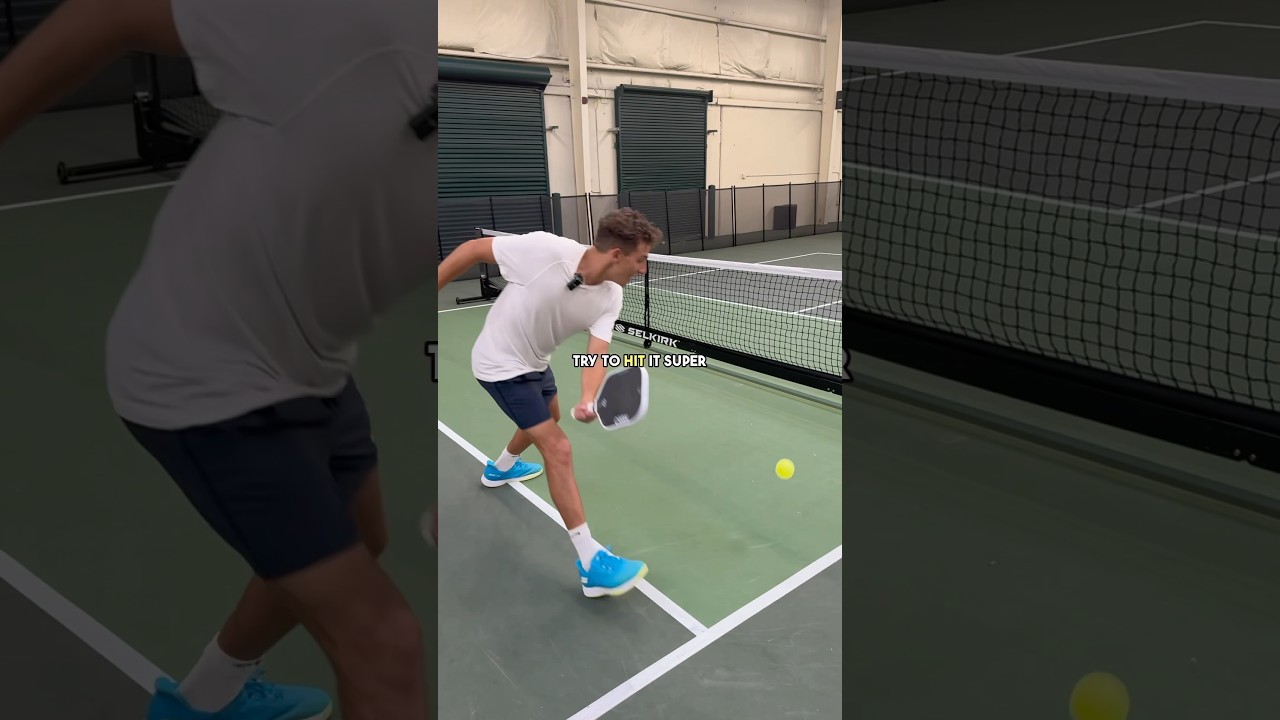
Popping up dinks is one of the most common mistakes in pickleball, and it's costing you points. Here are the three main reasons you pop up dinks and exactly how to fix each one.
If you've been playing pickleball for more than a few weeks, you've probably noticed something frustrating: your dinks keep floating up when they should stay low and tight at the net.
This isn't a random occurrence. There's a reason you pop up dinks, and the good news is that once you understand what's causing it, you can fix it.
According to Tanner from The Dink Pickleball, a verified pickleball educator with 140,000 subscribers, there are exactly three reasons why your pickleball dinks keep popping up, and they're all fixable with focused practice and awareness. Before diving in, four fixes to stop popping the ball up in pickleball is a useful companion read that covers the paddle positioning side of the same problem.
Love pickleball? Then you'll love our free newsletter. We send the latest news, tips, and highlights for free each week.
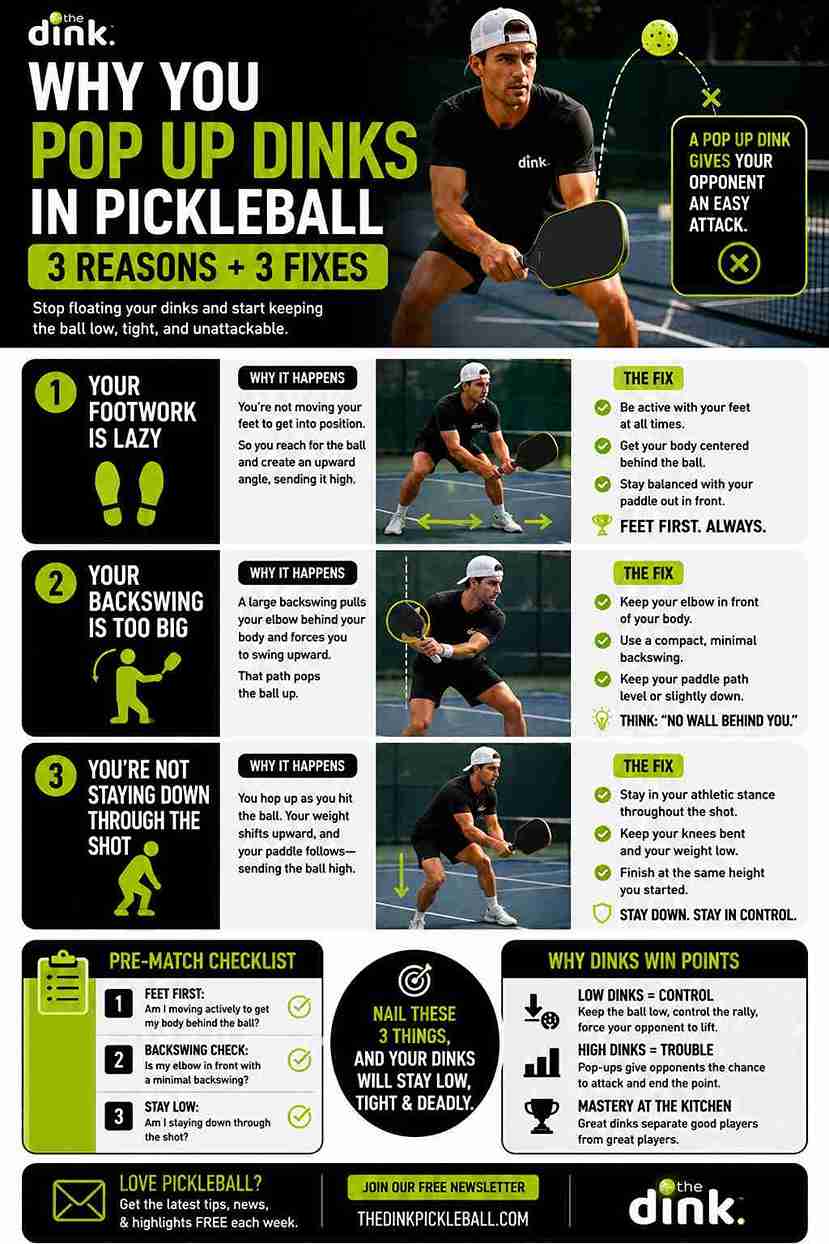
Reason #1: Your Footwork Is Lazy
The first and most common culprit behind a pop up dink is poor footwork.
When you're not actively moving your feet to get into position, you're forced to reach for the ball instead of meeting it with your body properly aligned.
Here's what happens: instead of lunging forward with purpose and getting your center of gravity behind the ball, you're standing flat-footed and extending your arm.
This creates an upward angle on contact, which sends the ball floating up instead of keeping it low.
The fix is simple but requires discipline. You need to be really active with your feet at all times. Every time the ball comes toward you, your feet should be moving.
Get your body centered behind the ball rather than reaching around it.
When your center of mass is properly positioned, your paddle naturally stays in front of you at the kitchen line, and the ball stays down.
Consistent pickleball dinking starts with your feet, not your arm.
Your forehand dink needs work: here's a 5-minute fix from a pickleball pro is the natural next step once your footwork fundamentals are dialed in.
Think of it this way: the dink shot is fundamentally a footwork problem before it's ever a technique problem.
If you're relying on arm extension to reach the ball, you've already lost the battle.
Reason #2: Your Backswing Is Too Big
The second reason you pop up dinks is that you're taking too big of a backswing.
This is especially common for players transitioning from other racquet sports or those who haven't yet internalized the unique demands of the dink.
When your backswing is large, two things happen: your elbow drifts behind your body, and you're forced to swing upward to bring the paddle forward.
Both of those mechanics create an upward trajectory on the ball.
The mental cue that works best is this:
Pretend there's a wall directly behind you, and you can't hit that wall with your elbow.
This forces everything to happen out in front of your body.
Your backswing becomes minimal, your elbow stays forward, and your paddle path naturally stays level or slightly downward.
A proper dink backswing should be almost imperceptible.
You're not winding up; you're simply positioning your paddle slightly back and then moving it forward with a short, controlled stroke.
The power in a clean pickleball dink comes from your legs and core, not from a big arm swing.
This is the same principle behind the number one mistake killing your shot-making consistency in pickleball: using your arm to do a job your body should be doing
Reason #3: You're Not Staying Down Through the Shot
The third and final reason you pop up dinks is that you're hopping up with the ball instead of staying down through your shot.
This is a timing and balance issue that many players don't even realize they're doing.
What typically happens is this: as you make contact with the ball, your weight shifts upward.
Your knees straighten, your body rises, and your paddle follows that upward motion. The ball, naturally, goes where your paddle goes.
Staying down through the shot means maintaining your athletic stance throughout the entire stroke.
Your knees should stay bent, your weight should stay low, and your paddle should finish at roughly the same height it started.
You're not jumping into the shot; you're staying grounded and letting your legs absorb the motion.
This is where footwork and shot mechanics intersect.
If your feet are active and your body is properly positioned, staying down becomes much easier because you're not overextending or reaching.
You're simply making a controlled dink shot from a stable, athletic position. The 2 essential pickleball techniques you're missing at the kitchen line covers both the stance and contact point adjustments that make staying down automatic.
 The Dink Media Team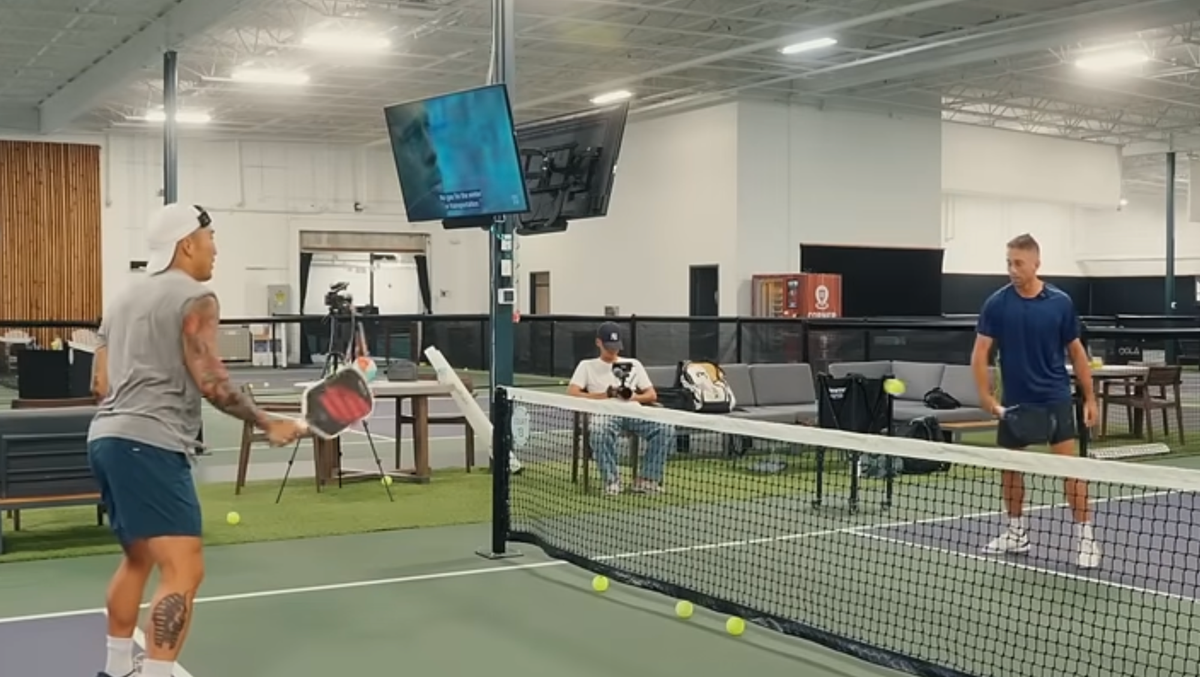
Stop the Pop Up Dink: Your Pre-Match Checklist
Now that you understand the three main reasons you pop up dinks, here's how to practice fixing them.
Before your next session, run through this mental checklist:
1. Feet First: Are You Moving Actively to the Ball?
Are my feet moving actively to get my body behind the ball?
2. Backswing Check: Is My Elbow Forward?
Is my elbow staying in front of my body with a minimal backswing?
3. Stay Low: Am I Finishing the Shot Grounded?
Am I maintaining my athletic stance and staying down through the shot?
If you can nail all three of these elements, your dinks will immediately improve. You'll keep the ball lower, tighter, and more consistent at the net.
The beauty of the dink is that it's fundamentally about control and positioning, not power.
Once you remove the three mistakes outlined above, you'll find that your dinks become one of your most reliable shots.
Simple wall drills to take your pickleball skills to the next level gives you a solo practice option for ingraining all three fixes between sessions.
The Dink Media Team
Why the Pop Up Dink Is Killing Your Pickleball Strategy
If you're wondering why we're spending so much time on the dink, here's the reality: the dink is the foundation of modern pickleball strategy.
Professional players spend countless hours perfecting their dink because it's the shot that wins points at the highest levels of the game.
When you pop up dinks, you're giving your opponent an opportunity to attack. A floating dink is an invitation to hit a winner.
Conversely, when you keep your dinks low and consistent, you're controlling the point and forcing your opponent to make a mistake.
Pickleball technique at the kitchen line is the great equalizer.
As reported by CBS Sports, the sport's explosive growth has elevated the importance of soft game mastery at every level of play.
This is why understanding the mechanics behind a pop up dink isn't just about technique; it's about strategy and point construction.
The pros know it. Now you do too. Fix the pop up dink, and you fix your entire game.
Frequently Asked Questions
What Is the Difference Between a Dink and a Drop Shot in Pickleball?
A dink is a soft, controlled dink shot hit from the kitchen (the no-volley zone) that lands just over the net on your opponent's side. A drop shot is typically hit from further back on the court and is designed to land softly in the kitchen. Both are core tools in your soft game arsenal, but dinks are hit from closer to the net as part of the rally exchange, whereas drop shots are often used as a third shot to transition forward.
How Long Does It Take to Fix a Pop Up Dink Problem?
This depends on how much you practice and how ingrained the bad habit is. If you're actively working on footwork, backswing, and staying down, you can see noticeable improvement within a few weeks. However, fully breaking the habit and making it automatic typically takes several months of consistent practice.
Should I Use a Specific Paddle to Improve My Dink Shot?
Not necessarily. While some paddles are designed with softer faces that can help with your soft game and dink consistency, the most important factor is your technique. A player with great fundamentals can dink well with almost any paddle, while a player with poor mechanics will struggle regardless of equipment.
Can I Practice Dinking in Pickleball Alone?
Yes, but it's limited. You can practice your footwork, backswing, and staying down against a wall or with a ball machine. However, the best dinking practice involves a partner so you can work on soft game skills, consistency, placement, and responding to different ball heights and speeds.
Why Does Fatigue Make My Pop Up Dink Problem Worse?
Fatigue breaks down your pickleball technique. When you're tired, your footwork becomes lazy, your backswing gets bigger, and you lose the ability to stay down through shots. A pop up dink late in a match is almost always a conditioning problem, not just a mechanics problem. This is why match fitness matters; the better your fitness level, the longer you can maintain proper technique throughout a match.

Love Pickleball? Join 100k+ readers for free weekly tips, news & gear deals.
Subscribe to The Dink