We've all been body bagged or lost a long rally and felt the urge to exact immediate revenge by playing fast and dumb instead of smart and deliberate.
Pickleball is as cerebral as it is physical. High level matches are as strategic as chess matches and require mental fortitude to survive the emotional highs and lows that accompany good and bad decision making.
An enormous part of improving your pickleball level is strengthening the mental side of the game. And for amateurs, this crucial mental maturation is often as simple as overcoming one shot: the frustrated speed up.
Here are three common scenarios that will make you want to speed up out of frustration, and some mentally tougher alternatives you can take to avoid this mental error.
The revenge body bag
If you play this game long enough, you will get hit eventually. The use of protective eyewear has skyrocketed in the last few years, and the term body bag is universal across the pickleball world.
Wade through the thousands of clips on social media and you will undoubtedly get fed a high dose of revenge body bag videos, especially in the pros.
Body bags are plentiful at the amateur level, spanning open plays at parks to moneyball tournaments at your local indoor center.
Getting body bagged, especially if it is intentional, will make even the calmest person’s blood boil. Getting body bagged multiple times can turn even the gentlest person into a revenge-seeking missile.
I have watched countless amateurs (and professional players) completely derail a match and lose sight of all strategy in the name of getting revenge after getting body bagged. Not only can this turn ugly, but it will most likely result in a loss (or loss of respect for those involved).
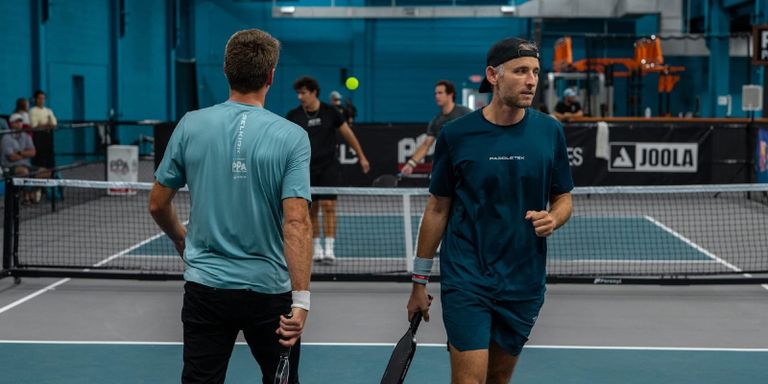
 Eric Roddy
Instead of focusing solely on body bagging the person who hit you, here is what I would do to weather this emotional and mental storm.
- First, take a deep breath and consider the moment in the game you are playing. What’s the score? What have you and your partner been doing strategically that has been working? Is being uber aggressive in retaliation the right strategy (possibly) or the wrong strategy in that moment (likely).
- Next, figure out what is needed from you and your partner in the long run. If this is a rec game, shake it off and refocus on the match. If this is a tournament or game with something at stake, maybe take a timeout and meet with your partner to discuss strategy going forward.
Focusing solely on retaliating in this moment will lead to poor decision making, which will lead to more unforced errors, and more points for your opponents.
Ultimately, if they win because of your mental lapse leading to more errors, they not only walk away with the body bag, but also the satisfaction of winning because of you losing your cool.
The best retaliation is to lock in and win the game or match!
 Eric Roddy
You lose the point after a long rally
This scenario is more common, but less obvious than the prior scenario. It also happens across all skill levels, especially intermediate to advanced, since beginners typically don’t have very long rallies.
- Let’s say you and your partner are serving and must hit 5-10 defensive shots and resets to get to the kitchen.
- Then, you construct a beautiful point at the kitchen and force your opponents back to the baseline.
- The point continues and your opponents play great defense and on the 30th or 40th shot of the rally, you (or your opponent) make an error.
Point over – the sting of having the point won multiple times just to ultimately lose is both frustrating and mentally draining.
What (often) happens on the next point is a story as old as time. You or your partner takes one of the first couple shots and try to force a speed up to make up for losing the epic point before. You either make an unforced error trying to do too much, or your opponents are all over it and counter the ball right back at you (hopefully not for a body bag, which would have a compounding impact to your mental fortitude).
This scenario can happen multiple times in a single game, and if you are playing someone of a similar level, you know that two to three points likely will determine the outcome of a game.
That is why it is extremely important to fight the urge to play a quick point and try to speed the ball up out of frustration following a long point.
If you construct the point or your opponents happen to give you a high ball early in a rally, take it and be aggressive. But, if you let the prior point carry over into the next point and as a result take a low ball and try to speed it up, that is ill advised.
Instead of letting your frustration of losing a long point take over and lead you to the speed up out of frustration, consider the long point a long-term win (instead of a short-term loss).
Even though you might have lost a point you should have won, the key takeaway is you set up the point well and could win the point, which is a better strategic position to be in rather than making an unforced error or poor decision. Remind yourself and/or your partner that in the long run, the point you constructed is the kind of point you want to play repeatedly, and that you will have success in the long run.
 Zoey Weil
Your opponents go on a big run
This scenario that leads to a frustrating speed up is a bit more nuanced than the previous two but is still prevalent across all levels in pickleball.
Let’s say it is 4-4-2, and your opponents rattle off four of five points in a row before you get a side out and get the serve back. I often watch the serving team (who was just tied but now faces a substantial deficit) try to force the next few points by overplaying.
They will take low balls and try to force speed ups or overplay from the transition zone and try to power through their opponents. And as a result, they will quickly give the serve back to their opponents and find themselves shaking hands (match over) in the next few minutes.
Pickleball players tend to feel rushed when giving up a scoring run to their opponents, especially towards the end of a game. They feel the need to try to win back those 4-5 points quickly, and as a result, they often fail to even get to the kitchen line (where offense can be played). They’ll press from the baseline, hitting drives out of frustration, or they will lack patience and fail to construct points from the Kitchen if they do get there.
 Eric Roddy
Instead of feeling like you need to close the gap your opponents just created quickly, try to refocus and remind yourself that pickleball, like basketball, is a game of runs.
The best way to catch back up is to extend points, focus on getting to the kitchen on your serve (and preventing your opponents from getting to the kitchen when they are serving), and slowly chip away at the deficit.
If you are down 4-9-1, you don’t need to score five points immediately by trying to play overaggressive.
Instead, try to get a point or two each time you are serving and hyperfocus on preventing your opponents from scoring when they are serving.
Winning a point or two at a time will slowly create scoreboard pressure for your opponents, and before you know it, you will be right back into the game.
Heads up: hundreds of thousands of pickleballers read our free newsletter. Subscribe here for cutting edge strategy, insider news, pro analysis, the latest product innovations and more.
Professional pickleball player Eric Roddy has teamed up with Jittery Joe’s to release a new pickleball coffee – The Kitchen Brew. Whether you are hitting dinks or chasing dreams in the Kitchen, our medium roast gives you the perfect boost to power through every game. Start your day right, both on the court and in your cup!
You can purchase The Kitchen Brew on the Jittery Joe’s website.

Eric Roddy
Eric is a PPA tour pro living in Charlotte, NC, sponsored by Paddletek. In addition to playing PPA events, he teaches pickleball 2-3 hours a week, enjoys golf, and listening to his favorite band Goose.

Love Pickleball? Join 100k+ readers for free weekly tips, news & gear deals.
Subscribe to The Dink