
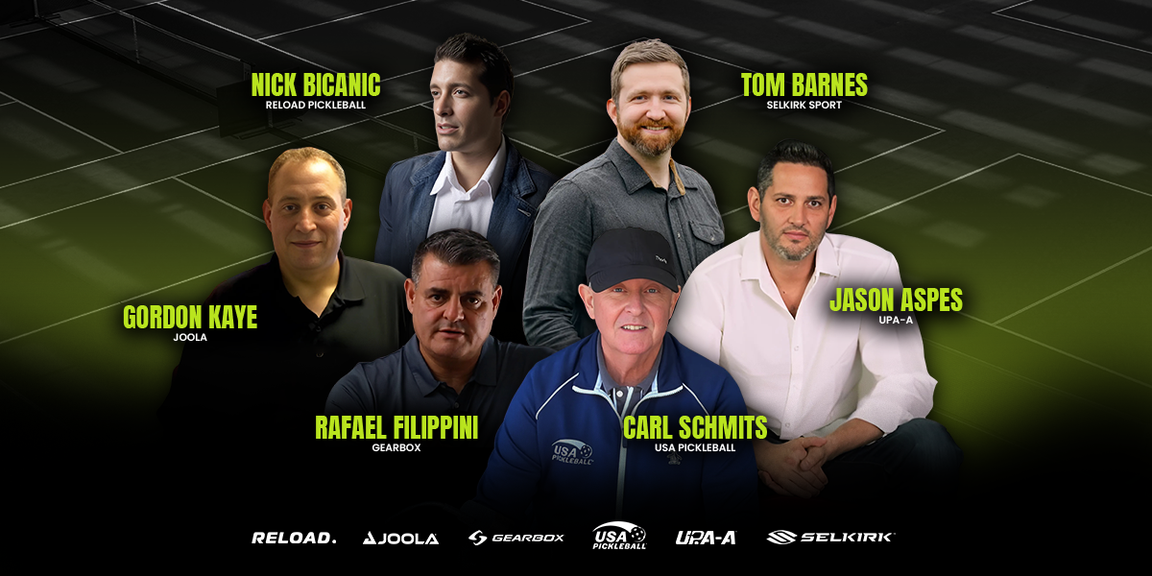
Six industry leaders convened at RacquetX in Miami for a discussion around the current fragmented state of regulation in the sport.
This past weekend, RacquetX took over the Miami Beach Convention Center in Miami, Florida. The conference brought together leading industry experts from around the globe to discuss topics related to all racquet sports.
One topic, in particular, caught my eye.
Pickleball at a Crossroads: Navigating the Wild West of Equipment, Standards, and Regulations
This panel took place on Sunday, March 23rd, from 11-11:45am on the Main Stage.
It involved six panelists:
Jason Aspes - President - United Pickleball Association of America (UPA-A)
Tom Barnes - Co-Owner & Director of R&D and LABS - Selkirk Sport
Nick Bicanic - CEO - Reload Pickleball
Rafael Filippini - Founder & CEO - Gearbox Sports
Gordon Kaye - Chief Experience Officer - JOOLA
Carl Schmits - Chief Technology Officer & Director of Manufacturing and Paddle Testing - USA Pickleball
Bicanic played the role of moderator, and there was a lively discussion for the full 45 minutes.
To see the entire 45 minute session, click here. Thanks to Today in Pickleball for posting the video to YouTube.
(p.s if you're new to the site feel welcome to use our employee discount "thedink" on Midwest Racquet Sports and even stack it on clearance items for extra savings)
Here are some snippets and select quotes of my biggest takeaways from the panel discussion.
Dueling Governing Bodies and the Pickleball Paddle Standard
The United Pickleball Association of America (UPA-A) was announced last year as "the global pickleball governing body under the United Pickleball Association to protect, grow and champion the sport at all levels."
This was a break away from USA Pickleball as the only national governing body.
In practice, the UPA-A governs play at the professional level while USAP sets the standards at the amateur and recreational levels.
 Jason Flamm
Bicanic (Reload Pickleball and the moderator of the panel): "Do you feel there are two competing governing bodies in the sport, and why do you think that might be?"
Schmits (USAP): "The short answer is, there is only one national governing body (USA Pickleball). In general terms, we support the 20+ million players that are out there today."
Barnes (Selkirk): "It is clear to me, in my opinion, it's (UPA-A) just the revenue stream. It's a for-profit entity. It's just there to make money, and it's just there to assist the bottom line of the UPA and that calls into question extreme concerns for us." (p.s use code "inf-thedink" on Selkirk to get a free giftcard at checkout)
Filippini (Gearbox): "I don't recognize two. I'll be straight up with that. Because on the pro side, I think that they have their organization, and they can run and control the players as they want, and I completely respect that. But as a sport, I personally recognize the USAP as the organization that should lead the amateur side of the sport."
Kaye (JOOLA): "As a matter of principle, I don't have an issue with there being both a USAP standard and a UPA standard. I think we could argue about who's a governing body and who's not a governing body all day. I just don't fundamentally have an issue with the idea that there's a pro standard and there's a wider standard.
"I come from a background of professional sports. This is quite standard. In Major League Baseball, the Major League Baseball standard for bats is different than Minor League Baseball, it's different than college baseball, it's different than high school baseball. This is not uncommon for the space that we work in."
 Jason Flamm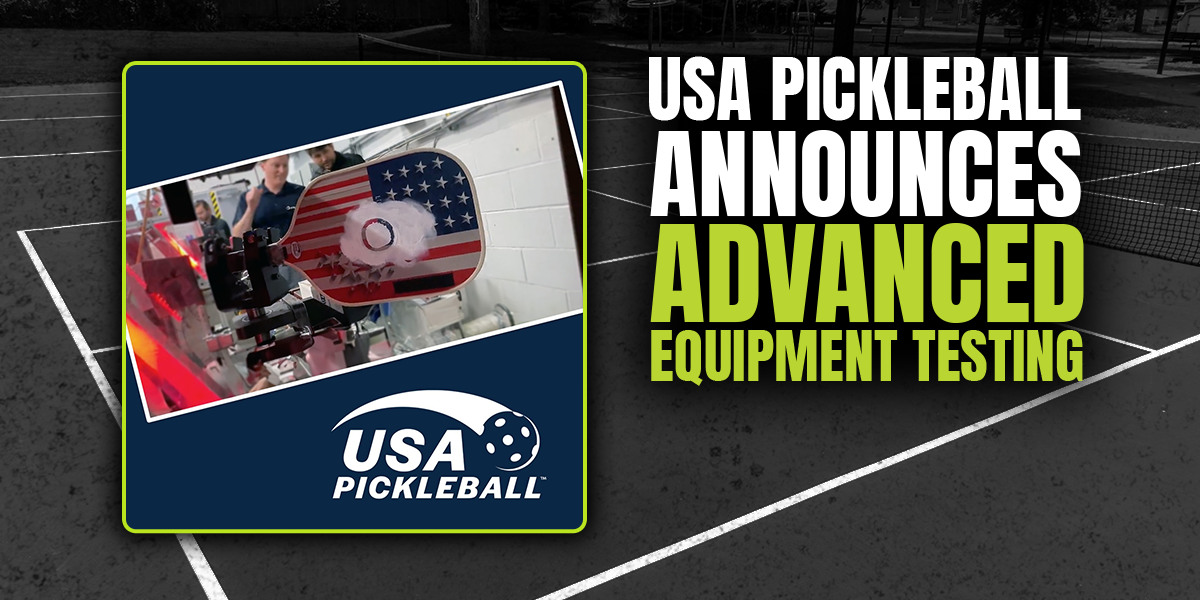
Confusion in the Market: Pro Play vs. Amateur Play
Moving on from the governing body conversation, Bicanic wanted to touch on pro play vs. amateur play. According to the UPA-A website, "The UPA-A was established to regulate the game of pickleball at the professional level."
One dichotomy came up more than once: If the paddle certification standards are different between the pros and amateurs — UPA-A allows for more grit (or spin potential) than USAP — why are UPA-A-certified paddles being sold to amateurs?
As Sports Illustrated has documented, the sport has long been described as the "Wild West," and the current split over equipment rules only deepens that characterization.
Bicanic: "How can we claim this is just about the professional game when in reality these paddles, as some people have already alluded to, will immediately make their way into the amateur hands?"
Kaye: "The reality is that a lot of people want to play with what the pros play with."
Bicanic: "By that logic, this standard is not about pro play, this is about selling paddles."
Aspes (UPA-A): "If the (UPA-A) limits were higher, if we allowed faster play, because everyone is after more power. We have brought the power down below USAP's level. If it were higher, I would absolutely agree with that."
To add a little more context to the Aspes quote, Bicanic was saying that the UPA-A is not about really regulating the pro game, but more about selling paddles. Aspes' response was basically saying that because the UPA-A certification level is stricter than the USAP's, this cannot be the case.
Before choosing a new paddle for your game, it helps to understand what you're actually buying. Our pickleball paddle buying guide breaks down what different certification labels actually mean for your game.
Two Different Pickleball Paddle Standards and What It Means for Manufacturers
The UPA-A and USAP have two differing certification protocols, which can be confusing for amateur players and difficult for manufacturers to navigate. The UPA-A announced pivotal updates to paddle regulations, effective September 1, 2025, and those updates have only intensified the debate.
 Luke Burton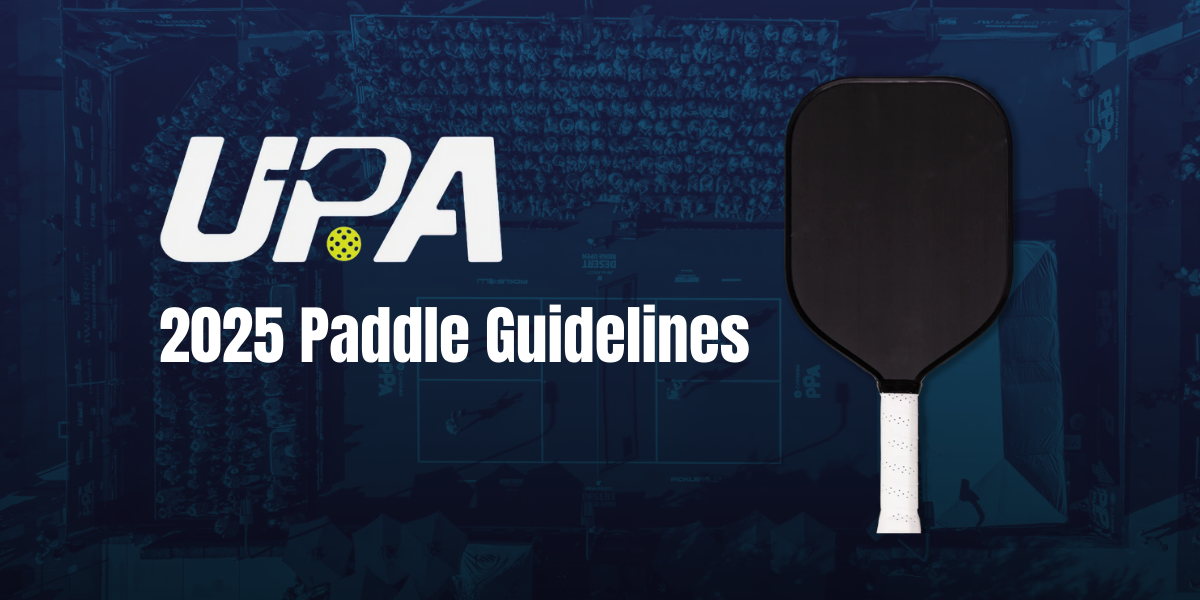
Bicanic: "Carl, do you think these two types of standards (USAP and UPA-A) can coexist, or does one of them need to go away?"
Schmits: "I think they should merge, frankly. Having two standards or two specifications again, I will reiterate the fragmentation comment I made earlier. There's really no reason from a technical standpoint that we couldn't merge. They're very close."
Aspes: "I think we could easily get to the same standard because it's not that big of a difference. Right now there are two standards because we (UPA-A) are only dealing with the pro game."
The gap between pro and amateur equipment regulation is smaller than most players assume. Both Aspes and Schmits agreed that a unified pickleball paddle standard is technically achievable.
This convergence of opinion from two opposing organizations is arguably the most encouraging sign to emerge from the entire panel.
UPA-A Structure and Independence
The structure, independence, and for-profit status of the UPA-A has been called into question by Tom Barnes of Selkirk in several instances, including appearances on the Pickleball Studio podcast and the JohnKew podcast. The UPA-A plans a $150-200M capital raise to build a vertically integrated pickleball platform, adding more fuel to questions about whether financial motives are shaping equipment regulation.
Bicanic: "The perception of USA Pickleball is that it is an independent organization. The perception of the UPA-A is that it's not independent from the UPA. Could you comment on who owns and controls the UPA-A?"
Aspes: "From an ownership organization, we fall under the UPA. From an organizational standpoint, I don't report to anybody, I report to the Board."
Barnes: "You don't report to Connor (Pardoe, President of the UPA)?"
Aspes: "No, I do not."
Barnes: "That's clearly not true, but you can say that."
Aspes: "Are you telling me I'm a liar?"
(This is where there was a little discourse and Bicancic brought the conversation back to the UPA-A structure and independence.)
Aspes: "I think that it's important that we are independent. I feel very good about the way we act internally."
"I recognize that we need to move towards an independence and being a non-profit, and I think that will bring a lot of confidence in the system. We are happy to move towards that. We said that we would do that this year, and we are actively taking steps to do so."
 Alex E. Weaver
The Manufacturer's Perspective on a Single Pickleball Paddle Standard
JOOLA was the first manufacturer to receive the interim UPA-A certification and has paddles that are co-certified by both USA Pickleball and the UPA-A. Bicanic wanted to know Gordon Kaye's perspective on both paddle certification standards toward the end of the panel. (p.s use code "thedink10" to save 10% on Joola)
The Selkirk SLK line recently reset with three new sub-$200 paddles, which raises the question of how manufacturers can keep product lines streamlined when regulatory frameworks keep shifting under their feet.
Bicanic: "Gordon (Kaye), as an organization that has chosen to release paddles to multiple different standards, would you prefer to only have one organization and one set of standards?"
Kaye: "I think everyone would. That's the goal here: convergence. There's no question, as a manufacturer you want to manufacture only to one standard.
I think having one global standard is absolutely the right thing for everyone in this room. The preference is to have these two guys (Aspes and Schmits) work it out."
I think having one global standard is absolutely the right thing for everyone in this room. The preference is to have these two guys (Aspes and Schmits) work it out."
Bicanic: "Two men enter - one man leaves."
Kaye: "No, two men enter - twenty million people benefit."
The push for a unified pickleball paddle standard is not just a regulatory preference, it is a business necessity for manufacturers across the industry.
The Final Word: An Existential Threat to the Sport
Ultimately, it was Barnes who was given the last word.
Tom Barnes: "Our (Selkirk) major concern is twenty years from now. One goal of my brothers and I before we die, is we want to see our paddles in the Olympics. We want to see pickleball in the Olympics, let's say. We cannot do that with the current fragmentation of standards.
"We don't want it to go in the ways of racquetball and be crushed via conflicts of interest and infighting and regulatory capture. We have to unify and go in one direction. That cannot happen if the bottom line of the investor and intention of the investor, is just to make money by whatever means necessary - that will crush our sport. That is an existential threat to our sport.
"The biggest threat is private interests putting the industry in the wrong direction. That is the biggest threat we face. Fragmentation of standards is one symptom of that."
Barnes' warning cuts to the heart of the debate: a fragmented pickleball paddle standard does not just create confusion for consumers and headaches for manufacturers. It threatens the sport's Olympic ambitions and long-term credibility on the world stage.
ESPN has noted that pickleball's participation numbers have grown more than 200% over three years, underscoring just how much is at stake when a sport this large cannot agree on a single set of equipment rules.
Keep up with all the new pro paddle deals in 2026 as manufacturers continue to navigate this evolving regulatory landscape. You can also check whether stricter cheating penalties from the PPA Tour signal a broader push toward accountability across the professional game.
If you want to understand how these paddle regulation debates affect what you see on the court, it helps to follow the PPA Tour's enforcement policies as they continue to evolve. And if you're newer to the sport and want to understand what all of this means for your own play, start with our beginner's guide to pickleball fundamentals.
Frequently Asked Questions
What is the pickleball paddle standard and why does it matter?
A pickleball paddle standard is a set of technical specifications that determine whether a paddle is approved for use in sanctioned play. The standard matters because it directly affects how much power and spin a paddle can generate, shaping how the game is played at every level.
What is the difference between the USAP and UPA-A pickleball paddle standard?
USA Pickleball (USAP) governs the amateur and recreational game, while the United Pickleball Association of America (UPA-A) was established to regulate play at the professional level. The key difference is that UPA-A certification protocols and USAP protocols diverge on specifics like spin potential and power thresholds, creating two competing benchmarks for manufacturers.
Can a paddle certified under the UPA-A standard be used in recreational play?
Yes, and that is exactly the controversy at the center of this debate. UPA-A-certified paddles are commercially available to all players, which critics argue means the so-called "pro standard" is functionally a marketing mechanism rather than a true competitive safeguard.
Why do manufacturers prefer a single pickleball paddle standard?
Manufacturing to two different standards increases cost, complexity, and production risk for every brand in the industry. As JOOLA's Gordon Kaye made clear at RacquetX, the entire industry agrees that convergence on one global pickleball paddle standard is the right outcome for manufacturers, players, and the sport's future.
Could the fragmented pickleball paddle standard prevent the sport from reaching the Olympics?
Selkirk's Tom Barnes argued directly that the current fragmentation is an existential threat to pickleball's Olympic ambitions. For pickleball to be seriously considered as an Olympic sport, it would need a unified, internationally recognized governing structure and a single, consistent equipment standard that the world's sporting bodies can recognize.

Love Pickleball? Join 100k+ readers for free weekly tips, news & gear deals.
Subscribe to The Dink