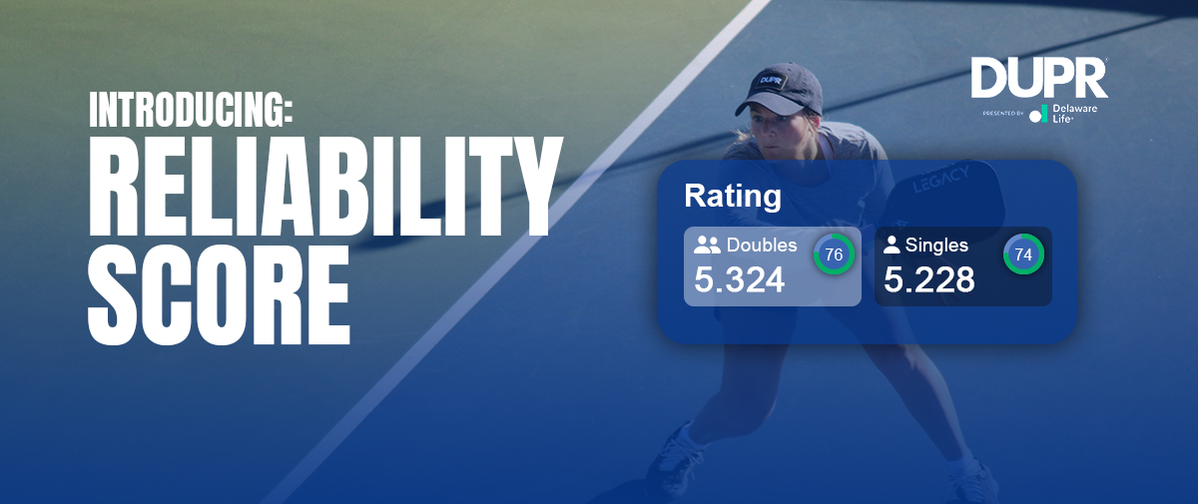
DUPR (Dynamic Universal Pickleball Rating) announced a new element to its rating system on Tuesday – the DUPR Reliability Score, its newest feature to help you better understand your rating.
Players will now have two numbers on their player profile: their DUPR Rating, which provides an assessment of your current pickleball skill level, and the Reliability Score, a percentage that indicates the level of confidence DUPR has in your rating based on the data in its system.
What Is the Reliability Score? How Is It Different From My DUPR Rating?
Your DUPR rating provides a real-time assessment of your pickleball skill level based on your match results. The reliability score measures how confident DUPR is in your rating based on how many matches you've played and your connectivity to the rest of the pickleball population.
A player's reliability score is calculated as a percentage between 1 and 100, with 100 percent being fully reliable. A reliability score of at least 60 percent means you have a reliable rating. Both singles and doubles ratings have a corresponding reliability score.


What Does It Measure?
The reliability score measures how confident DUPR is that a player's rating is an accurate representation of their current level based on match history and connectivity to the population. New players will have lower reliability scores; players that have more results and play frequently will have higher reliability scores.
 Jason Flamm
What Is a Good Reliability Score?
If a player has a reliability score of 60 percent or higher, it means the system is confident in the accuracy of a player's rating. Reliability scores that are lower than 60 percent indicate that more results need to be entered into the system. A rating of 100 percent is considered to be fully reliable, but anything above 60 percent is a good reliability score.
How Does the Reliability Score Help Players?
A reliability score provides a measure of how confident DUPR is about your rating. Players who have more results in DUPR will have a more reliable rating because there are more match results to offer a more in-depth view of your ability. A player who is just starting out will have a lower reliability score because DUPR does not have as many results to analyze.
As players play more and share their results with DUPR, their rating becomes more and more accurate, and their reliability score will go up.
For example, a player who consistently plays and enters match scores will have a more reliable rating than a player who has played once or twice, or only plays against the same person. As you play more, enter your scores, and play a broader range of people, your DUPR rating becomes more reliable. According to CBS Sports, rating-based systems like DUPR are becoming increasingly central to how recreational and competitive pickleball events are structured nationwide.
What Will the Reliability Score Be Used For?
Players can use the reliability score to have more insight into their rating and a better understanding of their current level. Clubs can use the reliability score to better evaluate players, and may even use it as a threshold for event eligibility to ensure players have a good, competitive experience
If you're looking to compete, playing in The Dink Minor League Pickleball is one of the best ways to log competitive matches and build both your DUPR rating and reliability score simultaneously.
How Can I Make My Rating More Reliable?
Play more. Your match count and the recency of those matches are a big component of your Reliability Score. But not all matches are equal in how much new information they provide to the accuracy of your rating. In order to make your rating more reliable, focus on playing matches that satisfy the following criteria:
- Play with various partners and opponents
- Play against similarly rated opponents
- Play Club/Tournament Matches
- Play against highly-reliable players
How Should I Expect My Reliability Score to Move Over Time?
Each match you play will increase your score, but the amount it goes up will depend on many factors that consider how much new information DUPR is getting from the match. Since your Reliability Score is measuring DUPR's confidence that the rating is an accurate representation of your current skill level, your score will decrease over time if you are not recording matches.
What Are the Steps I Can Take to Get a Passing Reliability Score?
There are many ways to get a passing reliability score (60 percent). The key here is that there are many paths you can take to make your rating more reliable, but some paths might require more matches than others. The biggest takeaway is to play frequently and against a broad group of players, so that DUPR's system has more information on your performance.
Jason Flamm
Here are some paths you can take to get a good reliability score. Each match represents one game. Matches with more games will count because there will be more information input into the rating system.
Doubles Paths:
- Two CLUB matches per week for four weeks, with 60 percent reliability teammates/opponents
- Six CLUB matches in one weekend, with 60 percent reliability teammates/opponents
- One CLUB and one Rec match per week for four weeks, with 100 percent reliability teammates/opponents
- One CLUB and one Rec match per week for six weeks, with 60 percent reliability teammates/opponents
- Five REC matches per week for seven weeks, with 60 percent reliability teammates/opponents
- Five REC matches per week for five weeks, with 100 percent reliability teammates/opponents
Singles Paths:
- One CLUB match per week for three weeks, with 60 percent reliability teammates/opponents
- Two REC matches per week for five weeks, with 60 percent reliability teammates/opponents
One of the fastest ways to rack up qualifying matches is to find The Dink Minor League tournaments near you and register for an upcoming event.
How Do I Maintain a Good Reliability Score?
Keep playing and play with a broad group of competitors. Your reliability score will decrease over time if you do not record new matches. To maintain your reliability score, we encourage you to log matches on a consistent basis.
The Dink Media Team
For example, a fully reliable rating could decay to the 60 percent passing threshold over the course of roughly six months without play. A 60 percent passing score can drop to 30 percent over the course of three months without play. A 30 percent score can drop to just under 10 percent over the course of six months.
This is because DUPR's rating places more emphasis on more recent matches as that provides a more accurate assessment of your current skill level. Older matches do not have as much impact on your rating.
Sports Illustrated has highlighted how data-driven rating systems are reshaping amateur competition across racquet sports, and pickleball's embrace of DUPR is a leading example of that trend.
Is Reliability or My Rating More Important?
Your DUPR rating is the most accurate assessment of your skill level. The reliability score is a supporting measure that showcases how you can get your rating to be even more accurate.
As players begin to play and enter scores into DUPR, ratings can fluctuate early on in their DUPR journey as they play different players. As players continue to play and enter more scores, the confidence in their assessment increases. If you're newer to the rating system, check out this DUPR AMA and origin story for a deeper look at how the algorithm was built.
How Often Will My Reliability Score Update?
Your Reliability Score will update weekly on Tuesdays.
If you're tracking your progress toward a specific rating goal, it's also worth understanding how a win or loss can now impact your DUPR rating depending on your opponent's reliability score and rating tier.
Frequently Asked Questions
What is the DUPR reliability score?
The DUPR reliability score is a percentage between 1 and 100 that measures how confident DUPR is in the accuracy of your pickleball rating. It is based on your match history, how recently you've played, and how broadly you've competed against other players in the DUPR system. A score of 60 percent or higher means your rating is considered reliable.
Does a low reliability score mean my DUPR rating is wrong?
Not necessarily. A low reliability score simply means DUPR doesn't yet have enough data to be fully confident in your rating — it doesn't mean the rating is incorrect. As you play more matches against a variety of opponents and log those results, your reliability score will rise and your rating will stabilize.
Can clubs or tournament directors use my reliability score against me?
Yes, and this is an important development. Clubs and event organizers can use the reliability score as an eligibility threshold to ensure competitive balance at their events. If your score is below 60 percent, you may not qualify for certain brackets or events until you've logged enough matches.
How quickly can I raise my DUPR reliability score?
The fastest path is to play Club matches, since they carry more weight than recreational matches. Playing six Club matches in a single weekend against opponents with at least 60 percent reliability is one of the quickest routes to a passing score. For singles, just one Club match per week for three weeks can get you there.
Will my reliability score drop if I stop playing?
Yes. DUPR places more weight on recent match data, so your reliability score will decay over time without new results. A fully reliable score can drop to the 60 percent threshold in roughly six months of inactivity, and a 60 percent score can fall to 30 percent in as little as three months.

Love Pickleball? Join 100k+ readers for free weekly tips, news & gear deals.
Subscribe to The Dink