For the entire history of amateur pickleball, the only record of your match was the score and your memory, and memory is a generous narrator. Thanks to AI integration, it's a whole new dawn.
In July, the number of AI-analyzed replays run at clubs on PodPlay more than doubled in a single month. We didn't launch a campaign. Nothing got cheaper. Players just started asking the video what actually happened out there.
A big driver was AI ratings – and at the end of the month, DUPR made them official.
Starting this August, AI-powered video analysis feeds into your DUPR Rating, drawing on a roster of video partners that includes PB Vision, PlaySight, SwingVision, Save My Play, Volley, and others.
If you play rated pickleball, that's the most consequential thing to happen to your number since DUPR itself.
What an AI Rating Actually Is
Let's strip out the mystique.
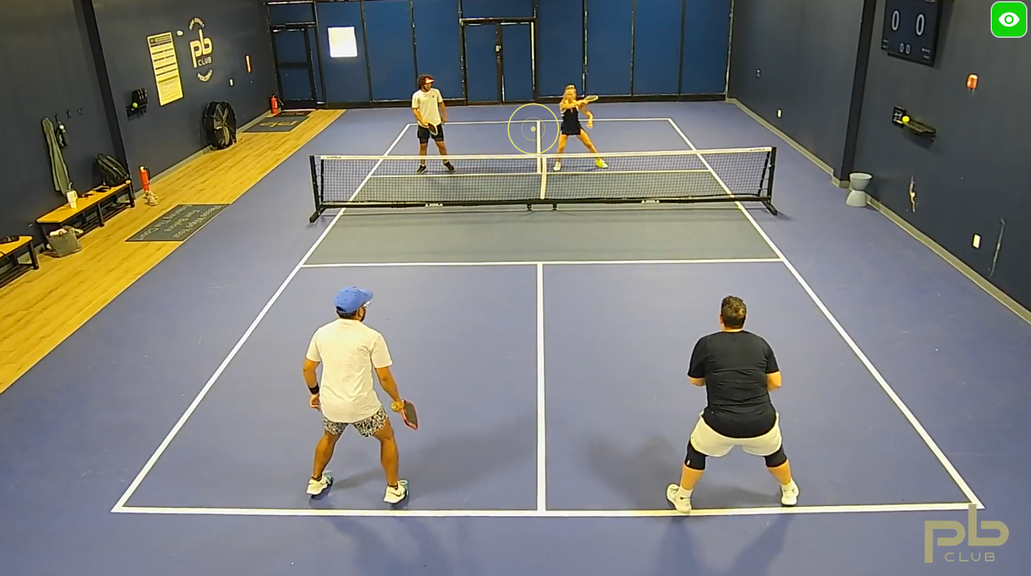
A camera watches your match. A model tracks the ball and four bodies through every rally and writes down what happened.
- Where you served
- What you did with the third
- How often you got to the kitchen line
- Who won the exchanges once you got there
- What happened on your backhand under pressure
Out of that comes two things:
- A shot-by-shot record of the match – a box score for pickleball, which the sport has never really had.
- A rating derived from how you actually performed, not from who happened to be standing next to you and across the net.
Baseball figured this out a century ago. You don't evaluate a hitter off the final score. You look at the plate appearances. Pickleball has spent its whole boom with two data points per match: the score, and a rating that moves a little afterward.
 Alex E. Weaver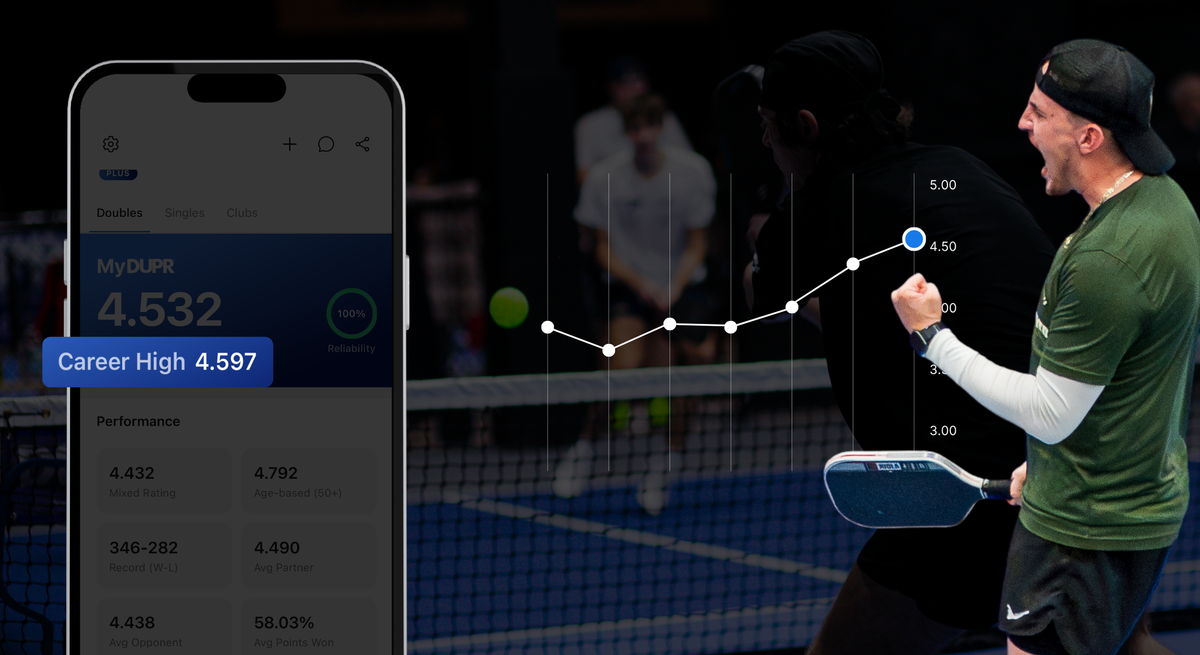
Why Now
Two things had to happen at once, and they finally did.
The models got good. Computer vision that can reliably track a plastic ball moving 40 miles an hour, distinguish four players, and classify a dink from a drop was a research problem a few years ago.
Fed the right inputs, the best models now produce output that holds up against what a good coach sees – and do it at a cost that isn't prohibitive. That combination is new.
The second thing is very recent, may matter more, and gets talked about less: getting video in stopped being work.
 Alex E. Weaver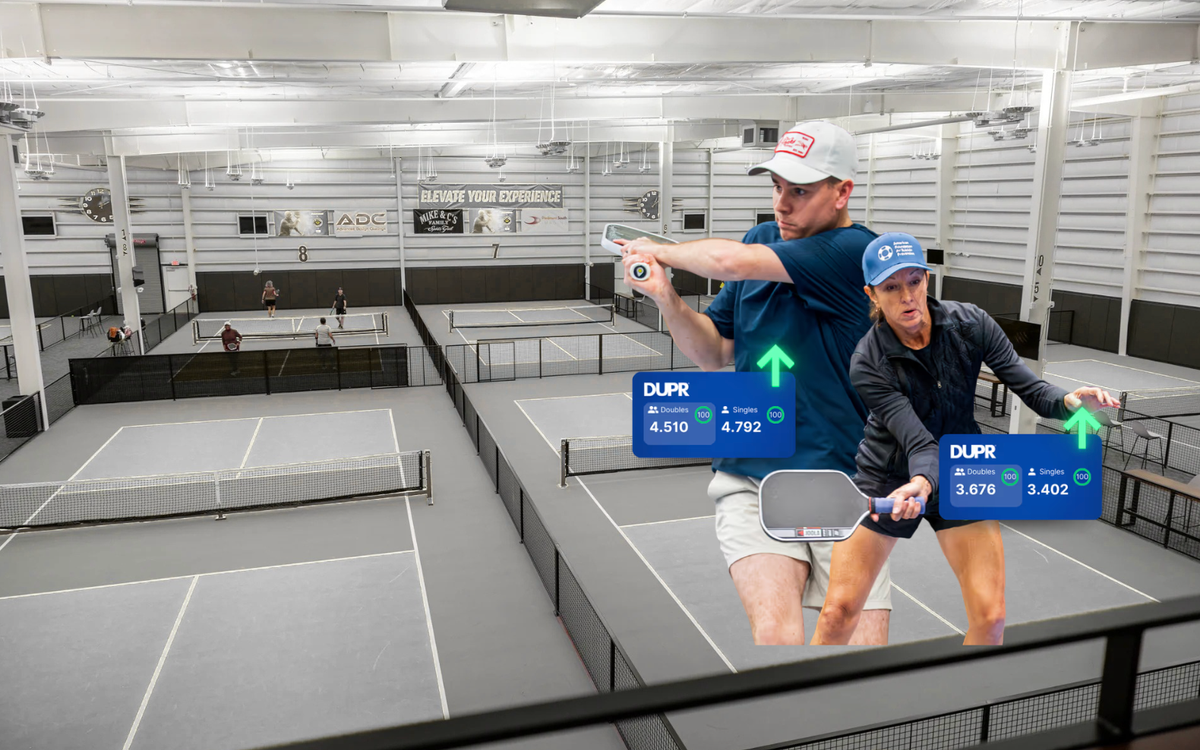
The old workflow killed adoption before the analysis ever ran. Bring a tripod. Charge it. Frame the court and hope you got the angle right. Play. Pull the card, download the file, find where the match started, trim the ends, upload, wait...
That's twenty minutes of chores for a rec match – and only the most dedicated rec players are doing that twice.
Most of that is now solved. Cameras live at the court, framed correctly and permanently. For those using scoreboards, systems detect when a match starts and ends on their own. There's no file to find, nothing to trim, nothing to upload.
Here's the heuristic: adoption of any analysis tool is inversely proportional to the work required to feed it.
Until recently that work was high and the output was mediocre, so almost nobody bothered. Both curves crossed at roughly the same time. That's the whole story of why this is happening in 2026 and not 2022.
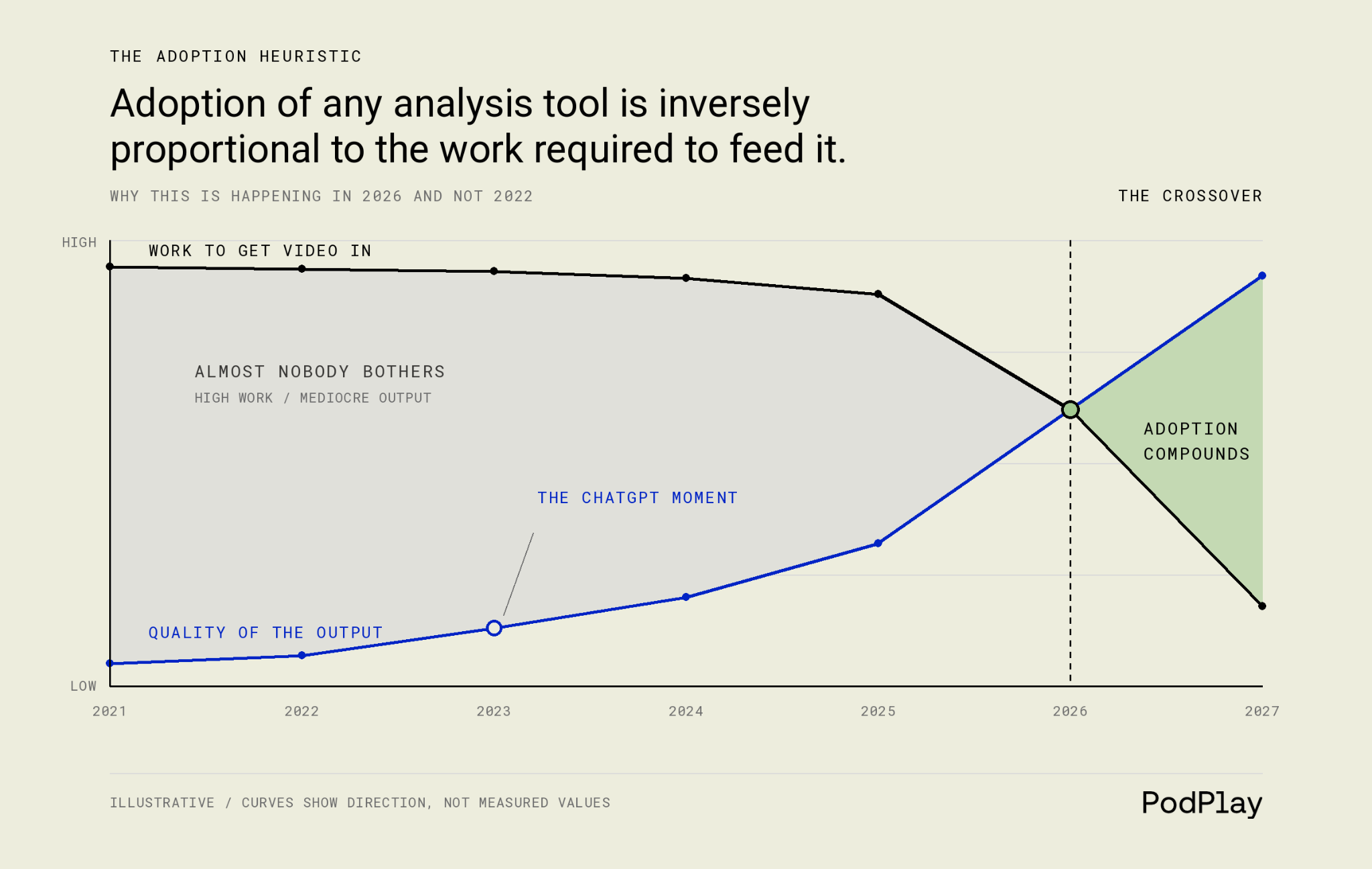
We saw the crossover up close when PodPlay integrated PB Vision into our clubs in January. The analysis had been excellent for some time. The limiting factor was not accuracy – it was the twenty minutes of chores.
Take those out and get it to three taps, and usage doesn't tick up. It explodes. Hence July.
One Number, Three Footnotes
DUPR did something genuinely hard: it got a fragmented sport to agree on one number. That's not a small achievement, and nothing here replaces it. A universal rating is what makes a stranger's 3.9 mean something to you.
But one number, by construction, flattens three things worth seeing.
- Cumulative versus today. Your rating is a cumulative record of all the games you have played. It is not a read on the match you just played. You can play the best pickleball of your life on a Tuesday and watch your rating barely move – and you'd have no way to know it was the best pickleball of your life. Match-level analysis gives you the game log underneath the average.
- Your play versus your partner's. Doubles ratings are built on a team result, and a team result is a blunt instrument. Everyone has won matches they didn't win and lost matches they didn't lose. Shot-level data can say who actually generated the points–which is uncomfortable, occasionally humbling, and by far the most honest feedback in the sport.
- The composite versus the components. A 4.0 rating doesn't tell you that your serve and return are above average and your consistency could use some improvement. Break your performance into buckets and you find out where you spike and what's dragging. That's the difference between knowing your level and knowing your next lesson.
None of those three replace the rating. They annotate it.
DUPR gave the sport one number; AI is giving that number a set of footnotes.
 Alex E. Weaver
Why It Matters for the Rest of Us
The pros have had film study forever. Everybody else has had a vibe and a group chat.
What actually changes for the average player is the closing of that gap.
You'll get a defensible answer to "why am I stuck at 3.5" instead of four conflicting opinions from the people you just played.
Your coach can stop teaching from memory and start teaching from evidence – here's the rally, here's where it went wrong, here's the pattern across nine matches. Improvement stops being guesswork and starts being a project with a scoreboard.
And ratings themselves get more trustworthy. A number informed by how you played, over more matches, in more settings, is harder to sandbag and harder to inflate. Everyone who's ever drawn a "3.5" in a bracket knows why that's worth something.
A word of honesty: this is early.
The models are good, not omniscient. The right posture is the one you'd take with any new stat – useful signal, not gospel, and better every quarter.
But the direction is set. For the entire history of amateur pickleball, the only record of your match was the score and your memory, and memory is a generous narrator. That era is over. Your matches are becoming legible.
Play enough of them and you'll stop asking what your rating is. You'll start asking what it's made of.
Heads up: hundreds of thousands of pickleballers read our free newsletter. Subscribe here for cutting edge strategy, insider news, pro analysis, the latest product innovations and more.

Love Pickleball? Join 100k+ readers for free weekly tips, news & gear deals.
Subscribe to The Dink