
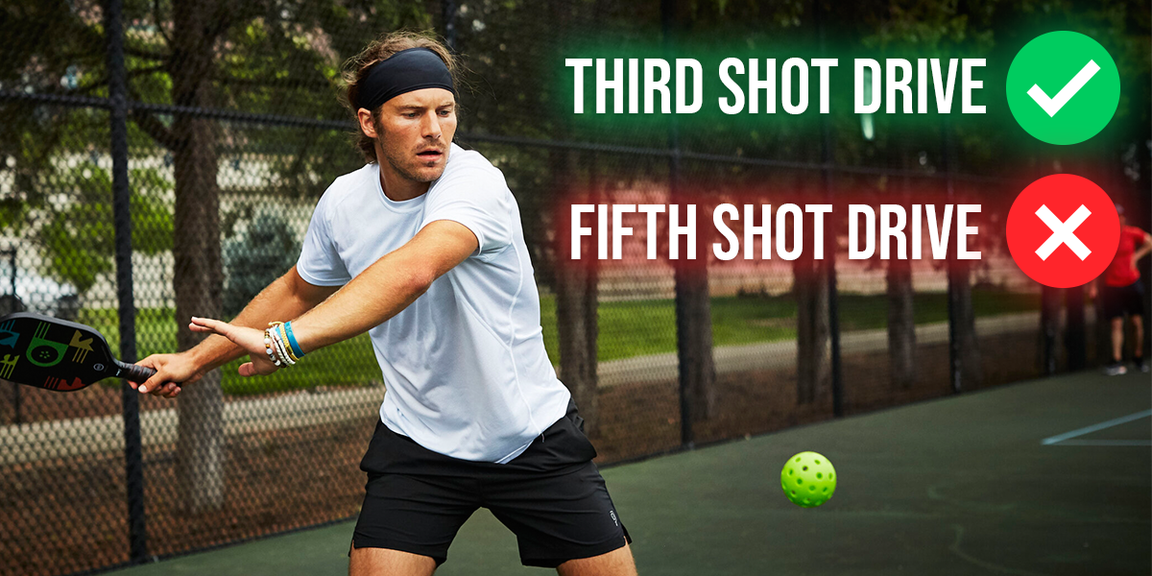
For most pickleball players, drives are the first shot they learn to hit consistently well.
Drives are typically easier to develop and come more naturally because most of us are at least familiar with swinging a piece of sports equipment (think bat, golf club, racquet, etc.) toward a ball. Drop shots are a bit more complicated and take some dedicated practice to develop.
This makes the drive the shot of choice for most players, especially at lower skill levels.
As you gain experience as a player and move up in levels, you should begin adapting a "third shot drop" or "third shot drive" strategy. This is one of the most basic strategies players learn in pickleball.
Third shots are probably the most important shots in pickleball. But that's not what this article is about. Instead, we're discussing another important shot: the fifth. Specifically, we're going to break down why driving a ball on your fifth shot is likely costing you pickleball matches and what you should do instead.
 The Dink Media Team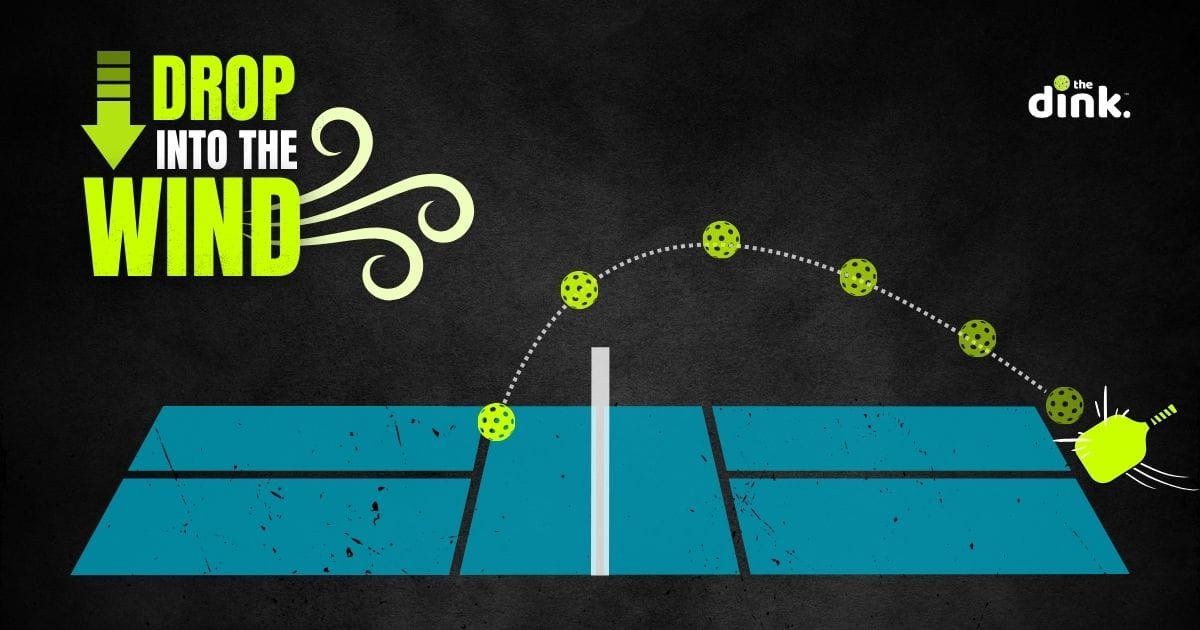
What is the Fifth Shot?
Just so everyone is on the same page, here is what we mean when discussing fifth shots:
- Shot No. 1 - Serve
- Shot No. 2 - Return of Serve
- Shot No. 3 - Third Shot (made by serving team)
- Shot No. 4 - Fourth Shot (made by returning team)
- Shot No. 5 - Fifth Shot (made by serving team)
Third and fifth shots are so critical in pickleball because they often determine whether the serving team will make it to the NVZ line. Getting to the line goes a long way toward helping your team win matches.
Why the Fifth Shot Drop Beats Driving (Most of the Time)
A third-shot drive is excellent. Many players, including pros, often drive on the third shot. The reason it's a great shot, though, is because of player positioning. The double bounce rule dictates that the serving team must wait for the ball to bounce, and oftentimes, that means we are stuck close to the baseline as the return is coming our way.
Because we are so far back, when we drive the ball, we have the benefit of having a lot of court space to work with (almost the full 44 feet). However, on the fifth shot, we are closer to the NVZ line than we were one shot ago.
Instead of 44 feet to work with, we may have closer to 35 feet (more or less). That means our drive on the fifth has an increased chance of going out of bounds long.
This makes driving on your fifth shot riskier. Could you get away with hitting another drive on the fifth shot? Absolutely, especially if you're playing weaker opponents. But as you progress in skill level, that fifth shot drive becomes a liability.
So, we need an alternate strategy.
What to Do on Your Fifth Shots Instead
Instead of driving your fifth, you should consider the fifth shot drop. Why? First, dropping the ball into a good spot in your opponent's kitchen is much easier because you are closer to the net. Second, as discussed, hitting a successful drive that stays in bounds is much harder.
And perhaps most importantly, the entire goal of your third or fifth (or even your seventh or ninth) shot in a rally is simply to help your team safely get to the kitchen line.
What shot helps you get to the line the easiest? The drop shot.
Jason Flamm
It's worth reiterating. Yes, there will be times when you could win the point outright with a drive. But that's not necessarily what you're trying to accomplish with your fifth shot drop.
Reasons You Might Still Drive the Fifth
Bangers rejoice. It's contradiction time. Is there ever a time when driving your fifth shot is the right play? Absolutely. Ignore everything you've read so far if one of these situations occurs in your games.
Your Opponents Can't Handle the Heat
If you're playing against opponents who can't handle your pace or consistently miss hit drives, there's no reason to stop driving the ball until they prove they can return it. In fact, this is a common strategy for some. They will bang away with drive after drive until their opponents make them stop, and then they'll switch it up.
Your Opponents Don't Let Balls Go Out
Another common error by lesser-skilled players is not letting out balls go out.
No matter how high you hit your drive, they feel the need to chase after it. Maybe it's because of inexperience or maybe they just want to prove they can block a ball well. Whatever it is, keep driving at them. When they stop chasing out balls, then change your strategy.
Your Opponent Hits a High Fourth Shot
If your opponent's block shots come back high and soft, there's absolutely no reason not to get on top of the ball and drive it down into their feet. So, if their fourth shots are weak and easy to drive, drive your fifth.
This is where recognizing your court position becomes especially valuable. Understanding where you stand on the court at the moment of contact is the clearest signal for whether to execute a fifth shot drop or go for the drive.
Your Drop Shot is Legit Awful
Perhaps the last reason to pull the trigger on the fifth shot is that you can't hit a drop shot to save your life. If the drive is all you have, then use it.
Hitting a consistent drop shot is hard. That's exactly why mastering soft game skills is so important for players who want to move beyond beginner and intermediate levels.
The Fifth Shot Drop and Your Path to the Kitchen Line
The fifth shot drop isn't just a safer shot option. It is a strategic bridge that carries you and your partner from mid-court to the non-volley zone, where most points in doubles pickleball are decided.
Every extra foot closer to the net you can gain is a foot of pressure you put on your opponents. Using the fifth shot drop to transition forward, rather than gambling on a drive, is the kind of smart shot selection that separates 4.0 players from 3.5 players.
Understanding the pickleball transition zone is critical here. When you are caught in no-man's land between the baseline and the kitchen, your fifth shot drop is often the safest and most effective way to neutralize your opponent's positional advantage and inch forward.
As CBS Sports has highlighted in its coverage of pickleball's growth CBS Sports, the sport rewards accessibility and smart play over raw power, which is exactly what the fifth shot drop exemplifies.
Players who struggle with common pickleball mistakes often find that fixing their fifth shot decision-making alone produces an immediate improvement in their win rate. The fix is not always about hitting harder. Sometimes it is about hitting smarter with a well-placed fifth shot drop.
How to Use a Brisk Wind to Your Advantage
A windy day can present a lot of challenges for recreational pickleballers. We share some tips that should make your game a bit more windproof.
How to Hit the Perfect Pickleball Lob and When It's Simply Not Cool
When is the right time to hit a lob shot in pickleball? Is it a good strategy? We discuss all aspects of the shot and when it's simply not appropriate.
Frequently Asked Questions
What exactly is a fifth shot drop in pickleball?
A fifth shot drop is the fifth shot of a rally, hit by the serving team, that lands softly in the opponent's kitchen (non-volley zone). It is designed to give the serving team time to advance safely toward the kitchen line rather than exchanging drives from mid-court.
Why is the fifth shot drop better than driving on the fifth shot?
By the fifth shot, the serving team has moved significantly closer to the NVZ line, which reduces the available court depth for a drive to land in bounds. This makes a fifth shot drive far more likely to sail long, while a controlled drop shot is easier to place accurately from that position.
When is it acceptable to drive on the fifth shot instead of dropping?
Driving on the fifth shot is a valid choice when your opponents cannot handle pace, consistently fail to let out balls go out, or return a weak and high fourth shot. If your drop shot is currently unreliable, it is also reasonable to drive until you develop a more consistent soft game.
How does the fifth shot drop help a team get to the kitchen line?
The drop shot forces your opponent to let the ball bounce in the kitchen, which neutralizes their ability to attack and buys your team time to move forward. Unlike a drive, which can create a fast counter exchange that pins you in transition, a well-executed fifth shot drop allows you to advance with much less risk.
How do I improve my fifth shot drop if I struggle with soft shots?
Start by practicing drop shots from closer distances and gradually work your way back toward the baseline as your touch improves. Drilling with a partner who feeds from the kitchen line and focusing on consistent drop shot technique will help you build the muscle memory needed to execute the shot under pressure in real matches.

Love Pickleball? Join 100k+ readers for free weekly tips, news & gear deals.
Subscribe to The Dink