
Full courts help. But the decisions that keep a club alive often happen before anyone hits a ball.
Your local pickleball club looks busy. Open play fills up. The weekend crowd keeps coming.
So how could it possibly be losing money?
Dave Conord, co-founder and CEO of PDI Consulting, offers an explanation: Some of the biggest financial problems are baked into a facility before its first member walks through the door.
The company's recent industry report identifies 121 ways to improve a pickleball facility’s finances: 61 to reduce costs and 60 to increase revenue. Its opening challenge: “121 levers. Most clubs pull four.”
'Full buildings still lose money'
Here’s what players and operators should take away.
Nearly half the cost-saving opportunities disappear before opening
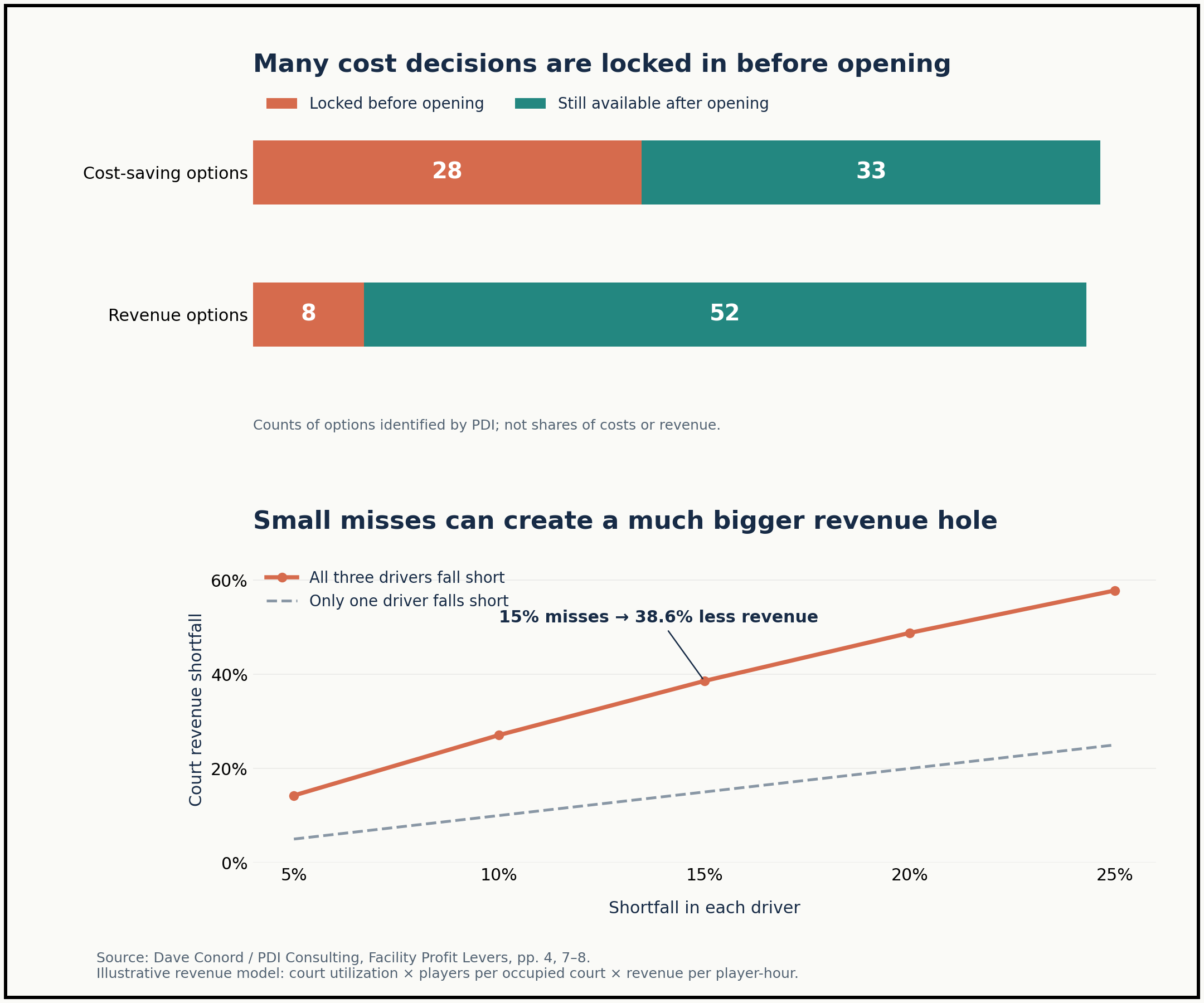
According to PDI’s framework, 28 of 61 cost-control options — 46% — are locked in during site selection, lease negotiations and construction.
That doesn’t mean 46% of expenses are unchangeable. It means nearly half the opportunities PDI identifies to control those expenses must be addressed early.
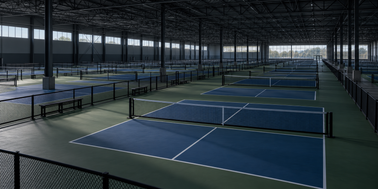
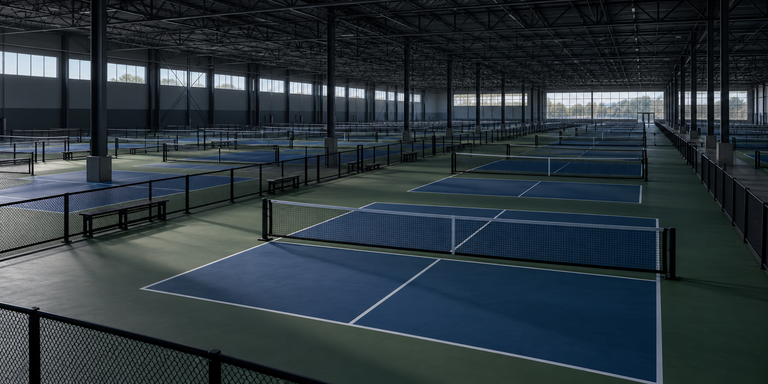
Think expensive lease terms, an awkward building layout or columns that limit usable court space.
“That is why good operators with full buildings still lose money,” Conord writes.
For players, those decisions show up as cramped courts, low ceilings, parking headaches — and a club with little financial breathing room.
"Worth saying plainly: 121 isn’t a to-do list. Nobody pulls 121," Conord added on LinkedIn.
The point is that the number isn’t four. If you’re running four levers, you’re not operating a facility. You’re renting out hours and hoping the lease was fair. Pick the three that are actually available to you this quarter and pull those.
 West Shaw
Small misses can become a big problem
PDI breaks court revenue into three basic ingredients:
- How often courts are occupied
- How many players use each occupied court
- How much revenue each player-hour generates
These factors multiply. If all three fall 15% below expectations, court revenue ends up 38.6% below the projection, not 15%.
Imagine expecting $100,000 in court revenue and bringing in roughly $61,400. The rent hasn’t politely dropped to match.
The encouraging part: That math works in both directions.
Improve each factor by 10%, and the model produces 33.1% more court revenue. That’s an illustration, not a guaranteed result — or an equivalent increase in profit.
More options than raising your membership fee
PDI counts 52 revenue opportunities still available after opening, including:
- Lessons, clinics and instructional programs
- Private events and full-facility rentals
- Sponsorships and court naming rights
- School partnerships and youth programs
- Renting space to physical therapy or sports medicine providers
The implication for players: A financially healthier club may need to serve more than the evening open-play crowd.
But adding a kitchen and bar isn’t automatically the answer.
“Food and beverage is not a bolt-on to a court business,” Conord writes. It requires its own expertise, staffing and investment.
There’s still plenty the industry doesn’t know
Conord also flags major gaps in publicly available information, including reliable facility failure rates, member retention figures and regional financial comparisons.
His framework is a way to examine a business, not proof that every club faces the same problems.
For anyone choosing where to play, the takeaway is straightforward: A packed parking lot tells you a club is popular. It doesn’t tell you whether the business will work longterm.
 David Johnson

Love Pickleball? Join 100k+ readers for free weekly tips, news & gear deals.
Subscribe to The Dink