It's one thing to rate yourself in pickleball, but it's quite another to be sure about your skills and how you can add some value to that rating number.
Be honest: have you ever exaggerated your rating in your mind? Have you ever thought that one maneuver was performed more expertly than it was? Have you ever thought you could be ready to move up a level?
If you answered "yes" to any of those questions, congratulations: you're not delusional. We've all done this. Admission is the first step to pickleball recovery.
What I'm saying is that pickleball improvement requires some amount of objectivity, which can be tough to find without buddying up to a higher-level player or paying for a coach.
I've been on a mission to push out of my 3.5 slump into 4.0 territory, and even though I play in many different locations with many different players, I still have a hard time analyzing precisely what I need to change to get there.
So, when the shot tracking app Unforced Pickleball offered to show me how to use the app for more specific insights into my pickleball game, I couldn't refuse.
Making Your Pickleball Improvement Journey More Objective
The Unforced Pickleball app can be used in two primary ways.
A free version allows you to track your shots manually by watching a live match, using your Apple Watch, or viewing a recorded match. A paid option allows users to submit video of their match to be analyzed by a real person at Unforced HQ.
I'll talk about the unpaid option which utilizes my smartwatch next time.
For now, I want to stress how valuable it was for someone else to review my games and show me key examples of my strengths and weaknesses as a player.
I just set my phone's camera facing the court, hit record, and played as many games as I could until I played one I felt was particularly worthy of examination.
Then I uploaded it to the app, and for less than $15, I gained access to both automatic clips and advanced stat tracking. You can pay less if you just want clips or the stat tracking, or you can enter all that information about each shot manually for free.
Here's how the resulting data looked after I uploaded my match:
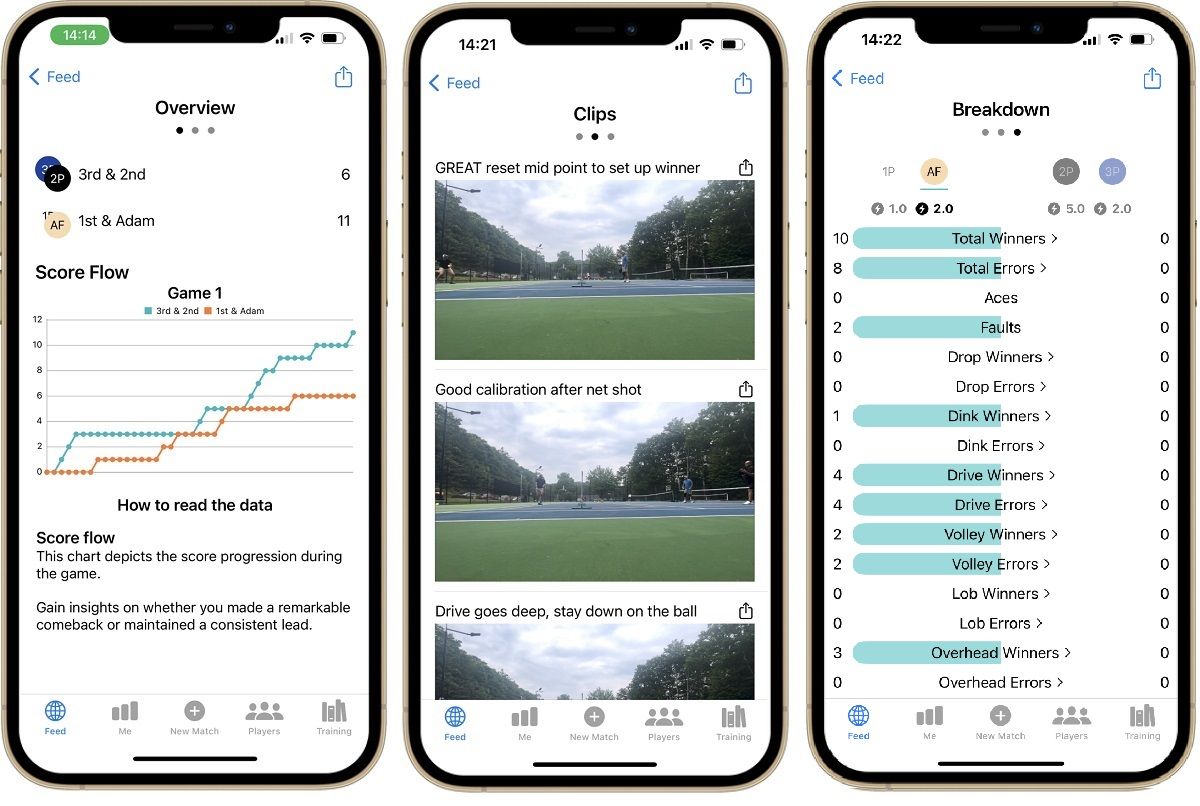
The Overview menu showed me the overall progression of points made during a game, throughout the points in the game. Me and my teammate's line color is orange, and as you can see, it wasn't our best game.
But the experience wasn't all for naught.
Even if I didn't perform at my best, the Breakdown menu on the right showed me where I went wrong and compared my performance across all possible areas of improvement. Seriously, you could keep scrolling through that menu for a long time, seeing every possible performance metric.
It seems my drives were really back-and-forth this game. I won four points on drives but also lost four on them.
Then, in the middle, there's the section to review clips generated by Unforced. This is one of the coolest functions of the app, not only because it gives you a shareable, demonstrable example of something you did right or wrong, but also because of the little comments which contextualize the clips.
"GREAT reset mid point to set up winner," "good calibration after net shot," and similar notes all helped me to actually see my strengths and weaknesses play out in digestible examples.
The Most Important Feature for Pickleball Improvement
Player Impact Score: The Single Best Metric
One of the most important features of the Unforced Pickleball app is the Player Impact metric.
Real Clear Stats says this is the single best metric for tracking your performance and improvement as a pickleball player because it measures your direct impact on the scoreboard.
Player Impact is a single metric of all the times a rally is won as a result of a player's winning shot OR lost as a result of that player's error. If someone's Player Impact is +3, that means they won three more rallies than they lost due to unforced errors.
Every rally, only one player's score will go up or down.
As Real Clear Stats explains: "In order to score points and win pickleball games, you have to win rallies. In order to win rallies, you need to make enough balls until your opponent makes an unforced error OR impose your will by hitting a rally-winning shot."
Of course, there are many skills which need to be practiced in order to become a great pickleball player. But the scoring system itself doesn't actually measure your improvement.
Since scoring and winning rallies is the object of the game, Player Impact involves simply measuring each player's direct impact on the score when they are involved in the conclusion of a rally.
Over a large sample size, the data becomes revealing. As Real Clear Stats notes, the players with the higher impact also turn out to be the most skilled and highest ranked, because they win significantly more rallies than they lose to unforced errors.
Why Data-Driven Feedback Accelerates Progress
Most players rely entirely on feel and memory to assess how they are playing, which is notoriously unreliable. Objective data from shot tracking cuts through that bias and gives you something concrete to act on.
This is exactly the kind of feedback that separates players who understand the pickleball plateau from those who stay stuck for months or years. The difference between a 3.5 and a 4.0 isn't just skill, it's self-awareness.
As ESPN has covered in depth, pickleball's fastest growing segment includes younger, more athletic players entering the game at higher skill levels. That means recreational players need every advantage available to keep pace and push their own game forward.
Tracking Progress Over Time
Consistency of data matters as much as the data itself. One match tells you something; ten matches tell you a pattern. Uploading multiple games to Unforced Pickleball gives you a true picture of your tendencies under different opponents and conditions.
Five signs you're still an intermediate pickleball player often have nothing to do with shot mechanics. They have everything to do with decision-making and self-awareness, both of which data tools help sharpen.
If you're working toward a DUPR reset or reassessment, having objective match data to reflect on before submitting results is a genuine edge.
How Shot Tracking Supports Specific Pickleball Improvement Goals
Breaking Through the 3.5 to 4.0 Barrier
If you've been stuck at 3.5 and want to understand what it genuinely takes to reach the next level, shot tracking is one of the most underused tools available. Moving from 3.5 to 4.0 in pickleball requires eliminating specific unforced errors, not just adding new shots.
Your Player Impact score makes those errors undeniable. There's no arguing with the data when it shows you lost four rallies on drives in a single game.
The reset shot is a perfect example of a skill that looks fine in drills but breaks down in matches. The pickleball reset is one of those skills that video review will expose quickly. Watching your clips, you may realize you're attempting resets from positions that make success nearly impossible.
Using Stats to Improve Court Positioning
Shot data reveals something that raw memory never can: the relationship between your court position and your error rate. Recognizing your court position to hit the right shot every time is a concept that becomes visual and concrete when you review your match clips.
The Breakdown menu inside Unforced Pickleball makes this analysis automatic. You don't have to interpret the raw footage yourself; the app does the heavy lifting.
CBS Sports has noted that pickleball's accessibility is one of its most remarkable qualities. But accessibility at the entry level doesn't mean improvement at the intermediate level is automatic. Data tools like Unforced Pickleball are what bridge that gap.
Stop Relying on Your Own Memory
We are all guilty of stubborn habits that lose us pickleball points, and we rarely see them in real time. Our brains edit our memories in our favor, which is why self-coached pickleball improvement so often stalls.
Video review paired with objective stats makes the invisible visible. A clip labeled "unforced error on a ball you had full control of" is harder to dismiss than a vague feeling that something went wrong.
Amateur pickleball habits that are sabotaging your game are often invisible to the player committing them. A tool like Unforced Pickleball surfaces them without judgment, in a format you can revisit and share with a partner or coach.
To learn more about Unforced Pickleball and your Player Impact score, click here.
Frequently Asked Questions
What is the best way to measure pickleball improvement?
The most objective way to measure pickleball improvement is through match data, not just wins and losses. Tools like the Unforced Pickleball app track shot outcomes, unforced errors, and Player Impact scores to give you a concrete picture of how your game is progressing over time.
What is Player Impact in pickleball and why does it matter?
Player Impact is a single metric that tracks every rally won through a winner and every rally lost through an unforced error. It matters because it directly measures your influence on the scoreboard, making it the most accurate individual performance stat in a doubles pickleball game, according to Real Clear Stats.
How can I move from a 3.5 to a 4.0 pickleball rating?
Moving from 3.5 to 4.0 in pickleball typically requires reducing unforced errors, not just adding new shots. Using a shot tracking app to review your match video helps you identify the specific situations and positions where your error rate spikes, so your pickleball improvement work becomes targeted instead of general.
Is the Unforced Pickleball app free to use?
Yes, the Unforced Pickleball app has a free version that lets you track shots manually through a live match, Apple Watch, or recorded video. A paid option is also available where a real analyst at Unforced HQ reviews your match footage and generates automatic clips and advanced stat tracking for less than $15.
Why is self-assessment so difficult in pickleball?
Human memory is selective and tends to edit out mistakes, which makes honest self-assessment in pickleball extremely challenging. Pairing video review with objective metrics like Player Impact removes that bias and gives you an accurate, repeatable baseline for tracking your pickleball improvement over time.


Love Pickleball? Join 100k+ readers for free weekly tips, news & gear deals.
Subscribe to The Dink