Protecting the Game: The Philosophy Behind USA Pickleball's Evolving Equipment Standards
Pickleball's extraordinary growth has been driven by its accessibility. We intend to keep it that way.
[Technical contributions from Carl Schmits, Chief Technology Officer, and Riley Burgess, Vice President of Equipment Compliance]
Every sport eventually reaches a point where growth alone is no longer enough.
Growth must be accompanied by stewardship.
Innovation should shape the future of pickleball, not redefine the game itself.
What began nearly sixty years ago on a backyard court has become America's fastest-growing sport while remaining remarkably true to its original spirit.
A beginner can step onto a public court with an affordable paddle and play the same game as those contested at the highest levels of competition. Families play together. Generations compete together. Local players share courts with National Champions.
Pickleball's extraordinary growth has been driven by its accessibility. We intend to keep it that way.
Accessibility is not simply one of pickleball's strengths; it is part of the sport's identity. Protecting that identity is one of our greatest responsibilities.
As the National Governing Body for pickleball in the United States, USA Pickleball has a responsibility that extends far beyond writing rules or certifying paddles. Our responsibility is to protect the game itself.
That means protecting competitive integrity. Protecting fairness. Protecting confidence in competition. And ensuring innovation strengthens the sport without fundamentally changing what made millions of people fall in love with it in the first place.
Every decision we make begins with a simple question: Will this protect pickleball, not just for today's players, but for the next generation?
That question has guided every equipment standard USA Pickleball has introduced.
Good Governance Doesn't Chase Innovation. It Guides It.
Innovation has never been the enemy of pickleball.
In fact, innovation has helped fuel the sport's remarkable growth. Manufacturers continue pushing engineering forward, developing new materials, construction methods and technologies that improve performance and expand player choice.
We want that innovation to continue.
But innovation without standards eventually stops serving the sport and begins reshaping it. That is where a National Governing Body serves a different purpose.
Manufacturers should continue asking: "What is possible?"
Our responsibility is to ask: "What is best for the game?"
Those are not competing priorities, they are complementary responsibilities.
The role of an NGB is not to choose winners in the equipment marketplace. It is to create a framework where innovation can thrive while preserving fairness, consistency and confidence for every player who steps onto a court.
The best equipment standards are the ones players never have to think about. They simply trust that the game is fair.
As the National Governing Body for pickleball, USA Pickleball continues to lead the way in advancing equipment standards that protect the integrity of the game while supporting innovation.
— USA Pickleball (@USAPickleball) July 9, 2026
Read the full update: https://t.co/GnuhyoAYpi
Evolution Should Be Deliberate, Not Reactive
Paddle technology evolves rapidly. Certification standards should evolve thoughtfully.
USA Pickleball has long followed a deliberate philosophy when introducing new equipment standards. Every significant advancement begins by evaluating the marketplace, studying emerging technologies, working alongside manufacturers, validating the science, and determining whether implementation is practical for the industry.
We often describe this progression internally as crawl, walk, run.
Not because innovation should move slowly. Because it should move responsibly.
Most paddle manufacturers operate on product development cycles lasting 12 to 18 months. Significant investments in engineering, tooling and production occur long before a product reaches players. Responsible governance recognizes that reality.
Equipment standards should never surprise the industry; they should provide manufacturers with transparency, stability and confidence while ensuring the game continues evolving responsibly.
Every Test Solved the Problem It Was Designed to Solve
One misconception surrounding equipment testing is that introducing a new test somehow means an earlier test failed.
In reality, every certification standard has reflected the needs of the sport at that moment in time.
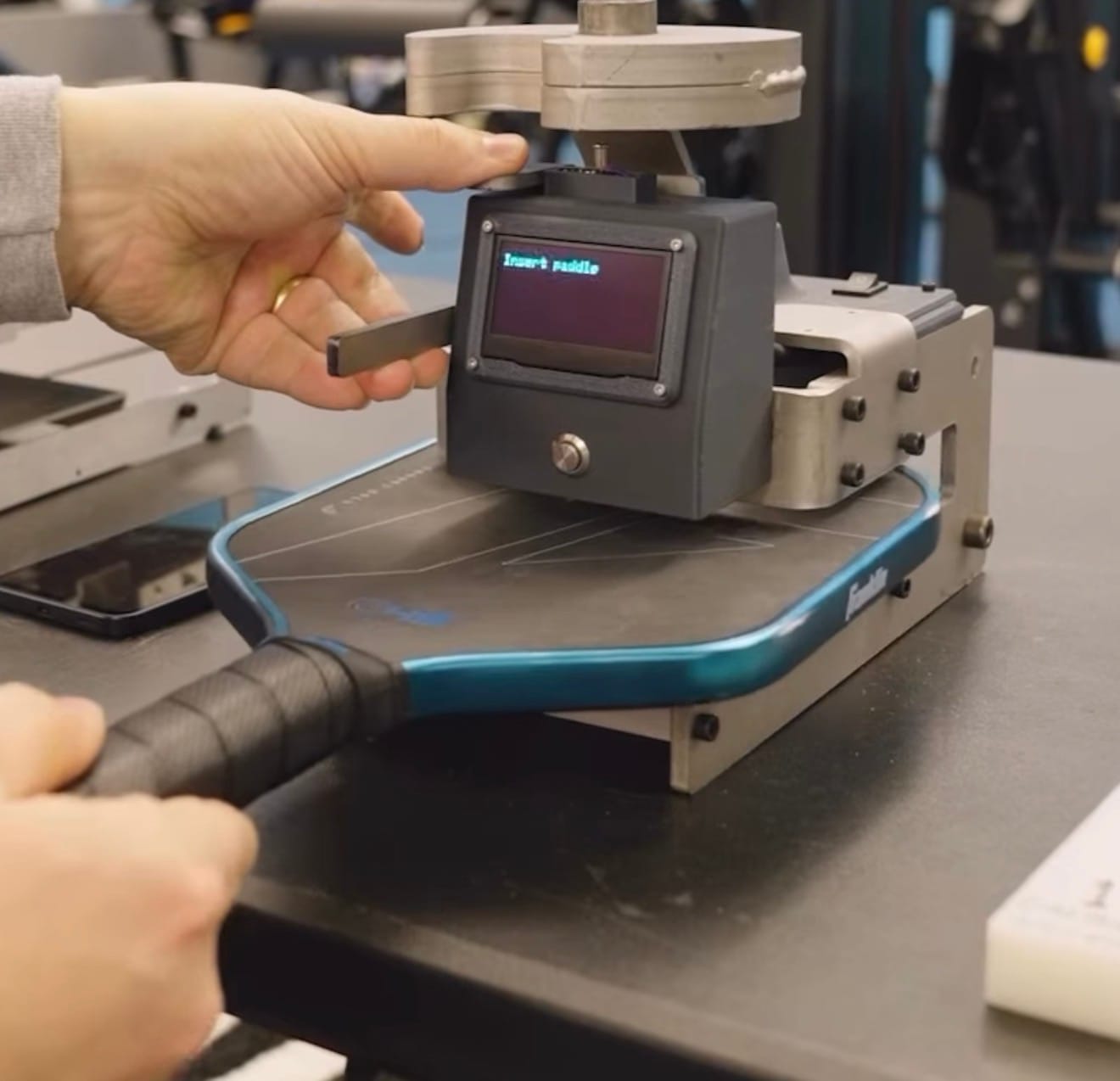
USA Pickleball's original Deflection Test effectively managed paddle power for many years while simultaneously providing one of the most reliable methods for identifying damaged paddle cores during courtside inspections.
As newer Generation 3 paddle constructions entered the marketplace, however, deflection alone became less predictive of actual power output. That did not make the Deflection Test obsolete; it simply meant the sport had evolved.
Today, Deflection remains an important part of certification because it continues serving a critical role in courtside compliance. The same is true of Surface Roughness and Coefficient of Friction. Those standards successfully controlled spin throughout a pivotal period in pickleball's growth. They accomplished exactly what they were intended to accomplish.
The introduction of the Spin Rate Test is not a correction of those standards. It is their evolution.
Why Now?
If a direct Spin Rate Test is better, why wasn't it introduced years ago?
Because responsible governance is about introducing the right standard at the right time.
Earlier Surface Roughness and Coefficient of Friction standards effectively controlled spin while the paddle market matured. More importantly, the technology required to directly measure spin with the accuracy, consistency, and repeatability necessary for certification simply did not exist in a practical form.
Today, it does.
Rather than regulating one characteristic of paddle design, USA Pickleball can now directly measure the outcome that matters most: how much spin a paddle actually produces when striking a ball.
That distinction matters.
Outcome-based testing allows manufacturers greater flexibility in how they innovate while ensuring every certified paddle meets the same performance standard.
Rather than prescribing how manufacturers should build paddles, we measure what the paddle actually does.
Measuring Spin Is More Complex Than It Appears
Developing an accurate Spin Rate Test required far more than recording slow-motion video.
Spin exists in three-dimensional space.
A single camera captures only one perspective of rotational movement.
Much like human depth perception depends on two eyes working together, accurately calculating RPM requires multiple synchronized viewpoints.
Without them, important rotational information, including side spin, can be missed, resulting in inconsistent measurements.
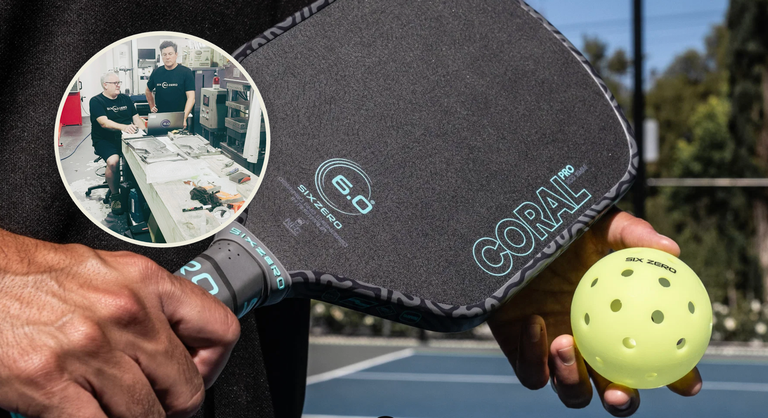
For that reason, USA Pickleball partnered with Image Systems, internationally recognized leaders in high-speed motion analysis. Their proprietary software has been trusted for years across aerospace, automotive and industrial engineering applications where precise motion tracking is essential.
Using a synchronized two-camera system, the software automatically calculates rotational speed, removing subjective interpretation and human error while producing highly repeatable results. The system is further enhanced by specially manufactured Franklin Sports testing balls featuring proprietary, high-resolution tracking patterns.
As a leading pickleball ball manufacturer, Franklin Sports helped solve the difficult challenge of printing these precise markings onto a round surface.
These markings allow the software to determine the ball's precise orientation throughout impact, enabling accurate RPM calculations that would not have been practical only a few years ago.
This combination of hardware, software, and validated engineering provides a testing system built upon repeatability, consistency, and objective science.
 Alex E. Weaver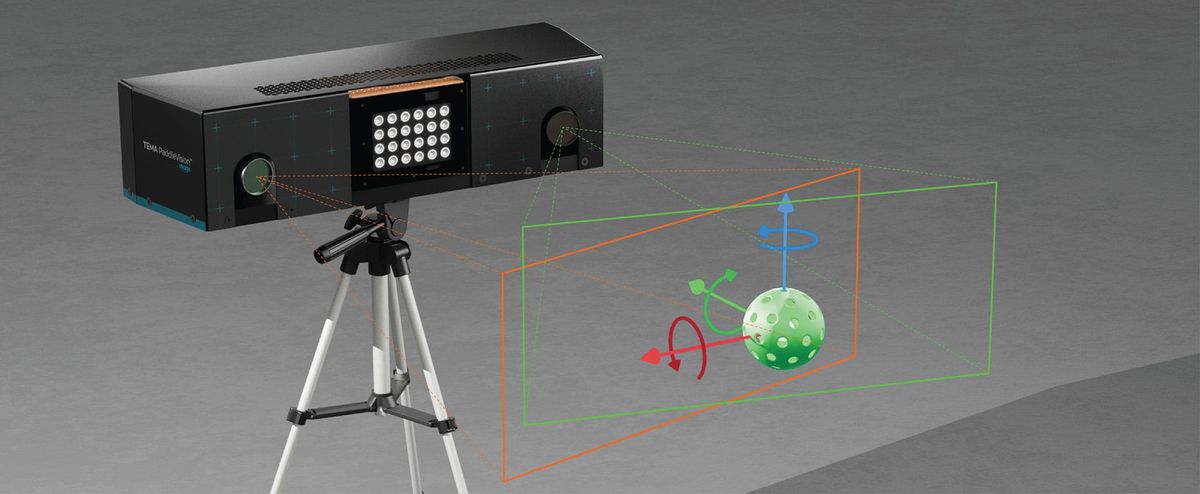
Building on Proven Science
The Spin Rate Test is only one example of USA Pickleball's transition toward measuring actual paddle performance.
In 2024, USA Pickleball introduced PBCoR (Paddle-Ball Coefficient of Restitution) to address increasing paddle power entering the marketplace.
Rather than inventing an entirely new concept, we adapted scientific principles already proven through BBCoR testing in baseball, where measuring the relationship between a ball's incoming and outgoing velocity successfully controlled equipment performance.
During PBCoR testing, a ball is fired at a stationary paddle while sensors measure both incoming and rebound speeds. Those measurements produce a PBCoR value, with USA Pickleball establishing a certification limit of 0.43.
Every shot is then independently validated using the Momentum Balance Equation.
Simply put, physics tells us how much energy should exist within the system based on the measured properties of both the paddle and the ball.
If a particular shot falls outside those expected physical limits, whether due to vibration, sensor interference or another anomaly, it is automatically discarded rather than influencing certification.
These validation processes happen behind the scenes, but they are essential to producing accurate, repeatable and trustworthy results.
Certification Is Only the Beginning
Approving a paddle is not the end of equipment governance. It is the beginning.
Maintaining compliance throughout a paddle's life cycle is equally important.
As paddle technology has become more sophisticated, conversations have naturally expanded to include how paddles change over time.
At first glance, creating a single laboratory test to artificially age every paddle before certification may seem appealing. In practice, however, the science is far more complex.
Paddle constructions do not degrade in the same way. Different core materials, face materials and manufacturing techniques respond differently to use over time. A single laboratory aging process cannot accurately represent every paddle design in the marketplace.
USA Pickleball believes that defining a single artificial aging process for every paddle construction would ultimately create more assumptions than certainty.
Manufacturers would understandably optimize products around whatever laboratory aging process was selected, even if it did not reflect how paddles actually change during real-world play.
USA Pickleball believes the ultimate measure of equipment compliance is not what happens inside a laboratory… it is what happens on a pickleball court.
That is why we continue investing in courtside testing with experts in Pickleball Instruments.
By evaluating paddles in actual play against the same standards under which they were originally certified, officials can identify equipment that has degraded beyond acceptable limits regardless of construction type.
As courtside technologies continue advancing, they will become an increasingly important tool for maintaining a fair and level playing field across every level of competition.
Responsible Governance Means Continuing to Learn
No governing body should assume today's standards will remain perfect forever. Technology will continue advancing. Manufacturing will continue evolving. Innovation will continue challenging existing assumptions.
That should be celebrated.
Confidence in a testing standard should never come from assuming it is perfect.
It should come from a willingness to continue measuring, validating, and improving it as the sport evolves.
That is why USA Pickleball has committed to actively monitoring Spin Rate Test results throughout its implementation. Data collected over the next twelve months will help inform future refinements, should the evidence support them.
That is not uncertainty; it is responsible governance grounded in science.
That same philosophy extends beyond the testing itself to how we communicate with the industry. As technology and our testing continue to evolve, so will our commitment to clear, consistent communication. Though implementing a provisional approval status is not embedded in our policy, should a provisional approval process be used in the future, we would ensure those approvals are clearly communicated from the outset.
Trust Is the Standard
Every equipment standard introduced by USA Pickleball ultimately serves one purpose.
Trust.
Trust that players are competing on a fair playing field.
Trust that manufacturers understand the standards and have a predictable path for innovation.
Trust that officials have objective tools to enforce those standards consistently.
Trust that the game being played on neighborhood courts remains fundamentally the same game contested at the National Championships.
Every significant decision we make is guided by one belief: We are not simply governing today's game; we are protecting tomorrow's.
The paddles will continue to evolve.
Manufacturing will continue advancing.
Technology will continue improving.
Our responsibility is to ensure those advancements strengthen the sport without changing the qualities that made millions of people fall in love with pickleball in the first place.
It is to preserve the game that millions of players have entrusted us to steward.
Because pickleball's greatest strength has always been the people who can pick up a paddle, step onto a court and know they are playing a game that is fair, accessible and worthy of their trust.
That is the game entrusted to us to protect.
About USA Pickleball
USA Pickleball is the official National Governing Body (NGB) for the sport of pickleball in the United States. As a nonprofit 501(c)(3) organization, USA Pickleball is dedicated to preserving the integrity of the game while advancing its growth and development nationwide. The organization supports players, clubs, and communities by sanctioning premier tournaments, offering certified equipment testing, training referees, certifying facilities, and providing a wide range of educational resources. USA Pickleball also maintains and updates the official rules of the sport, ensuring consistency and fairness at every level of play. Led by a Board of Directors and a dedicated national office staff, USA Pickleball delivers the infrastructure and strategic vision necessary to fuel the continued expansion of pickleball across the country—benefiting members with exclusive access to events, programs, and tools that elevate their experience on and off the court.

Love Pickleball? Join 100k+ readers for free weekly tips, news & gear deals.
Subscribe to The Dink