
Written by: Jaret Petras
Pickleball is one of those games that is just so addicting. Not only to play, but also to watch. Now more than ever, we have the access to watch the elite players challenging each other for championships.
These matches are so engaging as a fan, but also can be an educational opportunity to learn from the best players in world.
Coaches and players alike try to analyze these matches to pick up on the new trends of the games. Whether it be the shape of their hips or a new type of serve, even the tiniest details make a difference when it comes to pickleball.
At the same time, pickleball, like any other sport, can be very subjective and it is not always clear why certain actions are taking place. So, I decided to analyze a match through a data-driven approach to dive into a deeper layer of the game and see what is really going on.
GET THE NEW BEN JOHNS HYPERION PADDLE AT FROMUTH PICKLEBALL. If you snag anything else before you checkout, get 10% off with 10DINK (exclusions apply).
Pickleball Singles Strategy: Breaking Down the Match
The match I selected was Ben Johns vs. Tyson McGuffin in the gold medal match of the Rocky Mountain Open. Not only does this match have two of the game's elite players, but as a singles match, I thought it would be very interesting to see how these players strategize against each other, especially since there is no weaker partner to target.
Singles are clearly played very differently than doubles, especially from the tactical standpoint. Because of this, I decided to analyze the data surrounding each players' 3rd shot selection. This pickleball singles strategy deep-dive revealed some truly intriguing patterns.
The Third Shot in Pickleball
In doubles, a player's most valuable asset is typically the 3rd shot drop as it gives the serving team an opportunity to get to the No Volley Zone without defending an offensive volley.
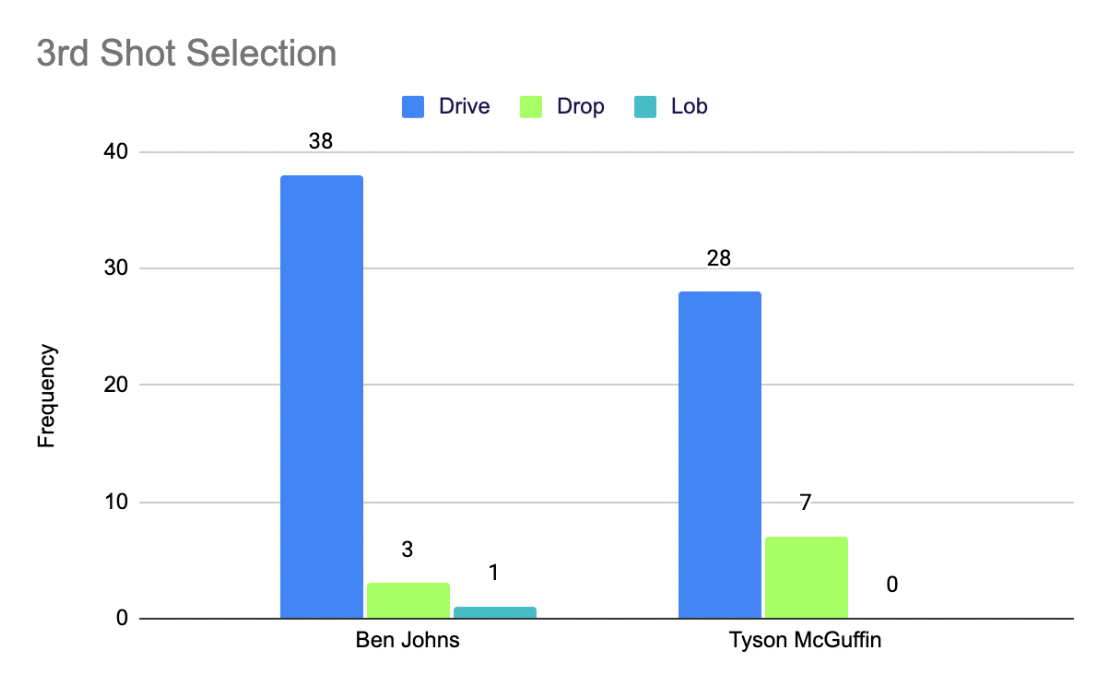
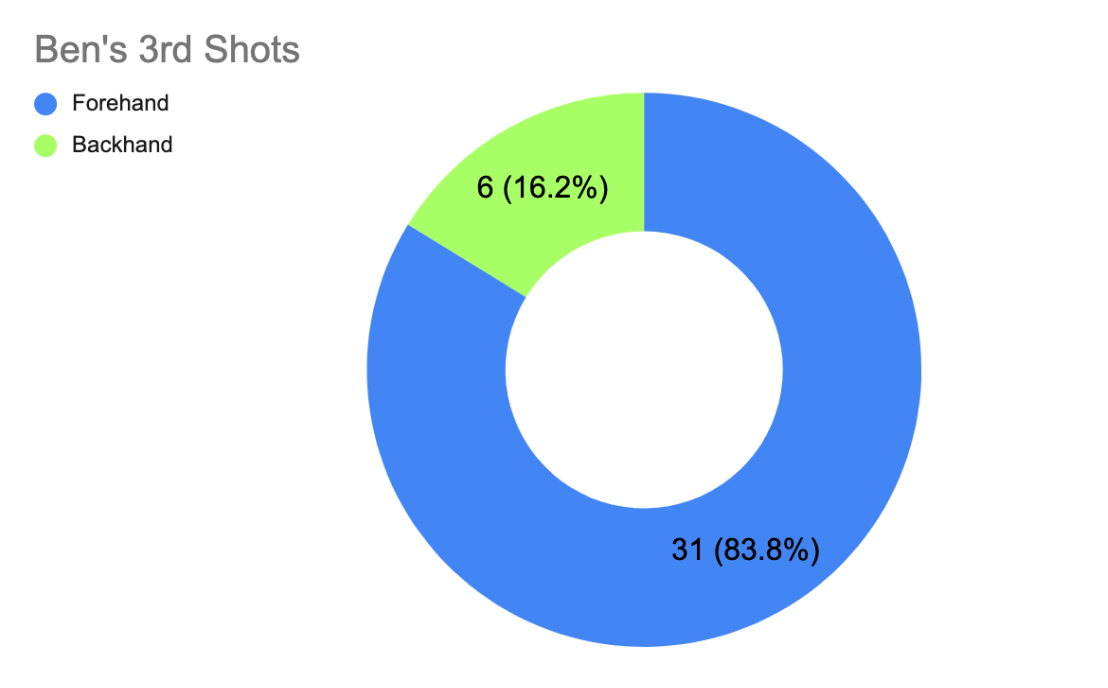
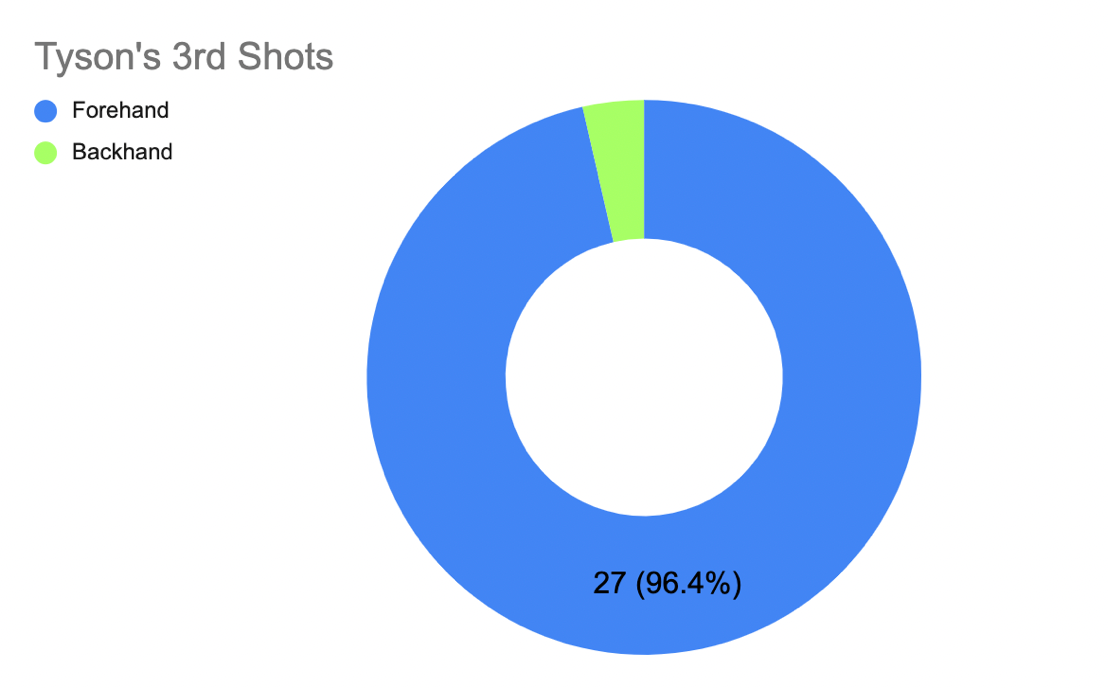
However, in this singles match, Ben Johns opts for a drive over 90% of the time and is the favorable shot. Tyson meanwhile drives 75% of the time on his 3rd shot. What was also interesting from this pickleball singles strategy analysis is that both players had a massive preference for their forehands for these 3rd shot drives. Tyson in particular hit forehands over 96% of the time.
Pickleball Singles Strategy: Breaking Down the Match
The match I selected was Ben Johns vs. Tyson McGuffin in the gold medal match of the Rocky Mountain Open. Not only does this match have two of the game's elite players, but as a singles match, I thought it would be very interesting to see how these players strategize against each other, especially since there is no weaker partner to target.
Singles are clearly played very differently than doubles, especially from the tactical standpoint. Because of this, I decided to analyze the data surrounding each players' 3rd shot selection. This pickleball singles strategy deep-dive revealed some truly intriguing patterns.
The Third Shot in Pickleball
In doubles, a player's most valuable asset is typically the 3rd shot drop as it gives the serving team an opportunity to get to the No Volley Zone without defending an offensive volley.
However, in this singles match, Ben Johns opts for a drive over 90% of the time and is the favorable shot. Tyson meanwhile drives 75% of the time on his 3rd shot. What was also interesting from this pickleball singles strategy analysis is that both players had a massive preference for their forehands for these 3rd shot drives. Tyson in particular hit forehands over 96% of the time.
To break this down even further, I decided to look where they decided to hit these third shots based on their court positioning.
Pickleball Singles Strategy: Reading Ben Johns' Court Positioning
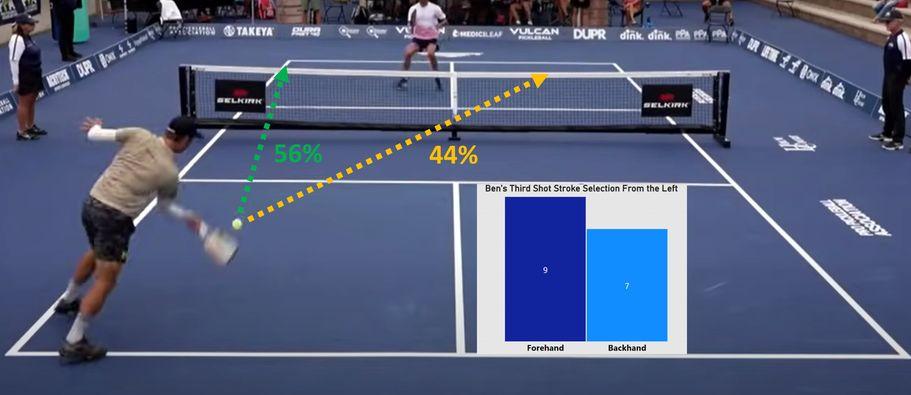
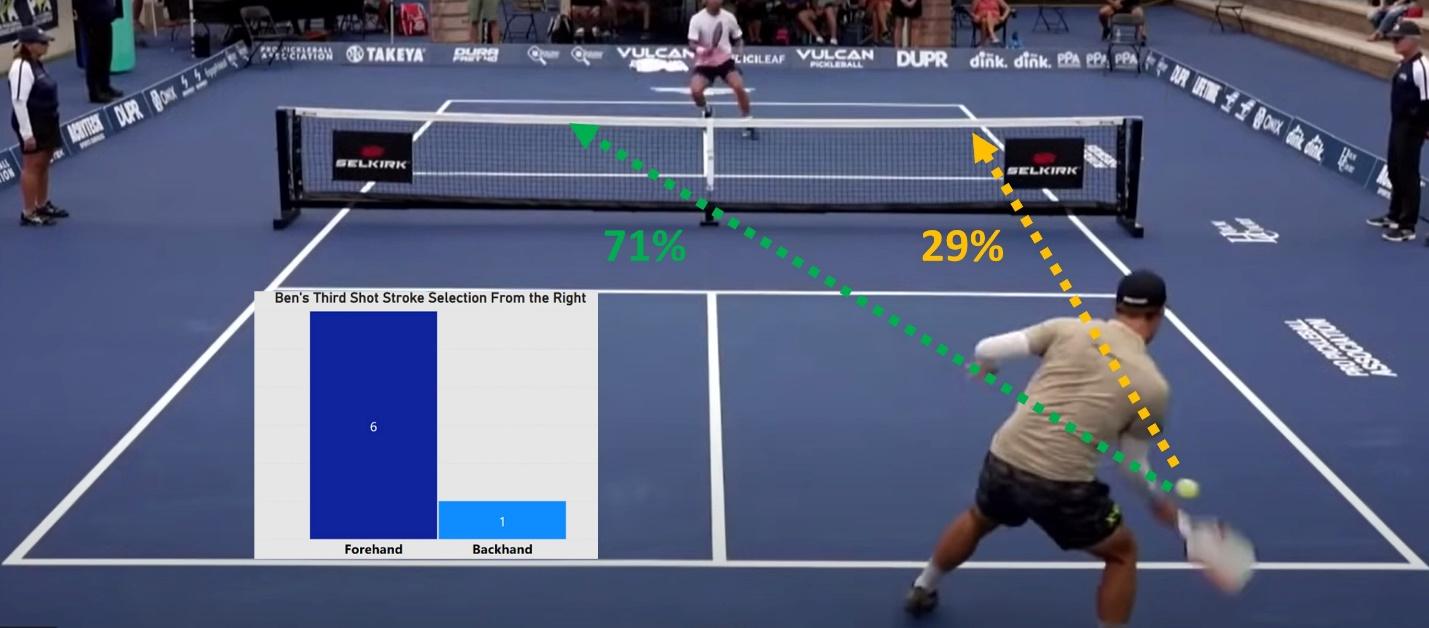
What I found to be very interesting is that when Ben is on the left side, he essentially goes either left or right evenly. However, when he is on the right he goes cross court to the left almost 3x more often than to the right. This is probably because the angle of the forehand allows him to generate spin going away from Tyson at the net.
Driving Down the Middle
What was even more intriguing is that Ben, regardless of which side he was on, never hit the ball down the middle. This is probably because it would make it easy for Tyson to punch it to the opposite side of the court.
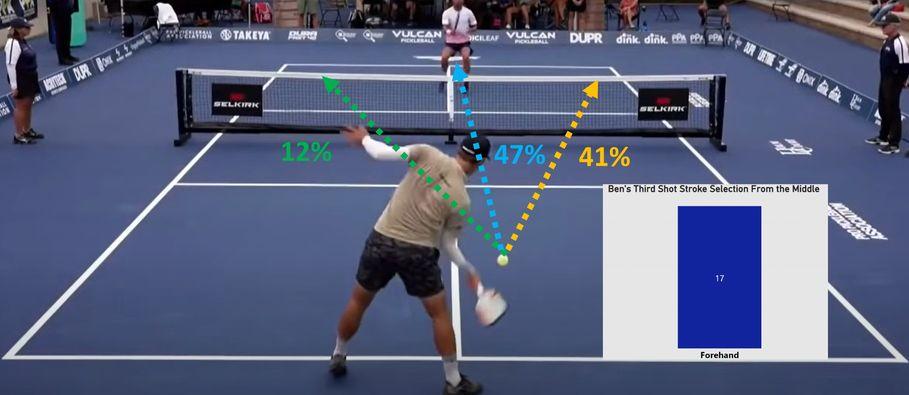
However, Ben did hit the ball down the middle 47% of the time when he was located in the middle. I was surprised by this, but it makes sense at the same time. I am assuming this is because since there is NOT a great angle to punch the ball, he tries to jam his opponent by hitting it hard at the body.
RAPIDLY IMPROVE YOUR GAME OR YOUR MONEY BACK WITH PICKLEBALL MASTER COURSE! GET 10% WITH CODE THE DINK
It is also clear that when Ben is positioned centrally, he doesn't like to hit the ball to the left since he only did this 12% of the time. I would imagine this is the case because when all other conditions are equal, most players can reach farther with their forehand and usually deliver a better volley with it too.
I also wanted to look at which stroke he prefers to use based on the location he is hitting from. From the right and center, 23/24 of his shots were with his forehand, showing a clear preference. In addition to that, even when the ball was on his left, he hit over 50% of his shots with his forehand by running around it.
Pickleball Singles Strategy: Now Let's Look at Tyson McGuffin
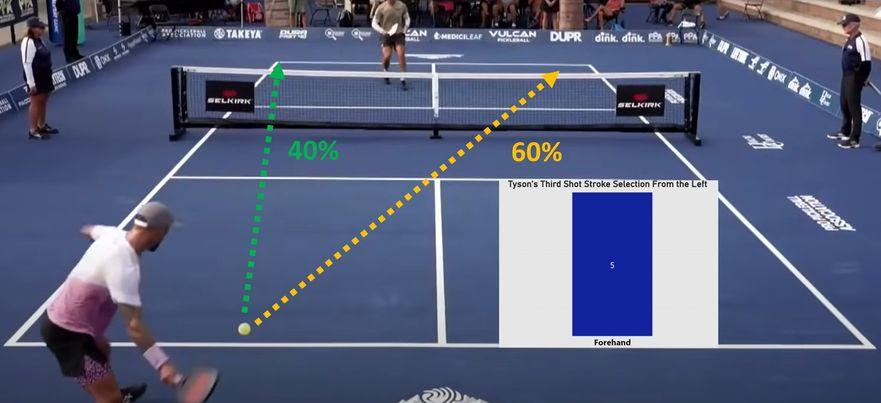
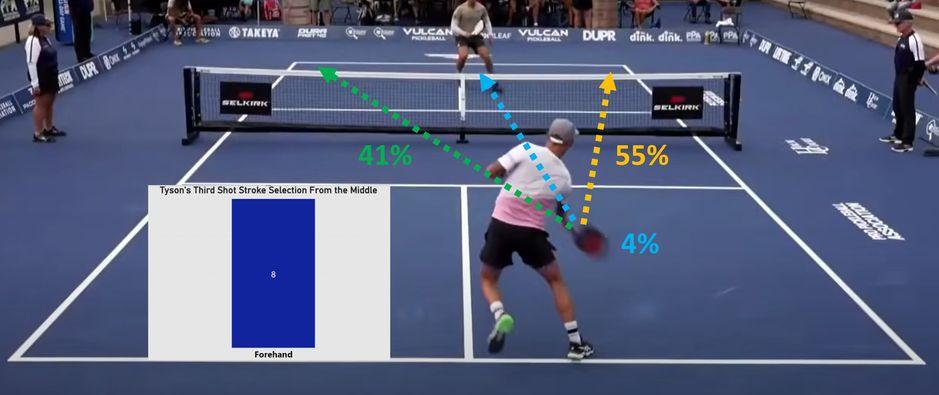
Moving on to Tyson, 33/34 of his 3rd shot drives are forehands. This key element of pickleball singles strategy shows up clearly in Tyson's numbers as well. As a result, both players are planning to drive the ball past the opponent with a huge preference towards their forehand.
Check out Tyson's instructional video on how to get more topspin on your forehand.
From there, the shot placement selection was a tad different for Tyson. Similar to Ben, he never went down the middle when he was on either side. However, when he approached the ball down the middle, he went to the middle only 4% of the time, where Ben did that 47%. Meaning that this was Ben's favorite shot when in the middle and Tyson's least favorite shot. An interesting juxtaposition.
Perhaps it is also helpful to have that unpredictability as a singles player. It also appears that Tyson prefers to go cross court when he is drawn out to the sides. However, there doesn't seem to be a massive preference instead of going down the line.
In conclusion, it is clear that both of these players share a similar pickleball singles strategy: get the ball to their forehand and apply pressure to the returner on the 3rd shot.
Whether it be a winner or forcing a pop-up, it appears that this is the most effective pickleball singles strategy considering that both players rank so highly in singles play and have so much success at tournaments. From there, it is also clear that both prefer to generate these powerful shots with their forehands.
You can watch the full match and see if you notice these same tendencies.
Takeaways
Understanding pickleball singles strategy at this level reveals that forehand dominance is not accidental. These elite level singles players take the opportunity to run around a backhand and rely on their forehands, even on the left side of the court.
One big difference between Johns and McGuffin was that Johns will utilize the drive down the middle, while McGuffin very rarely keeps thirds in the middle of the court.
From the right side on the court Johns sent the ball cross court 3x more than down the line. This little morsel is the type of actionable insight that might help a challenger get closer to the champ. When you cross-reference these patterns with the 4 shots that statistically lead to the most points won, the picture becomes even clearer.
Studying whether drives or drops win more rallies adds another layer of context to how top pros construct points. And research on how an early lead affects win probability shows the same calculative mindset both players bring to every rally.
For more pickleball statistics check out the Pro Pickleball Stats Group on Facebook.
Frequently Asked Questions
What is the most effective pickleball singles strategy for the 3rd shot?
In elite-level pickleball singles strategy, driving the ball is the dominant choice over the drop. Ben Johns drives on over 90% of his 3rd shots, using pace and angles to pressure the returner before approaching the kitchen line.
Why do top singles players favor the forehand so heavily?
Both Ben Johns and Tyson McGuffin hit forehands on more than 90% of their 3rd shot drives, often running around the backhand to make it happen. The forehand generates superior spin and power, letting players take control of the rally from the very first aggressive shot.
How does court positioning affect pickleball singles strategy?
Where you stand on the court shapes everything about your next shot decision. From the right side, Ben Johns goes cross court almost three times more often than down the line, using the forehand angle to push his opponent out of position.
How is pickleball singles strategy different from doubles?
In doubles, the 3rd shot drop is the primary tool because it lets the serving team move safely toward the kitchen. In singles there is no partner to cover the court, so driving aggressively from the baseline and forcing errors is a far more viable path to winning outright points.
Why does Ben Johns rarely hit down the middle from the flanks?
Hitting down the middle from either side gives your opponent the best angle to redirect the ball, which is why Johns avoids it when stationed on the left or right. When he is in the center, however, he uses a body-aimed drive to jam his opponent and take away those sharp redirects entirely.


Guest Author
Love Pickleball? Join 100k+ readers for free weekly tips, news & gear deals.
Subscribe to The Dink