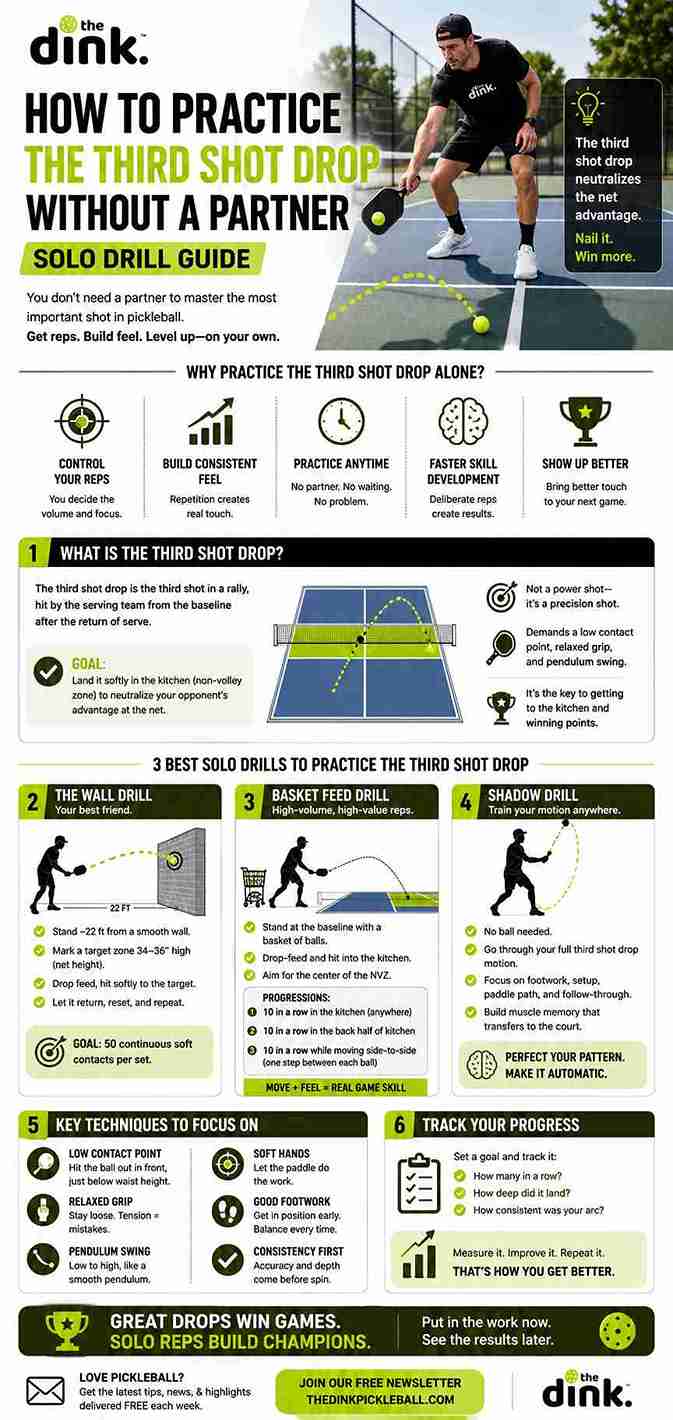
How to Practice the Third Shot Drop Without a Partner: Solo Drill Guide
The third shot drop is the single most important shot in pickleball, and you don't need a partner to get reps in.
This guide walks you through the best solo drills to practice the third shot drop alone and build real, transferable court feel.
The fastest way to practice the third shot drop alone is to stop waiting for a partner and start putting in targeted reps by yourself.
No hitting partner. No court booking conflicts. Just you, a basket of balls, and a wall.
Here's the thing: most players treat solo drilling like a compromise. It's not. Some of the best touch in the game gets built through deliberate, focused solo reps.
The third shot drop is fundamentally a feel shot, and feel is something you develop by repeating a motion thousands of times, not by hoping your Tuesday rec game gives you enough chances to figure it out.
This guide breaks down exactly how to build that drop, step by step, without a hitting partner.
Love pickleball? Then you'll love our free newsletter. We send the latest news, tips, and highlights for free each week.
What Is the Third Shot Drop (And Why Does It Matter So Much)?
The third shot drop is the third shot in a pickleball rally, hit by the serving team from the baseline after the return of serve.
The goal: land it softly in the kitchen (the non-volley zone) to neutralize the returning team's positional advantage at the net.
That's the textbook answer. Here's the real one: the third shot drop is the single shot that separates recreational players from competitive ones.
Without it, you're permanently stuck at the baseline while your opponents control the net.
According to USA Pickleball, the non-volley zone rule is the foundational tactical constraint around which virtually all advanced pickleball strategy is built.
The drop exists because of that rule.
The shot demands a specific contact point, a relaxed grip, and a pendulum-style swing, all executed under time pressure from a deep court position.
It's not a power shot. It's a precision shot.
And precision is built through repetition.
The Dink has covered why getting to the kitchen line consistently is the biggest unlock in doubles play, and that journey starts with the drop.
Why You Should Practice the Third Shot Drop Alone More Often
Most players improve slower than they should because their court time is reactive. You show up, play, and hope the right situations appear.
When you practice the third shot drop alone, you control the volume.
- You set the angle.
- You isolate the feel.
- You repeat until it clicks.
Research on motor learning consistently shows that blocked practice (repeating the same motion in focused sets) accelerates early skill acquisition, especially for finesse-based movements.
A 2020 study published in the Journal of Motor Behavior confirmed that high-repetition, low-variability practice produces faster initial consolidation of new motor patterns, exactly the kind of learning that a soft-touch drop requires.
You don't need a court partner for this. You need reps, and you can get reps alone.
Solo pickleball drills by yourself are one of the most underrated improvement tools in the game.
Players who commit to them show up to their next open play session with noticeably better touch.
The Wall Drill: Your Best Solo Third Shot Drop Training Tool
The wall is the closest thing to a live ball machine you'll ever get for free. Here's how to use it properly to practice the third shot drop alone.
Setting Up Your Third Shot Drop Wall Station
Stand approximately 22 feet from a smooth wall (simulating baseline-to-net distance).
Mark a target zone on the wall between 34 and 36 inches high, which represents the net height.
 The Dink Media Team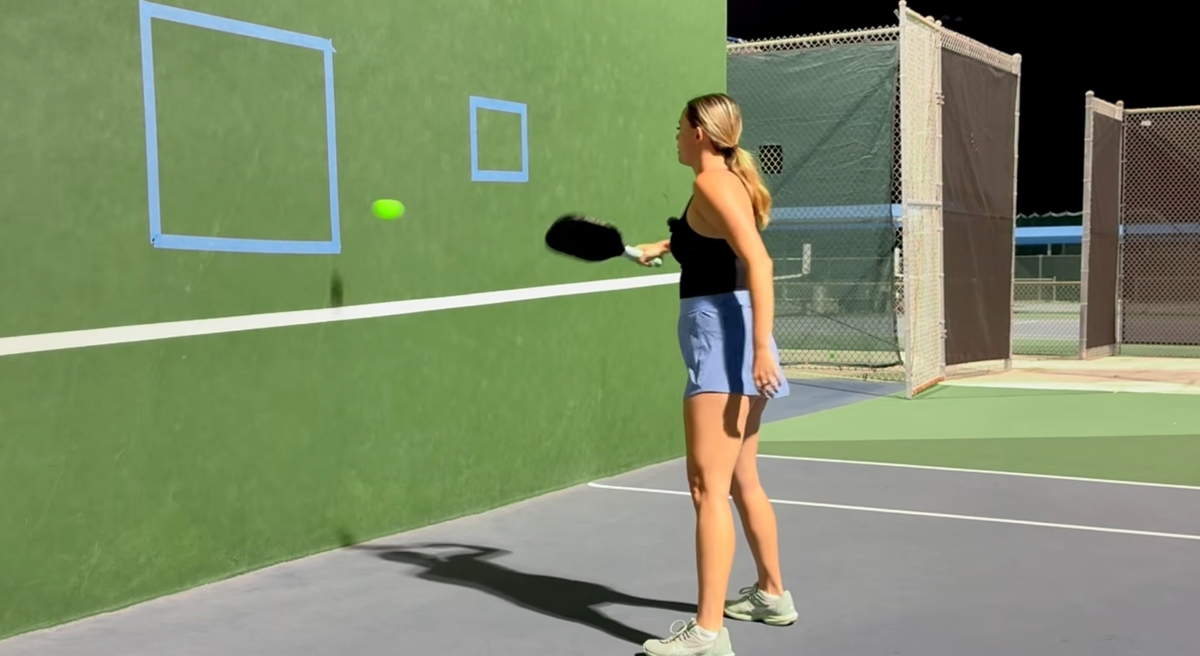
The Drill: Building Third Shot Drop Touch, Rep by Rep
- Drop feed a ball and let it bounce to a comfortable contact point.
- Swing with a low-to-high pendulum motion, aiming to hit the target zone softly.
- As the ball returns, reset your position and repeat.
- Target 50 continuous soft contacts per set before taking a break.
The key is contact point discipline. Most players hit their drop too late or too high.
You want contact out in front, slightly below waist height, with the paddle face slightly open.
The wall forces you to feel what "too hard" and "just right" actually means because the feedback is immediate.
This mirrors advice from advanced pickleball coaches about letting your paddle do the work, a concept that applies directly to a well-executed soft drop.
For more simple wall drills that sharpen all-around skill, The Dink has a full breakdown worth bookmarking.
How to Use a Ball Basket for Third Shot Drop Reps (The Right Way)
If you have access to a court and a basket of balls, this is the highest-value solo drill setup available.
Baseline Third Shot Drop Feed Drill
Stand at the baseline, drop-feed each ball, and hit third shot drops toward the kitchen. Aim for the center of the NVZ, not the sidelines.
You're training the motion and the arc, not placement precision, at this stage. Accuracy comes after feel.
Target progressions:
- Stage 1: 10 drops in a row landing in the kitchen (any position)
- Stage 2: 10 drops in a row landing in the back half of the kitchen
- Stage 3: 10 drops in a row while moving laterally one step between each contact (simulating real-game footwork)
The lateral movement element is critical. In a real game, you rarely get a perfectly set ball. Footwork is the unsung variable in pickleball, and training your drop shot in pickleball while moving builds functional skill, not just range-hitting consistency.
Practicing the Third Shot Drop From Wide Positions
Don't always feed from the middle. Feed from your backhand corner, your forehand corner, and from slightly inside the baseline. The shot demands feel from every position on the court, not just the comfortable ones.
Shadow Swings and Dry Repetition: Underrated, Underpracticed
You don't even need a ball for this one. Shadow drilling involves rehearsing the mechanical motion without contact, allowing your nervous system to encode the movement pattern cleanly.
Hold your paddle with your normal grip. Get into an athletic stance at your imaginary baseline. Drop your non-paddle hand as if releasing a ball, step into the shot, and execute the full swing motion, including follow-through.
Do 20 reps, rest, repeat.
Why does this work? Because the third shot drop fails most often due to mechanical breakdowns: a tight grip, a chopping motion instead of a pendulum, rushing the contact, or lifting through the ball instead of brushing under it. Shadow drilling lets you fix those mechanics in isolation without the pressure of a live ball scrambling your focus.
Pair this with the figure-8 drill for hand-eye coordination and you have a complete pre-court warm-up that builds real mechanics.
What Good Contact Actually Feels Like
Here's the thing almost every article on this shot skips: the physical sensation you're chasing.
A well-executed third shot drop should feel like you're scooping the ball up and over the net, not hitting it. The paddle decelerates through contact. The wrist stays firm but not locked. The follow-through finishes low and out in front, not up toward your shoulder.
When you practice the third shot drop alone with a basket, pay attention to the flight path of each shot. A ball with too much pace will float high and invite an attack. A ball that catches the net is a grip-too-tight or contact-too-late error.
The ideal arc is compact, clearing the net by 6 to 12 inches, and landing near the kitchen line, ideally down the middle.
The reset shot and the third shot drop share the same DNA. Both require a soft, decelerating contact point. Drilling one almost always improves the other.
Building Consistency: A Weekly Third Shot Drop Practice Routine
Want real structure? Here's a three-session-per-week framework built around how to practice the third shot drop alone.
Session 1: Wall Work (20 Minutes)
- 5 minutes of shadow swings (no ball)
- 3 sets of 50 wall drop contacts, focused on soft touch
- Cool down: 20 shadow swings with deliberate follow-through rehearsal
Session 2: Pickleball Kitchen Line Drills on Court (30 Minutes)
- 100 drop-feed third shot drops, baseline center
- 50 drops from backhand corner
- 50 drops from forehand corner
- Stage 1 and Stage 2 target progressions (10-in-a-row challenges)
Session 3: Movement Integration (20 Minutes)
- 50 drop-feed drops with a lateral step between each
- 25 drops starting from a wide position, recovering to center
- Final set: 20 drops under simulated pressure (count your makes, create your own competitive target)
Three sessions per week, four weeks in, you'll notice a measurable change. Consistent practice habits are what separate improving players from plateauing ones, and the third shot drop is one of the best shots to use as your improvement benchmark.
Key Takeaways
- The third shot drop is the most tactically important shot in pickleball doubles play.
- You can practice the third shot drop alone using wall drills, ball basket sessions, and shadow drilling.
- Focus on low-to-high pendulum swing mechanics and a relaxed grip above all else.
- Progress through stages: feel first, then consistency, then placement, then movement.
- Three focused solo sessions per week for four weeks will produce measurable improvement in your drop quality.
- The wall drill gives immediate feedback; the basket drill builds volume; shadow drilling fixes mechanics.
Frequently Asked Questions
Can You Really Practice the Third Shot Drop Alone Without a Partner?
Yes. The third shot drop is one of the most solo-trainable shots in pickleball because the mechanics and feel can be isolated through drop-feed reps, wall work, and shadow drilling. You don't need a live rally to build the muscle memory.
Focused solo sessions often accelerate improvement faster than unstructured partner play because you control the repetition volume and can isolate your weaknesses.
What Is the Most Common Mistake When Practicing the Third Shot Drop Alone?
The most common error is hitting with too much pace and mistaking a ball that clears the net for a successful drop. A real third shot drop lands softly in the kitchen with a compact arc, not a floating ball that sits up for an easy volley.
Focus on the deceleration feeling through contact, not on getting the ball over the net with pace.
How Long Does It Take to Develop a Consistent Third Shot Drop?
Most players see noticeable improvement after four to six weeks of deliberate solo practice, roughly three sessions per week. Full consistency in match play, meaning you're landing it reliably under pressure, typically takes two to three months of combined solo work and live play.
According to motor learning research, fine motor skills like soft touch develop through high-repetition, focused practice rather than incidental game exposure.
Should I Practice the Third Shot Drop on My Forehand or Backhand Side First?
Start with your stronger side to build the correct feel and arc first, then shift focus to your weaker side. Most players have a more natural pendulum motion on their forehand, making it a better starting point for encoding the correct mechanics.
Once you understand what successful contact feels like on your dominant side, transferring that feel to your backhand becomes significantly easier.
What's the Difference Between a Third Shot Drop and a Dink?
A dink is a soft shot hit from at or near the kitchen line, intended to stay low over the net and land in the opponent's NVZ. A third shot drop is hit from the baseline, requiring a longer arc and more precise arc control to die in the kitchen.
Both shots share a similar soft-touch mechanic, but the distance and trajectory demands are different. USA Pickleball's official rules glossary covers the technical definitions of shots and court zones in full.

Love Pickleball? Join 100k+ readers for free weekly tips, news & gear deals.
Subscribe to The Dink